Posted in Portuguese

Cão Com a Cabeça Para Baixo

Yep, more yoga in today’s corrected text. Thanks to Dani for the corrections. I’ve out footnotes at the bottom, mainly cool new (to me) vocabulary.

Downward Facing Dog
Downward Facing Pupper

(Este texto é uma tradução da descrição de Downward Facing Dog [nesta página ](https://destinationyoga.co.uk/latest-news/poses/downward-dog/) mas acho que o inglês não é perfeito portanto, fiz algumas alterações. Também ouvi “Cão Olhando Para Baixo” e “Cachorro olhando para baixo” em vários sites brasileiros e uma vez “Cão boca para baixo” num único site PT-PT. A página relativa à postura Downward Facing Dog não tem tradução em português.)

Para começar, fica de gatas* e verifica que os joelhos estão logo atrás das ancas. As tuas mãos(1) devem estar à largura dos ombros**. Estica amplamente os dedos. Pressiona com as mãos contra o tapete*** e suavemente mete os dedos dos pés por baixo dos pés. Inspira profundamente. Depois, continua a pressionar no tapete e expira profundamente, levantando os joelhos do chão e endireitando as pernas tanto quanto possível.

Não te esqueças inspirar e expirar**** profundamente e podes aproveitar de se mover dentro da tua postura. Podes pedalar com os pés para desfrutar da***** sensação de extensão atrás das pernas. Tenta criar mais espaço entre os ombros e relaxar o pescoço. Relaxar os músculos do rosto. Tenta levantar mais as ancas durante a inspiração e pressionar com os calcanhares contra o chão durante a expiração.
Não há problema se as pernas estiverem ligeiramente dobradas. Simplesmente desfruta do alongamento e da experiência de criar espaço na parte posterior do corpo.

Após algumas respirações, deixa os joelhos cair suavemente para o tapete, estica os dedos dos pés e deixa as ancas descer para a “postura de criança”.

(1) fiz um erro de digitação nesta palavra e a autocorreção tentou acertar. Quase publiquei o texto com “As tuas mamilos devem estar à largura dos ombros.” 😬 Não tentes isto em casa.

*De gatas = “on all fours”

**a largura dos ombros =”shoulder width apart”

***tapete is used for “yoga mat” as well as other kinds of rugs

****I used inalar and exalar in a couple of places thinking they were other ways of saying inhale and exhale. Both words do exist but they aren’t synonymous with inspirar and expirar, which are the words I should have used.

*****Desfrutar, like gostar, needs “de”

Posted in Portuguese

Yoga: Legbelly.

Another corrected text with footnotes. Thanks to Cataphract for the corrections

Já fiz duas sessões de Yoga (link to previous post about my yoga NY resolution) com uma professora americana e uma com uma brasileira mas ainda não experimentei os professores portugueses sugeridos por outros redditores. As aulas são vídeos de YouTube, mas apetece-me experimentar uma aula ao vivo com um português se for possível.

O curso da brasileira é demasiado fácil mas o da americana é melhor. É muito desafiante aos músculos da barriga, das costas e das pernas. Deixou-me com dores de perna, principalmente nas… Hum panturrilhas*….? Os músculos da parte posterior da perna, entre o tendão de Aquiles e o joelho.

*This does seem to be *a* right word for calves, yes, but the corrector had to use a dictionary and that doesn’t seem to be a good sign! “Gémeos” is more common. This is weird since the same word also means “twins”. OK, I can see thinking of your calves as “the twins”. It’s quite cute, but I can also imagine some scope for confusion if you’re a father of twins but also a yoga enthusiast. “Tenho de alongar os meus gémeos” “O quê? Seu monstro! Deixe os filhos em paz!”

The other fun way of describing that part of the leg is “barriga das pernas” – your legbelly. New favourite expression.

Posted in Portuguese

Yoga é Iogurte Vegan

Here’s a text about veganuary with some of the more interesting and instructive corrections at the bottom. Thanks to csc_3 for the help

A minha mulher sugeriu que façamos o desafio de comermos coisas sem cara* durante a mês de janeiro**. Também sugeriu ioga. A loucura da passagem de ano…

Infelizmente, depois de sugerir este novo modo de vida, ela lembrou que ovos não são vegan. Nem iogurte. E a nossa filha mencionou o seu amor por queijo. Então, vegetatianuary? Eu e a minha esposa fomos ambos vegetarianos desde a adolescência até 2004 quando ela engravidou da*** atual adolescente. Grávidas precisam de proteína. Proteína e chocolate. Proteína e chocolate e quaisquer outras coisas que lhes apetecem**** a qualquer hora do dia. Pois*****, começámos a comer carne naquela altura e hoje em dia esqueço-me como vivi durante os 20 anos de comer vegetais. E difícil imaginar um mês****** inteiro sem frango na salada e sem carne de vaca picada no molho bolonhesa.

E ainda por cima, tenho de fazer yoga?

*This was corrected to “sem carne” but no, vegetarians actually do say things like “I won’t eat anything with a face”.

**I’ll never get used to writing the names of months in lower case.

***Another one of those weird preposition differences between Portuguese and English: she got pregnant of our daughter, not with our daughter.

****I often think of apetecer as meaning to fancy something or feel like doing something but it’s more like “appeal”, so apetece-me means “it appeals to me”. The subject of the verb is the thing, not the person who desires the thing. So in this sentence, you have to give pregnant women what they want, but the subject of the verb is “coisas”. Que lhes (ie to the women) apetecem (they (ie the things) appeal)

***** I’m leaving this in because I think I don’t use pois enough and the more I get used to using it the better but the corrector pointed out that “Então” would be better in a written text and “pois” would be more common “na oralidade” – ie, in spoken language.

******I wrote “a mês” but you can tell it’s masculine because it has a moustache above the e.

By the way, it’s going ok-ish. I keep forgetting I’m meant to be avoiding cheese, butter etc and accidentally putting them in things but I haven’t eaten any meat at all, and even my daughter has voluntarily signed up for a meatless (but not cheeseless) month.

Posted in Portuguese

O Mistério da Estrada de Sintra

This is a text I wrote about an audiobook I’ve been listening to. The link to the Audible version is on the audiobooks page (here) but Bertrand also have an audio and a printed copy. There’s even an English translation on amazon called The Mystery of the Sintra Road but it looks like a print on-demand job, probably very low quality, so I wouldn’t bother tbh. As usual, thanks are due to the lovely correctors on WritestreakPT for their help with the corrections.

Estou quase a terminar este Audiolivro (update: finished now!). Não é nada fácil. Custa-me muito ler livros do século XIX em inglês, ainda pior quando tenho de pensar muito para entender o português. Comecei o livro durante a minha “peregrinação” pela a barreira do rio Tamisa há 3 semanas mas perdi o fio à meada.

O Mistério da Estrada de Sintra

A “história da história” é muito interessante: os autores, Eça de Queirós e Ramalho Ortigão escreveram uma série de notícias e artigos anónimos no jornal Diário de Notícias sobre um crime cometido nos arredores de Sintra à noite. Um grupo de mascarados tinham raptado dois homens e levado-os a uma casa onde foi encontrado o cadáver dum inglês. O povo da cidade ficou chocado e aterrorizado: será que estamos em perigo? Quem são esses bandidos? Logo depois, umas personagens da história escreveram cartas à redatora do jornal para explicar as suas acções e motivos. Cada um reagiu às cartas do dia anterior e ninguém deu pelo estilo de escrita muito polido destes cidadãos aleatórios, até ao fim da narrativa, quando os autores revelaram a verdade: os subscritores do jornal tinham estado a ler uma obra de ficção!

Adoro. Todos nós conhecemos a história da “Guerra dos Mundos” de Orson Welles mas Eça de Queirós conseguiu o mesmo engano* sete** décadas antes em meados do século XIX.

*I originally wrote “decepção” forgetting that that’s a false friend, meaning disappointment, not deception.

**Style guides say numbers up to 12 should be written as words and after that, digits kick in.

Posted in Portuguese

A Invenção do Dia Claro

Li este livrinho inteiro, da capa até à contracapa num só dia mas não é assim tão impressionante porque tem menos de 40 páginas.

A Invenção Do Dia Claro

O escritor é José de Almada Negreiros (geralmente conhecido simplesmente por “Almada” se não me engano). Almada fazia parte do movimento modernista nas primeiras décadas do século passado e do grupo ao redor da Revista Orpheu, mas este livro é mais brando do que os anteriores. O editor da sua página de Wikipedia atribui esta mudança de estilo a uma atitude mais construtiva depois da Grande Guerra. Em resultado disso, quando o autor leu o primeiro texto da terceira parte (“a flor”) em palco, houve* quem risse em voz alta, achando que era algo satírico o humorístico, mas não era, era sincero.

O estilo da escrita é muito bonito e não me custou entender apesar da ortografia desconhecida, oriunda duma época antes do que nós pensamos como “velha ortografia” a(c)tualmente.

*Haver is one of those verbs that almost doesn’t seem to make sense in the perfect tense. The perfect tense is usually used for things that happen and then they’re over, as opposed to the imperfect which describes things that happen continuously over time. Haver usually means something like “to exist” or “to be present” and how can something exist as a one-off? Surely if you exist you exist continuously. In this sentence I’m describing this scene of someone reading something on the stage and the audience is there at the start of the performance and they remain in place throughout the performance. If that isn’t the criteria for imperfect tense I don’t know what is. But the translator suggests I describe the scene one of two ways

quando o autor leu (o texto) em palco, houve quem risse

Or

quando o autor lia (o texto) em palco, havia quem risse

So in the first example, he read it once (leu) and the audience were there on that one occasion (houve), and in the second example, he used to read it (lia) and they were there (havia).

What I don’t seem to be able to say is that he read it (leu) for an audience that was just there (havia).

OK useful exercise since it helps me. Understand when to use havia vs houve. I think I’m stuck in thinking about imperfect and perfect in a way that’s more like my o’level French and I need to just rid myself of that way of thinking.

Posted in English, Portuguese

Locuções Temporais

I’m struggling a bit with finding the right tenses for some of the sentence structures set out in the C1 course so decided to try and write a few for practice. Thanks to Dani Morgenstern for help with the corrections.

  • Quando acabei de ler ele já tinha escrito a sequela (when I finished reading he had already written the sequel)
  • Enquanto ele tocava bateria, eu preenchia os formulários de divórcio (while he was playing drums, I was filling in the divorce forms)
  • Quando chegares a casa, descasca as batatas (when you get home, peel the potatoes)
  • Ela disse-me que queria ser primeira ministra quando fosse grande (she told me she wanted to be prime minister when she was big)
  • Quando o vírus tivesse passado, ela voltava a treinar (when the vírus had passed she went back to training – I think the sense here is of something that happened repeatedly: she’d get ill every so often and go back to training after each occurrence, hence the imperfect tense)
  • Enquanto não leres o texto não estás capaz de responder às perguntas (since you won’t read the text you won’t be able to answer the questions)
  • Enquanto os negócios tivessem apoio financeiro não iriam à falência durante a pandemia. (as long as the businesses had financial support, they wouldn’t fail during the pandemic)
  • Enquanto o tio Rui não tivesse chegado a casa, a família não começava a jantar* (since Uncle Rui hadn’t arrived at the house the family weren’t starting their dinner)

*It’s probably worth pointing out here that this “a” is a preposition and “jantar” a verb. They hadn’t started to dine. But jantar can also be a noun so I could also have said “o jantar” instead of “a jantar” and the sentence would still work but it would mean “they hadn’t started the dinner”.

  • Logo que o comboio parta, telefona-me (as soon as the train leaves, call me)
  • Assim que receberes a carta do SNS, marca consulta. (as soon as you get a letter from the SNS, make an appointment)
  • No momento em que as cortinas se abrissem, a banda comecaria a tocar (as soon as the curtains opened the band would start to play)
  • Mal tivesse aberto a janela, o pisco entraria na sala (as soon as he had opened the window the robin would enter the room)
  • Logo que eu acordava tomava um café (as soon as he woke up, he used to have a cup of coffee)
  • Assim que enviou a carta, percebeu que se tinha esquecido do selo (Just as he posted the letter he realised he’d forgotten the stamp)
  • No momento em que o professor abriu a boca a campainha tocou (at the instant the teacher opened his mouth the bell rang)
  • Mal soube as noticias, começou a chorar (As soon as he heard the news he started to cry)
  • Antes que te esqueças, faz notas sobre a reunião (before you forget make some notes about the meeting)
  • Antes que ligasse ao meu pai, ele enviou-me uma mensagem (Before I called my dad, he sent me a message)
  • Antes de abrir a boca vou pensar duas vezes (before I open my mouth I’m going to think twice)
  • Depois de nos termos encontrado a minha vida era vazio e sem propósito (Before we met each other, my life was empty and without purpose)
Posted in English, Portuguese

To Tu or Not To Tu, That is the Desmond

I’m not sure whether making this pun in the week when the anti-apartheid hero died will be taken as offensive, but I needed to write about when to use “tu” in a sentence and the pun was just there waiting to be made and I’m not made of wood, people. I once almost walked into him in… Cambridge, I think, after a group of us made a pilgrimage from Norwich to attend his speech in about um… 1989? He was very good-natured about it.

Anyway, let’s get down to business. Here’s the question I asked yesterday.

Why (according to the C1 course I’m doing) is the word “tu” necessary in this sentence:

Tu vais ter mais experiência de vida. Nessa altura, vais compreender-me.

But absolutely wrong in this sentence, which is my attempt to rewrite the first using different tenses.

Quando tu tiveres mais experiência de vida, vais compreender-me

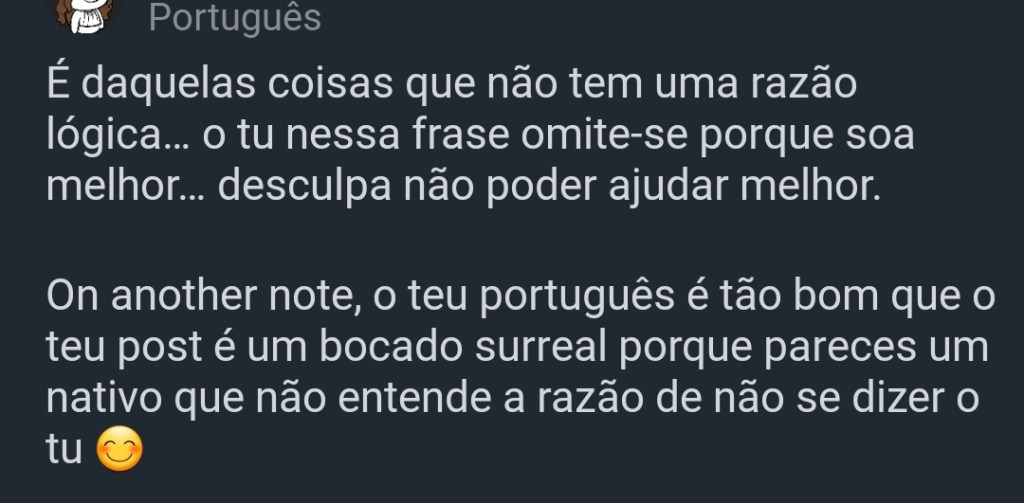
The gist of the answers I got was that the course’s model answer was wrong, or at least not unambiguously right. Although you don’t need it in the second sentence, you don’t need it in the first either, and since the exercise was to rewrite the sentence, it made sense to retain it if it was already there. The “tu” is superfluous because the conjugation of “vais” and of “tiveres” tells you you’re in the second person singular. If I had been changing “vai ter” into “tiver” then it would have been necessary to add a pronoun (ele or ela, probably) because “tiver” is ambiguous in a way that “vai ter” is not. Sometimes these things are just done on what sounds better so it might have been down to the personal sensibilities of the person setting the questions. It’s not very consistent though. Minor irritation.

Anyway, one of the respondents gave me some feedback that made me swell with pride:

So here is the question in the original Portuguese as a record of the most-praised Portuguese text I have ever written!

Uma das minhas dúvidas recorrentes é quando usar e quando não usar pronomes com verbos. Regra geral, não se usam tanto quanto em inglês mas por exemplo no meu curso, tenho de rescrever a seguinte frase começando com uma palavra específica e fazendo as alterações necessárias:

Q) Tu vais ter mais experiência de vida. Nessa altura, vais compreender-me.

R) Quando ____


Respondi assim:

Quando tu tiveres mais experiência de vida, vais compreender-me


Falhei. A resposta certa é exactamente igual mas tirando o "tu". OK tuga, mas... Porque? Porque é que o "tu" é necessário no modelo mas desnecessário - até errado - na resposta? Ambos exprimem a mesma ideia. Eu sei que a forma de "tiverES" assinala que estamos na segunda pessoa mas isso é igualmente verdade de "vaiS".

Desculpem o tom irritado. É ligeiramente frustrante fazer um curso que não explicam estas coisas. 🤷🏼‍♂️

Posted in Portuguese

Auscultadores

A amiga da minha filha utiliza auscultadores sem fio (airpods) mas está sempre a perdê-los. Ou seja perde sempre* um fone. Eu também desperdicei dois pares de auscultadores por perder um fone. O problema é o tamanho destes dispositivos. São minúsculos. Se deixares um fone cair ao** chão, não será fácil encontrá-lo.

A amiga dela fez exatamente isso: deixou um fone cair na rua, e logo depois um carro o atropelou e lá foram cem euros pelo cano abaixo.

Empresas de telemóveis, chega de Bluetooth. Fios! Queremos fios!

*=perde sempre, not sempre perde. Adverb after the verb.

**=ao, not no. It falls *to* the floor, not *on* the floor