Posted in Portuguese

A Entrevista

Warm-up text, written on iTalki shortly before the interview with the tech company in Portugal to get my brain going…

Amigos Portugueses, algo esquisito e surpreendente aconteceu: uma empresa convidou-me a uma entrevista de emprego. Isso propriamente não é assim tão estranho, porque sou bastante competente na minha área de especialização, mas neste caso, a empresa fica no Porto. É uma empresa de tecnologia informática e ao que parece tem muitos empregados que falam inglês. Não vou ter de encarar clientes e por isso espero que a minha falta de conhecimento da língua portuguesa não seja uma grande desvantagem, mas apesar disso, fiquei muito surpreendido quando recebi o convite, e ainda mais surpreendido quando ela não se riu ou como terminou a telefonema quando ela me ligou para combinar o encontro, mas ainda bem, porque a entrevista começa daqui a uma hora!
Se eles aceitassem a minha candidatura, mudar-me-ia para Portugal, alugaria um apartamento lá e visitaria a família aos fins de semana. Soa horrível, mas… No curto prazo, o objectivo é ganhar dupla cidadania, praticar a língua portuguesa e estabelecer a família no país. No longo prazo, depende do resultado de Brexit, porque somos uma família anglo-portuguesa. Se tudo se torna mais difícil para cidadãos portugueses, vale a pena ter um pé em cada país, mas não é provável (ou seja não é provável que coisas sejam pior para nós do que para os outros desgraçados que partilham uma ilha com Boris Johnson).
Enfim, seja o resultado o que for, a entrevista vai ser uma experiência interessante. Desejem-me sorte!

Thanks Paulo, Evandro, Leonardo e “WoLvS” for the help

Posted in English, Portuguese

From Beneath You, It Debaixo

I get mixed up over the variants of prepositions so I’m going to lay them out in a tabular format and see if that helps

Trás Baixo Cima Frente
* Preposition: after Adjective: low, short Not really used on its own Noun: front
A- Atrás de = behind Abaixo: below, underneath Acima: above Afrente: não existe
A[ ] A trás: não existe A baixo: não existe A cima: não existe A frente: at the head of (and à frente: onward, ahead (of))
De Detrás: behind (specifically right behind) Debaixo: under, underneath Decima: não existe Defrente: não existe
De[ ] De trás: from  the back (movement) De baixo: from below De cima: Upper, from high up De frente: head on
Por Por trás: behind – at some place behind (less specific than “detrás”) Por baixo: below Por cima: On top, above, overhead Por frente: from the front
Para Para trás: to the back Para baixo: down, downward Para cima: Up, upwards Para frente: forwards
Por de… Por detrás: behind Por debaixo: beneath Por decima: não existe Por defrente: não existe
Em Em trás: não existe em baixo: down below (used a lot on youtube when inviting comments!) Em cima: On, above, up there Em frente: in front of (opposite – as opposed to )
And also… Anos atrás = years ago Abaixo also used for “down with…” as in “Abaixo o governo!” Ainda por cima = And on top of that (something else bad happened!) Daqui para a frente= henceforth
And also… De baixo can also mean bottom – “a gaveta de baixo”=bottom drawer De trás para a frente: backwards

Sources:

Linguee

Lusografias

Ciberdúvicas [por detrás] [Atrás] [a frente vs em frente]

Posted in Portuguese

The Talking Dead

Trigger warning: may contain rudity.

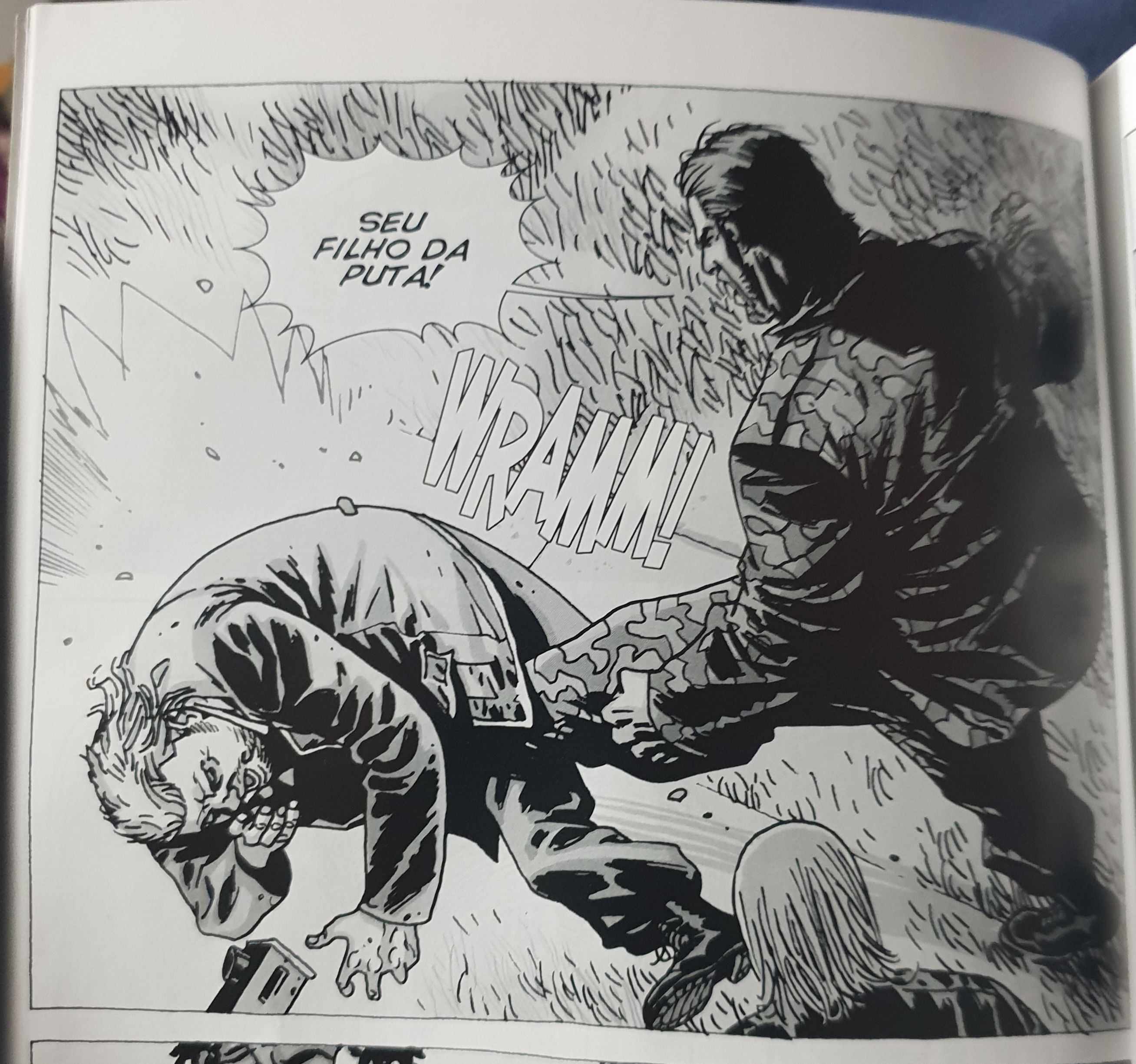
Two weird pieces of slang grammar in the Walking Dead book I’m reading (Vol 12, which is called “Viver Entre Eles” in portuguese), during a scene in which Abraham finds out Eugene has been lying all along and that Washington is not, in fact, a safe haven.

  • Seu filho de puta
  • Porque, c’um caraças?

Apparently that c’um is short for “com um”, and the “seu” can mean “you are” although why the heck that should be, I have absolutely no idea! To me it just looks like he’s saying “your son of a whore” which is baffling.

–update–

Paulo on iTalki offers an extra bit of wisdom, saying that “seu filho de puta” is ironically following the very formal way of addressing a member of the aristocracy – e.g. Sua Alteza Real o princípe-herdeiro, equivalent to “his royal highness….”. My mind is still grappling with this new information. Can it be right? It seems like a lot of baroque irony to apply to – basically – a physical assault…

–update to the update–

OK, Paulo’s explanation checks out. Although the person probably isn’t going out of their way to be wittily ironic, the format “seu…” is derived from that way of speaking and indicates a higher degree of specificity – you specific son of a whore!

20180930_182332.jpg

Thanks Ariene for helping me with these.

Posted in English, Portuguese

When They Start the Beguine

Race Start
Race Start (Patrick via FLICKR Licensed Under Creative Commons Attribution (CC BY) 2.0 License)

This is a reply to a query about the difference between the english words “begin” and “start”. I’ve written it in portuguese and english, with the english starting about half way down, and obviously all the examples are in english, even in the portuguese text.

[Portuguese Version] 🇵🇹 #UNCORRECTEDPORTUGUESEKLAXON

Pensei muito nisso e discuti com uns outros faladores de inglês, incluindo uma americana, mas acho que não há grande diferença entra os dois países neste assunto. Continuo a acreditar que “start” e “begin”, têm o mesmo significado em 95 por cento das situações. Quando não são sinónimos, parece que o padrão é, de forme geral, que “begin” encaixa a ideia duma transição mais gradual, e “start” é uma mudança que acontece de repente. Isso não é uma regra muiiiiito forte. É o que chamamos um “rule of thumb” ou seja uma regra que é só uma guia mas não se aplica em todos os casos.

Por exemplo:

Situações em que “begin” é preferível ou é a única palavra que cabe na frase

  • I began running when I was in high school [verbo]
  • I have been running for three weeks but I am still a beginner [nome = novato/iniciante]
  • A book should have a beginning, a middle and an end [nome=início]

Situações em que “start” é a única palavra que cabe na frase

  • I started running when the PE teacher blew the whistle [verbo]
  • I started the engine [verbo]
  • The car won’t start [verbo]
  • Press the start button on your laptop [nome]

Situações em que a escolha de verbos depende do movimento, e pode influenciar a imagem mental do escritor

  • He was walking slowly but as the rain got heavier he began to run
  • He was walking slowly but when he heard footsteps behind him he started to run

Escolhi “start” aqui porque queria dá para entender que a pessoa mudou a taxa dos seus passos de repente, talvez num pânico. Na primeira frase, usa-se “begin” porque na minha imaginação andava cada vez mais rápido enquanto que a chuva tornava cada vez mais pesado, até começou a correr.

Vi alguns websites que dizem que “begin” é mais formal. Não acho que isso seja correcto. As vezes pode ser mais elegante mas isso é porque o ar abrupto de “start” pode diminuir a elegância. Por exemplo

  • If you’re all sitting comfortably, I will begin my 3 hour long poetry recital [verbo]

É melhor do que “start” porque poesia é algo que começa suavemente. “start” não era errado, mas “begin” soa melhor. Portanto, acho que isso de velocidade de transição é uma regra melhor até que tens um melhor conhecimento das subtilezas (absurdidades) da língua!

Espero que isso te ajude!

Notas de rodapé

  1. Há mais um significado de “start” que é o saltinho que uma pessoa faz quando leva um susto. É mais relacionado com um outro verbo semelhante: “startle” mas transmite a mesma impressão dum movimento súbito. Se tudo fosse calma na casa e, de repente, eu estourei um balão, a minha mulher diria ou
  • “Agh! You startled me” ou
  • “Agh! You gave me a start”

2. Aliás, também existe mais um verbo “commence” que é obviamente um cognato da palavra portuguesa “começar” mas é muito mais formal e quase nunca usado na dia-a-dia.


[English version] 🇬🇧

I’ve thought about this a lot and discussed it with some other english speakers including an american, although there isn’t much difference between the american and british usage. I still think “start” and “begin”, are synonymous 95% of the time. When they’re not synonymous, the pattern seems to be that “begin” conveys a more gradual transition and “start” is more sudden. The rule isn’t veerrry strong, but it’s a good rule of thumb when in doubt.

For example:

Situations where “begin” is the best or the only option

  • I began running when I was in high school [verb]
  • I have been running for three weeks but I am still a beginner [noun = novato/iniciante]
  • A book should have a beginning, a middle and an end [noun=início]

Situations in which “start” is the best or the only option

  • I started running when the PE teacher blew the whistle [verb]
  • I started the engine [verb]
  • The car won’t start [verb]
  • Press the start button on your laptop [noun]

Situations where the choice of words might depend on the style

  • He was walking slowly but as the rain got heavier he began to run
  • He was walking slowly but when he heard footsteps behind him he started to run

I chose “start” in the second example because I imagine the person suddenly changing pace when they hear someone following them, maybe out of fear. In the first, I chose “begin” because I think they might have gradually walked faster and faster as the rain got heavier and heavieer, until finally they start running.

I’ve seen websites that suggest “begin” is more formal. I don’t really agree with this, but sometimes the suddenness implied by “start” can puncture the elegance of a formal situation. For example, an announcement in a theatre

  • If you’re all sitting comfortably, I will begin my 3 hour long poetry recital [verbo]

Here, “begin” is better because it fits better with the gentle nature of a poetry reading. “Start” would not be wrong, but “begin” sounds right. That’s why I think this idea of gradual change vs sudden changes is a better guide than formal vs informal

I hope that helps!

Footnotes

  1. There’s another meaning of “start”, which is the little jump someone makes when they get frightened suddenly. It’s related to a similar verb “startle”, so if I were to suddenly burst a balloon in the house when everything was calm and peaceful, my wife might say either
  • “Agh! You startled me” or
  • “Agh! You gave me a start”

2.There’s another verb “commence” that’s obviously cognate with the portuguese word “começar” but it’s much more formal and tends not to be used much in day-to-day conversation.


Posted in Portuguese

Lisboa – A Cidade Mais “Cool”

(This is old, old news, which I’ve had on my “stuff to write about” for over a year)

Lisboa permanece na lista de “18 melhores sítios para visitar em 2018” de CNN mas já não vi o anúncio de “cidade mais fixe” deste ano. Em 2014 e novamente em 2017, Lisboa ganhou essa honra. Havia 7 razões pela decisão:

  1. Os bares e restaurantes ficam abertos ainda mais tarde do que os de Madrid, e a vida nocturna é bastante gira
  2. Há tantos restaurantes e tascas onde se servem cozinhas interessantes*
  3. Há um grande sentido de ironia e melancolia. Citaram um dito de Fernando Pessoa “Tinha-me levantado cedo e tardava em preparar–me para existir”.
  4. Existem muitos sítios históricos tais como castelos, palácios e a Torre de Belém, mas além disso, também existem praias bonitas.
  5. Desde os pormenores dum rótulo duma garrafa de vinho até os edifícios mais altos, quase tudo em Lisboa mostra um estilo muito elegante.
  6. Há um património rico de arte, e museus em toda parte.
  7. Até as ruelas têm um ar fascinante. Dar um passeio através da cidade a ver as portas, as paredes e os azulejos é mesmo divertido

*=interesting cookings not interesting cooking

lisboa


Posted in Portuguese

From Sei to Shining Çei

Here’s an interesting snippet: in “Reaccionario Com Dois Cês“, Ricardo Araújo Pererira has someone mocking a football player online after he is the victim of a mugging:  “xupa, é bem feita por çeres um ignorante que ço çabe dar pontapés na bola”

I wondered what all the mistakes were all about – was it imitating a regional accent or something? Was the person writing just not very clever? Because the stray Çs didn’t seem like the kinds of typos one would make normally.

Apparently it’s a way of mocking someone’s lack of intelligence. If someone answers a question but you think their point is nonsense, instead of saying “sei” (I know) you reply “çei” , implying that’s the sort of thing only an idiot who can’t even spell “sei” would believe. Or if they write a tweet with lots of errors in it you can say “você çabe falar muito bem português” just as in english you might say “You’re grammer is exelent” or something.

Thanks Renato for helping answer this conundrum.

Posted in Portuguese

Reaccionário Com Dois Cês

36468299Este livro é o segundo deste autor que já li. Gostei bastante! Consiste num serie de artigos, publicados inicialmente na revista Visão. São muito engraçados. Soltei gargalhadas durante quase todos. Além disso, os artigos frequentemente têm temas sérios, relacionados com as notícias da época em que foram escritos. Há poucos comediantes que conseguem escrever opiniões assim, e dar um resumo duma situação, com humor e, quando é necessário, força.

Posted in Portuguese

Quando As Plantas Atacam

IMG_20180921_55978Hoje de manhã, quando acordei, havia algo estranho na cama (!) Senti umas picadas na pele da minha mão, como se houvesse umas agulhas nos lençóis, Não fazia ideia o que é que estava a causar este fenómeno. Tentei ignorá-lo mas cada vez que tocava nos lençóis, levava mais ferroadas nos dedos e depois nos braços e nas costas até já não puder ignorá-las. Levantei-me e fui em busca da pinça da minha mulher. Havia centenas de espinhos pequeninos em todo o lado, nos dedos, nos braços,  nas palmas das mãos… Pareciam pêlos fininhos, picando a pele. Passei uns minutos com a pinça, a retirar espinho após espinho mas já agora, fico com algumas. Quando faço um punho com a mão esquerda, consigo sentir umas ferroadas, mesmo que não veja nada.

Quando a minha esposa acordou, perguntei-lhe se teve o mesmo problema mas ela respondeu que não. Voltei para o quarto e vi o culpado: havia um cacto numa prateleira por cima da cama. Durante a noite, o cacto derrubara-se e caíra da prateleira. Caíra na mesa e rebentara-se, espalhando espinhos em toda a parte. Embora eu tenha dores nos dedos o cacto sofreu um destino ainda pior. Coitadinho.

Posted in English, Portuguese

Raul With It

One of the chapters in Reaccionário Com Dois Cês is an obituary for Raul Solnado, who I’d never heard of. He died in 2009 and was recognised as one of the greats of portuguese comedy. Here he is in front of an audience in the sixties or seventies, telling a rambling story of the war of 1908. Top quality R-rolling.

Posted in Portuguese

A Corrida

No sábado passado, eu fiz uma corrida de dez quilómetros. Há dois anos costumava correr muito. Corria mais de* vinte quilómetros por semana. Até fiz umas maratonas. Mas hoje em dia, estou mais gordo e menos em forma. Por isso, custou muito para me preparar para este evento. Treinei três vezes por semana durante um mês, até consegui correr em volta do parque. O perímetro do parque tem um comprimento de 11 quilómetros e mais inclinações do que o percurso da corrida. Por isso, quando chegou o dia, senti-me forte o suficiente para correr numa velocidade relativamente alta sem recear que eu cansasse antes do final. Cruzei a linha de chegada dentro de uma hora e quarenta e oito segundos, que é longe do meu melhor desempenho pessoal de sempre, mas apesar disso, senti-me muito contente.

*=I wrote “mais do que” forgetting this recent post