I came across a new (to me) channel on YouTube today and the first video I tried was full of good tips. She’s British so she seems to be coming at it from a practical standpoint of how to get by as an immigrant in Portugal rather than doing a lot of detailed stuff about grammar. Bookmarked for later to try the rest of her videos.
Category: English
Animães e Anipais
Just an update on the gender-of-animals thing I wrote a few days ago as a branch-off from the post about shelves, I asked a question about it on iTalki the other day and got some really interesting answers and I’ll probably go back to that from time to time when I need to write about animals for some reason.
Failure
Well, I’m not staying up till past midnight to fight this so I guess I’ll have to settle for second 😭

Friends With Bem Feitas
I watched a YouTube video yesterday about the French language, which turns out to vê useful for Portuguese too. She was taking about the use of the phrase bien fait. It literally means “well done” but although it is sometimes used to mean that as part of a larger sentence, when it’s used in its own, it doesn’t carry the same significance as it would of an English person said “Well done”. In other words, if you see a French person makes a heroic effort, saves a kitten from drowning, say, getting soaked in the process, bien fait is not the phrase you need.
The reason is that they use it to mean “serves you right” or “you got what you deserved”, so our heroic kitten-rescuer in the previous paragraph would think you were mocking her or saying she deserved to suffer through dampness because of being so reckless as to try and save a kitten.
So this morning I was reading Winepunk (a sci-fi short story compilation based on an alternative history of the Monarquia do Norte in the early twentieth century) and I came across this passage
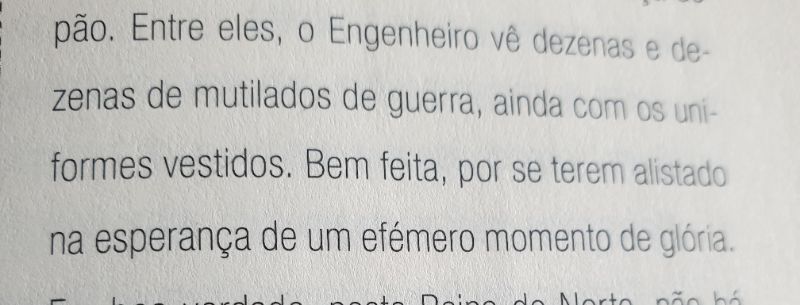
“Among them, the engineer sees scores of war-wounded, still in uniform. [Bem Feita] for signing up in the hope of an ephemeral moment of glory”
It’s pretty obvious from. The context that “bem feita” here means the same thing as bien fait: “It serves them right”. He thinks the war wounded deserved to be injured for signing up to the army in pursuit of glory.
How To Be Topp
Still battling on with Duolingo. The race to the top os pretty brutal though. I’ve been playing one-up with another learner for a few days but last night someone came out of nowhere notching up about a thousand pints in a day and going ahead of both of us by about 600. I’ve been trying to catch up all morning but I’ve got about 10 more exercises to go and my brain is broken.

Quarantined in Babel
I seem to be doing a lot of language work since quarantine started. I’ll let you decide whether that’s a sign of how productive you can be while staying the fuck at home provided you also log the fuck off twitter, or a sign that I’m one of those people who insists on having a routine but that routine turns into an obsession. I’m getting up between 6 and 7 most days and running through some exercises on Duolingo before starting work. I’ve decided to start learning Scots Gaelic now, just because I fancied something a bit different and I’m from there. I’ve also been doing French to try and revive my dormant vocabulary, and that’s going quite well. The nipper is joining in with that one. I’ve even reversed my usual policy by having a crack at the Portuguese module: it’s mostly stuff I already know, even at the highest levels, but of course it corrects me when I write things in a European way and makes me write them in a Bolsonaro-approved stylee, which is exactly why I’ve always avoided it, but I feel like I’m at the stage now where I know the difference and won’t get muddled as a result. Oh but the accent though, fam. Valha-me Deus! Studying three languages simultaneously isn’t as confusing as I expected it to be. I’m finding my brain cam compartmentalise them fairly well.
Anyway, I might have got a bit competitive about it… I’ve lost and regained first place in my league 4 times today!

Oh and I’ve been learning the ukulele too. Classic case. LOOK AT ME I’VE GOT A ROUTINE!!! I’ll be taking up knitting next.
Leftards
Quite interested to see this word “esquerdoide” or “esquerdoido” pop up a few times on Portuguese language twitter on both sides of the Atlantic. It seems to be the equivalent of the word “leftard” used by obnoxious maga types. It’s used in more-or-less the same way: identify some stupid thing said or done by one person or a small group of people on the other side. If it’s apocryphal or even if you just made it up, it doesn’t matter much. Then generalise that to characterise everyone in the other party as sharing the same opinion and being a bunch of leftards /esquerdoidos who aren’t smart like what we is. Sad.

The guy in the original tweet here is some Bolsonaro fartcatcher, so in American terms, this is like – I dunno – Stephen Miller, or Zac Goldsmith in the UK, mouthing off and one of their supporters jumping in and going “Yes, yes, they are all crazy aren’t they! Shit in my mouth please” or whatever people say when they wholeheartedly support the government in the face of all the evidence and are willing to let them get away with absolutely anything.
Side-note. “Coringa vírus” is presumably a reference to the movie Joker which is called Coringa in Brazil.
Música em Casa
I’ve really been enjoying the videos Rita Marrafa de Carvalho has been publishing from her house where she’s quarantined with her kids and a ukelele. They seem to be having a lot of fun and she can really sing/play too, which helps. I’ll try to embed one of them here but it’s on Facebook and Facebook is a bit awkward so I don’t know if it’ll work. They’re all really nice though, so you could do worse than go and look at her complete set on that platform if you have an account. A lot of them are on her Twitter too but I’m taking a Twitter break at the moment.
You Say Patati, I Say Patatá, Let’s Call The Whole Thing Off
One of my favourite booktubers recently started a new channel in Portuguese, after switching to English on her main channel. It’s called “As Revoltas da Manganet” if you’re interested. In the middle of the debut video she makes a noise that jumped out at me like “e pa ta ti pa ta ta”. It didn’t sound like anything that made sense but on the other hand, it sounded a bit too deliberate to be a random noise, so I hunted around and it turns out that the expression is “patati patatá”. It is roughly equivalent to “yada yada” or “blah blah blah” or just “and so on and so forth”.
The reason it took a little bit of digging was partly because it seems to be used in French and Spanish too, and partly because there’s also a Brazilian TV show called Patati Patatá, so on some sites it seems like they’ve translated it using the names of better-known (to English audiences) double-acts like “Frick and Frack”. But I think “yada yada” fits best in the context of the video, so I’m mentally shelving it as a useful little phrase to have up my sleeve for later…

Don’t Believe the Híf
More from “Camões Conseguiu Escrever Muito Para Quem Só Tinha Um Olho”. Its very good. Not at all what I expected (I thought it’d be much more like those toilet books like “F in Exams”) but very educational for intermediate Portuguese learners. I’m writing out this list of compound words in the hope that it’ll help me remember when to use a hyphen. They’re words commonly written incorrectly, with or without hyphens (hífens)
Abaixo-assinado and Abaixo assinado: The first is basically a petition, whereas the second is more like “the undersigned”
Antiacordo and pró-acordo. Pró-acordo needs an accent because the stress is on the prefix. A lot of words prefixed Pró, Pós or Pré seem to be like this. Antiacordo doesn’t need a hyphen because when the second part of the word begins with a consonant (other than h) or a vowel that’s different from the last letter or the prefix it doesn’t need one. The other examples she gives include autoevaliação, extraescolar, hidroeléctrico and plurianual.
Anti-inflamatório takes a hyphen because anti ends in an I and inflamatório begins with one.
Antirrugas and antissocial don’t need a hyphen but the r/s gets doubled to preserve the pronunciation, much as we’d do in English.
Bem-vindo: bem and mal tend to be hyphenated in situations where they’re joined to words that begin with vowels or Hs. When there stem word starts with a consonant it’s a bit more iffy. Mal tends to be joined to the stem word more often (malmandado, malcriado) whereas bem is more likely to be hyphenated (bem-mandado, bem-criado) but some conjoined words starting with bem do exist, like be feito and benquerente. Benvindo (capitalised) can also be a surname, apparently.
Coautor: co- is generally not hyphenated.
Contrassenha : as with some of the examples above, the s gets doubled to preserve the pronunciation.
Cor de laranja/Cor-de-rosa: she explains this in terms of one being a locution with its own meaning and the other not. I guess one is “the colour of an orange” and the other is “rose-coloured” but this just looks very inconsistent to me.
Ex-marido: words prefixed with ex in general have hyphens
Dia a dia, unlike day-to-day, has no hyphens
Efeito de estufa (greenhouse effect) and Fogo de artifício (fireworks) are “locuções nominais” and don’t need hyphens
Fato de banho (bathing suit), gaita de foles (bagpipes) and Fim de semana (weekend) don’t need hyphens because they’re a “locuções substantivas”
Febre-amarela (yellow fever) is a compound word and needs a hyphen
Galinha-da-Índia, louva-a-Deus, ouriço-do-mar are zoological species and all need hyphens. Could also have mentioned estrela-do-mar and porquinho-da-Índia
Grão-de-bico mad noz-da-Índia are examples of botanical species and behave the same way as the zoological species above.
Georreferenciação is another compound word that needs a double r to preserve the pronunciation.
Hás de /hei de: this is a bit niche. It used to be correct to write some forms of haver+de with a hyphen between them but in the acordo ortográfico it ceased to be correct, so you’ll see both forms. There’s a ciberdúvidas question about it here.
Hiper-rugoso: hiper needs a hífen when the stem word begins with an r.
Infraestrutura: if the word following “infra” begins with a consonant or a different vowel, it can be joined as one word
Infrassom: of the stem word starts with an r or an s then it gets doubled for the sake of pronunciation.
Intra-abdominal has a hyphen because the stem word starts with an a.
Limpa-para-brisas is a compound word (windscreen wipers) and takes two hyphens
Mais-que-perfeito: where this refers to a verb tense (ie, it means “plu-perfect” not “more than perfect”) it takes hyphens.
Micro-ondas: takes a hyphen because ondas begins with a vowel
Microrradiografia: the r is doubled to preserve the pronunciation where “micro” is followed by an r.
Minissaia: if the prefix Mini is followed by an s then it’s doubled to preserve the pronunciation.
Neorrealismo: if the prefix Neo is followed by an R it is doubled to preserve the pronunciation
Pós-graduação and pré-historia: pós and pré always have hyphens
Recém-nascido (newborn): likewise, any compound word starting with recém takes a hyphen
Sem-abrigo (homeless): likewise, any compound word starting with sem takes a hyphen
Semirrigido and semisselvagem: where “semi” is followed by an r or an s, it is doubled to preserve pronunciation.
Super-homem /supermulher: this immediately struck me as inconsistent like the example of cor de laranja and cor-de-rosa but in this case there’s a decent reason: homem begins with an h, and a lot of prefixes like supra and extra and contra and infra take a hyphen when they are followed either by an h or by the same vowel they end with. Anti-higiénico, anti-homofobia, extra-humano for example. Supermulher has a nice solid consonant so it’s immune.
Supraestrutura is the same story as infraestrutura.
That was a really useful list because I find those a bit random, so it’s good to know there’s some method to the madness!
 Luso
Luso 