I recently implied that Duolingo was not so bad, despite its Brazilian bias. I now realise, after reaching a 104-day streak in Gaelic and then having my account deleted and losing all my progress that it is a crap system produced by evil, evil people. I apologise for any confusion caused
One of the nice side-effects of exploring e-readers has been that I’ve come across a couple of proper portuguese audiobooks. I’ve had the most luck on Kobo but even that’s pretty hard to navigate, primarily because even when I tell it portuguese is my preferred language it insists on showing me english language titles and I don’t seem to be able to do anything as basic as search by language.
Anyway, I’ve come across Margarida Espantada which I’m reading now in conjunction with an ebiook version and Perguntem Sarah Gross, which has a good reputation. Naff all by Afonso Cruz, Joao Tordo, Nuno Nepomuceno, Ricardo Araujo Pereira – people who seem pretty mainstream, really. Still, though, it’s a good sign and I’m hoping to see more in the future.
I’ve already mentioned that I’ve finally got over my distrust of Duolingo during the lockdown, but I’ve also found myself feeling well disposed to the kindle app on my phone. Specifically, because of the built-in dictionary. This is incredibly handy…
I’ve been really interested in the parallels between Scottish Gaelic and Portuguese. One of the first things that made me want to get familiar with a celtic language was seeing words like Llyfr and Eglwys on signs in Wales, meaning Book and Church, respectively. Both are very obviously related to French, Portuguese and Spanish equivalents. Of course, it’s less surprising when you realise that churches and perhaps to a lesser extent books were introduced to these islands by Christian missionaries arriving from the mainland in the 6th century speaking languages not that distantly removed from the language of Caesar. So the words came along with the physical objects.
But it turns out that this Latin influence is just the tip of an iceberg and under the surface is a much larger body of connected words, dating back to before the Romans because of common Indo-European origins. All sorts of nouns have echoes of other languages in them, often changed almost out of recognition by the tides of history. Even the phrase “ciamar a tha thu?” (pronounced “kimmer a ha u” and meaning “how are you?”) which I’ve seen a few times in videos online turns out to be basically cognate with “como estás tu?” which seems obvious now but I’d never been struck by it before. It’s a link between Gaelic and Portuguese, not because Gaelic is a romance language but because both come from an even more ancient root.
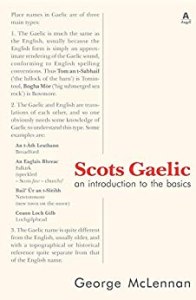
These moments of epiphany are coming to me courtesy of an excellent, and very concise introduction to the language, “Scots Gaelic – an Introduction to the Basics” by George McLennan. It’s exactly what I need right now: definitely not a how-to book, but one that maps out how the language works and why. Now that I’ve got to a certain point with Duolingo, I have a lot of questions and this is answering most of them in a very satisfying way.
8AM. Mrs Luso is up now and is telling me about Korean (which she’s learning) and we’re comparing notes. Language-learning is freaking amazing.
Having got through the first stage of Duolingo Scottish Gaelic, (and by the way, came top of the gold league, just sayin’ 💅 ) I thought it was time I booked my first online lesson.
It was really good! A bit daunting, but good. I found the teacher on iTalki and he was very nice, helpful and encouraging and as the torrent of new words came at me he typed them all into the skype chat for me so I wouldn’t have to write them down. Although writing things down might seem like a good idea, it’s quite confusing in Gaelic because the spelling is so weird. Up to now, I’ve been using Duolingo to load vocabulary into my head but although I know “gaothach” is pronounced like “Goo-hock” I have to type it in Duolingo, so I find myself memorising the spelling by saying it to myself phonetically as “gowt-hatch” so it’s like I am learning two parallel versions of everything and until I can read the syllables properly, writing things down is probably going to be a hindrance rather than a help. I’m addressing this by looking at the video tutorials on Gaelic with Jason‘s YouTube Channel and I’ve started reading a small introduction to the language called Scots Gaelic: An Introduction to the Basics by George McLennan. It’s surprisingly readable as an overview of the language and how it got that way.
So many words!
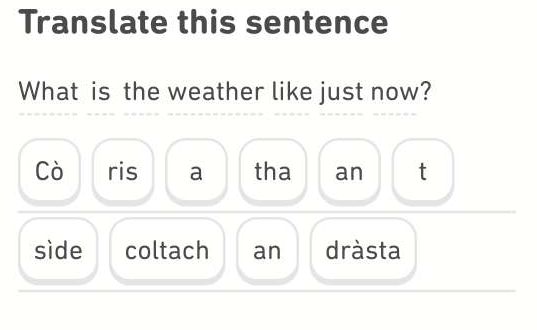
Anyway, no point wasting time asking a teacher about pronunciation, so let’s crack on! A bigger problem is why the hell there are so many words. For example, in the lesson about weather there is the following question:
And why does it bother me that there are so many “extra” words here? Well, I remember when I started learning French, the phrase that sounds like Kesker Say but is written Qu’est-ce que c’est just seemed like an arbitrary collection of letters and so I always found it hard to remember the spelling because i didn’t really understand what the components meant. It was only later when I twigged that it literally means “What is it that it is?” that I started to understand how it related to “c’est” and “est-ce que”, and the other little building blocks of the language. And from there I started to decode the rhythms and the… well, the plumbing of the language. So I thought if I could just parse this sentence then I could start to unravel Gaelic in the same way.
Here’s how it goes
Cò ris
a tha
an
t-sìde
coltach
an-dràsta
What
is
the
weather
like
now
Cò means “who” usually but can be pressed into service to mean “what” or “where” sometimes. “Ris” means something like “against” usually (or “rice”!)
Actually, “tha” on it’s own is the singular, present tense form of the word “to be” so it’s more like “this is”
female article
Why hyphenated? I have no idea. Presumably it could be broken down even further but Ididn’t get into that
Embarrassingly, I thought this meant “weather” whch is probably why I was so confused
As with “t-sìde”, I possibly could have asked whether an and dràsta have their own individual existences, but I didn’t go that far
I think the teacher was sceptical as to how useful this would be but I find it really helpful because I can watch out for the patterns in other sentences.
Questions
Cò ris isn’t always the word used for “what”. A more usual form of asking those kinds of questions is “Dè”, as in “Dè an obair a th’ agad?” (pronounced “Jane Opper a Hacket”) meaning “What work do you do? Obair must be related to “Obra” (in portuguese) and “Operation” in english via some circuitous etymological backchanneling, I think.
The answer to this question can be a bit odd or unfamiliar. “Is e IT consultant a th’ annam” which means “It is an IT consultant that’s in me”. Er… OK…
And, yes, like most languages, Gaelic uses some imported english words, especially for relatively modern words. “IT Consultant” was just written as-is, but it seems more common for them to be transformed into Gaelic spelling. I like “brabhsair” for “browser” for example and “cupa tì” for “cup of tea”.
Verbs
First of all, there aren’t any conjugations. So “Tha” means “is” and “am” and “are”. It has a past (bha) and a future (bidh). I’m not quite sure where “chan eil” fits into this. On its own it means “no” but it always seems to go at the front of the sentence (which is where the verb is always found in Gaelic) so maybe the “chan” part is… a….negative— form… of… the… verb…? I’m thinking out loud here, obviously.
There are only eleven irregular verbs. What are they? I have no idea. He did give me one example and all I can say it was pretty damn irregular, but I can live with that for the joy of not having to memorise long lists. Yeeeessss! I picked the right language!
Pleasantries
Gaelic, like french, has two forms of the word “you” (I was going to write “like portuguese” until I remembered that portuguese has about 17), and the more formal one is “sibh”. The effects of this aren’t always obvious: it messes with the endings of some common phrases like “thank you” which can be “tapadh leit” or “tapadh leibh” in the thu and sibh forms respectively, “and “what’s your name?” which can be “Dè an t-ainm a th’ ort?” or “Dè an t-ainm a th’ oirbh?”
Fhèin is a handy little word for returning a question or greeting back to someone. It means “yourself”. So if someone asks how you “Dè an t-ainm a th’ ort?” then after you tell them “Cailean a th’orm” (Colin = Cailean) you can lob the question back to them with “Dè an t-ainm a th’ ort fhèin?” (How are you yourself). So now I’m going to end this blog post and get back to work, so I’ll say tapadh leit for reading and wish you a good evening with a cheery “feasgar math”, and if you want to be able to tell everyone that you replied to a blog post in scots gaelic today, you can do that by replying in the comments below “feasgar math fhèin”. Don’t bother with the accent if your keyboard isn’t up to it: we’re all friends here.
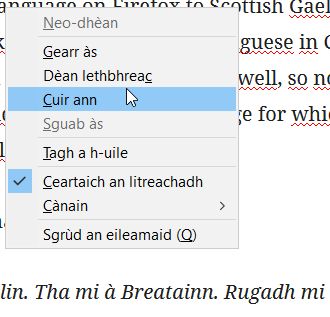
In keeping with the principles of language hacking, I’ve set my default browser language on Firefox to Scottish Gaelic so I can use it with Gaelic spellchecking on it instead of Portuguese in Chrome but it’s baffling because I’ve set all the controls to Gaelic as well, so now all the “copy”, “paste”, “file”, “new wondow” etc are in a language for which I only have about 100 words of vocabulary. Anyway, here goes…
Feasgar math! Ciamar a tha sibh?
Is mise Colin. Tha mi à Breatainn. Rugadh mi ann an Alba ach tha mi a’ fuireach ann an Lunnainn. Tha Lunnainn ann an Sasainn.
Tha mi leth-cheud bliadhna a dh’aois.
Tha mi pòsta agus tha nighean agam. Is e Olivia an t-ainm a th’ oirre
Tha dithis* bhràithair agam.
*Apparently there are special numbers used for people instead of things
So, as I mentioned recently, since the lockdown started I have been trying to learn three languages simultaneously: Portuguese (improving), French, (de-rustifying) and Scottish Gaelic (completely new, starting from scratch). I’ve mainly been using Duolingo, but also some books, videos and so on.
Obviously since this blog is very visibly dedicated to portuguese, having occasional posts about french and gaelic is probably a bit confusing and maybe at some point I should think about changing the title to be more inclusive but I’m still seeing Portuguese as my main mission and the others as side-quests at the moment, so I’m not going to turn into one of those smug internet polyglots just yet. Give it six months though and I’ll be livestreaming myself hanging out with Benny Lewis and trying to hold a conversation in 20 languages or some nonsense.
I came across a new (to me) channel on YouTube today and the first video I tried was full of good tips. She’s British so she seems to be coming at it from a practical standpoint of how to get by as an immigrant in Portugal rather than doing a lot of detailed stuff about grammar. Bookmarked for later to try the rest of her videos.
Just an update on the gender-of-animals thing I wrote a few days ago as a branch-off from the post about shelves, I asked a question about it on iTalki the other day and got some really interesting answers and I’ll probably go back to that from time to time when I need to write about animals for some reason.