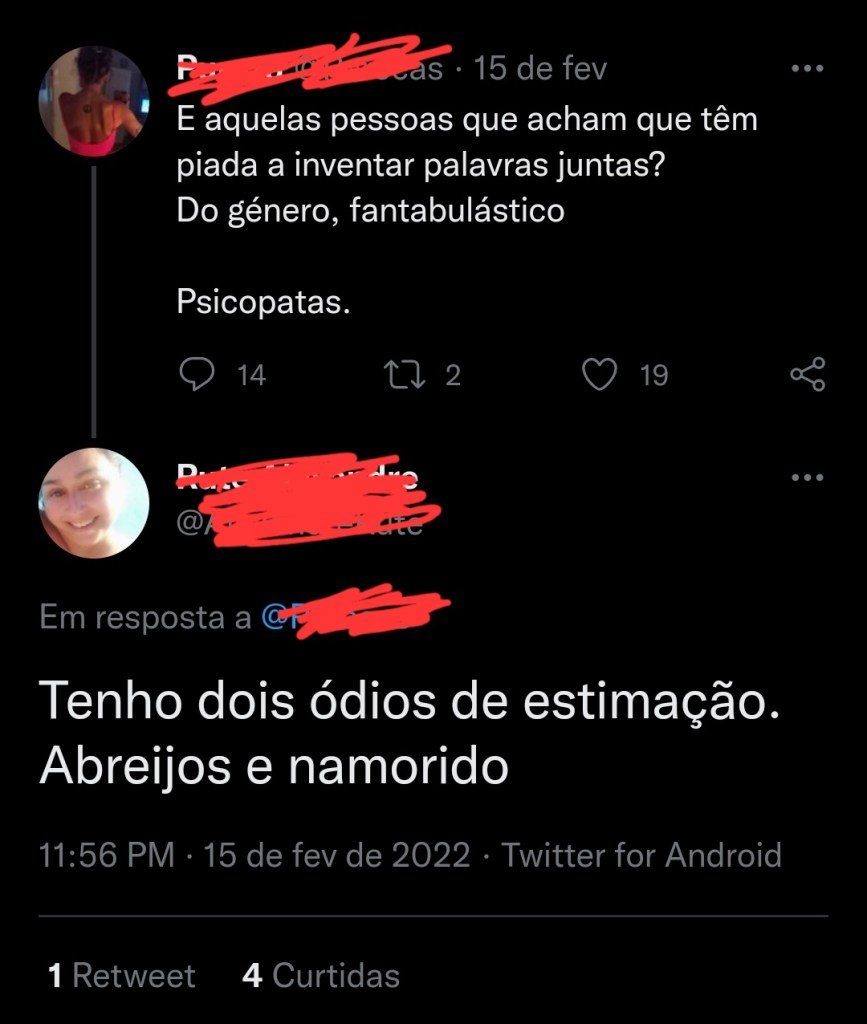
I saw someone on Twitter signing off a tweet with “abreijos” which is obviously a mixture of “beijos” (kisses) and “abraços” (hugs). I love it! I did a post a few years ago about equivalents of “frenemy“, and in general I am very pro-splicing, but this was a new one on me.
Looking around for other examples, I found plenty, including these ladies who were less impressed with the idea of these frankenwords…
But woah, there’s a bonus one in there: namorido, which looks like a mix of “namorado” (boyfriend) and “marido” (husband). Seems to just mean a long-term, live-in boyfriend who hasn’t actually bothered with the whole ring thing. I asked about it on reddit and everyone agrees it’s a neologism from Brazil. True, it looks like everyone using Namorido on twatter is Brazilian, but Abreijos is used widely by Portuguese tweeps, so I am definitely going to pull that one out when I get an opportunity.
This could have been a footnote to Wednesday’s post, but if I turn it into a pun headline about an indie band from the nineties it’s more likely to stick in my head, so here we are.
I explained that the word “Scoop” wasnt translated literally in the title of Evelyn Waugh’s book because it was a specific journalistic term. Apparently there is an equivalent word though, and that word is “furo”, or more specifically “um furo jornalístico”. According to Priberam, although the primary meaning of furo is a hole (specifically a neat hole made by a hole punch or an awl or some similar tool) one of its meanings is “notícia jornalística exclusiva ou dada em primeira mão”. A Scoop. Beautiful! This is the good stuff, people.
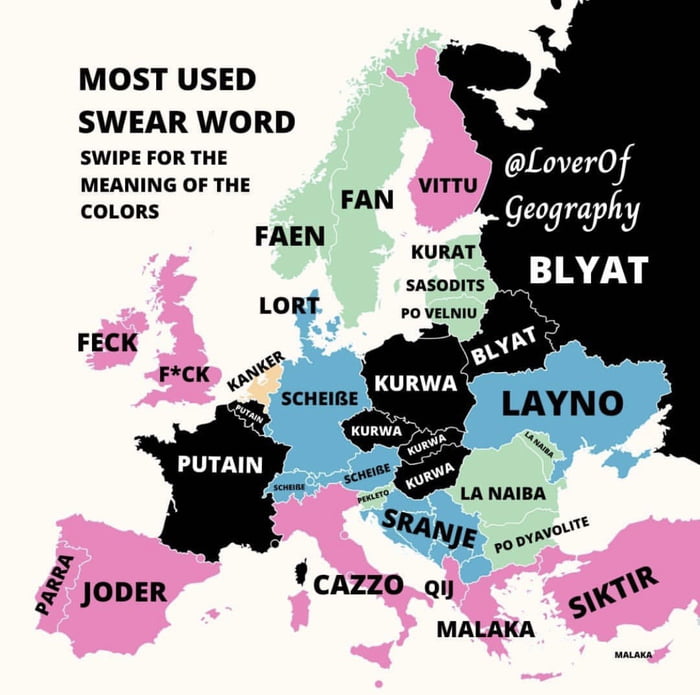
Portuguese twitter is very amused by this Instagram Post from “Lover of Geography”
For those not in the know, the actual palavrão here is “porra“, not “parra”.
Palavrão? Don’t I mean “asneira”? Palavrão is a swear word, whereas an asneira is any bad thing. You can “dizer asneiras” (say bad things) but you can also fazer asneiras (do bad things) so an asneira isn’t necessarily a swear word, it depends on context. The other relevant word is “calão” which just means slang.
By the way, why is Fuck the only one of these considered rude enough to have an asterisk? Or do they mean that English people actually say “Effasteriskseekay”? I wouldn’t put it past some people to be honest.
Second title in a row that hasn’t had any proper words in it but I think you’ll agree it’s merited: I mentioned a while back that I have been following a “Portuguese History” course delivered by two University lecturers, at least one of whom is also a TV pundit and alleged plagiarist. The course title is a bit of a misnomer because they mostly just deliver sermons on Marxist theory using Portugal as an example, but that’s cool, I don’t mind a little light Marxism.
Anyway, today I came across this clip of her on TV “a papaguear” (brilliant verb meaning “to parrot”) Putinist propaganda. Sigh. I think I might see if I can switch to a different course. I can’t be arsed with this.
Isto é a Raquel Varela, na sexta-feira, a papaguear a propaganda russa de que a maternidade bombeada de Mariupol tinha lá o batalhão Azov, e que não estava em funcionamento normal com civis. Há pessoas pagas para realizar este tipo de comentário. pic.twitter.com/HYOkivI8CQ
I lost my streak in Writestreakpt. I added a text yesterday which was number 181, but I started this daily text on a Monday, so Sunday texts should always divide neatly by 7. In other words, I should have been at 182 😱. I looked back and I seem to have skipped a day in mid-week and now I should be back at about 4 or 5. Frustrating…
If you’ve been learning Portuguese for a while now, you’ve probably heard of the Acordo Ortográfico 1990 (AO) which was an agreement between the Portuguese speaking countries to standardise spellings, because it was confusing to have different words spelled different ways depending on the author’s nationality. It was a bit like the US and UK, except the difference is even wider. Standardising the spelling has helped somewhat in reducing the linguistic confusion but as you can imagine, it wasn’t hugely popular. Brazil is a bigger country and seems to have dominated the negotiations and had its spellings accepted as default in most cases. Portuguese people liked this as much as if Boris Johnson passed a law saying brits all had to write “color” and “aluminum”.
Aaaaanyway, that’s all well and good, the accord have been on force for quite a whole now so you probably won’t see the old spellings much since the law has succeeded in suppressing them in most printed and online materials. So most learners can just ignore them while being aware that they might occasionally come across a luddite still spelling “reaccionário com dois cês” or whatever.
But did you know that that wasn’t the only time in history the Portuguese have rearranged their written language? In fact, I think this is the fourth time! There was a move in 1971-73 to suppress unnecessary diacritical marks that were responsible for most of the differences between Brazil and the rest. Before that, there was a process in the early forties, resulting in a new orthographical agreement in 1945. That makes me laugh. The rest of the world is at war, but Portugal and Brasil have time and energy to expend agreeing the way to spell words.
But the granddaddy of them all was A Reforma Ortográfica de 1911, which was a pretty thorough revision of all aspects of the written language. I’ve got a book published in the lawless time of 1902 and… Well, I daren’t actually read the thing, but just leafing through it is a bit of a strange experience because although it’s largely familiar, quite a lot of the words just look like they’re refugees from some other language. Here’s the title page and a random chapter heading, for example.
Right from the start, what really surprises me is the name of the author: Camillo Castello Branco had double Ls in both his names back then, which he certainly doesn’t now. The AO has actually changed someone’s name! I mean… Your name is your name! If someone told me I had to start spelling my name differently I’d tell them to shove their extra letters up their bum. I asked around about this and was told that while people are alive they will usually keep their original names, regardless whatever linguistic regime-change that takes place around them. Still though, changing someone’s name after they’ve died? What?
But the weirdness doesn’t end there. “Principaes” for “principais”, “ella” and “elle” for the two subject pronouns, “ahi”, “sáem”, “corôa”, and half a dozen others. Even the nationality doesn’t escape – it’s written as “portuguez”. Modern printings of this same book would have standardised all these words of course.
English orthography is a right old mess of course, but we like it that way. OK, I joked about standardising the spelling with America, but that’s nothing: imagine a more thorough change that would standardise all spellings, or even make it into a phonetic language as various idiots have suggested over the years. Now imagine that change being imposed on all subsequent reprintings of Shakespeare, say, or Chaucer, or Dickens. How would you even understand the historical evolution in a language if you erase the past like that? How would you understand the Shakespeare had invented hundreds of new words if the plays had been printed in such a way that the spellings of those words had altered radically to something he wouldn’t even have recognised.
I dunno, Portugal, I see why you did it but I’m not sure I approve.
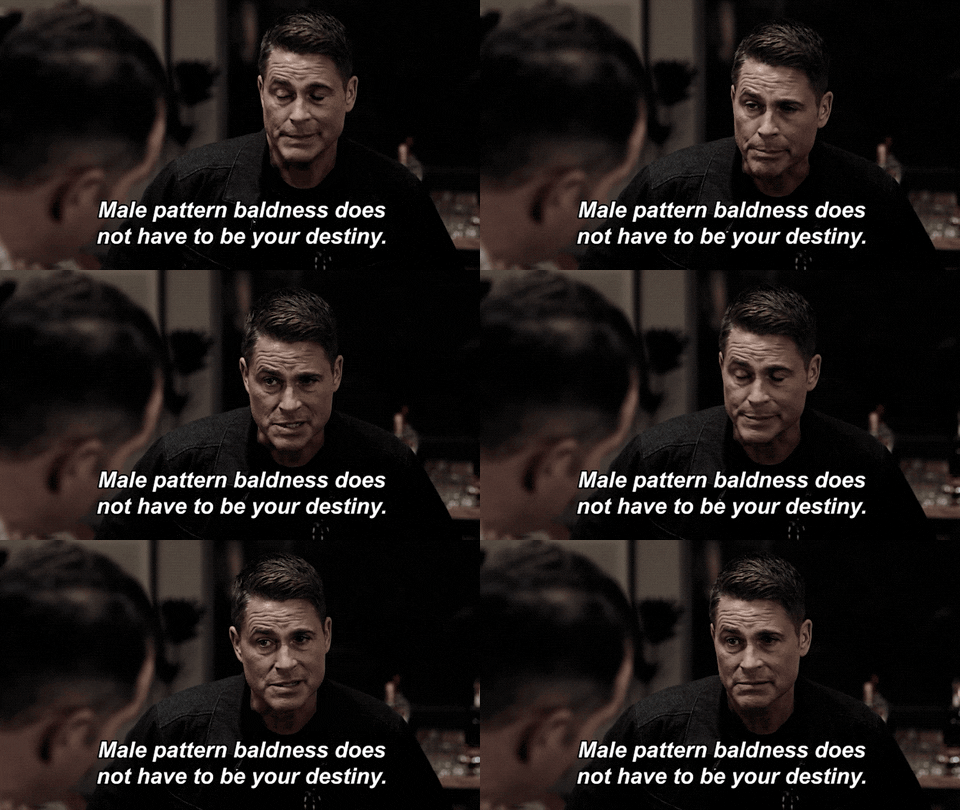
I just wondered how to say “male pattern baldness” in Portuguese so I googled it because it seemed like one of those things that would have a Wikipedia page and by looking across to the Portuguese version I could be sure that was the real term, not some shonky version from Google Translate. Now I’m going to be getting baldness cures pitched at me on every page I visit and every YouTube video I watch aren’t I. Damn you, technology.
Anyway, in case you’re wondering, it’s “alopécia androgenética de padrão masculino“. Pretty unwieldy, eh?
This must be my 400th title based on that song. I love it though. Anyway, the Social Media Find of the Day is this suggestion for ending the Russian invasion of Ukraine:
A mãe Putin vir com uma chinela dar taotao ao menino Vladimir.
Putin’s mother coming with a slipper to give her kid Vladimir tautau.
It’s not hard to guess from the context, is it, but my wife confirmed that yes, tautau means a smack – although she, and everyone else in the universe – spells it with a u, not an o. There’s a song called Vais Levar Tautau (you’re going to get a smack). Not my cup of tea, but if you’re interested it’s here





 Luso
Luso 