The exercises in the book I’m working through have themes to them. The last few have all been expressions involving body parts. The other day included one that said “Fugir a boca para a verdade” (The mouth runs rowards the truth) meaning if you don’t keep it under control, your mouth just blurts out what’s really on your mind. The very same day, I saw someone using it because George W Bush had given a speech and, as this tweeter commented, his big stupid mouth had done exactly that.
I’d like to thank Heike Dio who commented under a recent post about the Dulce Pontes / Moonspell collab. She suggested I have a look at the Linda Martini performance on Antena 3 with Ana Moura on guest vocals. It’s good: very stylish and original, so I’m really glad to have it on my YouTube music playlist. I must say, I still prefer the chaos energy of the Dulce Pontes one though. I’ve been watching that at least once a day since I first found it. Here is Heike’s recommendatiin though, and I’ll try and translate the lyrics underneath because that’ll help me understand it.
If I Grow*
Espero que te venha o sono /I hope sleep comes to you Que te deites cedo, antes de eu chegar /That you go to bed early before I arrive Que isto de ser dois, longe do plural /Because this thing of being a couple, far from being plural É tão singular /Is so singular
Paredes de empena / Gabled walls Já nem vale a pena /It’s not even worth it any more Resta-nos arder / Now it’s time for us to burn Que esta chama lenta /Because this slow flame Já virou tormenta** / Has become a firestorm E ao entardecer / And as it gets late
Ninguém me diz / Nobody told me O que há depois de nós / That there was something after us E se depois de nós / And that after us both Os dois me Agiganto / I’ll grow.
Eu já fui embora / And i left Já marquei a hora / And i marked the time Pra não me atrasar / So as not to be late Já comprei bilhete / i bought a ticket Deixei-te um bilhete / i left you a ticket E a descongelar / And once thawed out Os restos de ontem / Yesterday’s leftovers Dão pra o jantar / Will be enough for dinner
Ninguém me diz / Nobody told me O que há depois de nós / That there was something after us E se depois de nós / And that after us both Os dois me Agiganto / I’ll grow.
*=Agigantar literally means become a giant, but with that little reflexive pronoun, it becomes a verbo pronomial meaning “get bigger” so “grow” seems like a better translation.
**=Tormenta looks like it ought to mean “torment”. It actually means “storm” but I translated it as firestorm because a flame becoming a rainstorm doesn’t seem right.
When I was about 11 or 12 and learning Latin at school, my mum told me a rhyme she had for remembering the meaning of the word “semper”, meaning “always”: She’d say “Semper, semper, always keep your temper”.
It still works, most of the time, for the latin-derived word “sempre”. It usually means “always”, but there are exceptions. The first one you learn is “Sempre em frente”, meaning “straight ahead”, and there are a few other little expressions like “até sempre” and “para sempre” where it works with another word to mean something related but slightly different.
But even in normal usage, not part of an expression, it seems like the word order matters and it can change what it means depending where it comes in the sentence. I have made a couple of mistakes around this lately so I’ve been pointed to some examples. Here are a couple, shamelessly stolen from Reddit
O João sempre passou nos testes
O João passou sempre nos testes
In the first one, sempre goes before the verb, so it means “João ended up passing the tests”. Maybe he wasn’t expecting to pass but he managed to pull it off. Or maybe you weren’t sure but then you found out that, yes, yes he did.
In the second, sempre goes after the verb so it means what you expect it to mean – João was a smarty pants and every time he took a test he always passed it.
This seems to be a quirk of European Portuguese. In Brazil, it just means what you expect it to mean, regardless of the order, but in Europe, where you put it makes all the difference!
So, for us anglos, we need to resist the urge to put sempre where we would put it in our own language. “He always passed always the test”
There’s a video about it here if you’d rather hear about this from the horse’s mouth.
It’s hard to think of two musical. Genres that would be harder to turn into a crossover performance than Fado and Death Metal. And yet, if you think about it, is it that surprising a combination? They both deal in heavy stuff like death and despair, everyone’s wearing black and it’s all guitar-based (albeit a different kind of guitar). Fado is usually more subtle of course, but could it ever work? Well, here’s Dulce Pontes and Moonspell coming to test the theory at the Play Awards a few days ago.
It starts out with her singing fado and him not really able to keep up, and they go along together for a while, but by the end she’s pretty much reigning supreme over goth metal and he still can’t really keep up. The bit right at the end where he roars and she shrieks, but she can keep up the shrieking about four times as long as he can keep up the roar so he’s just left there staring at heaven from whence God’s vengeance cometh while she’s still belting out the same note. No prisoners taken!
The song they’re singing at the start is “Porque”, from Dulce’s latest album, and it’s based on a poem by Sophia De Mello Breyner Andresen. It’s expressing admiration for another person’s bravery and independence of spirit (“because others wear a mask but you don’t, because others use their virtue to pay for what can’t be forgiven – because others are afraid and you aren’t”) After the beat drops at about the half way mark, they’re onto Moonspell’s “In Tremor Dei“* which is a doom laden song about the 1755 Lisbon Earthquake “Lisbon in flames – a lantern lit, when a city falls another empire arises…” On the face of it, the two songs don’t seem to go well together, but the segue works because of the lyrics: at the end of the second verse of the fado, they sing together “porque os outros se calam mas tu não” – “because others keep quiet but you don’t.” Cue drums, guitar, crowd chanting and first pumping. Epic.
There were some other crossovers at the same show, like one between Nenny and Ana Moura, or between Camané, Agir and the Ukrainian Orthodox Choir, all good in their own ways of course, but this one is by far the most epic.
I’ve got tickets to see a Dulce Pontes concert that was delayed from last November to this November and I’m hoping she brings these lads with her now.
*Don’t panic if you’re struggling to translate the title – it’s Latin, not Portuguese!
I got so carried away the other day that I published a blog post with this title and no content at all. I’m a five-year-old at heart. By the time I’d finished reading the article I had planned to base it on, though, I’d changed my mind, because, despite being written in Portuguese, it doesn’t actually have much information about Portuguese culture. In fact, as you’ll see, I learned more about French than I did about Portuguese. I considered changing the title to “Peido and Peidjudice” or “Peidomaníaco”, “Peidogeddon” or “It’s Peidback Time” or something, but I just decided to stick with this title in the end so as not to disappoint anyone who saw the first post and had been holding their breath in expectation of the second.
Governor William J Le Petomane (left) and friends
Li um artigo no jornal Público sobre a História Cultural da Flatulência. O escritor não deu exemplos da flatulência na vida cultural portuguesa. Não faço ideia porquê. Os portugueses não se peidam? De qualquer maneira, o que mais me surpreendeu foi uma referência ao nome de uma personagem no filme do Mel Brooks, Blazing Saddles. O seu nome é Governor William J Le Petomane. O Le Pétomane original era um artista, antes da guerra, cujo nome significa “Peidomaníaco” por razões que são provavelmente óbvias. Apesar de ter visto o filme vezes sem conta, eu nem sequer sabia o significado do seu apelido.
It’s been a busy year in the Saudade mines and Portugal now has such a vast surplus of their untranslatable major export that they’ve taken to giving double portions away with every Eurovision entry. “Saudade, Saudade” is a good song. It’s a strange choice for a Eurovision entry, but that’s not a huge surprise: they’ve been sending strange choices to Eurovision for some time now and it keeps things interesting! I actually really struggled to listen to it on yesterday’s Eurovision final, because I was trying to tune in to the Portuguese lyrics but it wasn’t till the second listen that I realised it’s almost all in English! In my defence, there was a lot of background noise!
The only Portuguese verse (not counting the word “Saudade” itself of course) is
Tem tanto que trago comigo Foi sempre o meu porto de abrigo E agora nada faz sentido Perdi o meu melhor amigo
E se não for demais Peço por sinais Resta uma só palavra
Which translates as
He has so much I carry inside myself He was always my port in the storm And now nothing makes sense I lost my best friend
And if its not too much, I ask for a sign Only one word remains
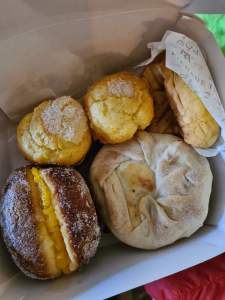
By the way, we set out to get a range of snacks from lots of European nations to eat while watching but we ended up just loading up on cakes from the Portuguese stall at Richmond’s Duckpond Market
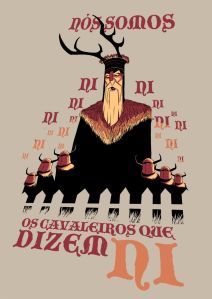
I put this meme on twitter earlier, inspired by a random thought from a previous post.
Tumbleweeds.
It’s always a bit tricky when a joke in Portuguese dies on its arse. Is it because my grammar is incomprehensible, or is it just not funny. Reposted on Instagram and it got a few likes. OK, I’ll take that.
Social media really is a treasure trove of stuff you can learn, and it doesn’t feel like a chore because you’re just looking at memes. Here’s one i found today.
I know “golpe” is like a blow – in the sense of a blow to the head or a blow from an axe: the impact of something. It’s used in “golpe de estado” (coup d’état) for example. And baú is a chest – as in “treasure chest”. So when you put them together, what do you get? A golpe de baú is the act of marrying an older guy in the hope of inheriting all his wealth.
So, basically, I’m the words of Kanye West, they ain’t sayin’ she a gold digger, but she ain’t messin’ with no broke tuga.
I don’t actually know who the woman is or what the account that’s posting this is like, so I’m not sure whether she’s in on the joke or whether it’s meant in a cruel way or whether she’s done anything to deserve it or whether they are just being arseholes, but I am so pleased to have learned a new thing that I don’t really care.
You can read more about the history of the phrase Golpe de Baú on Wikipedia if you’re interested
Found on someone’s Pinterest. No idea who owns it. Too good not to use.
I’ve been repeating a lot of silly errors lately, often just typos that don’t get caught by my usual method: pasting my Portuguese texts into Google Translate to see if it can correctly translate them back into English. Google Translate is quite forgiving of “gralhas” (typos) so if you wrote “ni” instead of “no” because you are a medieval Knight and that’s your favourite word and autocorrect has changed it for you, Google Translate will probably correctly guess what you meant, and the error will slip through.
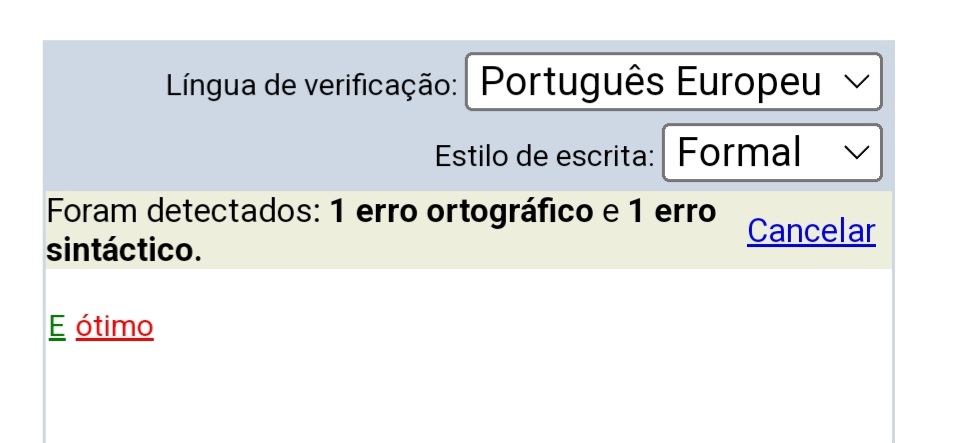
One of the correctors on the subreddit suggested I incorporate FLiP into my routine. It’s a spelling and syntax validator. I’ve had a play and concluded it definitely has its uses. It has a pretty big gotcha though. In fact, I thought it was wrong about a couple of AO spellings. It prompted me to change the spelling of Ótimo to the older Óptimo, for example. Well, I like the old version so I’m not too bothered, but it’s the wrong advice.
When it did the same with the word “corre(c)ção” I really started giving it side-eye. Considering corre(c)ções are its raison d’etre, that would be a pretty big error. It turned out there was a good reason though. Can you spot my mistake?
Yeah, it defaults to the old spellings and i hadn’t noticed there was a box to tick right there at the top that makes it use the newer ones. So make sure you remember that!
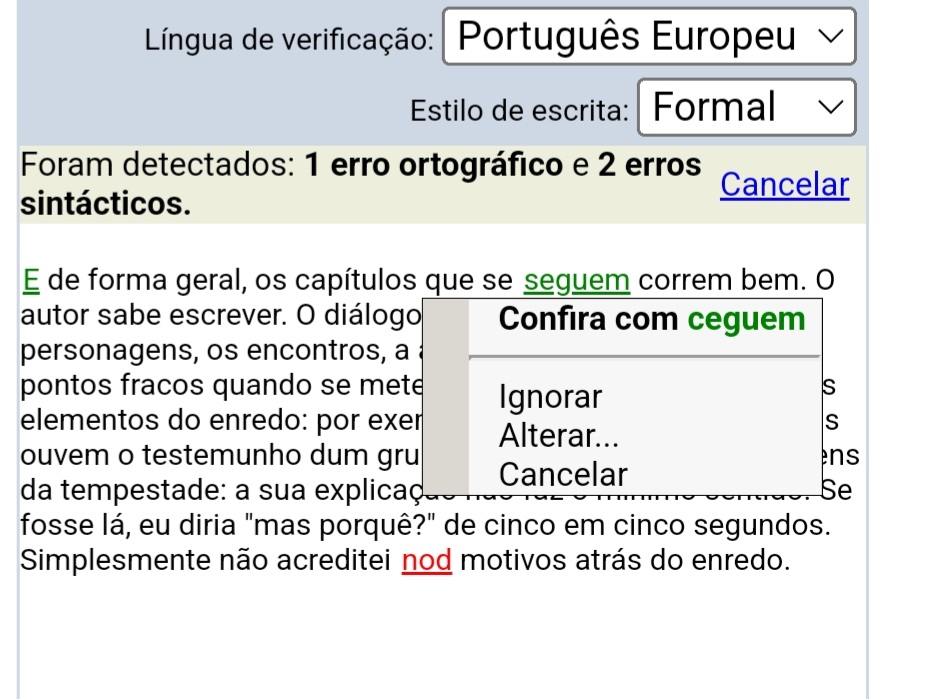
Like any computer program, it’s not immune to errors though. Today’s text includes the phrase “os capítulos que se seguem” (“the following chapters”). Computer said no, advising me to say “the chapters that blind themselves” instead.
Still though, like most online tools, it has its uses. It’s probably best to treat it like a GPS navigation system: follow its directions most of the time but not when it’s telling you to drive off a pier into the sea to get to Calais.
Embarrassing when you publish a blog post you haven’t actually written yet. Apologies to anyone who saw that and was confused. There will be a slightly better version of it in a day or two…