I can’t remember if I’ve mentioned this account in here before but it really is a great source of minor historical weirdnesses if you are a fan of Portuguese History. I mean, this for example.
Category: English
Ornatos Violeta – Ouvi Dizer
Here’s another song that keeps coming up in my YouTube recommendations. It’s really popular but it’s never really appealed to me. I think it’s the singer’s voice: it reminds me of a certain kind of American Rock bands the nineties like Alice in Chains, Stone Temple Pilots, Blind Melon: that sort of grumbly, sulky way of singing that I find a bit off-putting. But I also know it’s really popular so I wanted to focus on it and try to understand it better. There are a few versions of it on YouTube, including an official video, a really good live version at the Nos Alive Festival, some audio/lyrics versions and a whole range of covers including this really nice one by Serena Kaos and this Fadofication by Camané but I think the easiest one to follow is probably this one because its pretty clear and has veteran actor/musician Victor Espadinha on guest vocals

Here are the lyrics. I’m not totally sure I nailed the grammar in verse 2. Might ask my wife about that later. I read the third verse to my daughter and she said it was “emo”. Correct. I wonder if the female form of emo is “ema”. Probably not.
Ouvi dizer que o nosso amor acabou /I heard them say our love was over
Pois eu não tive a noção do seu fim / But I had no idea it had ended
Pelo que eu já tentei / As much as I tried
Eu não vou vê-lo em mim / I can’t see it in myself
Se eu não tive a noção de ver nascer um homem / If I had no notion of seeing a man emerge
E ao que eu vejo / And from what I can see
Tudo foi para ti / It was all for you
Uma estúpida canção que só eu ouvi / A stupid song that only I heard
E eu fiquei com tanto para dar / And I had so much to give
E agora /And now
Não vais achar nada bem / You aren’t going to like it at all
Que eu pague a conta em raiva / That I pay the bill with anger
E pudesse eu pagar de outra forma / And could I pay any other way
Ouvi dizer que o mundo acaba amanhã / I heard the world ends tomorrow
E eu tinha tantos planos pra depois / And I had so many plans for later
Fui eu quem virou as páginas / I was the one who turned the pages
Na pressa de chegar até nós / In a hurry to arrive at us
Sem tirar das palavras seu cruel sentido / Without taking from the words their cruel meaning
Sobre a razão estar cega / As for my reason being blind
Resta-me apenas uma razão / I only have one reason left
Um dia vais ser tu / One day it’s going to be you
E um homem como tu / and a man like you
Como eu não fui / Like I never was
Um dia vou-te ouvir dizer / One day I’m going to hear you say
E pudesse eu pagar de outra forma / And could I pay any other way
Sei que um dia vais dizer / I know one day you’re going to say
E pudesse eu pagar de outra forma / And could I pay any other way
A cidade está deserta / The city is deserted
E alguém escreveu o teu nome em toda a parte /And someone wrote your name everywhere
Nas casas, nos carros, nas pontes, nas ruas / On the houses, on the cars, on the bridges, on the roads
Em todo o lado essa palavra / everywhere that word
Repetida ao expoente da loucura / Repeated to the point of madness
Ora amarga! ora doce / Now bitter, now sweet
Pra nos lembrar que o amor é uma doença / To remind us that love is an illness
Quando nele julgamos ver a nossa cura / When we see on it our cure
Gerunds
Parsing this paragraph which has two gerunds in it. Gerunds are rare beasts in european portuguese so I thought I’d try and unpick the grammar a bit for my own benefit.
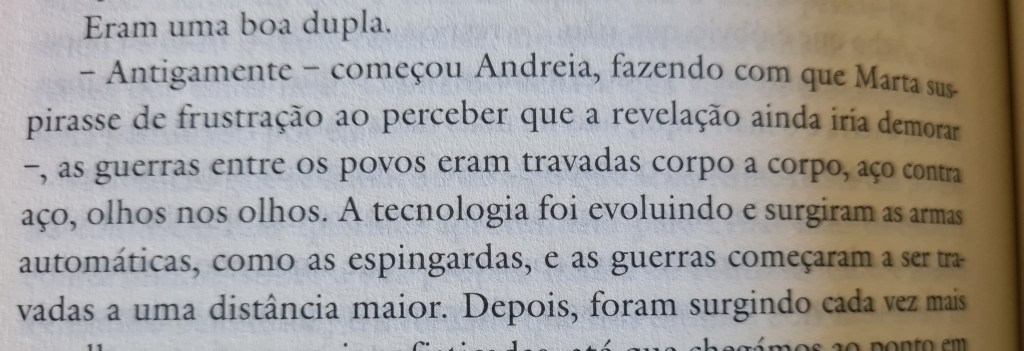
“A long time ago” began Andreia, causing Marta to sigh with frustration, as she realised that the the revelation would be delayed, “wars between peoples were fought body-to-body, steel against steel, eye to eye. Technology kept evolving and automatic weapons arose, like rifles and wars began to be fought at a distance. “
Fazendo com que:
There are a lot of compound verbs in portuguese, where a standard verb (usually a common one like dar or fazer), gets used with a preposition and takes on a different meaning.. Fazer com que means to provoke or cause something (check this ciberdúvidas article for more background). In this case, it’s in the gerund form, meaning it’s just scene-setting: The dialogue is being described and the author is just letting you know what effect it’s having on the listeners
Foi evoluindo
Using Ir + gerund like this is a way of describing something that keeps/kept happening, continuouly over time. For some reason the main example of this I can think of is a clip of a brazilian dancer in a tik-tok video compilation…. OK, OK, it’s a guilty pleasure. Leve me alone! At about the 4:35 mark, she tells you “abre e cruza e vai acelerando” (Open and close and keep speeding it up)
So “Foi evoluindo” means it kept evolving.
Dia De S Receber
I have been listening to other Xutos and Pontapés songs after getting over my mental block with A Minha Casinha the other day, I like this one: Dia de S Receber. I’m not a catholic so the title is a little bit alien to me, but saints’ days seem to be more of a thing in Portugal than they are in britain, at least if my Twitter feed is anything to go by. the S in the title is short for Sao (“Saint”) so São Receber means “Saint Receive” and that means o Dia de Sao Receber is payday, right? I’m not wrong about that am I? I hope not or this translation is going to be a right old mess….
This is the best kind of video, by the way: It has the lyrics appearing as part of the video, not just as inaccurate subtitles, which is really helpful for us learners. If you want to find out more about them you shouldn’t find it hard: there’s loads of their stuff on Youtube, on Spotify and all the usual places. I’m sort of intrigued by a book I came across on bertrand’s website too: there’s a comic book about them with a free CD. It’s part of a series including eight well-known portuguese bands. I wouldn’t go out of my way to get it but I might bung it in the basket next time I’m shopping for books, I shouldn’t be doing any such thing of course, because I’m on a book-buying ban, but it’s nearly my birthday so I might just treat myself.
Dia de S receber
Aaaaaaaaaaiiiiiiii a minha vida / Oh my life!
Aaaaaaaaaaiiiiiiii a minha vida / Oh my life!
Embora falar da arte / Let’s talk about art
Da arte de sobreviver / About the art of survival
Daquela que se descobre / Of what we find out
Quando não há que comer / When there’s nothing to eat
Há os que roubam ao banco / There are those who rob banks
Os que não pagam por prazer / Those who don’t pay for pleasure
Os que pedem emprestado / Those who borrow money
E os que fazem render / And those who earn money
Este dia a dia é duro / This day-to-day is hard
É duro de se levar / It’s hard to get up
É de casa pró trabalho / It’s from house to work
E do trabalho pró lar / And from work to home
Leva assim uma vida / A life could get taken up that way
Na boínha* sem pensar / Fair enough if you don’t think about it
Mas há-de chegar o dia / But the day has to come
Em que tens de me pagar / When you have to pay me
Ai é o dia / Oh** it’s the day
De S. Receber / The day of São Receber
Dia de S. Receber / Day of São Receber
Já não chega o que nos / It’s not enough what
Tiram à hora de pagar / They take from us on payday
É difícil comer solas / It’s difficult to eat
Estufadas ao jantar / stewed shoe soles for dinner
De histórias mal contadas / By badly-told stories
Anda meio mundo a viver / Half the world is living
Enquanto o outro meio / While the other half
Fica à espera de receber / Are waiting to get paid
Ai é o dia / Oh it’s the day
De S. Receber / The day of São Receber
Dia de S. Receber / Day of São Receber
Aaaaaaaaaaiiiiiiii a minha vida / Oh my life!
Aaaaaaaaaaiiiiiiii a minha vida / Oh my life!***
É assim esta diálise / That’s how it is, the dialysis****
Entre o deve e o haver / between owing and having
Sei que para o patrão custa / I know it’s hard for my boss
Enfrentar este dever / to face this duty
O dinheiro para mim não conta / Money doesn’t count for me
Eu trabalho por prazer / I work for pleasure
Mas o dia que eu mais gosto / But the day I like the best
É o dia de S. Receber / Is the day of São Receber
* You won’t find boínha in the dictionary. It’s just a diminutive though: Na boa + inha = na boínha. Ciberdúvidas says it shouldn’t have an accent but this is how I found it on the lyrics page so I’m leaving it in.
**Ai is an exclamation like “Oh!”, not to be confuised with “Aí” which means “There”. If you look at the video, it’s the same word he’s shouting at the beginning and in the middle as “AAAAAAAAIIIIII”
*** In the video, when he gets to the middle of the song at the second round of “AAAAAAAIIIIIII” etc, he adds a couple of extras in: first, a nursery rhyme called “Atirei o pau ao gato” (“I threw the stick at the cat”) which has been criticised for cruelty to animals (I wrote a blog post about this ages ago but it’s pretty much what you’d expect from people who have nothing better to do than to closely analyse nursery rhymes). Secondly, there’s a bit of swearing: “A puta da minha vida” – “My bitch of a life”, which seems to be quite a common expression. For a start, it’s used in the title of this very good collection of essays by Miguel Esteves Cardoso, which I read a few years ago when I was at B1 level and even then found very easy to read and very funny.
**** Weird word choice, this. According to Priberam it really does only have that medical meaning. I wondered if it was a misprint – maybe some other word meaning “dichotomy” or “dualism” or something but it’s right there in the video, so I asked Mrs L about it and she says yeah, it does just seem to be that idea some idea that there’s a medical procedure required to separate out the money owed and the money you have.

Refugiados
Here’s a corrected text from a couple of days ago with some additional notes. The theme is this weird new Mad-Libs policy about refugees that the British government came up with just before Easter and then were shocked… shocked! – when every vicar in the land used their easter sermons to say it wasn’t what Jesus would have done.
Pensei em escrever sobre a nova política do partido conservador face à imigração de refugiados mas é tão ridículo que, contado, ninguém acredita. A questão da imigração e dos refugiados (não são iguais mas são semelhantes até certo ponto) é complicado e cada país tem de pensar bem antes de fazer uma política que passa a prova de justiça e de compaixão, mas o nosso governo não se importa.
Amazingly this text didn’t need any corrections (it’s not often that happens!) but Dani told me more about the phrase “Contado Ninguém Acredita”. I only know it from the Deolinda song
… But it’s also the Portuguese translation of the name of the American movie “Stranger than Fiction”.
It’s usually said as part of a larger expression “Isto só visto porque contado ninguém acredita” which basically means “You have to see it to believe it. There used to be a TV series in the nineties called Isto Só Vídeo which was a sort of Portuguese equivalent of those cheap shows where people send in their home videos of terrible disasters – falling off bikes or getting whacked in the face by a swing or whatever – and you wonder how long they had to spend on A&E to bring the nation 30 seconds of amusement. I’m thinking of Jeremy Beadle because my cultural references are very out of date but I’m pretty sure they are still a thing now and of course YouTube is full of them. Anyway here’s what it looks like.
How’s that? I’ve gone from the refugee crisis to Jeremy Beadle in 5 paragraphs. Not bad eh?
Um Conto de Dois Embaixadores

Launching an occasional series tentatively entitled Ambassador Update. This week: there is a new Portuguese ambassador in London, and the British ambassador in Lisbon fell of his bike and tweeted (in Portuguese, natch) about how well he was treated by everyone involved. Thanks to Dani Morgenstern for the help. I wrote this a while ago and delayed till I had the corrections for it, so maybe by the time you read this the world will have moved on but I’m betting you are not the sort of person who needs their ambassador news to be bang up to the minute so I hope you’ll bear with me.
Aqui em Londres, há um novo embaixador português. Sua excelência Manuel Lobo Antunes aposentou-se e voltou para Portugal. No seu lugar, Nuno Brito apresentou as suas credenciais a Sua majestade na quinta feira da semana passada.
Entretanto no parque de Monsanto, nos arredores de Lisboa, no sábado da mesma semana, o seu homólogo, Chris Sainty, o embaixador do Reino Unido, caiu da sua bicicleta e partiu um ombro. Escreveu um tweet no qual elogiou a gentileza dos transeuntes que vieram em* sua ajuda, e o profissionalismo dos médicos e enfermeiros que cuidaram dele no Hospital São Francisco Xavier.
* vieram em sua ajuda: they came in his aid, not to his aid. Another of those confusing preposition switches.
A Minha Casinha
Wow, well, this was going to just be another Portuguese text with footnotes but one of the footnotes sent me off down such a rabbit-hole about the origins of this song that I’ve ended up writing a whole separate blog post in English grafted onto the bottom and frankly it’s a lot more interesting than the Portuguese text. Thanks to Patis12 for help with the Portuguese parts.
Já falei do filme que eu e a minha filha vimos há uns dias – Opération Portugal. Há uma cena perto do final no qual os portugueses lutam contra os criminosos. Batem-lhes na cara com as suas pás – pumba! A banda sonora da cena é uma música famosa dos xutos e pontapés, chamada “A Minha Casinha” e os estrondos de pás contra caras sincronizam com a batida da música.

Confesso que sou indiferente à canção. Seis linhas repetidas… Quantaz vezes? Quatro? Cinco? Mas a minha esposa gosta muito porque a música da nossa juventude tem sempre lugar especial nos nossos corações. Não sabia antes de começar este texto que os Xutos e Pontapés não escreveu a letra da canção: o original era parte da banda sonora dum filme dos anos quarenta do século passado chamado “O Costa* Do Castelo” Uau, que evolução imprevisível!
*= Why “O Costa”, not “A Costa”, given that Costa is a feminine noun? It’s because it’s not a noun at all, it’s the name of one of the characters in the film.
So slipping back into english, here are a few of the many manifestations of this song:
As I’ve said above, a well-known actress and singer named Maria de Lurdes de Almeida Lemos, better known as Milu sang it in a movie called O Costa do Castelo (1943) and wow, it really is almost unrecognisable. By the way, one of the commenters under the video has used an expression I mentioned a few days ago: “Nem a Grace Kelly lhe chegava aos calcanhares…”
Basically this is a very traditional song about the joys of being poor and pure at heart. This seems very much in keeping with the ethos of the dictatorship that was in place at the time.
In the eighties, Xutos e Pontapés started singing it for a laugh as a way of rounding off their shows and eventually recorded it on their album “88”. Here’s their version (they’re well into their later years in this recording, obviously)
They have stripped out the later verses about Christian humility and simplicity (neither of which is a punk virtue) and instead just taken the first verse and repeated it a few times, describing their top floor flat: “um (…) primeiro andar a contar vindo do céu” means “the first floor – if you’re counting down from the sky”, so the vibe your left with is more like a tower block anthem. This contrasts with Milu’s version which uses the same words but conjures more of a rose-tinted vision of life in a poky old house in an impoverished but proud neighbourhood in the Alfama.
The result is a pretty good anthem, as suitable for chanting on the football terraces as singing in the Coliseu.
When Metallica played Lisbon shortly after the death of Xutos’ lead guitarist Zé Pedro they chose this song as a tribute.
Xutos e Pontapés were also invited to make a video of the song to as a promo for the Spanish Netflix series A Casa De Papel (aka Money Heist)
And finally, here’s how it’s used in Operation Portugal with clanging shovels. Most of this is french of course, apart from the chant (“The people united will never be defeated”) and the soundtrack itself
Here are the lyrics:
As saudades que eu já tinha / The love I felt
Da minha alegre casinha / For my happy little house
Tão modesta quanto eu / As modest as I am
Meu Deus como é bom morar / My god, it’s good to live
Num modesto primeiro andar / On a humble first floor
A contar vindo do céu / Counting down from the sky
… And then the additional verses that were dropped from the Xutos version…
O meu quarto lembra um ninho /My bedroom is like a nest
e o seu tecto é tão baixinho / it’s cieling is so low
que eu, ao ir para me deitar, /that when I go to bed
abro a porta em tom discreto, / i open the door quietly
digo sempre: «Senhor tecto, / and say “Mr Cieling,
por favor deixe-me entrar.» / please let me come in”
Tudo podem ter os nobres / The gentry might have everything
ou os ricos de algum dia, / Or the people who happen to be rich
mas quase sempre o lar dos pobres / but almost always, poor people’s homes
tem mais alegria. / have more joy
De manhã salto da cama / In the morning I jump out of bed
e ao som dos pregões de Alfama /and to the sound of raised voices in the Alfama
trato de me levantar, / I start waking up
porque o sol, meu namorado, / because the sun, my beloved
rompe as frestas no telhado / breaks through the gaps in the roof
e a sorrir vem-me acordar. / and wakes me with a smile
Corro então toda ladina / Then I run, completely pure**
na casa pequenina, /in the little house
bem dizendo, eu sou cristão, / saying I’m a Christian
“deitar cedo e cedo erguer / “Going to bed early and rising early
dá saude e faz crescer” / makes you healthy and makes you grow”
diz o povo e tem razão. / say the people and they are right.
Tudo podem ter os nobres / The gentry might have everything
ou os ricos de algum dia, / Or the people who happen to be rich
mas quase sempre o lar dos pobres / but almost always, poor people’s homes
tem mais alegria. / have more joy
**=I’m not sure about the translation of “Ladina” meaning pure. According to Priberam, it’s an antiquated meaning, but it’s the only one that makes sense so I think it must have still be in current usage at the time the film was released.
Palavras Cruzadas (Páscoa)
I finished this easter crossword slightly late. It was one of the easier ones and I hardly even needed to use the dictionary.
One of the things I learned in the process was how you describe the clues. In English we say “one down” and “seventeen across”. In Portuguese the down clues are “vertical” and across “horizontal” but I’ve never been sure if it was “um da horizontal” or “um horizontal” or what.

So I asked:
Adoro fazer palavras cruzadas. Tenho um livros cheio de palavras cruzadas portuguesas. O autor é Paulo Freixinho e cada palavra cruzada tem um tema.
Uma coisa que não sei é como se referem os espaços (da grelha) e as pistas correspondentes. Por exemplo em inglês, dizemos “one down” para indicar a primeira pista no vertical” mas será que os portugueses dizem “um na vertical” ou “um vertical” ou “um para baixo” ou… Uma outra coisa?
The answer turns out to be pretty simple: it’s just “um vertical” and “um horizontal”. Boring but useful – at least if you are a crossword fan.
By the way, vertical and horizontal, when used as nouns, are feminine, but in spite of that its still “um vertical” not “uma vertical” because we’re not saying that there is one vertical, we’re referring to number one in the list of vertical clues.
Well I Obviously Misunderstood This One
I mentioned this guy’s YouTube channel a little while ago. He’s on Instagram now, and I’m glad I watched today’s video, because I had totally misunderstood this phrase. I thought it implied dishonesty – like the person was cunning and looking for a way to game the system for their own benefit but apparently not, it’s just someone who thinks they know everything.
More Reasons Not To Trust Google Translate
I think the original phrase is intended to mean something like “if you wish for something you can achieve it” but…
 Luso
Luso 