I’ve been noticing in the last few days I keep getting “likes” in old posts, and always the most boring, obscure homeworky ones too, not the fun ones. Of course I should have guessed, they’re all the ones with “exercise” in the name and some people are using bots to publicise their health-related blogs by dropping random likes on any post with a relevant keyword in the name. The Internet is a pointless place sometimes.
Discussing yesterday’s post with a friend, she pointed me to a sketch from a satirical show called Gato Fedorento (literally “Stinky Cat”) from 2007 which had a similar phrase in it. It’s actually not the same as the usage I’d heard, but it lives on as a meme, so I am definitely interested, and I spent some time understanding it anyway! The phrase is “É proibido mas pode-se fazer”.
The background is that in that year there was a referendum about reforming the abortion laws, which was quite a big deal in a largely catholic country. Marcelo Rebelo de Sousa had initially supported a referendum in 1997 but when it had finally come to the crunch ten years later he campaigned against it and set up a website critical of the plan called “Assim Não” (“Not like this”). Cynical political move or principled stand? Well, if I understand it, his reasoning was that in the ten years that had elapsed, he was out of power the Partido Socialista had launched the referendum, backed by a law they had written. The wording on the referendum remained “despenalização” (decriminalisation) but the law they were intending to pass was actually advocating “liberalização” (liberalisation), which he argued was slightly different. On top of that, there was an indication that women would be able to have abortions by their own choice, with no need to justify it on psychological, medical or other grounds, which he did not support. And he even goes on to paint a picture of a world where women are choosing abortions more-or-less at a whim. He is pretty ridiculous about it, actually. The bottom line was that he didn’t want to liberalise the conditions under which women could get abortions, he just wanted to take away the criminal penalty.
Here’s the original video.
(By the way, what’s the camera guy playing at? There are some really odd zoom shots and then, at about 2:00, he starts filming the guy through a glass on the table. That’s a pretty cool shot if you’re making an edgy police drama, but it’s weird AF in this context)
Anyway Gato Fedorento mocked him by having Ricardo Araújo Pereira repeat his speech (without the avant garde camera work) but spelling out the absurdity of how he wants it to work: “É proibido, mas pode-se fazer”. Or “It’s illegal but you can do it”.
Marcelo is the president now. Make of that what you will.
Quite enjoying a little nugget of dialogue I saw yesterday:
Posso means “may I?” and you probably know it’s used like “excuse me”, just as it is in English. If you need to squeeze past someone in a crowded space, you can say “posso” – may I? But since it is basically a question, the person you say it too might answer with the same verb in the second person and build it out a bit: “podes mas não deves”. You may, but you shouldn’t. It’s a kind of banterish way of replying if you are a banterish kind of person. Not quite as aggressive as this scene, which is the closest thing I can think of in English.
Apparently these lads have been at it for a decade now. I remember some of their earliest work and they’ve come a long way since. We in the language learning community salute you, sirs!
Today’s post is about Pão de Ló – specifically, Pão de Ló de Ovar, which I recently saw on a list of best cakes from all over the world. Since the cake isn’t very well-known here, I’ll put an English version of the recipe down at the bottom for anyone who wants to try it at home but can’t follow the instructions in portuguese.
Part 1 – My Interest Is Piqued (Thanks to Talures for the corrections)
Segundo um meme que já vi online, um dos melhores bolos de sempre é o pão de ló – especificamente o pão de ló de Ovar. Vi um vídeo dum homem a fazer o bolo e concordo que tem bom aspeto mas usa-se tantas gemas. O que é que fazem com as claras*? Merengues?**
Part 2 – Making It (Thanks to O_pragmatico for the corrections)
Falei há uns dias duma lista de melhores bolos no mundo. Acabo de fazer a minha primeira tentativa de Pão de Ló de Ovar (eu sei, o nome do bolo não leva letras maiúsculas mas este merece).
Liguei o forno um bocadinho quente demais, que fez o topo mais escuro do que o ideal, mas sabe bem.
Segui uma receita da Internet mas quaaaaase fiz alguns erros básicos. Principalmente, li a lista de ingredientes e vi “fermento” mas entendi mal. Ao que parece, fermento é uma coisa e fermento vivo é outra coisa (em inglês, temos palavras distintas para os dois). Estava quase a usar fermento vivo em pó (“dried yeast”) em vez de fermento em pó (baking powder). Felizmente escapei-me daquela asneira! ***
*in the end, I made a massive egg-white omelette
**In the original I write “fazer merengues”, repeating the same verb as in the previous sentence. Why? I think I was mentally translating in my head “What do they DO with the whites? MAKE meringues?” And because both “do” and “make” can be translated as “fazer” I ended up repeating the word in a way that sounds odd in portuguese. It’s a good example of how letting go of translation and embracing thinking-in-portuguese can make all the difference. (Deep philosophical postscript: The fact that fazer is used in both seems to foreclose some possibilities. In English, “what do they do” implies that in addition to making a different dish, they could use it as a glaze. Or compost it. Or flush it down the toilet. Or a host of other things, whereas in portuguese, you can just answer “meringues”, implying that the original meaning of fazer was always “make”. I don’t think that’s really what’s happening though. I could have replied “derrubam-no sobre a cabeça do carteiro” or “fazem merengues”, but because fazer can mean both do and make, we have the option of dispensing with the verb in the answer.)
*** it seems like I’m not the only person who was tripped up by this as you can see from this online shop listing.
Part 3 – The recipe for Pão de Ló de Ovar (in English!)
Heat the oven to 180°C
Grease and line a cake tin – about 22cm diameter
Grab the ingredients
80g of self-raising flour
A level teaspoon of baking powder
11 egg yolks. Yes, 11. If you like egg-white omelettes, maybe time it so you have that for lunch on the day you make it!
2 whole eggs
Pinch of salt
200g of sugar
Mix the eggs, yolks, sugar and salt. Whisk them with an electric whisk at full speed for a full 15 minutes or until your hand goes numb, whichever is longer.
Mix the flour and baking powder then carefully fold them into the mix using a spatula. Don’t use the mixer for this bit. It’s probably best to add it a bit at a time, otherwise it all sinks to the bottom and it’s hard to retrieve.
Pour the mixture into the tin and out it in the oven for about 35 minutes. It’ll probably need less time if your cake tin is larger than 22cm because the whole thing will be thinner.
Here’s what mine looked like. Nothing like the picture, as you can see. I think I had the oven too high. I always do that; it is my be setting sin. Tastes great though – and I have seen other people’s Pão de Ló looking the same so I’m not ashamed of it or anything!
O Google enviou-me um lembrete de que, há 6 anos, estávamos no Porto, onde fomos para ver um concerto dos Deolinda. Naquela altura a cantora, Ana Bacalhau, estava grávida e acho que o concerto foi o último antes da banda se dissolver*.
* If a band breaks up, dissolver seems to be the word you use. I went for separar.
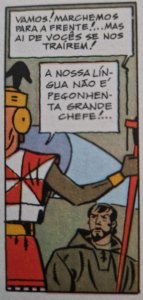
There are a couple of interesting bits in this little “quadrinho” from the graphic novel I’m currently ploughing through. Both the speakers are members of lost races. The chap who looks like a monk is actually a villain and some sort of Prince in the lost continent of Atlantis, while the fella who looks like some sort of inca is a member of some sort of barbarian tribe on the border of Atlantis, but still under the ocean.
Monk-looking guy: Let’s go. Let’s walk on, but woe betide you if you betray is.
Inca-looking dude: Our tongue isn’t poisonous, big chief.
“Aí de você” is obviously some sort of set expression. The main place I can find it is in the gospel of Matthew chapter 11, verse 21, where it’s used in place of the English “woe to you” (that’s a pretty universal translation in the ESV, KJV and NIV). I’ve translated it as “Woe betide you” which is even more archaic but I had a primary school teacher called Mrs Watson who used to say “woe betide you if…” (insert misdemeanor here).
And given the general missionary/indian vibe of the costumes (even though that’s not who they are meant to be) I thought “Língua Peçonhenta” would be something stereotypical like “forked tongue” and I wasn’t far off, but it’s “poisonous tongue”. I would have expected “língua venenosa”, since that’s the usual adjective you’d expect. Good word though!
I recorded my first YouTube video in ages as a way of challenging myself to talk more. Its about O Ano Sabático and it’s not terrible but there are a lot of hesitations and I’ve made some weird word choices in a few places: “aqui” in place of “agora” is particularly egregious. Watching myself like this let’s me see what I really sound like and gives me a way of seeing what I’m doing wrong.
I mentioned glasses in the last post and specifically the “ponteira”, which is the part that loops round the back of the ear. Like a lot of objects, even if you know what the thing itself is called, we don’t often learn the names of the parts. I’ve done bikes and hands before, but this seems like a good excuse to do the same for specs. Specs usually consist of a frame (armação) and lenses (lentes)
You can see a diagram of a pair of glasses and all the little bits and pieces on this (brazilian) optician’s Website, and the vocabulary breaks down like this:
Lente = lens
Aro = the front parts of the frame – the bit that actually holds the lenses. Other uses of this word, not specific to glasses include things like “rim”, “hoop” and “collar”
Haste = arm or spoke – the bit that hugs your face, basically
Armação – the whole of the frame, Aro, Haste and all
Ponteira = earpiece
Ponte = the bridge that links the two halves of the frame above the nose
Plaquetas = the plastic pads that sit on your nose
Charneira = hinge, aka “dobradiça”.
Mola = spring, might be included in the hinge to make it more flexible




 Luso
Luso 