Taking a line through how the previous exam levels have worked, I’m imaging there’ll be a section on the DUPLE Compreensão Oral test that will just be this and then the question will be like:
1 O público…
A) Gostam da música
B) Odeiam a música
C) Estão a pedir uma canção especifica
D) São fãs dos White Stripes que chegaram ao sítio errado.
(answers at the bottom if you want to play at home)
Another mildly annoying example of terrible design here – the PeF online course doesn’t allow enough space in the box to fill in all the missing words. Buuuu
This sentence flummoxed me for two reasons. Firstly because the overall gist didn’t seem to make any sense and secondly the grammar was baffling. I had to ask an expert to explain some it to me.
It’s from Uma Aventura nas Férias da Pascoa, and the lady who’s speaking is exasperated that some kids are making a lot of noise outside her door. The “Francamente!” is there to underscore her disapproval.
Let’s do the grammar first.
So firstly, obviously, we have the usual anglophone confusion of “gente” meaning people but it’s a singular word because of course it is. That’s pretty basic though, so didn’t throw me too badly.
“Pegue” is subjunctive present. Why? Good question. It seems to be a statement about the general qualities of something, nested in a dependent clause, but it doesn’t fit neatly into my subjunctive flowchart, even though it’s recognisably the same kind of sentence structure as sentences that do. I think that’s because “por onde” (“at where”) is doing the job that would normally be done by “que”. [Caveat – I’m pretty sure I’m right about this but didn’t specifically ask so I might be misunderstanding why they’ve used this tense]
And finally, the pronouns, se and lhe right after each other. Lhe means “them” but it is singular because – again – it’s referring to gente, and se is present as an indefinite pronoun*, which is a hard concept to grasp in English. I’ve had a stab at it in this post, but I’m sure it wouldn’t hold up to much scrutiny from an expert.
So if you were to translate it word-for-word in the most literal way possible, the whole sentence is something like “These young people don’t have a place at which one might get hold of them”. Well, that could refer to something that’s so dirty that we’re afraid to touch it for fear of getting our hands dirty, but here it’s referring to people so it must be some sort of expression, right?
The expression “não ter ponta por onde se lhe pegue”, or “estar sem ponta por onde se pegue” or variations of either, seem to be translated as “to be utter nonsense” on bab.la, and I can see it used in roughly the same way in a few places around the interwebs.
What would be an equivalent expression in English? Since it’s talking about getting a hold of something, I guess something like “I can’t get a handle on it” would be pretty close. It’s not an exact equivalent though, since if you “can’t get a handle on” something in English, you’re leaving open the possibility that you just aren’t clever enough to understand, whereas this is more in the direction of “it can’t be understood, because it doesn’t make any sense”.
More than anything else, what impressed me is that it has been ages since I have come across a sentence that has caused me this much puzzlement, and yet this is a book written for children!
Well done, you’ve made it this far. Reward yourself with this music video.
*I has a query about this so here’s a bit of self-justification! First of all, I wrote “impersonal” in the first draft of this which isn’t quite the right word so I’m sorry I got that wrong. “One” is anindefinite pronoun and in very correct, posh english you use it… ahem… or rather “one uses it” as a neutral pronoun when one wants to use a verb in a very general way, without having anyone specific in mind. I think that’s the closest analogue of what “se” is doing here. Priberam defines it as a “pronome indefinido” (4th and 5th definitions here) and this page gives more detail although confusingly refers to it as a partícula (particle) which I think is incorrect. Or at least in english a pronoun isn’t a particle, but maybe portuguese grammarians have a slightly different taxonomy…?
So I think I mentioned I’ve been doing map and flag quizzes in portuguese to try and boost both my knowledge of geography and to familiarise myself with the names of countries in portuguese. One of them is Worldle, which has one daily map for users to guess, and then asks follow-up questions about language, flag, capital etc. Today’s happened to be a country that looked familiar.
I have questions though.
First of all, have the Açores and Madeira drifted a lot since I last checked? What are they doing just off the coast there? Could you swim from Coimbra to Funchal?
But the language round was even weirder. The first language is easy enough, obviously, but the second?
As you can see from the screenshot, I tried Galego and Mirandês as the two other native languages. Actually I think I might have wrong to choose Galego because I think it’s spoken on the Spanish side of the border, but Mirandês has a proper linguistic community in the North-East of Portugal and I think has a claim to be the second language of Portugal. The other two languages given on Wikipedia are Barranquenho and Minderico, neither of which I’d even heard of.
As for non-native languages, I’d probably have guessed English, French or Spanish. There’s been an upsurge in refugees recently (eg from Ukraine – roughly 60000) and economic migrants (probably mainly from other lusophone countries like Brasil and Angola) but I’m pretty sure if you added together the British immig… er sorry “expats” (50000), Americans (10000) and people from various other anglophone countries, plus the fact that the portuguese education system seems to be doing an amazing job of teaching English as a second language, English must be pretty high on the list. Then there are quite a few Italian, French and Spanish migrants, and a few years ago there was a massive uptick of venezuelans, descendents of Portuguese migrants, returning home to escape the benefits of that socialist utopia, so I ended up guessing Spanish as my third and final option.
The answer they give is Estonês. I was estonêsed… er… I mean astonished, but I didn’t want to write it off so I did a bit of research to see if there really was a huge Estonian diaspora in Portugal.
Nope. Estonians are 86th on the list of immigrants by country according to the chart on this page. So what’s going on?
My first guess was that the person who made the pages picked from a list of languages and espanhol and estonês were just next to each other alphabetically, so maybe he just clicked on the wrong one. However, my brother does the same quiz in English and he was surprised to see Estonian pop up as the second language of Portugal too. Estonian and Spanish definitely aren’t next to each other in an alphabetical list of English language place names, so my theory looked shaky.
Digging further, languageknowledge.eu reckons 1.89 percent of the population of Portugal speak Estonian, which is the same percentage as the quiz gives. Does 1.89% sound plausible? The population of Portugal is about ten million and Estonia less than one and a half million, so for this to be true you’d need about fifteen percent of the population of Estonia to emigrate to Portugal and there would be about 3 or 4 times as many of them as there are brits. Hmmm… 🤔
Global Estonian, which bills itself as a global forum for Estonians around the world, gives the figure as 77 Estonians lifting in Portugal. That seems awfully precise, but I’d bet the true number is a hell of a lot closer to 77 than 190,000.
So how did they arrive at such a huge number? Maybe at some point it was 190, and some data entry clerk entered that in a database, not noticing that it said “population in thousands”, and that single insignificant error got picked up by other sites and eventually incorporated into the model answers for the quiz.
I think the lesson here is that sloppy data seeps out and pollutes everything downstream of where it’s keyed in. This isn’t quite as catastrophic in its effects as it could have been, but it’s an interesting little lesson in data pollution. Imagine a similar error creeping into some database used for planning or making policy. You could end up with serious miscalculation rather than just an annoyed quiz contestant.
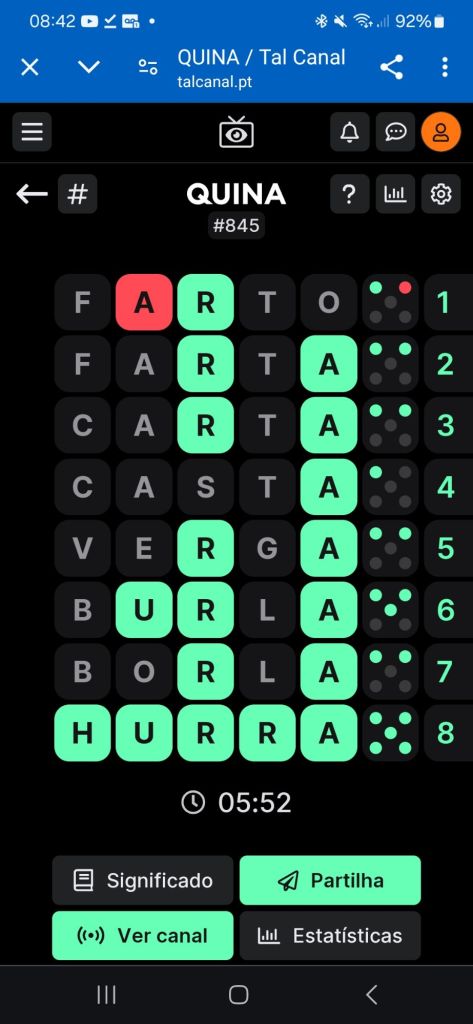
… Some of the words it comes up with are a bit iffy. This, for example, took several minutes of just trying random combinations of letters in the two spaces I had left. It just means “hurrah”, apparently, but would you call “hurrah” a word? Hm.. 🧐
Yes I always start with Farto because I’m childish
I got curious about this because it was covered by Amor Electro on one of the albums I listened to a few weeks back, and although I knew most of the songs they’d done, I’d never heard of this or even of the artrist who performed it originally so I sought it out. Disappointing, to be honest. It feels very dated and uninspiring. I actually liked the cover version better.
Portuguese
English
Há luz sem lume aceso Mas sem amar o calor Há flor de um fogo preso Há luz do meu claro amor
There is a light without a flame But without loving the heat There is a flower of a captive fire There is a light of my clear love
Há madressilvas aos pés E águas lavam o rosto Dedos que tens em resvés Ó meu amante deposto
There are honeysuckles at your feet And waters wash your face Fingers you have, so close Oh my former lover
Não foram poemas nem rosas Que colheste no meu colo Foram cardos, foram prosas Arrancadas do meu solo
There were no poems or roses That you picked in my lap They were thistles and prose Uprooted from my soil
Porque tu ainda me queres O amor que ainda fazemos Dá-me um sinal se puderes Sejamos amantes supremos
Because you still love Yje lobe we still have Give me a signal if you can Let’s be supreme lovers
Será sempre a subir Ao cimo de ti Só para te sentir
It wlll always be rising Above you Just to feel you
Será no alto de mim Que um corpo só Exalta o seu fim
It will be above me Because just one body Exalts at its end



 Luso
Luso 