Realness
This is the song Mariza sang as an encore at the concert. It’s more motivational-poetry-ish than I’m really comfortable with, but that’s OK, each to their own, and a lot of people really seem to like it. There are a few versions on youtube but I think I like this live, acoustic version better than the official video (which is definitely trying too hard imho)
| Hoje a semente que dorme na terra E que se esconde no escuro que encerra Amanhã nascerá uma flor Ainda que a esperança da luz seja escassa A chuva que molha e passa Vai trazer numa luta amor | Today the seed that sleeps in the earth And that hides in the enclosing darkness Tomorrow a flower will be born Even though the hope of light is scarce The rain that wets and moves on Is going to fight to bring love |
| Também eu estou à espera da luz Deixou-me aqui onde a sombra seduz Também eu estou à espera de mim Algo me diz que a tormenta passará | I’m waiting for light too He left me here where the shade seduces I’m waiting for myself too Something tells me the torment will pass |
| É preciso perder para depois se ganhar E mesmo sem ver, acreditar É a vida que segue e não espera pela gente Cada passo que demos em frente Caminhando sem medo de errar Creio que a noite sempre se tornará dia E o brilho que o sol irradia Há-de sempre me iluminar | You have to lose so you can win And even without seeing it, believe it It’s life that goes on and doesn’t wait for people Every step forward that we take Walking without fear of going wrong I believe the night always becomes day And the light the sun gives out Will surely always shine on me |
| Quebro as algemas neste meu lamento Se renasço a cada momento Meu destino na vida é maior | I’m breaking the handcuffs in this my lament Of rebirth in every moment My destiny in life is greater |
| Também eu vou em busca da luz Saio daqui onde a sombra seduz Também eu estou à espera de mim Algo me diz que a tormenta passará | I too am in search of the light I’m getting out of here where the shade seduces I’m waiting for myself too Something tells me the torment will pass |
| É preciso perder para depois se ganhar E mesmo sem ver, acreditar É a vida que segue e não espera pela gente Cada passo que demos em frente Caminhando sem medo de errar E creio que a noite sempre se tornará dia E o brilho que o sol irradia Há-de sempre nos iluminar | You have to lose so you can win And even without seeing it, believe it It’s life that goes on and doesn’t wait for people Every step forward that we take Walking without fear of going wrong I believe the night always becomes day And the light the sun gives out Will surely always shine on me |
| Sei que o melhor de mim está pra chegar Sei que o melhor de mim está por chegar Sei que o melhor de mim está pra chegar | I know the best of me is yet to come I know the best of me is yet to come I know the best of me is yet to come |
I keep learning new words from Quina. They are mostly useless, obscure words, but I was interested that there’s a feminine form of Touro because I always thought Touro was the masculine form of Vaca. Maybe that’s a hangover from English though, where the feminine is the default because you learn cow first, as a child, and only later find out that there’s a daddy cow called a bull, who is always in a bad mood, and that people in other countries like to wave red capes at him for reasons that are difficult to fathom.

Anyway Toura (or “toira”, because it’s one of those words that can be spelled with an ou or an oi) refers to a young or sterile cow. It can also be an irascible woman (informally – and I’ve no idea how someone would react if you called them that so would not recommend) or a handled cooking pot (tacho) but only in some regions.
So if there’s a feminine form of Touro, is there a masculine form of Vaca? No, no there is not, not even in 2024, but as soon as the Americans find out about this they’ll have an entire academic department writing papers about it, I’ve no doubt.
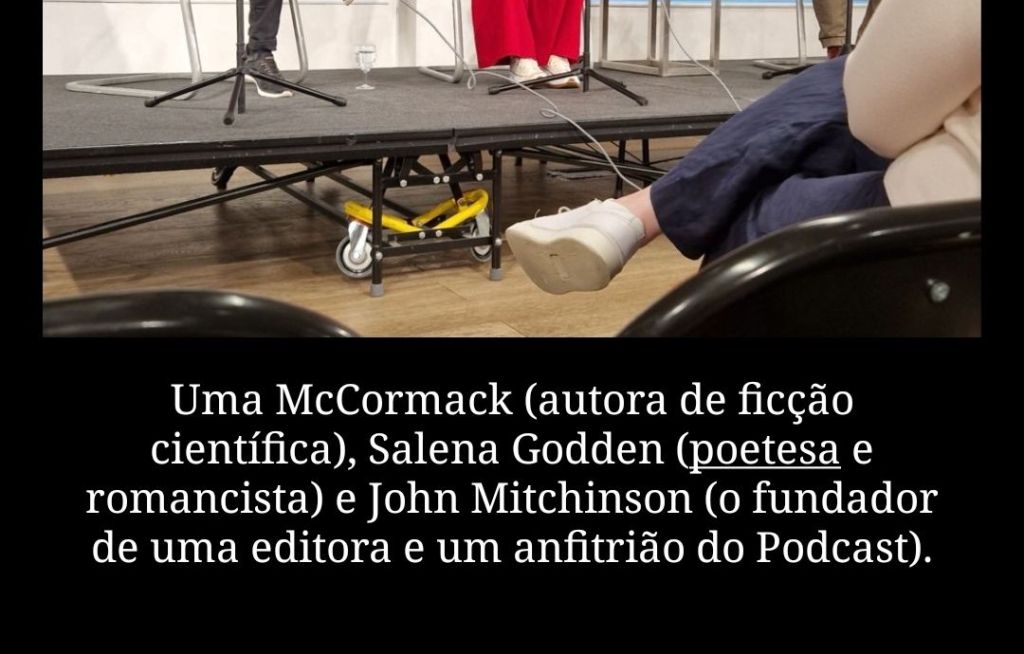
Like Alexander Fleming failing to keep his room tidy, William Webb Ellis getting away with handball or Christopher Columbus getting lost on the way to Japan, sometimes we fuck up, but the result turns out to be a kind of victory. Apparently I did this in yesterday’s post. I referred to Salena Godden as a “poetesa” thinking it was the feminine form of poet. It isn’t.
But it doesn’t matter. Why? Well, as you probably already know, poeta just means poet, and is masculine by default despite the -a ending. The equivalent of poetess is poetisa. In English almost nobody says poetess and it sounds a bit antiquated because we’re moving to a world where a job is a job and doesn’t need to change with the gender of the person performing it. Portuguese is a more gendered language generally, and if pens, TVs and hats can have gender, maybe it seems less obvious why gender has to be eliminated in words that refer to people. As a result, poetisa persists and is still used. But even though it is less of an endangered species that poetess is, don’t be surprised if you meet a poetisa who describes herself as uma poeta because why not?
But why is poetesa not a mistake then? I was baffled when I was told it actually sounded better than the right word, so I dug around, and I think it’s because of this. Esa is a suffix from latin which, when used as part of a feminine noun designates status and dignity. Well that’s good then. I don’t really know Salena Godden’s work but I bought a copy of her book Mrs Death Misses Death to read later and she signed it and I’m happy to have accidentally given her a respectful title!
Cuca Roseta is coming to play in London soon. It really has been an excellent year for portuguese entertainment here. I’m sure there are a lot of fair-sized towns in Portugal that haven’t had as much choice of big name acts visiting them as we have. Anyway, I’d never heard of her, as far as I remember, but I looked her up and found one of the craziest song titles ever: Call the FBI of the Heart. It’s mid but I thought I’d try and translate it. It didn’t make me like it any more, I’m afraid.
| Português | Inglês |
|---|---|
| Tirem-me às palavras o sentido Se é p’ra ser sonante ao ouvido Do que é certo ou do que tem mais valor Tenso assalto aos meus neurónios De uma espécie rara de demónios E que ninguém saiba que se chama amor | Take the meaning of my words If it sounds better to your ear Of what is right or has more value Tense assault on my braincells by a rare kind of demon And that no-one knows it’s called love |
| Tirem-me as palavras à cigana Que de faca e de mão na trama Saem da boca sem lhe dar a permissão Eu bem que me tento comedir Penso em trocá-las ao sair Mas sou sempre ultrapassada p’la emoção | Take my words from the gypsy Who, with knife and a hand in the plot come out of her permission I’m trying to contain myself I’m thinking of swapping them on the way out But I’m always overtaken by emotion |
| Chamem o FBI do coração Façam sindicato da paixão Tragam-mе as algemas para a boca Estou a ficar louca Levem-mе para a prisão da Cuca | Call the FBI of the heart Make a love syndicate Bring me handcuffs for my mouth I’m going crazy Take me to Cuca-prison. |
| Tirem-me as palavras que desato Quando chegas perto e eu relato Digo tudo o que não queria dizer Venho a mastiga-los pela boca De uma outra eu que é meia louca Que faz sempre o que eu não queria fazer | Take my words that I untie When you get close and I report I say everything I didn’t want to say I come to chew them in the mouth Of another me who’s half crazy Who always does what I didn’t want to do |
| Ao meu lado Dorme a tristeza Gota a gota dessa vil certeza De não te poder tirar do coração | At my side Sadness is sleeping Drop by drop of this criminal certainty of not being able to take it from my heart |
| Chamem o FBI do coração Façam sindicato da paixão Tragam-me as algemas para a boca Estou a ficar louca Levem-me para a prisão da Cuca Chamem o FBI Chamem o FBI Chamem o FBI Do coração | Call the FBI of the heart Make a love syndicate Take these handcuffs off my mouth I’m going crazy Take me to Cuca-prison. Call the FBI Call the FBI Call the FBI of the heart |
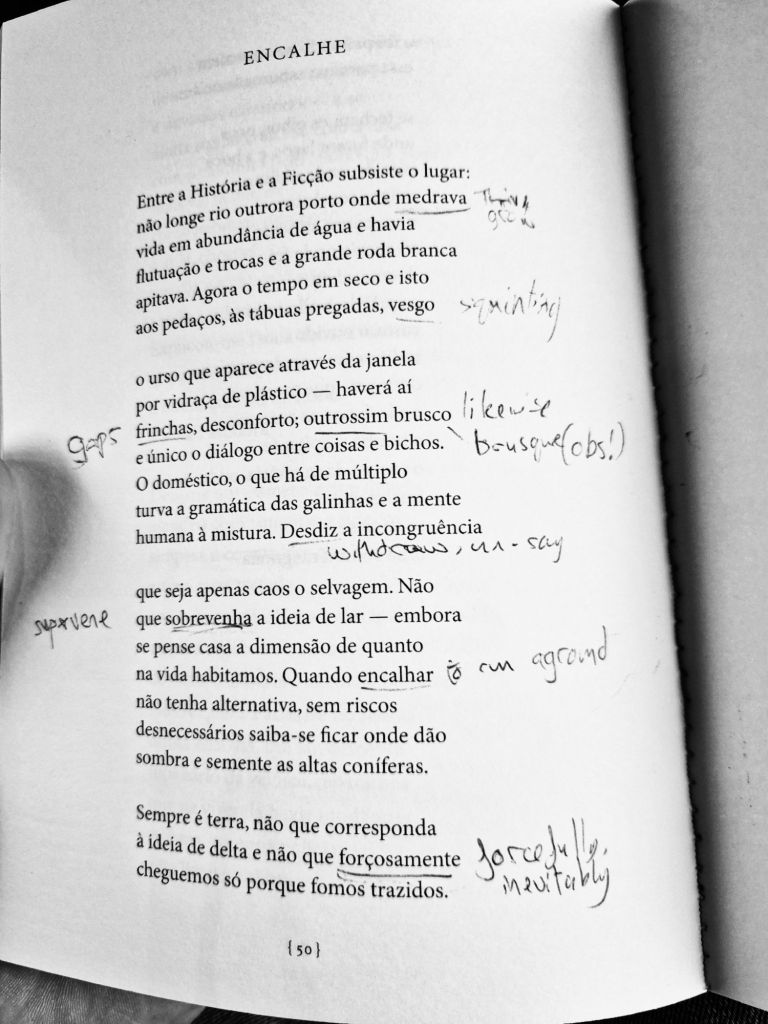
It’s Atirar Para o Torto by Margarida Vale de Gato. Just about every page brings me a whole crop of obscure vocabulary. It makes it hard to get absorbed in the flow. I underlined the mysterious strangers on this page because there were so many I couldn’t keep track. Some are obvious (“forçosamente”,”desdiz”), others I’d seen before but couldn’t remember (“frincha”) and others are total mysteries (“vesgo”). Outrossim looks like it’s combining ‘outro’ and ‘assim’ but it’s “likewise” (another one like that) rather than what I thought at first: “otherwise” (like something else entirely)
Even the title of the book was a mystery: “Atirar para o torto”. Torto can mean someone who has a physical deformity of some sort – they’re lame or cross-eyed – as in Que Mulher é Essa by A Garota Não, so I wondered in a vague way if she was taking about some sort of persecution of disadvantaged people. That wouldn’t be a great title for a poetry book though. “Para o torto” means something like “wide of the mark”, so if you threw something at me but your aim was way off, you could say you had thrown “para o torto”. So the book means something like “Shooting and Missing”.
Edit – I’ve been re-listening to old episodes of Say It In Portuguese and the word Torto comes up in this episode, so if you want to know more, have a listen.
Literally can’t get a word here.
I think she says microfone in the middle there but even that I’m not sure about.

I don’t really know what the rule is here, so was expecting at least one to be knocked back but got them all right first time. I suppose it’s one of those things where reading books just makes it “feel right” in a particular order.
Having tried to write a sonnet the other day, I felt like trying a different poetic form. The Clerihew is something of a lost art form but I was obsessed with them for a few weeks in about 1998. My Favourite was
The people of Spain think Cervantes
Equal to half-a-dozen Dantes:
An opinion resented most bitterly
By the people of Italy.
And I can’t do a direct translation, so I decided to have a crack at recreating the spirit of the thing in Portuguese. I know some of the words are in a weird order, but I hope I haven’t stretched the grammar too far and it’s allowable within the poetic form…
Camões, segundo os portugueses,
Vale mais, uma dúzia de vezes,
Do que Shakespeare, o que provoca uma exclamação
De qualquer cidadão da minha nação.
I crowdsourced an answer to that question and one of the two respondents replied in the positive at least so I’m calling that a victory. Both suggested I sort out the metre, but Clerihews are allowed to be rambling and uneven so I haven’t even really tried to do that. If you’re curious, you could do worse than check out u/urinaRabugenta’s answer under my post here, for a more professional version. It’s better in every way, especially the second line (which is a real dog s breakfast in my version). The only thing I don’t like about it is rhyming – ção with – dão in the last line. Apart from that, it’s a banger! Notes underneath explain the reason for the changes. It’s good stuff.

Quite a false friend, this. It looks like it ought to mean the ability to hold your pee in, but no, it means a salute.

OK, OK, it means the other thing too, and covers a range of ideas in the general area of self-control, but it also means a salute.
 Luso
Luso 