At the time of writing, Conjuga-me.net is offline with some message about being suspended. I’m horrified because it’s my go-to site for verb conjugation.
Luckily, my teacher has told me of an equivalent called conjugacao-de-verbos.com which seems, if anything, even better – but terrifying – because it has ALL THE TENSES not just the main ones. But I will miss conjuga-me if it is gone for good. It’s a very tidy little site and I am used to its layout and it’s colour scheme.
Ouvi o Hugh Laurie dizer que na sua idade, ler livros é como encher uma banheira quando o tampão não está no ralo. Estou de acordo com ele (or “concordo com ele”). Na minha idade também, derramo português dentro da minha cabeça mas tudo drena depressa.
*suspiro*
…which, for those of you who don’t speak Portuguese means…
I heard Hugh Laurie saying that at his age, reading books is like running the bath with the plug out of the plughole. I agree with him. At my age too, I pour Portuguese into my head but it all drains away (quickly)
*sigh*
The word “quickly” wasn’t part of my original intent but both people who corrected it seem to have thought that’s what I was saying so I’ve left it in.
Thanks again to Sophia and also Rubens for their help with the corrections.
I just sat in on a taster webinar for Lindsay Dow’s Successful Self Study course. It was really interesting and her enthusiasm is definitely infectious. It sounds like a course I could have used a couple of years ago when I was struggling to do anything at all. I’m sort-of in the zone now, but I can definitely see the benefit of it for new starters. If you need a motivating force to get you on the right track you might like to take a look (*points* at the link in the first line).
I’ll jot down my answers to the quiz questions here so I don’t forget.
A big tip to boost my language-learning self-confidence: try not to get hung up on one point. I think in my lessons I often spend time making sceptical noises if I don’t understand something, as if the entire nation of Portugal is playing some elaborate practical joke on me. While I haven’t completely ruled out this theory, I can see how that is probably a bit unnerving for the teacher and creates awkward pauses that don’t help anyone.
Three things I can do to achieve this:
Smile!
Do some offline study before the lesson to get my mental juices flowing.
Jot down distracting questions to research later in a grammar book so that I don’t get off the point during valuable conversation time.
Four tips for working around words I don’t know:
I thought I knew a few tricks already but there are always more, so
Learn the phrase “é uma coisa que…” (“it’s a thing that…”) so you can describe the thing you’re trying to find a word for.
Mime the thing (assuming the person you’re talking to can see you!) and ask what it’s called
Say the opposite (e.g., if I don’t remember the word “barato” say “não é caro” instead)
Read “We’re Going on a Bear Hunt” (Hm, I’m not sure about this one)
There were some other hot tips too, both from Lindsay and the other students, but I won’t give you too many spoilers – go and have a look.
One of the things that’s keeping me motivated to work every day is the knowledge that I have an exam in May. The standard model for competency in European languages is known as The Common European Framework of Reference for Languages and the Portuguese variant of it is known as Centro de Avaliação de Português Língua Estrangeira (CAPLE). It has six stages, corresponding to the main framework’s A1, A2, B1, B2, C1 and C2. I am taking the B1 exam (known as the Diploma Elementar de Português Língua Estrangeira) at a centre here in the UK (sign up here if you’re interested). It’s a good way of increasing motivation and of course of proving to the world that I really am quite good at Portuguese, and not just braggin’. The trouble is, yesterday I did a test paper based on the A1 exam (that’s the easiest level of all) and I couldn’t do it at all. Specifically, I couldn’t tune in to what was being said. I’m a bit worried now. I need to boost my confidence levels somehow.
Partly, I suppose, I missed out on a lot of the basic school exercises in my rush to get ahead into complex sentences. For example I had never tried to write a letter or email in Portuguese. There’s a tutor who has written a helpful page about it though so that was a good place to start. Maybe I need to work through some more things like that and get some experience under my belt. Back to the books…
In search of amusement, I made my own list of vocabulary in Memrise, using words relating to running, training and general gym stuff. It’s here if you’re interested but you’ll need to be a Memrise user to see it. I wrote the last blog post – O Alarde – using the same list.
Fiquei feliz de encontrar o livro audível de Amor de Perdição de Camilo Castelo Branco, disponível de fazer o download gratuitamente em Librivox ontem. Librivox é um projecto voluntário para narrar vários livros de domínio público e distribui-los na internet. Há também outras obras Portuguesas, incluindo Os Lusiadas mas parecem narradas por Brasileiros, assim evito os seus sotaques pelas razões habituais. Espero ouvir isto cedo!
O Comentário em Librivox diz:
Amor de Perdição é uma das obras mais marcantes de Camilo, um dos mais importantes e proliferos romancistas portugueses. Inspirado nos amores de Romeu e Julieta, Camilo conta-nos a história do amor proibido de seu tio Simão, de intrigas, crimes e desespero. Mas a história relata-nos também o seu próprio sofrimento, já que Camilo a escreve na Cadeia da Relação do Porto, onde está preso por um amor proibido
…or in English…
I was really pleased to come across a free download of the audiobook of Love of Perdition* by Camilo Castelo Branco on Librivox the other day. Librivox is a voluntary project to record audio versions of public-domain works for distribution via the internet. They have a few other Portuguese works too, including The Lusiads but they seem to be recorded by someone in Brazil so I’m avoiding the accent for the usual reasons. I’m looking forward to this though!
The Librivox blurb says:
Love of Perdition* is one of the most remarkable works of Camilo, one of the most important and prolific Portuguese novelists. Inspired by the loves of Romeo and Juliet, Camilo recounts the history of the forbidden love of his uncle Simão, of the intrigues, crimes and despair. But the story tells us also of his own suffering, because Camilo wrote it in the Cadeia da Relação in Porto, in which he is imprisoned for a forbidden love.
*=I believe it’s known as “Doomed Love” in the standard translation, actually.
My Portuguese Teacher, Sophia, has a blog now, so if you’d like to get slightly more authoritative views on the language, you could do a lot worse than to pop over there and have a look.
It’s always a good idea to have some tricks up your sleeve for learning languages when you don’t feel like it, when you want to increase the density of [insert name of language here] in your life, or when you just want a change of pace. Here are a few of my favourites:
Trivia
I found it pretty hard to find good apps for learning European Portuguese, but it’s relatively easy to find good quiz apps and many of them have other language settings. I have a copy of Trivia Crack which I’ve set on Portuguese so I can enjoy farting about playing games and still be learning new words, phrases and pop culture references and (crucially) facts about Brazilian football. It has its drawbacks of course: most of the questions are written by Brazilians so you get quite a lot of Brazilian grammar in there, but still, it’s more educational than Angry Birds.
If you’re feeling feisty, there’s even a “translate questions” feature that lets you translate Portuguese (or whatever) questions into English.
Change the Way You Use The Web.
If you spend a lot of time online (ha ha ha, sorry, I’m kidding – obviously you do! It’s the twenty-first century and you probably haven’t left the house in weeks!) you can massively increase the amount of language in your life by tweaking the settings on your most-used websites. The obvious one for me is my Google Account settings, which affects all my search results, plus the menus in Google Chrome, names of folders etc in Gmail, spellcheck in Google Docs, names of days and months in Google Calendar and half a dozen other things.
I’ve also changed twitter, but that doesn’t do much except teach you some stupid pretend words like “tweetar” (shouldn’t that be “pipiar”???). I daresay if you use Facebook you could get some mileage out of changing the language settings in that. I would love to change Windows and MS Word too but that’s surprisingly hard to do.
Memrise
Memrise is really the only dedicated language-learning app worth having. What makes it different from other apps is that it keeps track of the words you’ve learned and returns to them a short time later, to jog your memory so that they really stick. There’s some science behind it apparently. I dunno. It works pretty well though.
The decks are made by users, so they vary in quality. Some are mildly irritating. For example, they will count something as wrong because you used a lower case letter instead of a capital, then in the next slide you’ll use a capital and it’ll mark it as wrong because now it wants a lower case. That doesn’t stop it being a kick-ass language-learning tool though. I usually have a go on it while I’m brushing my teeth at night and while I’m eating my breakfast in the morning.
As with most things, make sure you specify European Portuguese, not Brazilian.
Podcasts
If you’ve got some mindless task to perform, don’t listen to the new Kanye West album, listen to someone speaking your chosen language instead. Portuguese (as opposed to Brazilian) podcasts are hard to come by but you can find them if you look hard enough. Some of my favourites are:
Practice Portuguese These are produced by a native Portuguese guy called Rui and his Canadian friend Joel. They’re explicitly aimed at developing listening skills for the new learner. Unfortunately it doesn’t come out quite as regularly as I might hope, so I don’t think I can recommend you subscribe to the premium version [* UPDATE here *]
Caderneta De Cromos A series on Rádio Comercial about eighties pop culture, covering Star Trek, Pat Benatar, Ghostbusters, Space 1999, Rocky, Pac Man… What’s not to like?
O Novo Normal Bite-sized morsels of interesting things – you know, productivity tips, brain science and that sort of thing. Possibly not reliable but certainly interesting as a five-minute listen while the kettle boils.
Revista De Semana This is a podcast from RDP International, broadcasting to the Portuguese “Diaspora” and it’s interesting to me because it deals with the issues affecting Portuguese people around the world. The consulate in London comes up a lot (not in a good way) and recently there have been issues with some countries in Europe banning Portuguese children from speaking the language in the playground.
You could also look for “Grande História Universal das Traquitanas” which I’ve heard is very good but it doesn’t seem to be downloading when I try [*Another update: I’ve found a way of getting them: you have to open the page in Internet Exploder, not Chrome. .You still can’t subscribe, but you can download the episodes individually, so that’s my listening for tomorrow sorted out!*]
A lot of podcasts are quite hard to find in iTunes but I’ve found some interesting nuggets by looking on the websites of Portuguese broadcasting companies. Here’s Rádio e Televisão de Portugal’s for example. There is usually enough variety that you’re bound to find something that suits your interests and ability level.
Taking a left-turn at the traffic lights, there are some good, inspirational podcasts for language-learners in general. Have a look at “Actual Fluency” or “Creative Language Learning” in iTunes, for example. Personally, I can only take this kind of thing in small doses, but a little of it now and again is good. It reminds you that you’re not alone and it gives you some ideas from the hardcore language-ninjas.
Music
If podcasts aren’t your thing, there’s always music. I’m a bit ambivalent about music as a learning method. A lot of people recommend it, including my wife, but I often find it’s like watching as a stream of syllables rushes by at speed. I think unless you’ve taken trouble to read the lyrics written down beforehand and compare with a translation, it’s difficult to pick the words out and appreciate them. Of course, you can still enjoy the music, but understanding the music adds a whole other dimension.
If there’s one thing Portugal has lots of, it’s music. I’ve already mentioned (here) my favourite song at the moment is by Deolinda. I also loves me some Mariza
Some of the old Fado music is pretty powerful, especially if you get the right singer, and singers don’t get much more right than Amália Rodrigues
Label Your House
I mentioned, last week, posting post-it notes all over my house with the names of things on them. That’s quite a cleaver way of bumping up your vocabulary a bit without really trying, although with hindsight I wish I’d written the words in larger letters with a big fat marker, as I find myself peering at the post-its instead of having the words thrust in my face.
Lindsay Does Languages has a brilliant variant on this theme. I came across it earlier today and decided to incorporate it in my life as soon as I get a free minute (2019, I think). While you’re at it, have a look at some of the other articles on her site. They’re pretty good fun.
Films
If you’re clever enough to understand films made in your target language, that’s a great way to learn more. Me, I’ve looked at a few – like “A Costa Dos Murmúrios”, “Capitães de Abril” and “Ossos” but I found them too hard to follow.
Easier fare would be an English-Language film you’re seen before, dubbed into your target language. That usually means children’s animated films, since nobody ever dubs live-action movies. If you’re like me and learning Portuguese, try and check that the actors doing the voice-overs aren’t Brazilian. The last thing you want is all that Eejy Beejy Beejy thing that Brazilians do. We have three dubbed films in the house (*points* at the picture at the top of this section) and it’s good because my daughter likes watching them too. Turn on English subtitles if you are very new to the language, or Portuguese subtitles if you just want written clues to help you disentangle the words.
So once you’ve picked your book, what can you do with it? Well, as I see it, there are three styles of reading in another language, and I vary them depending on what I’m reading and what mood I’m in:
Slow Reading
This is the hardcore, grind-through-it-with-a-dictionary option. The aim is to translate every word and understand every sentence to know exactly what is being said and what tense it’s being said in. You’ll need a good dictionary for this of course, and you’ll need a lot of patience, usually, or at least you will if your vocabulary is as pitifully limited as mine is.
If you are a fan of kindles, this method becomes a lot easier because of course it has a built-in dictionary so you can just highlight the word and it’ll tell you the meaning. I’m not a fan of Kindles but I’ve used this and I can see the attraction.
Fast Reading
The aim with this one is only to practice your accent and your reading skills: read the text out loud and don’t worry too much whether or not you can understand it. Have someone listen to you and correct your pronunciation. Obviously the drawback of doing this with a book you’re actually trying to follow is that it become a black hole in the narrative, and you’ll have to go back and read it properly if you want to retain your grip on the plot, but if you’re reading a book of short texts like the running manual I mentioned in part 1, it won’t matter too much if you just read one section for phonetics, especially if it’s covering something you already know.
Half-and-Half Reading
I saved the best for last. I sometimes like to read the text at a sort of half-and-half pace, without looking up any of the words, but slow enough that I can follow most of what is being said. I use it as practice for understanding the language as a whole, following enough of what’s being said to draw out the general gist. I only really use a dictionary if there is one word that comes up over and over again, and seems key to the text, but other than that I just skip over the gaps in my understanding. It’s a bit like watching actors on stage under a strobe light. There are gaps in what you can see, but your mind fills it in. I don’t think I could read a whole novel like this, but at times it can be quite thrilling and a good alternative to the hard work of looking up every unfamiliar word, and it forces you to think of words in their wider context rather than as individual dictionary-entries. In short, it’s the nearest thing I can really get to “Thinking in Portuguese” producing a stream of language and trying to process it without really having time to translate it all.
Want to know more? If you’ve read this post and the preceding one and you are hungry for even more reading tips, there’s an article on FI3M about reading that has some interesting tips you could look at. Have a look here. And when you’re feeling suitably inspired, go and find out…
Where to Get Books in Portuguese
Amazon have a few of course, but they’re gits who don’t pay their taxes or their workers. Foyles has a better selection and, if you’re in the UK they’re pretty much just as fast
 I found it pretty hard to find good apps for learning European Portuguese, but it’s relatively easy to find good quiz apps and many of them have other language settings. I have a copy of Trivia Crack which I’ve set on Portuguese so I can enjoy farting about playing games and still be learning new words, phrases and pop culture references and (crucially) facts about Brazilian football. It has its drawbacks of course: most of the questions are written by Brazilians so you get quite a lot of Brazilian grammar in there, but still, it’s more educational than Angry Birds.
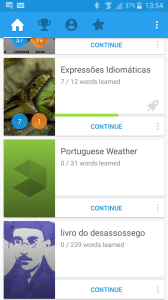 Memrise is really the only dedicated language-learning app worth having. What makes it different from other apps is that it keeps track of the words you’ve learned and returns to them a short time later, to jog your memory so that they really stick. There’s some science behind it apparently. I dunno. It works pretty well though.
 If you’re clever enough to understand films made in your target language, that’s a great way to learn more. Me, I’ve looked at a few – like “A Costa Dos Murmúrios”, “Capitães de Abril” and “Ossos” but I found them too hard to follow.
 Luso
Luso 