I noticed this in the book I’m reading, principally because it has a version of a verb, aviar, which had come up in a lesson. Aviar is despatch, prepare, generally get something ready to be handed over, say to a customer. So I feel like I should be able to take the phrase “ver se te avias” and translate it back into something that makes sense: “see if you prepare it” maybe, but the literal translation doesn’t do it justice because it’s a set phrase and it means something more like “a rush order” or “a high priority”. The Instituto Camões includes it in its list of expressions, so presumably it’s fair game for a CAPLE exam and therefore worth knowing.
É um ver se te avias Significado: Temos de acelerar o nosso desempenho para cumprir uma determinada tarefa o mais rapidamente possível.
Desde a última semana que ando a ver versões desta piada por todo o lado. Um bugalho é um inchaço das células de uma árvore que parece um fruto mas, na realidade, é resultado de doenças ou de parasitas. O puto na imagem chama-se Sebastião Bugalho, um inchaço de células humanas que parece um jornalista mas na realidade a sua fama é resultado da política e de ser o cabeça-de-lista da Aliança Democrática às Eleições Europeias em Junho. Não sei nada sobre este menino mas não importa muito porque o blogue de hoje não é uma biografia dele.
O humor deriva da expressão “trocar alhos por bugalhos” ou “confundir alhos com bugalhos” que significa “confundir duas coisas muito diferentes”. Por exemplo: “Coloquei a colher na lixeira e o saquinho de chá na máquina de lava-loiça. Estou a confundir alhos com bugalhos!” Sendo assim, quando o rapaz fizer um erro em qualquer situação os seus críticos terão uma piada batida na ponta da língua.
Antes de terminar, fica a dica, “bugs com alho” não tem nada a ver com Sebastião Bugalho. É uma receita inventada por Bill Gates. Ouvi falar dela num Podcast americano, portanto deve ser verdade.
Olha, duas piadas num só blogue. Que pechincha!
I hope to have the oppotunity to write about this guy again in the future so I can call the sequel “Electric Bugalho“. As far as I can gather he’s a not very nice bloke, and the trouble with young, charismatic but not very nice people is that you suspect they have a long career of villainy ahead of them, so please don’t take the light-hearted tone of this as an endorsement if he starts committing atrocities 5 years from now or whatever.
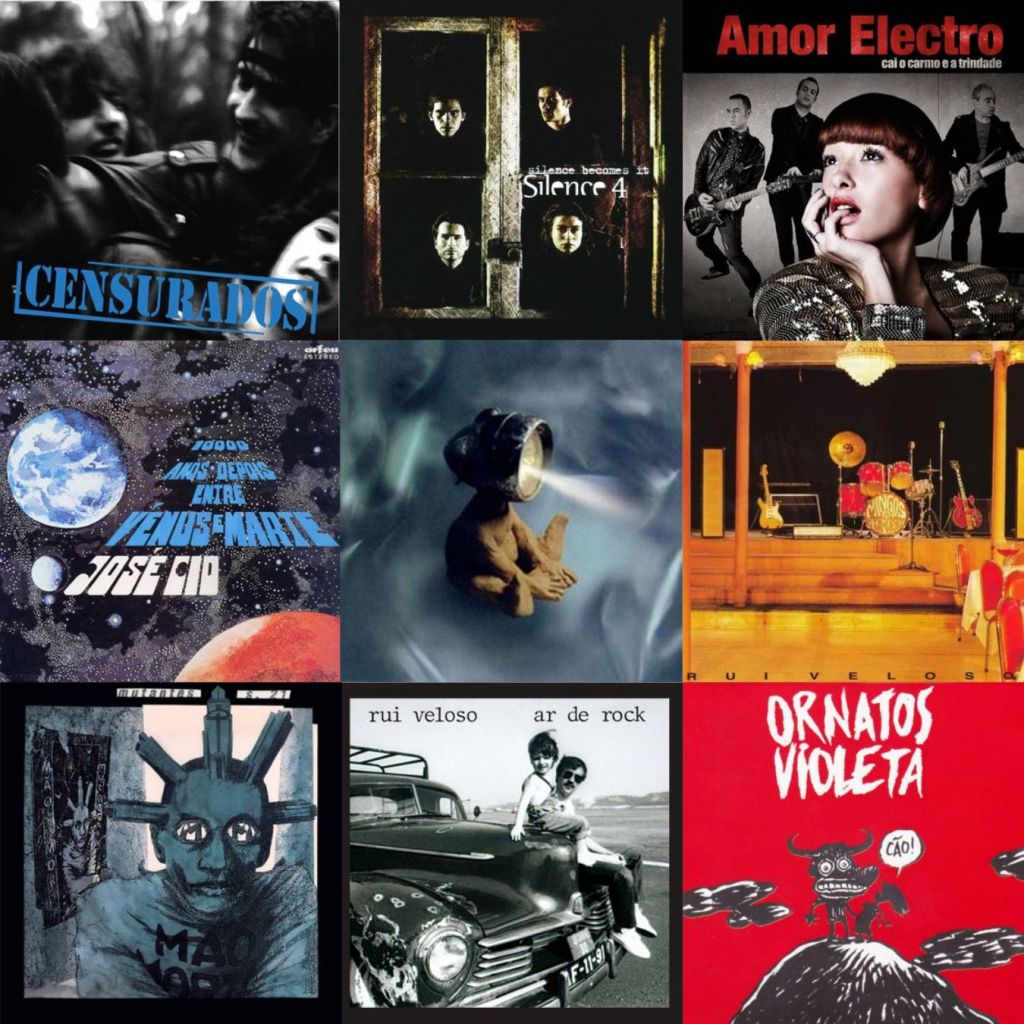
Li uma conversa no Reddit sobre os melhores álbuns de Rock portugueses. O “OP” (a pessoa que fez a pergunta, na lengalenga daquele site) colocou esta colagem no topo do texto para ilustrar alguns candidatos. Muitos escolheram opções da lista, mas outros sugeriram outros discos. Gosto de encontrar novas bandas, portanto decidi ouvi-las todas para avaliar quais são os diamantes entre os calhaus*. Além de quanta loiça é que partem, vou dar uma avaliação sobre quão fácil é cada um para um estrangeiro ouvir as letras. Somos estudantes, não é, portanto isso importa muito!
Censurados – Censurados
Este disco lembrou-me da obra dos Stiff Little Fingers. O ritmo da música é rápido e agressivo, como nos primeiros anos do movimento Punk. Foi lançado em 1990, quando aquele género de música estava prestes a fazer um ressurgimento com bandas como os Green Day, os Offspring e os Blink-182 a nascer nas vésperas da década de 1980 e os primeiros anos da década de 1990. As canções são interessantes para quem gosta do Punk e, apesar do cantor gritar sempre, não é assim tão difícil entender as letras. Depende da canção mas, na verdade, é mais fácil do que dezenas de bandas anglófonas!
Qualidade ⭐⭐⭐
Compreensível? ⭐⭐⭐⭐
Silence Becomes It – Silence 4
Tenho de desqualificar este disco porque quase todas as faixas se cantam num idioma estrangeiro chamado “inglês” que ninguém sabe falar. É uma pena, a sério, porque a música é boa. O género é rock/pop, muito bem realizado. Tocam uma versão de uma canção de Erasure, o que nos dá uma pista sobre os artistas que influenciaram a sua música, e uma das duas canções portuguesas é uma colaboração com Sérgio Godinho.
Qualidade ⭐⭐⭐⭐
Compreensível? 💩💩💩💩💩
Cai o Carmo e a Trindade – Amor Electro
Esta é uma escolha esquisita porque acho que é composto principalmente por covers. Reconheci o “Barco Negro” (de Amália), “Capitão Romance” (dos Ornatos) e “Estrela da Tarde” (de Carlos do Carmo) e acho que Sete Mares também é um empréstimo dos Sétima Legião. Sem fazer uma pesquisa, apostaria que não são os únicos exemplos. A cantora canta bem, e a música é muito suave. Fez-me pensar em várias bandas esquecíveis dos anos noventa. É perfeitamente agradável mas não me agarrou a atenção.
Qualidade ⭐⭐⭐
Compreensível? ⭐⭐⭐⭐⭐
10000 Anos Depois Entre Vénus e Marte – José Cid
Sem dúvida, este tem o melhor título de todos! E uau, esta escolha é fora da caixa. O disco foi lançado em 1978, na época do álbum conceptual. Lembrou-me álbuns como “Close to the Edge” dos Yes, a banda sonora do “Jesus Christ Superstar” e…. Hum… Ouso mencionar o “Rocket Man”? Acho que José Cid é comparado muitas vezes a Elton John mas ele acha-o uma “ataque” por qualquer motivo… Vejo porquê tantas pessoas gostam: é um projeto ambicioso e bem produzido, mas não é um género de que gosto assim tanto e soa muito antiquado em 2024! Ainda por cima, não é nada fácil entender o que está a cantar por causa dos efeitos auditivos.
Qualidade ⭐⭐⭐⭐
Compreensível? ⭐⭐
O Monstro Precisa de Amigos – Ornatos Violeta
Já traduzi uma canção deste álbum: Ouvi Dizer, que é um clássico, e adoro que a banda tenha convidado Gordon Gano, um dos meus músicos preferidos de sempre, para colaborar com eles no Capitão Romance. E o seu sotaque é incrível apesar de ser americano; o cantor é um exemplo que nós estudantes todos devemos seguir! O álbum foi gravado em 1999 e a atmosfera é ligeiramente semelhante aos álbuns daquela altura, tal como o “Yankee Hotel Foxtrot” do Wilco ou o “Peloton” dos Delgados, é até os álbuns dos Violent Femmes da mesma época, mas não é uma cópia: a banda tem um som distinto.
Qualidade ⭐⭐⭐⭐⭐
Compreensível? ⭐⭐⭐
Mingos e os Samurai – Rui Veloso
Ouvi** a música de Rui Veloso anteriormente e achei-o muito influenciado pelo blues, mas este disco tem mais diversidade de estilos e emoções. Estou curioso sobre as letras e penso fazer uma tradução de uma canção no futuro.
Qualidade ⭐⭐⭐⭐
Compreensível? ⭐⭐⭐⭐
Mutantes S.21 – Mão Morta
Cada faixa tem o nome de*** uma cidade: Paris, Barcelona, Amsterdão, Lisboa. É muito Punk. A música é ótima mas infelizmente não gosto dos gritos do cantor, como um bêbado à porta de uma tasca após a hora de fecho.
Qualidade ⭐⭐⭐⭐
Compreensível? ⭐
Ar do Rock – Rui Veloso
Ouvi este álbum depois do outro do mesmo artista e achei-o melhor realizado em termos musicais, mas depois voltei ao primeiro e mudei de opinião. Ambos têm o seu próprio estilo. Ar do Rock é mais pesado, e está a enfatizar os elementos de rock. É semelhante a Eric Clapton em vez das influências brasileiras…? Ou pelo menos achei assim, mas talvez precisasse de ouvir mais.
Qualidade ⭐⭐⭐⭐
Compreensível? ⭐⭐⭐⭐⭐
Cão – Ornatos Violeta
Ornatos Violeta, assim como Rui Veloso, tem dois álbuns na lista, mas este tem um sabor muito diferente de “O Monstro Precisa de Amigos” o título da primeira faixa é “Punk Modo Funk” o que assinala a direção deste lançamento: tem mais em comum com a obra dos Red Hot Chilli Peppers ou os Fishbone. O tom é mais animado e mais acessível.
Qualidade ⭐⭐⭐⭐
Compreensível? ⭐⭐⭐⭐⭐
Eis uma seleção das sugestões da seção comentários: qualquer coisa que soou interessante e cujo título não era em inglês. Vou ouvir apenas as primeiras canções de cada um para dar um resumo, e se gostar, pode ficar na minha playlist
Casa Ocupada – Linda Martini
Fixe!
Qualidade ⭐⭐⭐⭐⭐
Compreensível? ⭐⭐⭐⭐
Pharmácia Ananaz – Comme Restus
Rock muito pesado. Escondi-me atrás do sofá. Não entendi nada das letras e não só por causa das almofadas a tapar os meus ouvidos.
Qualidade ⭐⭐
Compreensível? ⭐
Capitão Fausto Têm os Dias Contados – Capitão Fausto
Chato
Qualidade ⭐⭐
Compreensível? ⭐⭐⭐
Virou – Diabo na Cruz
A primeira faixa soa como uma música folclórica, mas se odiares aquele género, não desesperes já – fia-te na virgem e não corras****, porque o resto do álbum é incrível. É rock, pois, mas há outras influências mais tradicionais também, que dão um tom inédito ao seu estilo. Acho que vou voltar a este álbum e aos outros discos da mesma banda no futuro. Infelizmente, o cantor canta rápido, portanto às vezes, torna-se ligeiramente difícil entender o que está a dizer.
Qualidade ⭐⭐⭐⭐⭐
Compreensível? ⭐⭐⭐
Ao Vivo (1988) – Xutos e Pontapés
Sinto-me disposto a gostar dos Xutos, ainda que não conheça bem a sua obra. São trabalhadores (lançaram um álbum chamado “40 Anos a Dar no Duro” e aquele disco já tem cinco anos!), o seu cantor chama-se Tim, e deram à luz o hino não oficial do país, (eu sei que é um cover mas não me importa: já pertence a eles). Este disco é mais velho e contém muitos clássicos dos avôs do Rock português. Claro que gosto, mas acho que seria mais fácil ouvir as letras num álbum gravado num estúdio.
Qualidade ⭐⭐⭐⭐⭐
Compreensível? ⭐⭐⭐
Rock Radioativo – Mata-Ratos
Não é mau mas não me agarrou a atenção
Qualidade ⭐⭐⭐
Compreensível? ⭐⭐⭐
In Vivo – GNR
Hum…. Não consigo justificar esta opinião mas acho que a música dos GNR é um gosto adquirido. A voz do cantor é fraca e desafinada, mas tem um certo fascínio, e é claro que o público que está na sala de concertos os adoram, apesar dos integrantes serem velhos após de tantos anos a virar frangos. Não gostei assim tanto mas posso imaginar que, ao longo do tempo, podia aprender a apreciar a sua obra
Qualidade ⭐⭐⭐
Compreensível? ⭐⭐⭐
Cairo – Taxi
A música dos Taxi é o que nós chamamos “ska”, e lembrou-me de várias bandas inglesas da mesma época (1982). A canção mais famosa (tanto quanto sei) é Chiclete, que nem sequer está neste disco, mas as faixas todas têm a mesma “vibe”… eh pá, que batota… está bem, têm a mesma atmosfera.
Qualidade ⭐⭐⭐
Compreensível? ⭐⭐⭐⭐
Lambe-Botas – Tara Perdida
Terminamos com um dos meus favoritos deste conjunto: este Lambe-botas nunca para de entregar música acelerada. O baterista é a estrela do disco. Tocar tão rápido deve ser um bico de obra.
Qualidade ⭐⭐⭐⭐⭐
Compreensível? ⭐⭐⭐⭐
O meu Top 3:
Virou – Diabo na Cruz
Lambe-Botas – Tara Perdida
Casa Ocupada – Linda Martini
Mas o primeiro está muitíssimo distante do segundo!
*Not a portuguese expression – “separar o trigo do joio” would be better but I like my made up version so I am sticking with it.
**I used “experimentei” here, aiming to say I sampled his music, without putting any effort into it, but it didn’t seem to be understood so I guess that’s not a thing in portuguese.
***Changed from “é nomeado para” which doesn’t mean ‘is named after”, but more like “is appointed to”
****Is it obvious I just found this randomly while looking up a different expression for another review and liked it so much that I decided I had to crowbar it in somewhere?
I am shocked at how many obvious mistakes I miss on proofreading my own stuff. My brain obviously skips over some real howlers because it already knows what I was trying to say so can’t see what I actually did say.
Gostei muito disto: Luísa Sobral (uma cantora e a irmã do Salvador, vencedor do Festival Eurovisão de Canção vários anos atrás) apresenta o seu novo livro infantil no seu Insta
Que livrinho esquisito. A autora escreveu uma série de poemas como ferramenta para educar crianças sobre a diversidade, e sem dúvida fez um bom trabalho. Os poemas rimam bem e são divertidos e as ilustrações são bonitas. Mas escolheu usar uma linguagem inventada. Baseou-se no sistema elu (descrito neste blogue) mas a autora acrescentou mais mudanças para ser ainda mais “inclusiva”. Existem professores que aceitariam um livro com palavras inventadas, não de forma lúdica mas com propósito didático, para impor uma reforma ortográfica como se as ditas palavras fizessem parte da língua partilhada pelo povo?
Acho muito estranho que pessoas que aceitam que uma cadeira seja feminina (quer dizer que a palavra o seja) e o conceito de medo seja masculino, sentirão a necessidade de criar uma sistema gramatical neutro mas só para falar sobre pessoas. E isto torna-se ainda mais parvo quando percebemos que a palavra “pessoa” é feminina. Será que ela acha um grande insulto referir ao seu ilustrador, Tiago M como “uma pessoa”?
Existem algumas mudanças do sistema de género que (na minha humilde opinião) fariam todo o sentido, e já falei delas no mesmo blogue mas desta forma, eu (como estrangeiro…), achei o sistema sem pés nem cabeça.
Mas tendo feito estas queixas sobre a gramática, achei a atitude da autora muito simpática. Ela ilustra os pontos de vista de um rapaz muito constrangido, uma rapariga que anda de cadeira de rodas, uma cigana, uma imigrante e vários outros. Até as duas crianças para quais o género é a tema principal da sua história, o Rodrigo (um rapaz que não encaixa dentro do estereótipo de comportamento masculino) e a Maria Miguel (uma rapariga que gosta de atividades, penteados e roupas estereotipicamente masculinos e por isso acha que muda do sexo de dia para dia) são tratados de forma sensível. Os pais e os professores deixam-nos experimentar e exprimir-se como querem, sem pressão e sem interferência de adultos bem intencionados mas estúpidos. Acho que, num livro americano, seriam capazes de ter um desfecho muito mais escuro.
Em suma, este livro apresenta um conjunto de poemas divertidos e educativos, mas estragados pela presença de algumas palavras feias distribuídas aleatoriamente através do texto.
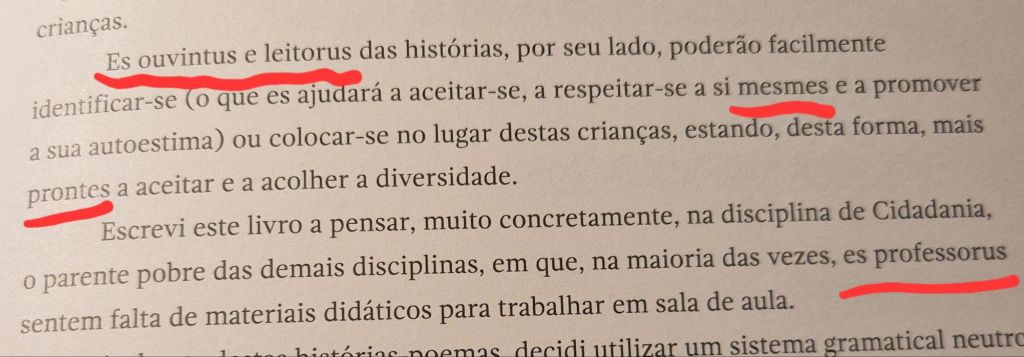
Some examples: “es” here seems to be a plural article replacing os/as (so the singular must be “e”, I guess – isn’t that going to be confusing?) and leitorus is in place of leitores and leitoras. Why the unchanging “ouvintes” gets the same treatment, but criança (feminine) doesn’t become criançu is a mystery. Professorus is the only acceptable one because it sounds like a dinosaur with a lesson plan and I like the idea.
Se quiseres saber mais sobre o sistema elu em vez de ler apenas os meus resmungos de velho, aqui está a página a qual a autora refere no apêndice.
You don’t have to have dirty fingernails when you read it, but it helps.
Estou tão contente por ter a oportunidade de ler mais nos últimos dias porque cria inúmeras ocasiões de encontrar palavras desconhecidas no seu habitat natural. Hoje, vi esta palavra num livro chamado “As Regras do Isolamento”. Desmiolado… Tentei adivinhar o significado, baseado na estrutura: des/miol(o)/ado: o meu primeiro pensamento era “desembaraçado”. Imaginei algo torto a ficar reto. Mas não é. O meu erro foi confundir “miolo” com “mola”.
Mola é… hum… Eh pá… Devia escrito isto em inglês… Força, Colin, aguenta-te! Uma peça metálica na forma de uma hélice, que faz parte de um relógio (se for pequeníssima!) ou de um colchão (se for muito maior) entre various outra coisas.
Miolo, por outro lado, é uma palavra que pode significar várias coisas, tipo a parte interna do pão, ou de certos frutos, mas por extensão pode também significar a parte interna de uma cabeça, ou seja, o cérebro; a massa cinzenta!
Afinal, o que quer dizer “pensamentos des/miol(o)/ados”? Pensamentos distraídos, sem juízo, sem coerencia, sem pés nem cabeça.
Deparei-me com uma nova palavra, a Olarilolé. Segundo o artigo a palavra exprime satisfação ou surpresa ou pode até ser usada como uma saudação, mas o Priberam limita-se a falar do primeiro destes significados. Diz-se que a origem da palavra é na expressão árabe “la ilaha illa Allah” ou seja, “não há divindade senão Deus”.
Mas para mim o uso mais promissor é como uma alcunha nova para a minha filha, Olivia. Ela há de gostar, não achas?
(these kinds of things are probably very variable by time and place so, for the sake of completeness, here are some videos recommended after i wrote the initial post, that have variants on this theme as part of song lyrics: olaré, olaró, olari olaré and this fella who was on the PT version of The Price is Right and uses olarilole. (it’s terrible, I’m sorry, please do not watch this)
Expressions relating to eating and drinking, fixed homework, aiming to find equivalent expressions in English. Most don’t have literal identical versions in English, so I’m just looking for something more less equivalent.
Trincar qualquer coisa (Trincar =morder)
Existem muitas opções. A minha preferida é “Have a little smackerel of something”, que é uma frase do livro Winnie the Pooh
Dar ao Dente
Não há nada igual, mas talvez “nibble” seja a palavra mais parecida, uma vez que implica o uso dos dentes.
Morfar (Morfar = comer )
Também posso sugerir várias alternativas mas acho que “scoff” é a mais próxima
Encher o Bandulho (Bandulho =barriga)
Acho que diríamos “fill your belly”
Encher a mula (mula = mule)
Não temos uma expressão igual. Às vezes falamos de “fill your boots” (“encher as botas”) que pode ser semelhante mas não tem necessariamente a ver com comida. Pode significar “faz qualquer coisa tanto quanto quiseres”. Por exemplo, “Queres colher rosas no meu jardim? Vá lá! Enche as botas!”
Ferrar o dente
Diríamos “Get my teeth into” alguma coisita.
Estar com larica (larica =erva daninha mas neste contexto quer dizer “fome”)
Equivalente a “To feel peckish”
Enfardar (enfardar = comer muito)
Equivalente a “gorge” ou “binge”
Matar o Bicho
Esta expressão pode significar “tomar o pequeno almoço”, ou até “dar uma gorjeta” mas para tratar uma ressaca bebendo aguardente em jejum é chamado “hair of the dog” em inglês. Se fossemos mordidos por um cão, é óbvio que precisaríamos dum pêlo do cão que nos mordeu. [this one is sort of complicated too and probably doesn’t quite mean “hair of the dog” but sometimes it’s just breakfast (implying the “bicho” is hunger) and sometimes just means booze for breakfast (the background explained in a one-minute-long video on this page)
Afogar as mágoas
A única frase que tem uma equivalente muito próxima: to drown ones sorrows.
Dar de beber à dor
Hum… Drink to forget (beber para esquecer)? Não é igual, mas não consigo me lembrar de uma expressão melhor .
Estar/ficar bem aviado (aviar =preparar)
Diríamos “to be well-oiled”. Existem outras expressões mas acho que olear um avião ou um veículo é necessário antes da viagem e daí escolhi esta! [i got the translation slightly wrong originally. There are a few meanings for the word aviar in Priberam and I think I was lulled by the similarity to “avião” to think of it as preparing for a trip, but it can be other kinds of preparation. For example, here’s a page telling EU citizens how to have their prescription made up in another EU country, and the word used is aviar. I think “Well oiled still works as an equivalent even if it isn’t quite as good as I thought it was]
Beber de caixão à cova (caixão = caixa grande para conter um cadáver; cova = o buraco onde se enterra o caixão)
Mais uma vez temos muitas expressões tipo “tie one on” ou “go on a bender”
Emborcar
Podemos dizer “neck”, que nem sequer é um verbo, mas se fosse uma palavra portuguesa, seria “pescoçar”!
Apanhar uma piela (piela = estado de estar bêbado)
Embora tenhamos um monte de adjetivos significando “bêbado” acho que não temos um substantivo no nosso calão que represente o estado de embriaguez. Tanto quanto sei, o único exemplo é “swerve” na expressão americana “Get your swerve on”, ou seja, bebe tanto que não consegues andar em linha recta.
Enfrascar-se (enfrascar-se = meter em frascos)
Dizemos “crawl into a bottle” que soa muito parecido mas o significado é mais perto de “Afogar as mágoas”. (after I wrote this I remembered that there are a couple of slightly antiquated expressions for drunkenness that are a bit closer: “Potted” and “pickled” both seem like the kind of thing you’d find in a PG Wodehouse novel when a member of the Drones Club had had one too many cocktails but they’re pretty good synonyms I reckon!)