The Bertrand Bublio App (mentioned on the Audio Books page) is annoying me. I’ve been listening to Vida Dupla by Sérgio Godinho but it pauses every minute or so and I have to keep tapping the screen to make it move on. I think it’s a bug where it needs permission not to suspend when the screen goes blank or when a notification comes in or… I dunno… Something. Maybe tomorrow’s writing task will be uma carta de reclamação about the issue.
Author: Colin Lusk
Just a data nerd
D-I-S-P-O
One of my pet theories is that every tech company has a guy somewhere in the organisation whose job title is “visionary architect of making everything slightly worse”. He (and I’m sorry to be one of those dudes who disses other dudes to ingratiate himself to his female readers, but yes, I’m sure he’s a he) is the one behind all those little changes to apps that make them look sleeker but leave the user frustrated and annoyed because they are harder to use. Anyway, the guy who holds that role at google translate has obviously been busy because its latest incarnation is hugely irritating. Well done, mate.
It remains quite useful though. I’ve just written a text about street food and I mentioned a disposable glove. As usual, when I finished, I pasted it into gtranslate to see what it thought I’d said. It translated it as “available glove” because I’d used a false friend: Disponível. The word is obviously related to disposable but it means available. It’s easy to see the link. If you’ve ever heard anyone say “I’m at your disposal”, the person wasn’t asking to be thrown in the bin, they were saying they were available to help. So the meanings must have drifted apart relatively recently but it’s worth knowing the difference.
What should I gave said? Descartável. That’s easy too. You can discard them.

Danificado
Corrected Text – thanks to gws-lthrowaway for the help

Saí de casa* ontem para ir correr no parque mas infelizmente, quando lá cheguei, havia um sinal na portão a dizer “Fechado. Perigoso – Não entrar”
Houve uma tempestade em partes da Europa ocidental na sexta-feira. Continua a ter efeito ainda hoje (oiço o vento enquanto escrevo este texto) mas o pior já passou. Nos arredores do parque, e na cidade, havia danos por todo o lado: árvores caídas, cercas abaladas e barracas de jardim destruídas. Não havia nada tão grave como os danos de tempestades que chegam a matar centenas de pessoas nas ilhas tropicais, nem tão forte como um tornado que levou a casa de Dorothy para a terra de Oz, mas para nós foi um choque!

*de casa not da casa. I left house not left the house.
Doomscrolling
Em tempos de transtorno no palco mundial, é muito fácil perder toda a esperança. Há uma palavra inglesa “doomscrolling” que encapsula bem este sentimento. As notícias são tão deprimentes que ficamos estupefactos e não conseguimos funcionar porque temos que saber mais e mais sobre o quão lixados estamos. Mas somos cidadãos de países democráticos e temos opções. Há sempre qualquer coisa, quanto pequena que seja, que podemos fazer para contrariar a ditadura e a guerra.
Expresso: Quer apoiar o povo da Ucrânia? Saiba como ajudar hoje, porque “amanhã pode ser tarde demais”
Twitter account of London Euromaidan which has been organising protests here in London asking for the UK government to do more.

With thanks to h_doofenschmirz for correcting my grammar in a few places here
A Discutir Comigo Mesmo
Tiveram uma vez uma discussão* ou um debate com outra** pessoa que não entendeu o vosso ponto de vista ou que reagiu mal a alguma coisa que nem sequer disseram? Acho isso muito frustrante. Estou a passar a manhã inteira a repetir a discussão. É ridículo. Estou em risco de desperdiçar o dia todo porque não consigo focar-me noutras coisas. Preciso de esquecer. Felizmente sou um velhote e geralmente esqueço-me de coisas facilmente.
Mas… É que… Não quero. Sinto-me como se perdesse um dente e quero enfiar a língua*** no buraco onde estava. Digo-me a mim mesmo:
“Calma pá. Pega nos auscultadores, meu burro**** e escuta, mas é, uma música punk até a memória fica perdida”.
“Pois é”, respondo “mas antes disso, só quero praticar mais uma vez o que teria dito, e o que irei dizer se alguma vez inventar uma máquina do tempo e viajar no tempo até àquele momento…”
E assim se passa uma, duas, três horas a fio. Burro, burro, burro.

* I made the schoolboy error of using “argumento” here but it doesn’t mean quite the same thing as argument and certainly doesn’t fit here.
** tempting to write “uma outra” (another) but you only need outra. The corrector said “Uma outra” is “um gallicismo oitocentista” – a French import from the nineteenth century.
*** a língua not a minha língua as per the post I wrote a few weeks back abiut how possessive pronouns are sometimes unneeded.
**** When I first saw this sort of construction “seu burro” I couldn’t see what was going on. Its an exclamation, calling someone “you donkey” not discussing their donkey, if you see what I mean. Anyway, you can say “seu burro” (or tolo or palermo or whatever) and you can say “meu burro” but not – for some reason – “teu burro”.
Campo Vermelho
A semana passada foi um bico de obra para mim e trouxe vários transtornos à família toda: a carteira perdida de que falei ontem (ainda desaparecida – cancelei os cartões todos), a minha filha tem montes de trabalho de casa e ainda por cima foi traída por uma amiga, e a minha mulher anda preocupada porque teve uma entrevista de emprego mas ainda não sabe* o resultado. Estamos todos com muito stresse.
Fomos ver uma peça de teatro ontem à noite. O título era Red Pitch (Campo Vermelho). Tem lugar num campo de jogo num bairro em Londres onde três jovens negros praticam futebol. Têm os seus próprios sonhos, mas o seu bairro está num processo de modernização que vai dar cabo do** seu modo de vida. Soa pesado, eu sei e lá estávamos nós com as nossas cargas de stresse. Será que a peça acrescentaria mais miséria? Mas não a achámos pesada de todo. Acabou por ser muito divertida e muito engraçada. Apresentou um fim duma época mas com esperança pata a vida se formos valentes o suficiente, se trabalharmos e se ficarmos abertos às oportunidade que o destino apresenta.
*Just as an experiment I put “ouviu” here. As we might say in English “she hasn’t heard the result yet”. It was a no!
** I never see to use this expression right. I out “levar cabo a…” First of all, the expression is “levar a cabo” not “levar cabo a”, but that means carry something through right to the end – like if you were managing a project and you wanted to see it through to completion. The expression I should have used here is “Dar cabo de” which means to kill something off, end it or generally destroy it.
Perdi a Minha Carteira
Fui ao supermercado na quarta-feira e, no dia seguinte, não encontrava* a minha carteira. Vi nos bolsos das minhas calças, mas sem êxito. Liguei ao supermercado, andei lá e de volta a procurar pelo chão, mas não tive sorte. Provavelmente está algures em casa, mas acho que cheguei a hora de cancelar uns cartões de crédito. Uma chatice**.
* A good example of how not to translate too literally. I was thinking “I couldn’t find” = “Não consegui encontrar” but that’s not very Portuguese. Não encontrava is the way to go: I wasn’t finding it.
** o wrote “que chatice” (what a nuisance!) because its what I hear sometimes and I sometimes see on twitter people post some delicious treat they’re eating with the caption “Que chatice!” but apparently that’s more of a conversational thing and the best way of saying it in a written text is “uma chatice” – (which was) “a nuisance! ”
A Portuguesa: TL;DR
For the benefit of anyone who is too lazy to read that last post, here it is in the form of a meme. I actually posted it on a world history Facebook group and it was modded out of existence almost immediately. Not surprising I suppose but I thought there might be one or two people willing to do the work to decipher it.

A Portuguesa
This post is long overdue. I said back in November that I was going to do a post about the Portuguese national anthem but I haven’t got around to it yet.
National anthems are often written in the heat of some patriotic fervour, often caused by conflict with another country. God Save the Queen, for example, has an apocryphal verse that someone tried to shoehorn in, about fighting the jocks* although contrary to what the nationalists might have you believe, it was never part of the official national anthem. I think if you did a survey of all the countries whose national anthems specifically refer to Britain being evil it’d probably be about two-thirds of them. The United States for a start: the Star Spangled Banner is about looking out for the flag and hoping it doesn’t get blown to bits under the British shelling. Well that’s fair, we have put ourselves about a bit and we were pretty much the last empire to openly call itself an empire so people remember us for that and that’s often set down in writing. So in a sense, national anthems are like Taylor Swift break-up songs but on a diplomatic scale.
Surprisingly, despite being our oldest ally, Portugal is a former member of the BBC (The Britons are Bastards Club) too, because they used to have us in their anthem. Oh my god, Becky, why are you so obsessed with us? Well, here’s why:
Portugal became a Republic in 1910 as a result of a chain of events sparked by the British empire reneging on its treaty and issuing an ultimatum – in 1890 – claiming the land in between Mozambique and Angola which the Portuguese had intended to settle, as part of a strategy referred to as “A Mapa Cor-De-Rosa”. The monarchy was powerless to stop Britain and the Portuguese people were pissed off about it. The opinion of the Africans on the matter was not sought. Anyway, the resulting crisis saw the monarchy replaced by a Republic and, a few years later, the Estado Novo. Portugal’s Hino Nacional (National Anthem), called “A Portuguesa”, was written in response to the initial crisis in the last decade of the 19th century, and it is everything you’d expect from an anthem – “Heroes of the sea, noble people, valiant, immortal nation, lift up again today the splendour of Portugal”. Stirring stuff. But the chorus originally ended with a call to arms: “Contra os Bretões marchar, marchar!” March, March against the British!
Luckily, long before it was adopted as the national anthem in 1911, cooler heads had prevailed. They had time to think it through and they decided not to pick a fight with the most powerful nation on earth at the time, so the new anthem had the slightly less incendiary “March, March against the cannons”, which saved a lot of awkwardness.
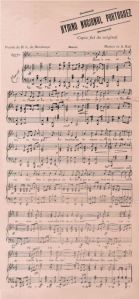
Soirce: Wikipedia Data: 1890 Letra: Henrique Lopes de Mendonça
Música: Alfredo Keil
I
Heróis do mar, nobre povo,
Nação valente, imortal,
Levantai hoje de novo
O esplendor de Portugal!
Entre as brumas da memória,
Ó Pátria, sente-se a voz
Dos teus egrégios avós,
Que há-de guiar-te à vitória!
Às armas, às armas!
Sobre a terra, sobre o mar,
Às armas, às armas!
Pela Pátria lutar!
Contra os canhões
marchar, marchar!
II
Desfralda a invicta bandeira
À luz viva do teu céu!
Brade a Europa à terra inteira:
Portugal não pereceu!
Beija o solo teu jucundo
O oceano, a rugir d’amor,
E o teu braço vencedor
Deu novos mundos ao Mundo!
Às armas, às armas!
Sobre a terra e sobre o mar,
Às armas, às armas!
Pela Pátria lutar!
Contra os canhões
marchar, marchar!
III
Saudai o Sol que desponta
Sobre um ridente porvir;
Seja o eco de uma afronta
O sinal de ressurgir.
Raios dessa aurora forte
São como beijos de mãe,
Que nos guardam, nos sustêm,
Contra as injúrias da sorte.
Às armas, às armas!
Sobre a terra e sobre o mar,
Às armas, às armas!
Pela Pátria lutar!
Contra os canhões
marchar, marchar!
*It’s OK, I’m Scottish, I can say the J word
Short Shorts
I heard about this channel, Portuguese Dips the other day. There are some really good little snippets in there: little useful bits of language to pick up and spice up your spoken language, mostly. This for example isn’t really something I see often in traditional lessons but it definitely seems plunderable. A good one to add to your YouTube follows.
 Luso
Luso 