I updated the list of portuguese graphic novel recommendations. I keep seeing peeps on social media asking for decent easy reads, and I find it’s helpful to have a list I can point to. It’s almost twice as long now!
If you look over there on the right 👉 on a laptop or down on a phone 👇 you’ll see there are a few of these resources pages now, covering learning resources and so on.
Here are a few expressions gleaned from the C1 book
Em casa de ferreiro, espeto de pau (In The blacksmith’s house, the skewers are made of wood) People who have skills they use in work don’t use them for their own benefit.
Cada cabeça sua sentença – everyone has their own opinion
Nem tudo o que luz é ouro – all that glimmers is not gold. Easy one, this. The only thing that grabbed my interest was that “luz”. I’d only ever come across this word as a noun so I had a hard time choosing it as an option in the exercise, but it’s actually part of the verb “luzir” in this context.
Quem canta, seus males espanta – is another that threw me since it sounds like it’s saying “whoever sings will shock you with their evil deeds” which is probably right for Michael Jackson, but “espanta” can also mean scare something away or chase it away, and “males” can be a person’s woes or troubles, not actual evils, so it just means if you sing a song you’ll chase your blues away. OK, cool.
Zangam-se as comadres, descobrem-se as verdades – When the godmothers start arguing, the truth will come out. In other words, when people start getting heated they tend to say things they would normally keep to themselves
Ladrão
O ocasio faz o ladrao – the opportunity makes the thief. This seems to be used slightly differently. If you look around various sites, some people take it as meaning that a person driven by circumstances might steal but isn’t to be regarded as a born thief; others take it as more like “if you don’t take care of your stuff someone is bound to nick it”. A middle way seems to be “People might be tempted to steal if there isn’t a strong motivation for them not to”. That seems to be how this guy interprets it anyway,and he mentioned a reference by Machado de Assis who says “Não é a ocasião que faz o ladrão, o provérbio está errado. A forma exata deve ser esta: a ocasião faz o furto; o ladrão já nasce feito”.
It’s definitely a pessimistic expression, anyway!
Em águas de bacalhau – I keep seeing this one and forgetting what it means. Apparently it comes from the fact that cod fishing used to be very dangerous, back in the day, and you were quite likely not to come back from a fishing trip if you went off to the cod fishing waters. So if something “deu/ficou/continuou em águas de bacalhau” then basically it came to nothing and had no result.
Trazer água no bico – bring water in your beak – do or say something sneaky or with a hidden agenda
Dar água pela barba – Give water in the beard (“sweat through the beard, I guess?) If something dá água [pela barba, it’s something very complex and challenging
Here are a few that are easier, because they’re equivalent to english expressions
Fazer crescer água na boca – to make the mouth water
Como peixinho na água – like a fish to water
Enquanto há vida há esperança – where there’s life there’s hope
Em terra de cegos quem tem olho é rei – in the land of the bline, the one-eyed man is king
Cao que ladra nao morde – his bark is worse than his bite (lit “A dog that barks doesn;t bite”)
Quem semeia ventos, colhe tempestades – sow the breeze, reap the whirlwind
I hit an exercise that had quite a lot of expressions I hadn’t heard before
Um amigo de Peniche – comes from a British action during the succession crisis of the 1580s. Nine years after the Spanish seized the portuguese crown, a force led by Francis Drake landed near Peniche ostensibly to restore the crown to Dom António, Prior do Crato, but really to prevent the Spanish launching another armada and, in the process, also doing quite a lot of looting and attempting to seize the Açores to sever the route if the Spanish silver trade. So an Amigo de Peniche is a friend who is only really looking out for what they can get out of the friendship and doesn’t really give much in return. Apparently people from Peniche are self-conscious about being associated with treachery and never miss an opportunity to tell you the true origin.
Peniche TrutherYou used to call me on my cellphone, to help restore you to the throne
Um unhas de fome – a grasping, tight fisted person
Um atraso de vida – a harmful or annoying life problem
Um amostra de gente – a very small person
Um mãos-largas – a very generous person. Note that here (and in a couple of other expressions, the article “um” doesn’t seem to match the noun. That’s because this is a description of a person, and the default is singular and masculine, even if they are described as having wide hands – mãos largas – feminine and plural.
Um bom garfo – a gourmet
Um cabeça de alho chocho – if you are an old shriveled garlic head, you’re a forgetful, absent minded person.
Um bota de elástico – someone who dresses, acts, or thinks in an old-fashioned way
Writing letters of complaint is a popular exam exercise. I’ve pinched a couple of phrases from a C1-level example, highlighted in the text
Londres, 5 de Outubro 2021
Assunto: Apagão* do site
Exmo Sr Zuckerberg
Venho por este meio*” apresentar uma reclamação relativa ao assunto em epígrafe***. Ontem, tentei entrar no seu site, Facebook, para ver memes sobre gatinhos mas o site estava em baixo. Ao falhar desta tentativa, dirigi-me ao Instagram mas isto também não deu êxito. Fui forçado a falar com a minha própria família e a ouvir as opiniões da minha esposa e da minha filha sobre o Squid Game. Fiquei com marcas mentais que provavelmente nunca se curarão. Devido a esta situação, gostaria de ser ressarcido pelo honorário do meu psicanalista e uma indemnização por danos causados. 2 biliões de dólares deverão ser suficiente. Sem outro assunto de momento e aguardando uma resposta da vossa parte**** Com os melhores cumprimentos _________
* “Apagão” “em baixo” are phrases I pinched from recent news articles but I don’t think the terminology is very fixed. The marker changed the latter to “tinha ido abaixo” But I’ve left it as it was since I guess the Jornal de Notícias has its reasons.
**This phrase is something like “I hereby”. Super-formal, obviously.
***This is referring to the title line so only works if you’ve written a subject at the top of the letter
****More formal boilerplate – Not having anything further to say and awaiting a reply in your part.
The recipient reacts to my complaint letter
My wife tells me people really do write in this sort of formal style. Probably not about cat photos, but still…
Translating one of the poems I’ve been learning. It’s by Ricardo Reis, one of Pessoa’s Hetronyms. I found it a bit inspiration-postery at first but it’s really grown on me, especially the last two lines of the first verse and the last two lines of the last:
Portuguese version
Translation
Segue o teu destino. Rega as tuas plantas. Ama as tuas rosas. O resto é a sombra De Arvores alheias.
Follow your destiny Water your plants Love your roses The rest is just the shadow Of other people’s trees
A realidade Sempre é mais ou menos Do que nós queremos. Só nós somos sempre Iguais a nós próprios.
Reality Is always more or less Than we want We alone are always Equal to ourselves
Suave é viver. Grande e nobre é sempre Viver simplesmente. Deixa a dor nas aras Como ex-voto aos deuses.
It’s easy to live It’s great and noble always To live simply Leave pain on the altar Like a votive offering to the gods
Vê de longe a vida. Nunca interrogues. Ela nada podes Dizer-te. A resposta Está além dos deuses.
Look at life from afar Never question it It can’t tell you Anything. The answer Is beyond the gods
Mas serenamente Imito o Olimpo No teu coração. Os deuses são deuses Porque não se pensam.
But serenely Imitate Olympus In your heart The gods are gods Because they never think of themselves
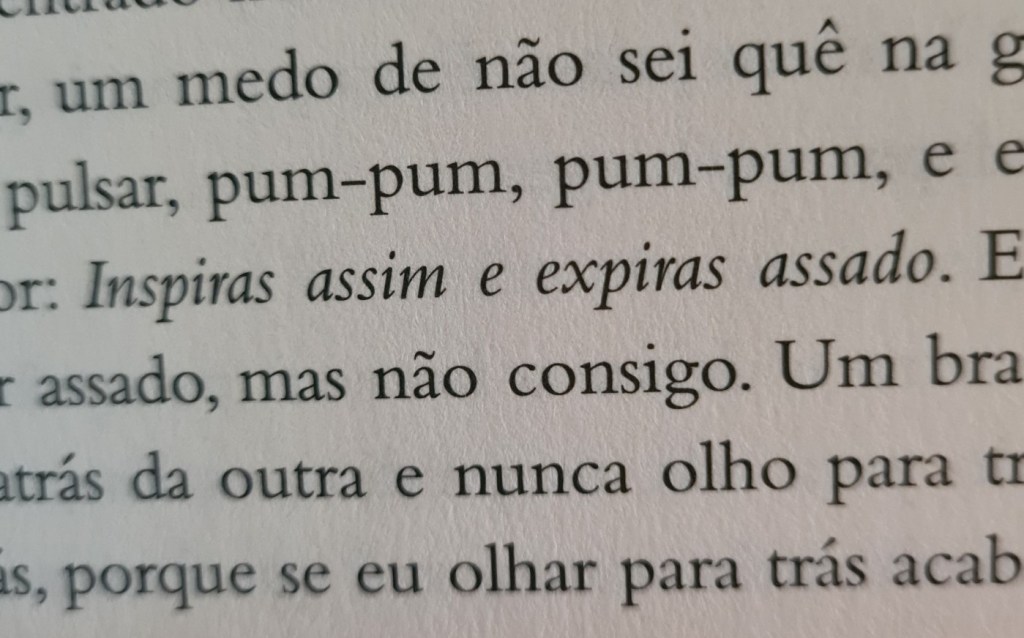
Here’s another one of those posts where I find some weird thing in a book and I bring it to the blog and drop it on the doormat like a cat with a mouse. Check out this rodent corpse:
“Inspiras assim e expiras assado”
The first bit is easy: “You breathe on like this” but what’s with “Assado”? Assado means “roasted”. But according to Priberam, “assim e assado” is an expression meaning “like this and like that”. So breathe in like this and breathe out like that.
I’ve been looking at words related to money and I’ve put together some short paragraphs that use them in context
This has absolutely nothing to do with the text, I just like puns, OK?
Os meus vizinhos oferecem alvíssaras (a reward) a quem forneça informações sobre o seu cão que desapareceu no domingo passado.
O governo já aumentou os impostos (taxes) apesar de ter prometido não agravar a carga fiscal (tax burden).
O meu contabilista (accountant) pratica honorários (professional fee) muito altos mas vale a pena
Além da propina (tuition fee) que pagava à universidade tinha de pagar uma joia (subscription fee) ao clube Marxista e manter a minha quota (periodic membership fee) em dia. Caso contrário, eu ficaria “cancelado”.
O meu avô recebe dividendos (dividends – not a hard one to guess, that!) modestos* cada ano em resultado dos seus investimentos (investments – another easy one!) . Comprou um por cento das ações (stocks. I’ve seen “títulos” and “papéis” used in this context. See here for example) duma empresa chamada “Apple” em 1978 e os lucros (profits) do seu capital cobrem as despesas (expenses) da sua humilde mansão numa pequena ilha privada no mar das Caraíbas.
A minha filha ganha (earns) bem com o seu serviço de ama mas vive connosco sem pagar renda (rent free: renda can also mean “income” in other contexts as well as rent). É rica. Penso em pedir-lhe um empréstimo (loan) mas a taxa (rate) de juros (interest) que ela aplica é bastante alta.
Depois de receber uma indemnização (compensation) do meu empregador, fui ao banco fazer um depósito (deposit, obviously) e depois à tasca praticar o levantamento do copo.
*This useage of “modesto” to describe something as small and unshowy, is not actually given in the dictionary but seems to be used as in English alongside the more normal use of modest to mean a person who is not boastful.
I mentioned a couple of days ago that was a minor kerfuffle about the teacher on my Portuguese history course.
It seems there’s was more to it than I thought. Some of her scholarship students have complained about her having abused power, apparently, and in one case even claimed she had plagiarised a big chunk of one of her books from a student essay. Blimey!
1/ O caso Raquel Varela – a ascensão mediática, a construção do CV, o concurso à medida e os abusos s/bolseiros (tolerados pela faculdade, como a peça abaixo noticia) dá um retrato sobre a FCSH, a Nova e a academia na área das ciências sociais. Thread⬇️ https://t.co/Bai6ttiipj
I don’t know what to make of this, and I’ll tell you why my cluelessness is interesting: when I’m online in my normal guise, reading about scandals in English speaking countries, I tend to have a pretty good idea of who is where on a sort of graph where one of the axes is ideology (where they are likely to come down in an argument between different points of view) and the other is honesty (whether they are prepared to bend the facts to fit their narrative, whether they fight dirty). Crucially, I can usually spot sarcasm, shitposting , spitefulness and attention-seeking when some British ideologue (Owen Jones say) or American (Candace Owens, maybe) is doing what they do, but I am absolutely unable to read it in most Portuguese tweets. Unless people are very obvious, I don’t really know what’s fake and what’s real. This one seems reputable but really, I’m a hopeless naive and maybe he’s a well-known partisan hack, shilling for some very Conservative paper that has targeted her for her opinions.
And I suppose it’s worth pausing at this point and asking who we trust online and why? I know there are a lot of sources I’d basically trust all the way. Like the BBC. They aren’t always right but they’re always trying. They’re not Fox News or Infowars and I trust their basic integrity as a source of facts. But there are other sources I’ve sort of grown to trust over the years but how well do I really know them? Are they just the people who have told me what I want to hear for so long that I’ve become blind to their biases? Yeah and not just me, reader. What about you, eh? I’m waving my finger at you as I type this. What about you, eh? How sure are you that the people in your social media feed are trustworthy?
I came across this picture on the tweeters and was trying to de cypher it. Mossar is a real word but it’s meaning is pretty obscure. If I’m reading Priberam right, it means to clean the spikes of a mace with a cloth.
Um… OK…
After staring at it for a while I realised the message is supposed to say “Fui Almoçar” (I’ve gone to have lunch). I asked online whether there was more to it than that does mossar have some double meaning perhaps? No, it’s just laughing at an “analfabeto” (illiterate person). It’s a really crusty old meme, apparently so they were quite amused that I’d dredged it up.
A pessoa mais inteligente que conheço é o meu mordomo, o Jeeves. A sua cabeça está inchada por causa do seu cérebro gigante. Acho que a sua inteligência vem de comer tanto peixe. Infelizmente, apesar de ser o meu empregado, às vezes o Jeeves utiliza aquela inteligência sobrenatural para influenciar a minha vida. Há algum tempo, comprei um fato branco. Quando desfiz as malas, o Jeeves viu o fato. Levantou* uma sobrancelha como que me pedindo** “O senhor tem certeza?”. Um sinal ameaçador, sem dúvida. Eu sabia que deveria devolver o fato***. Caso contrário****, o Jeeves teria provocado um incidente envolvendo a minha tia Dahlia, o seu cozinheiro, um jarro prateado e uma carta roubada para fazer a minha vida um pesadelo. Fiquei com coração despedaçado porque adorava aquele fato, mas convém andar conforme os seus conselhos.
*Levantou, not levou
**A good expression involving a gerund: “as if he were asking”
***I put the words “para a loja” on the end of this sentence but you only need devolver. The rest is redundant. Where else would he be devolvering it to?
****I have a list of words and phrases that Portuguese people use a lot and that I always forget about because they are so different from the way we say things in English and I try to slip them into texts whenever I can. This is the first ever outing for this one. We don’t say “in the contrary case” in informal English conversation, but this is basically equivalent to a phrase like “otherwise” or “or else” and I hear it fairly often when I’m listening to podcasts and whatnot.







 Luso
Luso 