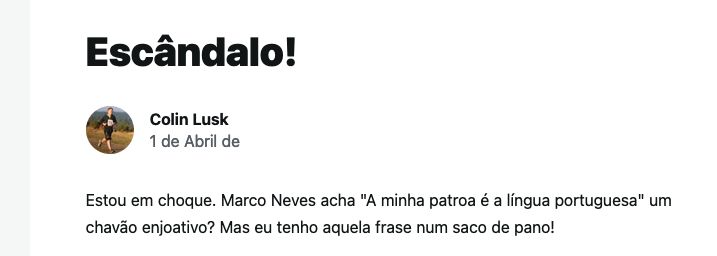
So I wrote this silly post a few days ago and Marco Neves himself popped by to comment on it, which was nice. And then a couple of days later I realised I’d made a ridiculous typo in it and written “patroa” in place of “pátria”
*facepalm*
But it’s OK, because an eagle-eyed reader who spotted the mistake told me it still worked because patroa, the feminine form of “patrão” can also mean “wife“, just as in english you might hear blokey blokes refer to “the boss” or “she who must be obeyed” or whatever. And I’m married to someone who speaks a língua portuguesa, albeit with an accent the mainlanders sometimes affect not to understand, so I’ll just point to the publication date, 1 Abril, and pass it off as a joke. Yes, I am clever and funny and I never, ever make typos.
I’ve noticed for a while that if I type portuguese into Gmail on the laptop it underlines a few words in blue. I tend not to pay much attention because it has 3 spellcheck languages and gets confused easily but recently I’ve started paying more attention. It actually seems to be offering better suggestions for correction than FLiP does these days. So much so that I might just ditch FLiP from my typo-prevention process and pass my texts through Gmail instead. It found 4 mistakes in the text of tomorrow’s blog post even after I’d made corrections in flip.
Sadly, it doesn’t seem to be available in android as far as I can see, but that’s ok, I don’t mind switching to the office chair for a couple of minutes.
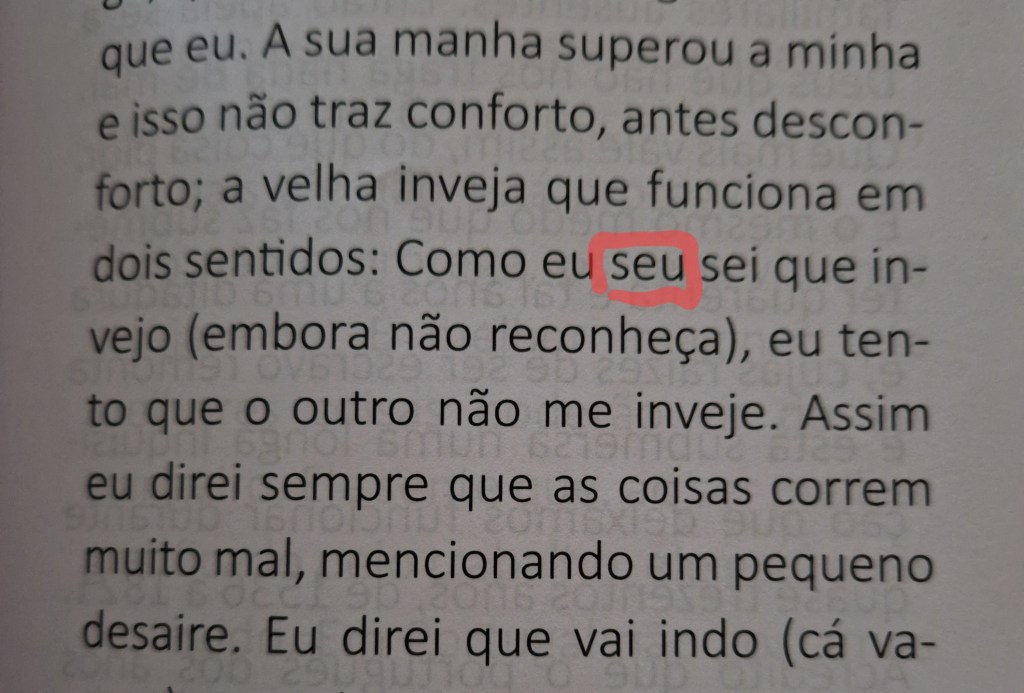
Typos tend to be annoying at the best of times, but they can be super-confusing when they come up in portuguese texts because you don’t know if they are real typos or if it’s just some aspect of the language that you’re not familiar with. I was pretty sure about this one but had to go and ask. It is one of course. The fact that the stray “seu” is right next to the right word, “sei”, makes it obvious how it happened.
Found on someone’s Pinterest. No idea who owns it. Too good not to use.
I’ve been repeating a lot of silly errors lately, often just typos that don’t get caught by my usual method: pasting my Portuguese texts into Google Translate to see if it can correctly translate them back into English. Google Translate is quite forgiving of “gralhas” (typos) so if you wrote “ni” instead of “no” because you are a medieval Knight and that’s your favourite word and autocorrect has changed it for you, Google Translate will probably correctly guess what you meant, and the error will slip through.
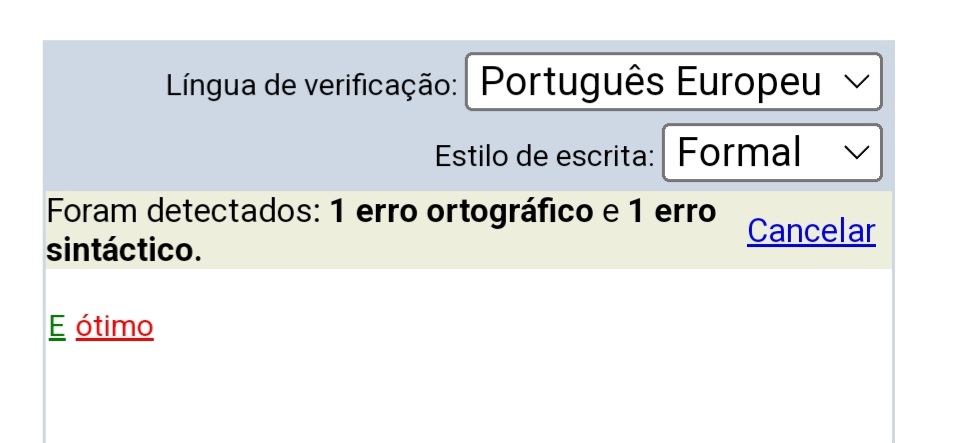
One of the correctors on the subreddit suggested I incorporate FLiP into my routine. It’s a spelling and syntax validator. I’ve had a play and concluded it definitely has its uses. It has a pretty big gotcha though. In fact, I thought it was wrong about a couple of AO spellings. It prompted me to change the spelling of Ótimo to the older Óptimo, for example. Well, I like the old version so I’m not too bothered, but it’s the wrong advice.
When it did the same with the word “corre(c)ção” I really started giving it side-eye. Considering corre(c)ções are its raison d’etre, that would be a pretty big error. It turned out there was a good reason though. Can you spot my mistake?
Yeah, it defaults to the old spellings and i hadn’t noticed there was a box to tick right there at the top that makes it use the newer ones. So make sure you remember that!
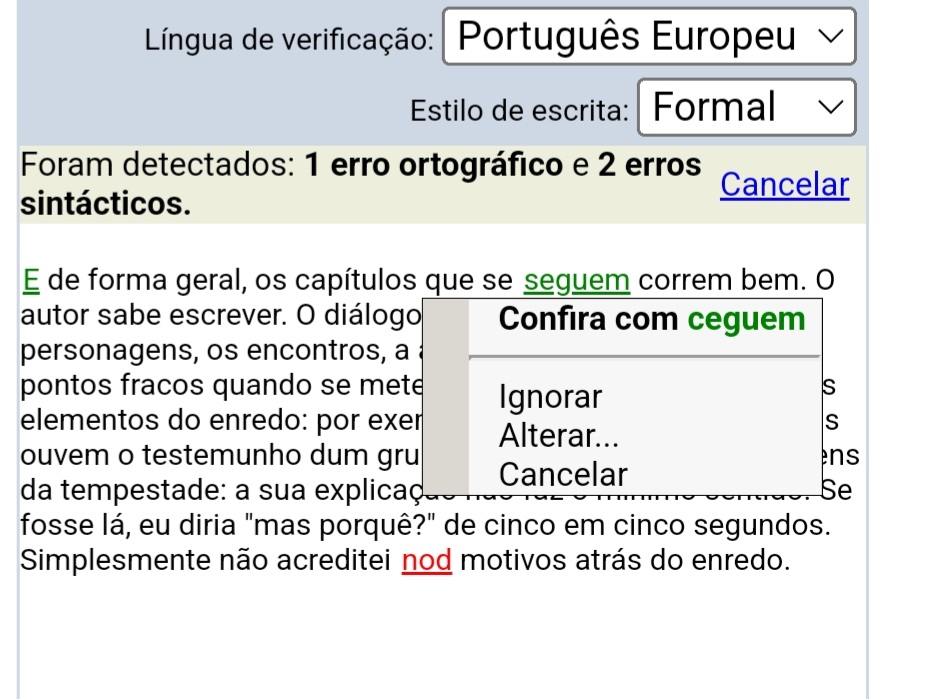
Like any computer program, it’s not immune to errors though. Today’s text includes the phrase “os capítulos que se seguem” (“the following chapters”). Computer said no, advising me to say “the chapters that blind themselves” instead.
Still though, like most online tools, it has its uses. It’s probably best to treat it like a GPS navigation system: follow its directions most of the time but not when it’s telling you to drive off a pier into the sea to get to Calais.



 Luso
Luso 