Posted in Portuguese

Mais Uma Tradução

Stoyo Petkanov, a personagem* principal do novo romance de Julian Barnes é uma criação satírica de génio. Três partes Todor Zhivkov, o líder outrora** da Bulgária, uma parte Alf Garnett(1), é um deposto líder comunista dum país soviético sem nome. Prisioneiro dos seus sucessores reformadores, vai ser julgado. O julgamento vai ser transmitido na TV. Para Peter Solinsky, o advogado chefe de acusação, isso é uma oportunidade para obter uma promoção no estado novo. Para os milhões de espectadores, é uma oportunidade para afastar o passado. Contudo para o Petkanov, o tribunal fornece-lhe um palco pelo qual pode apelar a história. “Não tencionou protagonizar o papel alocado para ele. Tinha um outro papel em mente”.

(1) para quem não sabe, este gajo é uma personagem duma comédia da televisão inglesa

notebook_image_825869

*=Male character but still a feminine word

**=apparently not an adjective that changes with the noun!

Posted in Portuguese

Tradução

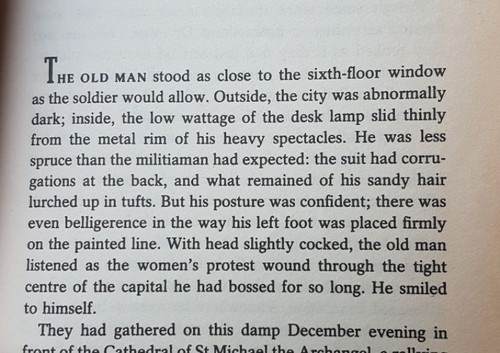
notebook_image_823103I recently tried to translate the first paragraph of “The Porcupine” by Julian Barnes” into Portugese. It was a real struggle because of the high literary style. Anyway, the result was quite interesting because it shows that there’s more to transation than just constructing grammatically correct versions of each sentence in turn. The corrections I got back were all right, in the sense that they were free of errors, but the result was stilted and not really reflective of the original. For reference, Larissa wrote her own translation, in Brazilian Portuguese, to show how a real native speaker would express it.

So here’s the fixed  version of the original

O velhote estava de pé tão perto da janela do sexto andar como permitiu o soldado. Lá fora, a cidade estava estranhamente escura; cá dentro, o poder fraco do candeeiro de secretária deslizou ligeiramente da orla metal dos seus óculos. Era menos elegante do que tinha suposto o militar: o terno dele estava amassado por baixo e o resto dos seus cabelos loiros surgiam de forma duns penachos*. Mas a sua postura mostrou confiança e mesmo havia uma certa pugnacidade na maneira em que o seu pé foi colocado na linha pintada. Com cabeça inclinada, o homem ouviu enquanto a manifestação das mulheres serpenteou pelo centro estreito da capital que tinha liderado durante tanto tempo. Sorriu para si mesmo.

And here’s Larissa’s

O velho permaneceu o mais próximo da janela do sexto andar quanto lhe permitiria o soldado. Lá fora, a cidade estava anormalmente escura; dentro, a luz de baixa voltagem da luminária de mesa refletia fracamente nos aros metálicos de seus pesados óculos. Ele era menos elegante do que esperava o militar: o terno estava amarrotado nas costas e o que ainda restava do seu cabelo cor de areia movia-se em tufos. Apesar disso, sua postura era confiante; havia até mesmo certa agressividade no modo que seu pé esquerdo permanecia firmemente plantado na linha pintada. Com a cabeça ligeiramente inclinada o velho ouviu o protesto das mulheres que seguia pelo apertado centro da capital que ele havia comandado por tanto tempo. Ele sorriu para si mesmo.

And finally, here’s a line-by-line comparison of the two with Larissa’s in red and mine in blue. I’ve italicised the words that I think (I might be wrong) are not generally used in European Portuguese “por padrão”, but the rest should be basically just a more natural, fluid way of describing the scene in the novel.

O velho** permaneceu o mais próximo da janela do sexto andar quanto lhe permitiria o soldado.

O velhote estava de pé tão perto da janela do sexto andar como permitiu o soldado.

Lá fora, a cidade estava anormalmente escura; dentro, a luz de baixa voltagem da luminária de mesa refletia fracamente nos aros metálicos de seus pesados óculos.

Lá fora, a cidade estava estranhamente escura; cá dentro, o poder fraco do candeeiro de secretária deslizou ligeiramente da orla metal dos seus óculos.

Ele era menos elegante do que esperava o militar: o terno estava amarrotado nas costas e o que ainda restava do seu cabelo cor de areia movia-se em tufos.

Era menos elegante do que tinha suposto o militar: o terno dele estava amassado por baixo e o resto dos seus cabelos loiros surgiam de forma duns penachos.

Apesar disso, sua postura era confiante; havia até mesmo certa agressividade no modo que seu pé esquerdo permanecia firmemente plantado na linha pintada.

Mas a sua postura mostrou confiança e mesmo havia uma certa pugnacidade na maneira em que o seu pé foi colocado na linha pintada.

Com a cabeça ligeiramente inclinada o velho ouviu o protesto das mulheres que seguia pelo apertado centro da capital que ele havia comandado por tanto tempo.

Com cabeça inclinada, o homem ouviu enquanto a manifestação das mulheres serpenteou pelo centro estreito da capital que tinha liderado durante tanto tempo.

Ele sorriu para si mesmo.

Sorriu para si mesmo.


*=Penachos might be OK for “tufts” but it seems a bit touch-and-go.

**=Velhote seems to be specific to Portugal. On the other hand, the Brazilian “O Velho” is slightly dismissive in Portugal. Alternative phrases are “pessoa de idade” or “idoso”


Thanks Sofia, Larissa, Andre, Vitor and Natan for help with the corrections


Posted in Portuguese

Andorinhas em Voo

I set this post as a challenge to myself – to translate something someone else had written into Portuguese. There’s always a temptation, when making up “textos” to avoid difficult topics and stick to familiar vocab, so a translation seemed like a good way to go. The text I chose was a blog post from “A Portuguese Affair” about the swallow decorations that are so ubiquitous in Portugal. I have recently bought some swallows  from A Vida Portuguesa. Mine are just decals, or “andorinhas para colar” – and I recognise “colar” as the portuguese equivalent of “Paste”, as in “copy and paste”, so they are literally swallows to stick, but the real fancy kind need to be drilled into the wall and I don;t know that I trust my DIY skills enough to commit to that much drilling in the newly-painted wall.

#UNCORRECTEDPORTUGUESEKLAXON

Vamos falar sobre aqueles andorinhas que vê enquanto que fica em Portugal. As boutiqies são cheias delas e pode encontrar andorinhas cerâmicas nos paredes de restaurantes, no lado de fora de prédios portugueses e, sem exceção, em cada loja de recordações. Talvez as exibições apereçam fofas, ou elegantes, ou as vezes deixem-os boquiabertos! Mas o que é que estes pássaros significam? E porquê é que estejam tão populares?

19932066_715898125284053_7333483862795747328_nTudo começou em mil oitocentos e noventa e um, quando o Rafael Bordalo Pinheiro desenhou a primeira andorinha cerâmica na sua fomosa fábrica de cerâmica. Rapidamente, ficou o mais vendido*, e durante os cem e vinte e cinco anos, tem-se tornado um das imagens mais icónicas da empresa além de ser um símbolo da vida portuguesa.

Enquanto que algumas pessoas escolham para colocá-las nas suas cozinhas (o coração do lar) outros metem-nos nas suas salas de estar ou até lá fora das paredes. Hoje em dia, estas andorinhas encontram-se em quase quaisquer lugares – possivelmente até no seu hotel quando visita Portugal.

Ora bem, porque é que estes pássaros ficaram tão populares? Além do seu lindeza estética, são cheias do simbolismo. Sabe que andorinhas casam-se com um único companheiro durante as suas vidas? É além de serem fiéis aos seus maridos, estes pássaros migratórios são também fiéis aos seus lares. Após duma viagem comprida, regressam de ano para ano ao mesmo lugar para fazer um ninho. Por causa deste comportamento, ficaram representantes da casa, amor, família, lealdade, fidelidade. Não admira que sejam tão populares nas casas dos portugueses.

Cada vez mais, a popularidade das andorinhas aumenta-se, pois uma nova geração inteira têm-nos abraçado sem reserva. Hoje, pode encontrar andorinhas cerâmicas ou feito de argila de qualquer tamanho, de qualquer cor (até com padrões) para se encaixarem com a sua decoração, que dá para estar mais fácil utilizá-los em qualquer tipo de quarto.

*=Não “a mais vendida” apesar de ser “UMA andorinha…?

Posted in English, Portuguese

Ciúme – Translation

I’ve been trying to translate this new Ana Bacalhau song. It’s pretty difficult. I get the general gist: she’s describing her jealousy as a gift she gives. The actual language isnt easy though and I have probably made a load of mistakes.

Mais que uma rosa
More than a rose
Mais que um perfume
More than a scent
Dou-te uma cena de Ciúme
I give you a sense of jealousy
Faço prova aparatosa
I make a huge proof
Do meu amor por ti
Of my love for you
De peito* aberto
With an open heart
Cabeça ao lume
Head aflame
Mostro-te as minhas feridas de guerra
I show you my battle scars
Gentileza que o peito descerra
Kindness that my heart unlocks
Aceita o meu ciúme
Accept my jealousy
À vista de todos por cortesia
In the sight of everyone as a courtesy
Salta-me a tampa
My lid flies off
Vou ao teto
I’m going to the cieling
Como quem cede um afeto
Like someone who gives affection
Em plena luz do dia
In the plain light of day
Ciúme que não sai do peito
Jealousy that doesn’t leave the heart
É espinho que corta a direito
Is the thorn that cuts right through
E queima como sal
And burns like salt
A ferida onde fermenta todo o mal
The injury where the all the evil lies
Podes soltar aos quatro ventos
You can release the four winds
Podes não contar a ninguém
You can’t count on anyone
Mas toma conta dos meus tormentos
But take account of my torments
Como um presente de quem te quer bem
Like a present from a wellwisher
Guarda esta birra de menina
Keep this temper tantrum
Aceita a minha gentileza
Accept my kindness
Guarda com uma certeza
Keep it as a certainty
De haver quem te queira assim
That someone wants you like this 
E se eu às vezes abuso do meu
And if I sometimes abuse my own
É porque nunca acusas o toque
It’s because you never acknowledge the touch
Ciúme que não sai do peito
Jealousy that doesn’t leave my heart
É espinho que corta a direito
Is the thorn that cuts right through
E queima como sal
And burns like salt
A ferida onde fermenta todo o mal
The injury where the all the evil lies


*=Peito actually means “breast” but “heart” was the only way I could make it sound non-ridiculous in english.

Posted in English, Portuguese

A Vida Nos Livros

“A Vida No Livros” de José Jorge Letria – Tradução

Nem dez vidas me bastaram, eu sei

Ten lifetimes wouldn’t be enough, I know

para ler os livros que fui arrecadando

to read the books I’ve been collecting

e que me desafiam para que

and that challenge me because

me perca neles como um peregrino

I lose myself in them, like a pilgrim

nas rotas de um mitigado desespero.

on the trails of a muted despair

Sou eu que pertenço aos livros

It’s me that belongs to the books

e não o contrario, já o disse tantas vezes

and not the other way around, I’ve said it many times

pois o que eles vão entesourando

because the treasure they are hiding

é a pequenez do tempo que me resta

is the shortness of the time that remains to me

para os ler e neles me encontrar.

to read them and find myself in them

Os livros falam de vidas e de guerras

The books speak of lives and wars

e eu só falo do que os livros contam,

and I only talk about what the books tell me

esquecido que ando do que vivi

oblivious that I’m wandering from what I lived

e bem podia e devia contar-vos.

and can and should tell you

São os livros que me acenam

It’s the books that move me

apontando-me para os mostradores

pointing me to the faces

dos seus relógios imóveis e opacos,

of their motionless, opaque clocks

assim como quem diz: por mais que vivas,

as if they were saying: no matter how you live,

por mais que faças, tu partirás

no matter what you do, you will depart

e nós, bem ou mal, havemos de ficar,

and we, good or bad, have to stay

porque não nos cansámos de viver

because we never got tired of living

a ficção de que são feitas estas vidas.

the fiction from which these lives are made

Posted in English, Portuguese

Dia Mundial da Poesia

jose_letriaVerso Alcançando o Infinito – Tradução

O poema nasce de um impulso,
The poem is born of an impulse
de uma febre, da tirania de uma miragem,
from a fever, from the tyranny of a mirage
da tentação sonora de uma metáfora,
from the sonorous temptation of a metaphor
do vazio que teme transformar-se em nada.
from the emptiness that fears becoming a void
Depois é a escrita, é o trabalho da mão
Then comes the writing, the work with the hand
sobre a matéria incandescente das sílabas.
on the incandescent material of syllables.
E, quando damos por nós, é de corpo inteiro
And when we discover ourselves, it’s the whole body
que estamos na fragilidade do poema
that we are in the fragility of the poem
como se tivéssemos ousado cavalgar numa nuvem
as if we had dared to ride on the back of a cloud
para desafiar todos os poderes do céu.
to challenge all the powers of heaven
Quem ousará explicar este sortilégio?
Who dares explain this sorcery?
Nem sequer os deuses, pois esses
Not even the gods, because they
nasceram da própria erupção do verbo,
were born in their own verbal eruption
da explosão da prece fingindo ser capaz
from the explosion of prayer that claims to be capable
de vencer o sofrimento e o assombro.
of conquering suffering and dread.
O poema nasce, afinal, da ilusão
The poem is born, after all, from the illusion
de que ainda resta algo para ser dito
that there still remains something to be said
e de que o silêncio é um cativeiro fugaz
and that silence is a brief captivity
em que as palavras se amotinam
in which the words rebel
para de novo voltarem a ser voz.
to return to being a voice again.

José Jorge Letria, O Livro Branco da Melancolia (2001)

Posted in English

Let It Be Now

Time is ticking down to the B2 exam in T minus 4 days but I fancied a break from full-on learning so here’s a translation of another song by my favourite Portuguese band, Deolinda. I was really chuffed, on listening to it the other day, to realise it has an expressão idiomática in it that I recognise from the Practice Portuguese Podcast (in this episode). The phrase is “o que tem de ser tem muita força” (marked with *** below) and it means “What has to be has a lot of force”, or more colloquially “You gotta do what you gotta do”.
It also has some fun grammar in it including the contrast between “haver de” (means “to have to” but in a vague, non-specific way as in “you have to come and visit sometime” or “I really have to fix that broken clock” and “ter de” which is much more specific, signifying inevitability or obligation: “I have to do my homework” or “You have to put clothes on, sir, you can’t come to church naked”.
There are some good subjunctives to, most obviously in the title – “Seja Agora” being expression of hope – something like “let it be now”.

Nós havemos de nos ver os dois
We have to see each other
ver no que isto dá
to see what happens
ficar um pouco mais a conversar
stay a while and talk
Ter a eternidade para nós
We have eternity to ourselves
Quem sabe, jantar
Who knows, maybe have dinner…
Se quiseres pode ser hoje
If you want, it could be today.

Tem de acontecer, porque tem de ser
It has to happen because it has to be
e o que tem de ser tem muita força***
and what has to be has a lot of force
E sei que vai ser, porque tem de ser
And I know it’s going to happen because it has to be
Se é pra acontecer, pois que seja agora
And if it’s going to happen, let it be now!

Nós havemos ambos de encontrar
We both need to find
um destino qualquer
some kind of destiny
ou um banquinho bom para sentar
or a little bench to sit on
Vai ser tão bonito descobrir
It’s going to be so beautiful to discover
que no futuro só
that in future the only thing
quem decide é a vontade
that will decide is our own will

Tem de acontecer, porque tem de ser
It has to happen because it has to be
e o que tem de ser tem muita força***
and what has to be has a lot of force
E sei que vai ser, porque tem de ser
And I know it’s going to happen because it has to be
Se é pra acontecer, pois que seja agora
And if it’s going to happen, let it be now!

x2

Que seja agora
Let it happen now
Que seja agora
Let it happen now
Se é pra acontecer
If it’s going to happen
Pois que seja agora
Well, let it happen now

x4

Posted in English

And while I’m on the subject…

….of translated lyrics, you could do a lot worse than have a listen to “Tu Gostavas de Mim” which is by Ana Moura and is sung in a duet with Miguel Araújo on his live album. Araújo is one of the singers in As Azeitonas who I mentioned in the last post and by the way, also the guy singing in “Bitter Portuguese Guy Sings” a few weeks back. I really like the simplicity and the dry humour of it. The whole live album is good, actually.

Translation here

Posted in English

In the Cartoons

I couldn’t find a translation of “Nos Desenhados Animados” (“in the Cartoons”) by As Azeitonas so I made one on LyricsTranslate. I like it. It’s soppy and nostalgic and has an overwrought widdly-widdly sax solo near the end but that doesn’t make me like it less.

In the Cartoons

I want to be lucky like a cartoon
in the morning on RTP1
You’re my Tom Sawyer
And my Huckleberry Finn
And you come in a mask and a cape
Up there, there are planets without end
You are my super-hero
Without a cowboy hat
With a galleon and a bottle of rum
I was yours and nothing more
One for all and all for one

In the cartoons
I already know the end
The good pioneer
The swordsmen seizing power
and Prince Charming
Always returns to me

I am Jane and you Tarzan
The Juliet of my Dartagnan
If your horse fails you
I have so much to tell
Of the ghost beneath my sheets
Of the treasures we hide from the Spaniards

In the cartoons
I already know the end
The good pioneer
The swordsmen seizing power
and Prince Charming
Always returns to me

When the ending comes
We can change the channel
In the cartoons
It rarely rains and never – almost never – ends badly
[By the power of Greyskull!]