I decided to try my hand at mind-mapping to set out all the situations in which I might need to use the subjunctive tenses. In case you don’t know, these are three tenses that are used in situations where there’s some sort of doubt, intention, or future eventuality implied. Usually, they are not the main verb in a sentence, just part of a supporting phrase. They’re actually pretty easy to conjugate. The difficulty for us English speakers is recognising the situation in which they are needed, and remembering to pull one out of the bag in place of the standard indicative. That’s because we hardly use them at all in English. Basically the only time they would rear their head is in a phrase like “If I were a rich man”. So, in the song:
If I were a rich man,
Daidle deedle daidle
Daidle daidle deedle daidle dum,
All day long I’d biddy-biddy-bum.
“Were” is a subjunctive (imperfect subjunctive, I think) because it’s describing a hypothetical situation (being a rich man), which is why we’re using “were” instead of “was”. When it comes to translating, I think the verb we want here is “Ser” because although rich people can become poor, it feels more like a statement about a permanent state of affairs. I don’t think he wants to be rich for just one day. So we would translate this as “fosse” (first person imperfect subjunctive of “ser”)
“I’d” – short for “I would” of course – indicates we’re dealing with the conditional, which is a normal indicative tense, because it’s leading into the main thrust in the sentence: what he would do in that hypothetical situation. It’s a little difficult to translate because I don’t know the Portuguese verb for “to biddy-biddy-bum” but let me make an educated guess: bidibidibombiar, and you can make the first person conditional by just whacking an “-ia” on the end.
As for the daidles and deedles, well, I’ll have to leave those to someone with more expertise. Hey, my degrees are both in science, so what do I know about language? They’ll be adverbs, I expect. I never trusted adverbs.
Putting it all together then:
Se eu fosse um homem rico,
Daidle deedle daidle
Daidle daidle deedle daidle dum,
Todos os dias, eu bidibidibombiaria.
If you’re reading this and you’re not sure if you need to know about subjunctives, check with your teacher, but I believe they only really come into play at DIPLE/B2 level. It’s worth looking at them earlier, if only because they come up in books quite often and it’s useful to be able to recognise them, but I don’t think you would need to worry about them at B1 level… I didn’t anyway!
Anyway, if you’re interested, I’ve saved a pdf of the work in progress here. So far it only has the presente do conjuntivo (present subjunctive) but when it’s finished it’ll have the other two subjunctives – imperfeito (imperfect) and futuro (future)
Anyway, if you’re interested, I’ve saved a pdf of the work in progress here. So far it only has the presente do conjuntivo (present subjunctive) but when it’s finished it’ll have the other two subjunctives – imperfeito (imperfect) and futuro (future)
Anyway, if you’re interested, I’ve saved a pdf of the diagram here.

 Para praticar a gramática de B2 PT-PT (tempos verbais conjuntivos e situações que são *quase* conjuntivas com asterisco)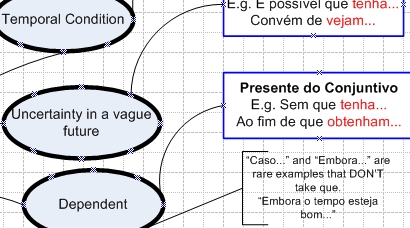
 Luso
Luso 