Não conhecia esta palavra da Quina de ontem. Após um pesquisa, acabei por entender que é um bioma que consiste numa floresta boreal em zonas frias. Mas a palavra inglesa é igualizinha porque tem origem no russo e os ingleses e os portugueses ambos pediram-na emprestada pois este tipo de floresta não existe nos nossos países relativamente calorosos.
I keep learning new words from Quina. They are mostly useless, obscure words, but I was interested that there’s a feminine form of Touro because I always thought Touro was the masculine form of Vaca. Maybe that’s a hangover from English though, where the feminine is the default because you learn cow first, as a child, and only later find out that there’s a daddy cow called a bull, who is always in a bad mood, and that people in other countries like to wave red capes at him for reasons that are difficult to fathom.
Anyway Toura (or “toira”, because it’s one of those words that can be spelled with an ou or an oi) refers to a young or sterile cow. It can also be an irascible woman (informally – and I’ve no idea how someone would react if you called them that so would not recommend) or a handled cooking pot (tacho) but only in some regions.
So if there’s a feminine form of Touro, is there a masculine form of Vaca? No, no there is not, not even in 2024, but as soon as the Americans find out about this they’ll have an entire academic department writing papers about it, I’ve no doubt.
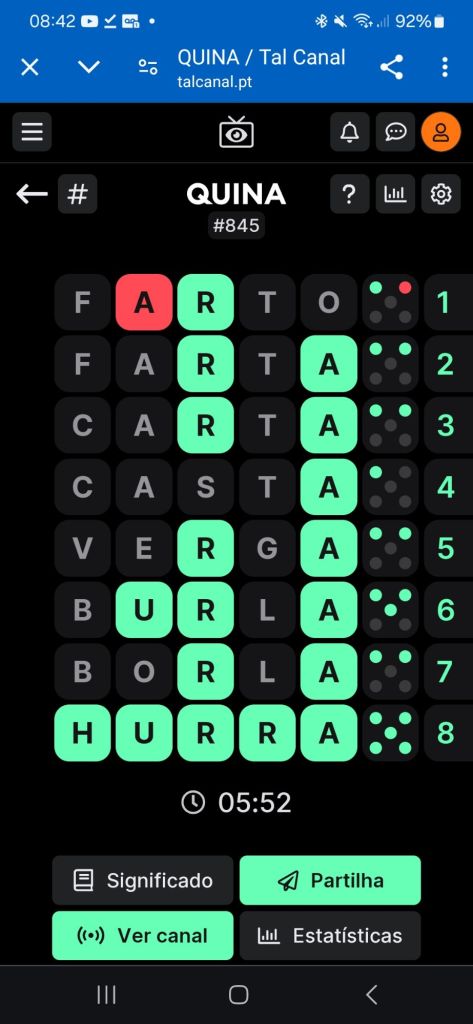
… Some of the words it comes up with are a bit iffy. This, for example, took several minutes of just trying random combinations of letters in the two spaces I had left. It just means “hurrah”, apparently, but would you call “hurrah” a word? Hm.. 🧐
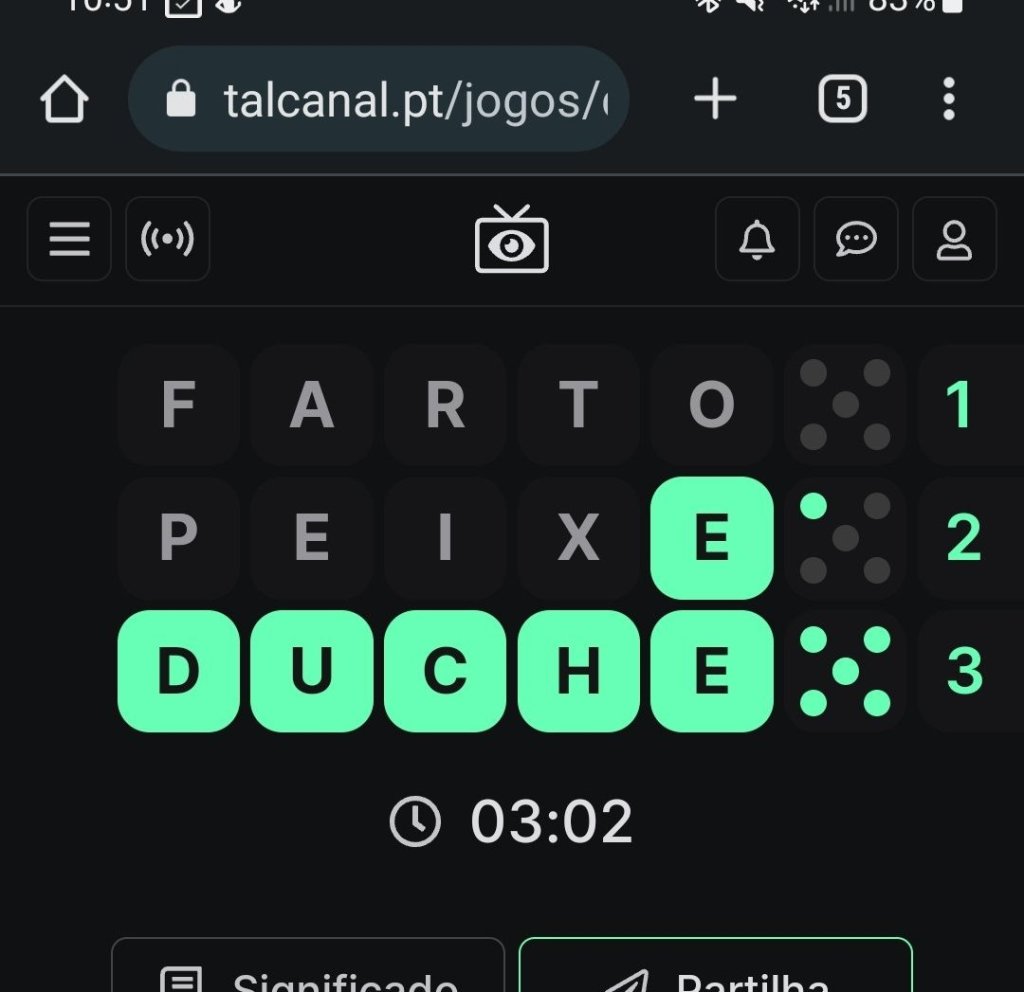
Yes I always start with Farto because I’m childish
This is a good example of the way Portuguese words are easier to guess than English ones because it’s a much more “lawful” language that isn’t quite so promiscuous at absorbing foreign words and isn’t as cavalier about spellings.
OK, so given that any portuguese word is going to have at least two vowels in it, and the game doesn’t seem to allow slang, plurals or (m)any verb conjugations, let’s crack on:
In the first row, we find out there’s no A or O
In the second row, I’m using Es and Is and one of the letters is in the right position. It has to be one of the vowels, because if not then there’s no E, I, A or O in it, which means our two vowels must both be Us and I don’t see that as likely… Maybe there’s a portuguese word that would fit, but I can’t think of one.
OK, so it’s either
_E___ with a U at position 4 (where else could it go?) seems unlikely.
__I__ with a U… Er… Somewhere… And I think that’s unlikely too
____E with a U in positions 2 or 3. Surely the only likely option.
Since I’ve already used a lot of consonants, there aren’t many options left. Has to be duche, right? Right.
OK, not the most modest post title I’ve ever written, but seriously, every time I’ve tried Quina, I’ve managed to get the answer even though it’s insanely difficult. Each time, I get half way though and think “there’s just no way I can do this”. I make silly mistakes, don’t feel like I’ve any solid ground to stand on, and yet, by the end, I pull a rabbit out of the hat.
Ceifa means harvest, by the way. Specifically, it seems to mean harvest using a scythe (gadanha) or sickle (foice), so maybe it means more like “reaping”. And it has a related verb, ceifar, in case you’re wondering.




 Luso
Luso 