Posted in English

Another Brick In Na Qual

Getting driven mad by the sense that although I usually know roughly when to use (o) qual and when to use que, I don’t really know why and I sometimes used to get pulled up by Dani on the Portuguese subreddit for getting it wrong, so I’m doing a data dump in a post to get it straight in my head. It’s going to be rambling. If you found this page on Google and you think I’m a teacher, LOL, go back to the search results, buddy, because I’m not that reliable.

The examples I’m thinking of are when que and qual are being used as “relative pronouns”. In other words, they are mostly dealing with situations where in English you would use “which”, when taking about a person or thing. “The parlous state to which American democracy has sunk”, “enjoy the tax breaks for which you have traded your freedom”. That kind of thing

There are other uses of qual (“Qual é a dúvida” for example) and lots of other uses of que (“o que é que é?”) but they are easier to deal with so I won’t be going into those. Nor do I have any trouble with words like quem, onde and cujo, which sometimes to the same job in English but only when dealing with people (quem =who), places (onde =where) or ownership by people (cujo=whose).

Está bem, vamos meter as mãos na massa. Começo com as notas no livro Qual é a Dúvida

Que

Used after monosyllabic prepositions – em que a que, com que, de que, por que. So “in which”, “to which”, etc

Qual

Used after other prepositions “para o qual”, “sobre o qual” (“for which”, “about which”). So far so good. It is “partitive” in other words, it singles something(s) out for discussion from among a larger group.

Here’s an example of o qual from…. Um… Somewhere:

“O lavrador sobre o qual falei” O qual is a relative pronoun here. The speaker has mentioned a ploughman earlier and he wants to refer to him again so he says “The ploughman about which (sobre o qual) I spoke…” The relative pronoun is a way of singling him out without having to do all the work of reintroducing him in the story.

So, relative pronouns usually come after prepositions but be careful, because there are some things that look like relative pronouns but aren’t. For example:

Confuso sobre qual palavra usar“. Qual seems like a relative pronoun here but it’s not. He is wondering “qual palavra usar?” and he’s confused about that, and the qual ends up being after sobre, but it isn’t doing the same job. In English it’s the difference between “I’m confused about which word to use” and “Ah, so this is the new Fado about which the critics are losing their shit”.

O qual differs from que in these situations because it always has an article (‘o’) tacked on, which means it’s going to change with the gender and number of the thing it’s referring to, so it could be “a qual” or “as quais” or whatever, whereas que is always que.

Hm, ok, we’ll, moving on, let’s see if we can find anyone else with some light to shed.

This Ciberdúvidas page discusses em que and no qual as substitutes for onde in a sentence. So you might choose to say “the University in which I studied” instead of “the University where I studied”. The correspondent reckons it comes down to what sounds best.

This (Brazilian) teacher advises that o qual  is mainly useful for avoiding constantly repeating the word “que” every five seconds. Que is a very overused word in Portuguese and there might be situations where you’ve used it so often in a sentence that using it again is going to confuse things, perhaps…?

This page for school-age children focuses specifically on “no qual” but doesn’t shed much light except to show examples of cases where o qual is basically synonymous with que, and you can check whether you are using it correctly by substituting “que” and seeing if the sentence works.

So is that it then? At bottom, it’s not really a grammar rule as such, just a question of what sounds gooder?

I poked around some more because I couldn’t quite believe it. This Ciberdúvidas page gives a few situations where it’s important to use one or the other, and I thought maybe he would be more rulesy, but, on closer inspection, he was just ruling out some of the other uses of qual and que discussed above:

O rapaz que tinha medo do escuro venceu os seus obstáculos

O qual wouldn’t fit here, but that’s because it isn’t really acting as a relative pronoun anyway. It’s a determiner I think. In English we would use “that” or “who” instead of “which”

And he goes on to talk about prepositions of one syllable…

‘A verdade é um postigo/ A que ninguém vem falar.’ (Pessoa)

Versus prepositions with two…

‘Tinha vindo para se libertar do abismo sobre o qual sua negra alma vivia debruçada.’ (Torga)

And that’s really just a question of which sounds better, again.

Well, that was a bit of an anticlimax. I thought it would be more complicated than this, but that’s OK. I feel a bit more confident in using them after this deep dive.

Posted in English, Portuguese

The Road at Preposition… I mean “to”… Yes, as I was saying, The Road to Preposition.

Annoyed to find I got about a third of these wrong. Even after two more attempts at guesses I was still two short of a full house. Maddening! How can prepositions be so completely hatstand? So I’m putting the whole exercise up here and writing up the reason for each one in a way that will probably make the whole thing illegible but hopefully should pound the message into my brain. The original text is from Visão, I think, but it doesn’t seem to be online so I can’t link to the original – it’s cited in Português em Foco.

A fellow preposition non-understander in action

Green is for the prepositions themselves

Pink is for the explanations

Cresce a moda dos treinadores que vão a (I put à, but they’re visiting clients “at home”, not “at the house”) casa, mas só para (straightforward “for”) quem pode pagar‑lhes e detesta ginásios!

Duas da (“de tarde” would be in the afternoon, but adding the article indicates something like “the afternoon in question”) tarde. Equipada a (I used “com” which Linguee seemed to think was the most likely option but equipada a rigor seems to be a set phrase for “in your gym kit”) rigor, Maria João recebe o treinador que, durante uma hora, lhe puxará pelo (puxar pelo físico is another expression and it just means “work out”. I had no idea and just guessed some old rubbish) físico, sem (straightforward “without”) sair de casa. Os ensaios no Teatro Infantil de Lisboa não roubam à (extremely counter-intuitive for english-speakers, but “roubar a” means “steal from”) atriz, de (straightforward “of” – because she is 40 years old) 40 anos, as duas ou três horas semanais de treino com o Paulo, responsável pela (responsável por / responsible for) sua boa forma. Maria João explica a opção doméstica: a sua profissão é muito exigente e a deslocação a (“deslocar(-se) a” means to go to relocate – or just go somewhere, really) um ginásio é tempo perdido. Além de (além de just means “aswell as”) que as aulas em (straightforward “in”) grupo raramente correspondem às (straightforward “to the”) necessidades particulares de (straightforward “of”) cada um.

Paulo, o treinador privado, diz dominar uma técnica especial. Os exercícios dele exploram a funcionalidade do corpo humano, o que quer dizer que obrigam a pessoa a (straightforward “to” – which you need after “obrigar”) trabalhar os músculos da (unexpected use of “of the same way” where in english we would say “in the same way”) mesma forma que os usa no dia a dia. Um colchão, uma bola suíça, uma bola medicinal, bandas elásticas com pegas e uma plataforma instável destinada a (straightforward “to”) treinar o equilíbrio do aluno são os apetrechos que leva consigo para as casas dos clientes. De (De is used to indicate “wearing a…”) camisola preta, com (striaghtforward “with”) Treinador Pessoal escrito a (counter-intuitive use of “a” where translating literally from english would make you want to write “em” because it’s written in white) branco nas costas, ele incentiva Maria João a (a-infinitive = “contracting”) contrair os abdominais, a (a-infinitive = “relaxing”) relaxar os braços, a (a-infinitive = “lifting”) levantar a perna esquerda e a (a-infinitive = “offering”) oferecer resistência ao movimento do elástico.
Os treinos individuais ao (straightforward “at the”) domicílio custam entre (straightforward “between”) 30 e 70 euros por (straightforward “per”) sessão e duram de (straightforward “from”) 60 a (straightforward “to”) 90 minutos.

Embora as condições em casa não tenham comparação com (straightforward “with”) os equipamentos, os estúdios ou as piscinas dos ginásios, há vantagens na (straightforward “in the”) opção doméstica, sobretudo para (straightforward “for”) figuras públicas que querem fugir de (I put “aos” and then changed it to “a” and actually I don’t think I was on the wrong track. “fugir a” and “fugir de” both mean to escape from, as opposed to “fugir para” which is escape to”) olhares alheios, em recintos sobrelotados.

Maria Duarte, de (…she was 30 years old…) 30 anos, gestora, outra cliente de Paulo, só vê benefícios no treino caseiro. Além de (além de again: aswell as) ter dois filhos pequenos, já andava desmotivada por (straightforward “from” or “by” or “as a result of”) ir ao ginásio, porque durante um ano não conseguiu obter os resultados que pretendia. Agora dá‑se por (According to the invaluable Guia Prático, “dar-se por” means “julgar-se”, “considerar-se”, “sentir-se”) satisfeita. As duas horas que perdia no (straightforward “in the”) ginásio a fazer máquinas equivalem a (straightforward “to”) 30 minutos de exercício em casa, com os equipamentos que o Paulo traz.

O professor alerta para (straightforward “for” although I went for “a” and I think it feels like a more direction-y “to” than I would intuitively expect because even when it told me I was wrong I tried “de” and “com” and this ended up being one of the two that I were still wrong at the end) os esforços exagerados que poderão ocorrer nos ginásios. É preciso dividir o nosso corpo em partes e trabalhar uma de (um(a) de cada vez just means “one at a time”) cada vez, em sessões diferentes.
Deve‑se dar descanso ao (straightforward “to the”) físico e manter uma alimentação saudável prescrita pelo (straightforward “by the”) dietista. Paulo aconselha, no (counter-intuitive use of “no” when a literal translation would push me towards “ao” for “at least”) mínimo, três meses de trabalho para (straightforward “for” in the sense of “in order to”) se obter resultados concretos. O negócio parece correr‑lhe de (de feição is an expression meaning “de forma favorável ou propícia”) feição!

Posted in English, Portuguese

Errant Preposition Hearts Club Band

Corrections from Português Outra Vez

Frustrating that there isn’t a preposition that sounds more like “George”. Oh well.

Ele entrou na igreja, aproximou-se dum ícone, beijou-o, persignou-se e saiu, balbuciando algo. I wrote “aproximou-se a”. Also, persignar-se (genuflected) was a new word for me!

Vocês vão para o Egito?! Só podem estar a entrar connosco (I hadn’t the faintest idea what this was even meant to be saying so took a total guess on both the verb and the preposition)

Se quisesses ser menos obeso, obedecerias às prescrições do doutor Nunes. (I used the imperative tense, but that doesn’t make sense following in from the imperfect subjunctive)

Em 2003, eu formei-me em Filologia Eslava pela Universidade de Bratislava. (i used “na” as the second preposition)

Posted in English, Portuguese

The Red Hot Silli Preppersitions

More corrected exercises from Português Outra Vez

Grammar, we love you

Quando elas vierem a casa, lembra-lhes para regarem as flores no rés do chão.

Eu faltei aos ensaios e, por isso, não vou em digressão pelo Canadá. (I actually feel like my wrong answer wasn’t totally wrong: dedicar-se was an option so I put “dedico-me aos”. I feel like that works but the book says no No, apparently not, because the ensaios are rehearsals for the tour. Duh!)

O pai do nosso amigo Charles valeu-se do cargo que ocupa para lhe arranjar trabalho no Ministério dos Negócios Estrangeiros.

O presidente faltou à palavra e adotou essa lei discriminatória

Levantei-me as cinco de manhã; faltou pouco para amanhecer.


Thanks to Cristina for spotting the typos & the misunderstanding in the first version.

Posted in English, Portuguese

Exercícios Lacunares

Now that I’ve finished Qual É A Dúvida I’ve returned to the bloody awful, boring “Português Outra Vez“, aimed at C1/C2 level students. On the face of it, there’s no reason it should be so dull: both books are just page after page of exercícios lacunares (missing word problems), but they’ve ordered it into three sections and within each section they’re all the same *kind* of missing words. I’m currently part way through 60 pages of verb+preposition. I have a copy of the Guia Prático de Verbos com Preposições for any that I don’t already know. Helena Ventura is co-author of both books, so the examples are often quite similar.

Now, that much repetition could be useful if it was drilling the variations of dar+preposition or passar+preposition but there’s surprisingly little repetition of those. Dar appears just twice, I think, and ser, passar, ficar seem only to be there once. Instead we’re doing easy things like gostar de, precisar de, plus some fairly obscure ferns that only ever take one preposition anyway. It’s not ideal and I am finding it much harder to stay motivated. I’ll see how it goes but I might just open a window and fling it at the pigeons outside.

The other two sections are expressões idiomáticas and vocabulário. I feel like this is all good meat-and-potatoes stuff, necessary for building core competencies for the advanced exam, so I hope the pigeons enjoy it.

More practically, I suppose I should hope between sections to break up the monotony or something.

Aaaaanyway, enough moaning. I’m writing out some that I got wrong, hoping they’ll stick in my mind better:

Não Conseguimos convencê-lo; ele torce pelo Benfica e não muda de ideias. I got torcer por, but failed to realise that Benfica needed a definite article. Torcer por =Ser adepto de = to be a supporter of

Todas as pessoas devem ser compassiva e solidárias, olhando a quem está em situação de pobreza e depende da ajuda dos outros. Again, i got the right formula – olhar a – but I used the imperativo. That probably would have worked if there were a full stop after “solidárias” but it doesn’t make sense as it is and I should have rethought it. Olhar a =ter em consideração =to look out for

Quantas costeletas tocam a cada pessoa? Parecem-me poucas para tanta gente. I had no clue here and just guessed badly. Tocar a = calhar a =to… Hm, it’s a difficult one to translate neatly but the whole sentence is like “How many cutlets are there for each person”. It can also mean “to have to do with” or “to compete for”

O António foi falar com o chefe e foi pedir-lhe pela colega da receção, para que o chefe a promovesse, pois ela merecia. I got the wrong end of the stick with this one. I didn’t realise Antonio was a worker in the same firm. I thought he was a customer who was recommending the receptionist for promotion. Conseqiently I messed it up. Pedir por =interceder a favor de= to ask on behalf of, to act as an intermediary.

Há pessoas tão ambiciosas que não olham a meios para atingir os fins. I missed the relevance of this. And used “ser contra” instead. Olhar a =atender a = care about. So in this case they don’t care what means they have to use to achieve their ends. We’ve all met people like that, eh? Some people are so ambitious to be a good portuguese students they will even stoop to doing the actual exercises diligently.

Não compares um Ferrari com um Toyota! São completamente diferentes! I used a in place of com. Classic overliteral translation from English. Compare x WITH y, not x TO y. Comparar com = colocar em igualdade com =Make a comparison. The way this is phrased implies that the comparison will always be of equality, but priberam is much closer to the English notion of comparing. Ie, you can make an unfavourable comparison, but even though “this is a million times better than that” is a comparison, people will often be opposed to you comparing Shakespeare to Dan Brown or whatever, feeling that Shakespeare is somehow demeaned by being spoken of in the same breath as such a terrible writer, and I assume that’s what’s going in in the example.

Posted in English, Portuguese

Exercises (p60)

Trying the same as yesterday but this time I’m going to list all the verb/preposition combinations out before I start.

(While I was doing this, my sister-in-law, who is madeiran, came over and tried to do one of the questions in the opposite page. She couldn’t do them either, so I don’t feel so bad now)

The verbs to choose from today are

Agir

  • Agir contra = to act against
  • Agir por = to be motivated by
  • Agir segundo = to act in accordance with
  • Agir sobre = to act on something, produce an effect

Falar

  • Falar com =to speak with
  • Falar de = to make criticisms about
  • Falar sobre = to talk about, express opinions about
  • Falar em = to mention, refer to
  • Falar para = to speak on the telephone to someone in another location, to direct your speech toward
  • Falar perante = to speak on front of an audience
  • Falar por = to speak for someone, as a representative

Meter

  • Meter em = to put inside

Meter-se

  • Meter-se a = to dedicate oneself to, to roll up one’s sleeves and start doing something
  • Meter-se com = to direct one’s words at, to provoke, to challenge
  • Meter-se em = to dedicate oneself to something, to shut oneself in somewhere, to interfere in
  • Meter-se por = to go somewhere

Pensar

  • Pensar de = to have an opinion about
  • Pensar em = to reflect on something, to have an intention of
  • Pensar por = to do someone’s thinking for them
  • Pensar sobre = to think about, to have an opinion about

Saber

  • Saber a = to taste of
  • Saber de = to know about

Telefonar

  • Telefonar a = to phone someone
  • Telefonar de = to phone from somewhere
  • Telefonar para = to phone a place

Ter

  • Ter com = to have some relation with
  • (ir) Ter com = to meet with someone
  • Ter alguma coisa contra = to have something against
  • Ter de = to have to do something
  • Ter alguém por = to consider something (tenho-o por boa pessoa means you believe someone is a good person)
Grammar batman
Holy prepositions, Batman

This feels much easier than yesterday’s. The expressions aren’t so similar. Anyway, here we go with the questions.

  • A Isabel é de ideias fixas: há nove meses meteu-se a aprender russo e já fala muito bem ✔️
  • Estamos a pensar em fazer uma viagem à Índia, talvez em Setembro ✔️
  • Na cerimónia académica, o estudante mais velho falou pelos colegas de turma ✔️
  • O José queria ajudar o neto, mas não podia porque não sabia nada de informática ✔️
  • Vais ter com a Ulrike ao Chiado? É um sitio muito bom para passear ✔️
  • O professor de História é “um livro aberto”: consegue falar sobre todos os assuntos com facilidade. ✔️
  • Os meus vizinhos são escandalosos, andam sempre a se metem em complicações ✖️ meter-se em (meh, right verb, wrong tense)
  • A família do homem-bomba declarou que ele agia pelas suas convicções religiosas ✖️ agiu segundo
  • O que é que pensas deste primeiro ministro? Eu acho-o um competente.✔️
  • Tenho a Fernanda por uma pessoa leal e honesta. ✔️
  • A mãe telefonou para o consultório do médico, mas não conseguiu falar com ele. ✔️
  • As alunas chinesas queixam-se e dizem que os portugueses se metem constantemente com elas. Elas acham-nos muito atrevidos*. ✔️
  • O réu, acusado de homicídio, argumentou que agiu por legítima defesa e agiu sobre os interesses da família. ✖️ Agiu em/ agiu pelos
  • Pedro, tens de pensar seriamente no seu futuro, não podes continuar nessa indolência. ✔️
  • Mete o dinheiro no bolso porque podes perdê-lo ✔️
  • Tens de acabar o trabalho quanto antes, já estamos atrasados na entrega. ✔️ (the answer actually gives “temos” but I think this works if you imagine one person’s work holding up an entire project team..?)
  • Detestava ouvir falar de outros pessoas, sobretudo quando era crítica gratuita. ✔️
  • A que é que te sabem essas batatas fritas? Acho-as horríveis. ✔️
  • A nossa filha, no seu doutoramento, teve de falar perante uma audiência de mais de cem pessoas. ✔️
  • Tens de dar a tua opinião, não posso pensar por ti ✖️ falar por
  • É difícil provar que ele não agiu por má-fé. ✖️ Tenha agido de

*nice word: cheeky

Well, that was much better but still left a lot to be desired…

Posted in English, Portuguese

Exercises (p59)

I’ve been stalled in my textbook for quite a while. It’s quite hard to get through because the exercises are so samey. For example, at the moment I am working through a section in which you have to fill in blanks with verb/preposition combos. The section is 58 pages long with about 20 per page so I era thousand questions of the same type. This would be OK if they gave examples or pointers to teach you something before you embark on the exercise, but it really expects you to go and find the answers from some other source (in my case, the Guia Prático de Verbos com Preposições, which I definitely recommend even if I don’t recommend the textbook!)

It’s pretty exhausting and doesn’t make me feel motivated at all. I think I probably need to switch because ploughing through this isn’t yielding results.

Anyway, let’s have a go – I’m just going to straight up do my homework on here and mark it in real time.

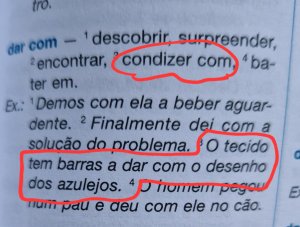
Condizer com = dar com
  • Chegamos no Porto, de manhã, fomos do comboio das sete e regressamos ao fim da tarde ✖️ Vamos ao/Vamos no = We are going to Porto. In the morning, we’re going by train at 7.0p and return at the end of the afternoon. This is a bad fail. The tenses are all wrong, even. I think if I’d gone back and checked this one I’d have spotted it but I didn’t.
  • A cor das cortinas dá-se com as tonalidades usadas na decoração da sala ✖️ dá com =The colour of the curtains matches the tones used in the decoration of the room. I guessed “dar-se com”, which usually means “to get in with” would also mean match, but “dar com” is the right answer. It has a few different meanings but “condizer com” (to match) is one.
  • O autocarro 31 vai para a cidade universitária? ✖️ Passa pela = Bus number 31 goes through the University town?
  • O Pedro deu-se pela janela do comboio para admirar a paisagem. ✖️ Chegou-se à = Pedro went close to the train window to admire the countryside.
  • A Maria andava completamente obcecada por uma colega: lançou-se em si, constantemente, a pensar nele e não conseguia concentrar-se no trabalho. ✖️ Dava por =Maria was completely obsessed with a colleague: she was aware of him at all times, thinking about him and she couldn’t concentrate on work.
  • Emagrecia de dia para dia: os médicos passaram a pensar que fosse cancro. ✖️ Chegaram a = she was getting thinner day by day: the doctors had reached the point of thinking it was cancer.
  • A mãe quando o viu partir, de tão comovida, pôs-se a chorar. ✔️ Good lord, I’m on question (g) and this is my first right answer???
  • Como a Laura quase nunca sorri, muitas vezes passa por antipática. ✔️
  • Depois de muitos desgostos e desilusões, a Marta, deprimida, deu em alcoólica ✔️
  • Todas as cenas do filme não passaram dum manicómio ✖️ se passam num = All the scenes take place in a madhouse. This is a really good example of me getting it wrong because I got the wrong idea about what they were trying to say. I thought it was a bad film and every scene was like a madhouse.

Oh god, I’m so lost…

  • Esse aparelho tão esquisito dá para quê? ✔️
  • Acho que há pouco comida, as sardinhas não chegam para tanta gente ✔️
  • Não posso ir a um café a meio de manhã ✖️ passar sem = I can’t do without a café at midmorning.
  • A Helena dá-se bem com todos os seus colegas de trabalho. Assim o ambiente é ótimo. ✔️
  • O cão-polícia lançou-se sobre ladrão e conseguiu dominá-lo ✔️

OK at this point I had some wine. Let’s see how my success rate changes

  • O Rui vai a frequentar concertos, desde que namora com aquela pianista ✖️ passou a = Rui started going to concerts ever since he started dating that pianist
  • Estamos fartos de tentar modos diferentes de resolver a equação matemática mas não conseguimos chegar à solução. ✖️ Dar com = We’re exhausted from trying different ways to resolve the maths equation but we can’t find a solution
  • A empregada pôs os pratos e os talheres sobre a mesa para o jantar dos patrões. ✔️
  • O deputado do partido “Os Verdes” foi ontem a Dublin, onde esteve dois dias e deu uma conferência. ✖️ Chegou de = The MP from the Green Party arrived yesterday from Dublin where he was for two days and gave a conference.
  • O António foi para Bruxelas com um contrato de trabalho de três anos. ✔️
  • Abriu a porta de repente e deu com o filho mais novo a fumar às escondidas. ✔️

Oof, pretty terrible. Maybe I need to keep ploughing on because I’m really not doing well with these! That’s what? 11/21? Even with a reference book to hand. Terrible!

Posted in English

Compound Verbs

Hard Mode Homework. From Português Outra Vez: using verbs with prepositions. Often the meanings of the verbs can change so radically with the choice of preposition that it basically acts as a compound verb. The base verbs it offers are these

  • Andar
  • Fazer
  • Ficar
  • Ficar-se
  • Vir
  • Voltar
  • Voltar-se

Each can use a variety of prepositions and I’m using the Guia Prático de Verbos com Preposições by Helena Ventura and Manuela Caseiro to pin down which is which. I often use some of these without quite realising why and it’s useful to spell it out.

Quite often, I’ll come across a feature of Portuguese and think it’s weird and unlike anything in English and then I realise that, no, we do have them, we just don’t notice them because nobody draws attention to their existence. Think of the difference between “Stick to”, “Stick out” and “Stick around” for example – or “Pass by”, “Pass over”, “Pass for” and “Pass out”.

Andar

  • Andar a (+inf) = to progressively achieve something (ando a ler Fernando Pessoa)
  • Andar com = to feel (anda com dor de dentes) OR to live with (ele agora anda com gente muito esquisita) OR to have something with you (ela anda sempre com o telemóvel)
  • Andar de = to use some form of transport (ando de bicicleta)
  • Andar em = to frequent (ela anda na Faculdade de Direito) OR to achieve (ela anda em grandes obras na casa de praia)
  • Andar para = to have an intention to do something (ando para ir ao cinema)
  • Andar por = to approach (o preço do carro anda por dez mil euros) OR to visit, pass through, hang out in (gosto muito de andar pelos parques)
  • Andar sem = to be without something (o Pedro anda sem atenção)

Fazer

  • Fazer com (que) = to force (fizeram com que o ministro aceitasse as reivindicações) OR to have a consequence (a avaria na EPAL fez com que alguns lisboetas ficassem sem água durante muitos dias)
  • Fazer de = to act like (o Pedro fazia de palhaço) OR to transform (os E.U.A. disseram que queriam fazer do Iraque uma pátria livre)
  • Fazer… Por… To do something for (or on behalf of) someone (a Patricia fez o trabalho pelo colega)
  • Fazer por (+inf) to make an effort (ela faz por gostar de bacalhau mas não consegue)

Ficar

  • Ficar a =to be in a place (Lisboa fica a cerca de 300 quilómetros do Porto) OR to stay somewhere (não fiquei a assistir ao espectáculo ao final)
  • Ficar com = to get, or keep hold of (fico com a blusa verde) OR to continue to feel (fico sempre com medo quando ouço barulhos estranhos)
  • Ficar de (+inf) =to promise to do something (ele ficou de passar por minha casa às nove horas)
  • Ficar em = to stay, to be situated – similar to ficar a (o Hospital fica em Lisboa, a atleta Rosa Mota ficou em primeiro lugar)
  • Ficar para =to be destined for something (o colar de pérolas fica para ti) OR to be deferred (a nossa conversa fica para amanhã)
  • Ficar por =to support (nas discussões ela fica sempre pelas mulheres) OR to substitute for someone (o meu colega ficou por mim) OR to cost (o fato ficou por cem euros) OR to remain uncompleted (as camas ficaram por fazer porque ela teve de sair à pressa) OR to stop (hoje ficamos por aqui)
  • Ficar sem =to lose or be deprived (ficamos sem água toda a tarde)

Ficar-se

  • Ficar-se por =to limit oneself to (na reunião com os seus apoiantes, o presidente ficou-se por um discurso breve)

Vir

  • Vir a =to attain an objective (se vice estudar muito, pode vir a falar português corretamente)
  • Vir de =to finally do something (era minha intenção saudar os alunos que vinham de chegar)

Voltar

  • Voltar a =to repeat an action (o telefone voltou a tocar)
  • Voltar para =to turn something toward (voltaram os olhos para o céu)

Voltar-se

  • Voltar-se para =to turn toward (voltei-me para ele e disse-lhe tudo o que oensava

The book lists several other combinations of verbs and prepositions but I don’t think they are different enough from their original meanings to bother defining like this. For example, vir normally means “come” and you can come to, come from, come by and so on. Voltar means return, and you can return to, from, whatever. It’s not rocket science.

OK, here we go… I’ll put my answers in brackets. When I get it wrong, I’ll cross out my answer and replace with the corrected version.

A Teresa (anda para ficou de) passar por minha casa hoje à noite para estudarmos juntas, espero que não falte. [hm, I don’t think my answer was too bad. Maybe not the best one, but doesn’t seem wrong either…]

Após muitos anos no estrangeiro p Zé, cheio de saudades, (voltou para) Portugal

Lisboa (fica a) cerca de 300km

O excesso de açúcar é de álcool (faz com) que as pessoas fiquem obesas

Quando eu morrer, o meu colar de pérolas (fica para) a minha neta Joana*

Para cá chegares mais depressaa, sugiro-te que (vir venhas pela) autoestrada.

De repente (voltou-se para) o chefe e disse-lhe tudo o que lhe ia na alma.

Costumas (andar de vir a) pé ou (andar vir de) autocarro para (andar vir para ) a faculdade? [The word “para”, just after “autocarro” is missing from the book but it doesn’t make any sense without it, so I’m not 100% sure but I think it should be there]

Porto Covo (fica na) costa vicentina, (fica ao no) litoral alentejano

Não gostava de (andar de) transportes públicos sobretudo, detestava (andar de) metro

Se estudares muito, podes (vir a) falar português fluentemente no futuro**

Eles (virão de ficaram de) pagar as dívidas às Finanças no prazo de seis meses, caso contrário vão a tribunal [OK I can see that makes sense]

Eu (ando a) ler um livro de Mário de Carvalho***: “A Arte de Morrer Longe”

Ele (fazia por) agradar ao chefe mas era sempre um esforço em vão.

O ministro, lacónicamente (ficou-se por) um breve discurso na tomada de posse

(Andamos para) fazer um passeio no Douro, já há dois anos, mas ainda não nos foi possível fazê-lo.

Depois da queda do muro de Berlim, muitos imigrantes da Europa de leste (vieram para) Portugal.

A empregada é incompetente: limpou mal a casa e as camas (ficam ficaram por) fazer. [I was umming and ahhing over the tense for ages and it looks like I plumped for the wrong one]

Carlos, (voltou voltaste a) casar? Não desistes, é a terceira vez!

Os lisboetas (ficaram sem) água durante toda a manhã. Foi o caos!

Por vezes, convém-me (fazer de) surda, para não ter de responder a certas pessoas

*Woah, this question from Português Outra Vez is almost exactly the same as the one in a the Guia Prática.

**Another one! Oh right, I’ve just realised Helena Ventura is a co-author of both so she’s probably recycling her own material

***Coincidentally, I have a different book by the same author, Ronda Das Mil Belas em Frol, on the arm of the sofa as I write.

Posted in English, Portuguese

Grammar Practice

Verb conjugations and prepositions from Português Outra Vez. The conjugations are easy enough, the prepositions, as usual, are confusing.

Não consigo tratar a Adelaide por “tu” (I can’t call Adelaide “tu”)

Os polícias caíram sobre os assaltantes que foram apanhadas em flagrante (The police fell upon the thieves, who were caught red handed)

A notícia correu em todos os jornais.(The news ran in all the papers)

As traseiras do prédio dão para o cemitério (The rear of the building faces the cemetery)

O Zé é tão parecido fisicamente com o pai. E em matéria de teimosia também sai ao pai. (José is so physically similar to his dad. And as for stubbornness too, he takes after his dad)

Costumo tratar com carinho as minhas empregadas, para que se sintam à vontade (i usually treat my employees with kindness so they feel at ease)

O estudante coreano saiu-se muito bem na prova oral de língua portuguesa (The Korean student did very well in the spoken Portuguese test)

Depois daquele escândalo, o político caiu em desgraça e foi esquecido por todos (After the scandal, the politician fell into disrepute and was forgotten by everyone)

Tento convencer-te mas vejo que não consigo levar-te a gostar de jazz. (I try to convince you but I see that I can’t make you like jazz)

Não resisti àqueles bombons de ginja: acabei com eles em dois tempos (I couldn’t resist those sour cherry sweets: I polished them off in two goes)