Posted in Portuguese

Interlude 3: Gentrificação e Turismo

É sempre fácil de esquecer que as forças que conduzem o crescimento e a mudança da nossa própria cidade agem em outras cidades porem toda parte. Por exemplo, notei ontem as diferenças entre as áreas de Lisboa onde há muitos turistas e onde não há nenhuns.
Algumas diferenças são positivas, claro: apartamentos, hotéis, lojas, tudo tinham sido renovados, mas outros aspectos na mudança são mais problemáticos. Por exemplo, sinais escritos em inglês*, lojas cheias de produtos horríveis, e há áreas da cidade onde o ambiente turístico fica tão chato que adivinho que um lisboeta não queira ir.
Os académicos que têm feito estudos da gentrificação dizem-nos que o processo dá benefícios a uma cidade, mas acho que, quando for acompanhado pelos turismos pode prejudicar o carácter da cidade. Neste caso a responsabilidade para evitar danos é com o governo local e com os turistas.


*=este frase foi disputada em italki. A minha resposta foi assim: Pode ser não queria dizer “sinais”. Estava a pensar em nomes da varias lojas, texto nas ementas e coisas deste tipo. Por exemplo, no meu blogue, mencionei este mercado, designado “Time Out Market” em vez de “Mercado da Ribeira” ou “Mercado do tempo a fora” ou qualquer nome portuguese.

time-out Alguns Lisboetas jantam lá, pois claro, mas parece um “tourist trap” e confesso que tomámos um almoço e um pequeno-almoço ali durante as nossas férias. Uma empregada disse me que uns clientes zangaram consigo porque não falou bem inglês. É normal que espaços deste tipo vai crescer numa cidade com muitas turistas, mas é saudável…? Hum….

Posted in English

Language Love and a Colourful Map

I was interested to see the reaction to “Don’t Blame Benny” a few days ago, both from the author of Loving Language, Richard Benton, and from the subject of the original post, Benny Lewis, via twitter. The debate of which it is a tiny part is still going on and I think it’s well worth a look if you are in the mood for a new perspective on languages. The latest post is here, but you can track back to earlier instalments.

I’m not planning to say anything more on the subject because I feel like I’ve had my say already. I find myself drawn to his core idea of learning languages spoken widely in your own community (see the second video on the about page for a good intro) despite already-expressed reservations about some of the specific arguments advanced in support of it.
udnwmumAnyway, in case you’re interested, here’s a map that did the rounds a year or two back of the languages most spoken in my home town of London, other than English of course. I live in LB Richmond where the second language is Polish. To be honest, I wouldn’t have guessed this as it’s so diverse around here that there isn’t one dominant group. Just thinking of children in my daughter’s class at primary school and their parents (maybe 40 kids in total over the years): Poland, Portugal, Brazil, Finland, Denmark, Sweden, America, Canada, Thailand, India, Pakistan, Jamaica, Iceland, um…. Oh Lordy, I’m sure I’m forgetting a few… she shared a class with three times as many children with Portuguese language ties as Polish, for what it’s worth.

There’s a breakdown of the numbers on randomlylondon, which I basically agree with: that it’s surprising to see Portuguese Spanish and French as dominant languages in some boroughs, and interesting that if Southwark were a bit bigger, it and Lambeth would look like a tiny map of the Iberian Peninsula. Portuguese around Streatham, Clapham, Vauxhall sounds about right though, so if you want to know where to get a decent cup of coffee or a custard tart, now you know.

What surprised me most is that Greenwich seems to be Little Kathmandu! If you’d asked me to guess I would have said that you’d need to move the entire population of Nepal to London to make an appreciable dent in the demographics, but… well, that’s what the numbers say, apparently. 26 million people live in Nepal, 50,000 in the UK and 19,000 in London. I should have been more surprised by the fact that Lithuania (population less than 3 million) seems to have so many of its citizens based out in the Essex fringes.


Posted in English

Don’t Blame Benny

I saw an interesting and controversial article on Twitter, published on the  Loving Language Blog (a blog I follow but apparently missed this the first time around!). The author, Richard Benton, seems really cool and I like his approach to learning languages and building communities in general but in this case I think he has picked the wrong target and maybe also been a little pessimistic and since twitter is a bit limited in space allowed for a reply I thought I’d do a blog post to say why I think so.

Intro: The Benny Lewis Phenomenon

Firstly, let’s start with the man mentioned in the first paragraph – Benny Lewis, aka Benny the Irish Polyglot, author of “Fluent in 3 Months“. Benny is the best known example of what I would call a “celebrity polyglot”. In other words, he is mainly famous for learning languages, quickly and publicly, watched by a huge audience on all social media channels. He has written books and in the process inspired a lot of people to change how they learn languages. Cards on the table, I am one of those people. I used to learn languages mainly from books. It didn’t work out too well I’m afraid, but I’m having a lot more success these days. largely thanks to him. I’m not a full-blown disciple, and I don’t follow him very closely, mainly because one of the languages he speaks is a hideous travesty called Brazilian Portuguese, but I have to admit if I hadn’t stumbled across his website I’m pretty sure I wouldn’t have got as far as I have.

Benny and Tim

Lewis himself is part of the digital nomad movement but I wouldn’t say he was the author of it. That honour seems to go primarily to Tim Ferriss, author of “The Four Hour Work Week“, a guide for people who want to live carefree in the world by farming out their work to a third world underling. To be honest, I haven’t read any of his 6,729 published works so I am probably being unfair, but this seems to be the buzz around it. Ferriss himself started a hands-off business selling supplements through a website which apparently was  nice little earner, but I bet his income as an author and speaker has eclipsed that a long time ago. So when I read about a gathering of digital nomads who were all “white people” (I’ll come back to that later) it was Ferriss I was thinking of, not Lewis.

I share the view that encouraging people to produce as little actual value as possible and just ponce off the labour of others seems like a recipe for the worst kind of douchebaggery but I must admit that some of the followers of the four hour workweek have spawned some interesting and useful business ideas that have actually made the world better without any real harm. Benny is a pretty good example of that, and I can also think of Steve Kamb, creator of Nerd Fitness, who turns couch potatoes into ACTUAL SUPER HEROES! And I’m sure they’re not the only ones.

The Case For Benny

Shelving the wider question of digital nomads, let’s focus specifically on the polyglot angle to this. The case against Benny seems to be largely that he “gave people the tools to exploit more people in more countries”. I don’t think this is entirely fair. Rich people have always been able to exploit poor people – that’s usually how they got rich. Now maybe more knowledge is more power, but I don’t think learning language from someone makes your hosts poorer or makes you a worse human. Moreover, I don’t actually see why people shouldn’t travel while they work.

This brings me back to the “Notice how many white people are there?” comment. I find this irritating, to be honest. If someone posted a picture of a café in London and said “Look how many Asians are there?” I would find it annoying for exactly the same reasons. Being  foreign doesn’t make you bad. Let’s stick to what people are doing while they’re there. Maybe there’s a case to answer for the behaviour of the white people (and Richard certainly seems to think so, as we’ll see below) but I think starting with the skin colour is unhelpful.

The observation does have some light to shed though, in one important way: what it tells us is that here we have a lot of people from Oz, from the UK, from America, who have – so we’re told – read “Fluent in 3 Months” and spent enough time listening to locals that they can now hold a conversation. Well hallelujah! Back when I was slumming it around the world, my method of communication consisted of “Excuse me, do you speak English?” I’m not proud of that but it’s true. And all my fellow travellers – Kiwis, Yanks, Aussies, Brits – were just as bad because historically English speakers have been absolutely terrible at learning languages. Wherever we go we’ll find someone who is able to speak English well enough to direct us to the nearest photo opportunity, so why bother, right? The fact that that’s changing seems like a huge step forward. Not the whole answer but a start.

The Problems with Polyglot Culture

From a survey of various Polyglot sites and podcasts, I can see there are a few things about the whole “polyglot” thing that rub me up the wrong way. Some of those things are related to “digital nomad” culture, but when I think them through, more often than not, they are usually just aspects of the wider cult of hedonism and self-actualisation in western society, and particularly younger people of the American persuasion (I’m 47 and British so maybe I’m biased!)

  • I feel there’s an element of “trophy hunting” about it. Often the number of languages a person speaks is dropped into the conversation, with points seemingly attributed not to how they have used the knowledge but for how difficult it was to conquer.
  • It doesn’t really offer a critique of selfish, heedless attitudes to other societies. True, there are often asides about learning other cultures but they often feel like they’ve been tacked on and that often the person is more interested in getting laid* in as many countries as possible because they are the guy in the nightclub who can actually speak _______ (insert name of local language) with a cute ______ (insert own nationality) accent.
  • Generalised disapproval of the idea of global jet travel and environmental impact of travel generally. These objections are set out more clearly in a follow-up post in which Richard discusses some other people’s critiques of his ideas and sets out some of the detrimental effects of tourism bringing money into a poor economy.

However, I can’t lay any of these problems at the door of language-hacking; they’re all things that were happening anyway, but in the past they were done by people speaking (or shouting) only English and unable to understand any objections put to them. Encouraging English speakers to pay attention to people from other cultures is a huge benefit, because contrary to what the blog post implies, language-hacking doesn’t consist of drinking by the pool; you have to speak to other humans, and little by little, those language students will absorb enough actual experience from their interlocutors that in time they will come to have a broader appreciation of other cultures. And oh my god, is that ever something our world needs right now! This, to me, seems like the truly good and important thing about the trend for learning languages. It’s small but it’s significant, and I think we should encourage it.

And for those of us who don’t travel, the internet is such a huge help. I’m learning Portuguese and my daughter is learning Japanese from a native speaker on the other side of the globe. I can’t even begin to imagine how hard it would have been for me, age eleven, in Preston at the dawn of the eighties to learn Japanese. That’s a whole window open in her mind that was never opened in mine. And it’s happening more and more in the Anglosphere. Thank you internet. Thank you! And thank you Benny Lewis! For all your imperfections, you beautiful Irish moustache owner. Thank you! Thank you!


*=Sorry, this isn’t an expression I use often but it seems to fit in this context!


Disclaimer

It’s too easy, when discussing things like colonialism and race, to stray the wrong side of the line that divides debate from incivility. I hope I have stayed on the right side of that line. I am not in any way intending to disrespect the blog post or – God forbid – make any sort of daft reverse-racism aspersion about the comments about the white people in the photograph. I’ll leave such tactics to the knuckle-draggers, Alt-Right and  Trump supporters, but if I haven’t expressed any of it properly then I hope you’ll not hold my poor prose style against me!

Posted in English

Portuguese Views of Brexit

Here in the UK, everyone’s nerves are shredded. It’s the 22nd of June, the day before the referendum. At this stage, nobody is going to change their mind and on Twitter, conversation quickly moves from disputing the veracity of a statistic to name-calling, blocking and general unpleasantness.

That being the case, I thought I would go further afield and look at some Portuguese reporting on the Brexit on the grounds that looking in from the outside might give some useful perspective. A few days ago, I blogged about the delightful description of Boris Johnson by Miguel Esteves Cardoso in a column in Público (cf “Learning from the Brexiteers“) but I have come across some other examples, too. As you would expect, it’s a mixture of fear for the future of the EU and the Western Alliance more broadly, versus a sort of mystified bafflement about why we are having this collective hissy-fit, and I’ve even seen a few saying “sod ’em” and describing the UK as “the Crying Child of Europe”. It’s a fair cop.

First of all, I was interested to see some views from Portuguese people living in Britain. Here’s one in the Jornal de Notícias, and another in Bom Dia Europa. The worry for existing residents is twofold. First of all, although it’s unlikely there would be mass deportations, nobody knows what post-brexit Britain will be like, so it’s not impossible, and with the mood getting as ugly as it is. I know my wife and some of her friends are already sensing a higher level of ambient resentment against them from people whose opinions are formed by the Daily Mail and Daily Express. Secondly, Portuguese people will have a higher level of hassle and inconvenience moving about,. Presumably it’ll be the same for Brits living in Spain who will be lose a lot of their current rights and entitlements. And we haven’t even got into things like VAT harmonisation and the nightmare small businesses will face dealing with paperwork, reclaiming money and on and on. Some of the interviewees are small business owners and there’s a level of concern about the unknown consequences as they see the remain campaign being forced onto the back foot by the giddy, unthinking optimism of the leave campaign for some ill-defined future. Some are considering leaving.

Next, let’s look at a blogger – César Agosto – who writes for Homo Causticus on WordPress. He has blogged a few times on the referendum and related matters such as the last general and mayoral elections. I don’t know anything about him but I guess he must live here, or visit often, or at least be a keen bifewatcher because his blogs draw on a knowledge of history and pop culture. In “As Propostas Por Favor” he rightly highlights the lack of a clear sense of what is to come after Brexit, and the problem that causes in trying to decide whether or not you want to support it. In Life on Mars he uses the TV show of the same name as a jumping-off point to illustrate differences between the seventies, when the first EEC referendum took place and the modern world, where we are now holding the second one on the European Union. The first is typified by the famous debate between Tony Benn (much-revered eccentric hero of the left) and Roy Jenkins (mainly remembered, I think, for his speech impediment). Each one is measured and forceful, defending their views (basically: economics vs democracy) without rancour (just as well… I don’t like to think what would happen if Roy Jenkins were to say “Rancour”).

What he could add, but kindly doesn’t, is that the second is typified by the sight of useless, workshy UKIP MEP Nigel Farage telling Herman Van Rompuy ” I don’t want to be rude but, really, you have the charisma of a damp rag and the appearance of a low-grade bank clerk”. And this is what our country has come to after forty years. Other modern figures get a mention too, and not just the usual suspects. Redwood gets a mention, and Cameron’s Eton demeanour is contrasted with Sadiq Khan, famously the son of a bus driver. Bizarrely, he is described as charismatic, although to me he seems to disappear into the background on any stage he’s on, even when he’s actually speaking, but hi ho.

In the news media, there is some sympathy for the idea that the EU is in need of a good kick in the arse. For example, José Pedro Teixeira Fernandes says “Long Live the European Union – and Down with the technocracy of Brussels and Frankfurt” while José Vítor Malheiros proclaims “The EU has turned Europe into a brothel” and argues that the brexit might just cause a welcome return of democracy to the region. Portugal, of course, has had its fair share of problems with the EU, and has more cause for complaint than our whining. With that in mind, Paulo Pisco calls the brexit vote “A national egoism” and defends the humanist spirit of the European project against the xenophobia and selfishness of one nation that seems to want to dominate it completely. Actually, Público is buzzing with columnists looking for an angle on the story, so you can take your pick, really.

Finally, there’s an article I can’t even read in its entirety because it has a paywall but I liked the first few lines. As you know, last week  some deranged idiot, driven on by some misplaced sense of fighting against “traitors” shot and killed his local Member of Parliament, Jo Cox, near a constituency surgery. There was – and still is – a heated and rather nonconstructive debate about the extent to which the tone of the Leave Campaign’s rhetoric fed a climate of violence that led to the attack. In “I am Jo“, João Duque invokes the memory of “I am Charlie” to stand with her against violence and for European values. Paraphrasing the first three sentences:

If Jo Cox died because she believed the UK is important to the EU then I am Jo

If she believed that a more diverse Europe can be richer and more stable then I am Jo

If Jo Cox believed that democracy will allow wisdom to prevail then I am Jo


Posted in Portuguese

Book Review

Europe In or Out: Everything You Need to Know by David Charter

Original (and more detailed) review in English here

22388483Estou a escrever este comentário três dias antes do referendo, por isso, se pensa em lê-lo, venha logo!

David Charter é um jornalista do “The Times” em Londres com um impressionante conhecimento do funcionamento interno do UE. É cético sobre o assunto, mas com uma certa forma de ceticismo: Quer investigá-lo e descobrir o que acontece lá, ao contrário da outra definição de ceticismo, que significa odiar a UE e todas as suas obras para as razões viscerais.
O livro é dividido em duas partes. A primeira parte trata de argumentos a favor e contra o “brexit” que se referem às maiores áreas do mundo político: a segurança, a prosperidade, a paz, a cooperação com os nossos vizinhos no continente, a democracia e algumas coisas assim. Não é surpresa que as maiores dúvidas (a economia, a influência mundial) apoiam a ideia de ficar na UE. Por outro lado, o assunto da democracia é mais difícil de resolver, e depende de como acha do com promisso entre a cooperação, a falta da democracia em Bruxelas e as problemas de segurança por causa das fronteiras porosas. A segunda parte concentra-se nos maiores sectores económicos como o financiamento, a agricultura e a pesca. Claro que o sector dos serviços financeiros será confuso sem as ligações à UE, e é mesmo para a agricultura. Além disso, a pesca, apenas tem muitas regras más, não conseguirá ganhar muito por causa do “brexit”.
O leitor pode fazer as suas próprias conclusões, e os prós e os contras são resumidos para ajudar a avaliá-los.
Uma coisinha que não concordo com o autor é o assunto de dúvidas sobre a situação após o “Brexit”. Ele afirma que esta incerteza vai assustar-nos e por isso vamos ter medo de mudar, mas parece que a verdade é o oposto: a incerteza ajuda a campanha de brexit. Acho que cada “brexiteer” tem uma diferente visão individual da vida no futuro. Algumas esperam que o Reino Unido vá estar na Área Económica Europea (EEA), outros na Área Europeia de Comércio Livre (EFTA) e mais algumas creem que apenas devemos ter um acordo de livre comércio com o continente.
Estas opiniões têm um certo apelo para vários grupos dentro do campo de Brexit, mas não pode acontecer a todos, e por isso, muitas pessoas vão ficar desapontados. Votarão para as suas próprias utopias, mas receberão um governo escolhido por uma pequena minoria.
Esta é a razão pela qual os britânicos devem de ter medo.

Posted in English

Learning from the Brexiteers

I learned a fantastic new word today from Miguel Esteves Cardoso’s piece “Não ao Brexit” in the Portuguese tabloid Publico. In it, he’s describing the contrasting personalities of the two main Brexit advocates, Gove and Johnson. The word is “queque” which I think is pronounced like “cake” with perhaps a bit more tail on the end. It literally means cupcake and he uses it in the sentence “Johnson é simpático e queque.” Johnson is likeable and cupcake. So what does that mean, I ask my wife. Basically it means… well, someone like Johnson – vain, snobbish, wanting public admiration. I guess the closest english equivalent would be “toff”, not that it’s exactly the same word, but it’s in the same area and of course has a link to confectionery (being short for “toffee nosed”).

Johnson doesn’t get off so lightly as this sentence though. All the way through, Cardoso seems to be contrasting Gove’s honest nationalism and intellect with Boris, who he describes as “um  aldrabão” (a crook), “um palhaço esperto, indolente e mentiroso” (an expert clown, lazy and dishonest), and “um traidor e um oportunista” (a traitor and an opportunist). In summary, to contrast the two “Johnson é um Trump educado e europeu enquanto Gove é um Larkin prosaico e incapaz de poesia”, all of which is so close to the English that even if you don’t speak Portuguese, you probably get the gist, but in case not “Johnson is an educated, European Trump, while Gove is a prosaic Larkin, incapable of Poetry”.

Such a great character sketch and yes, I’m definitely saving that word, queque for later.

Posted in English

Portuguese Somersault

Eastbourne doesn’t have much to recommend it but it has – or had when I lived there, anyway – an absolute jewel of a bookshop. It was a massive, sprawling affair with three floors and no recognisable system. Sometimes there was a parrot upstairs. And it was there that I first came across a book called “Portuguese Somersault” by Jan and Cora Gordon. I’d never heard of it before and I haven’t heard much of them since, either. To my surprise, though, they are still known today, and there’s a chap who has taken the time to curate a fan site, with biographical details and more about their various travel writings, which you can find at janandcoragordon.co.uk.

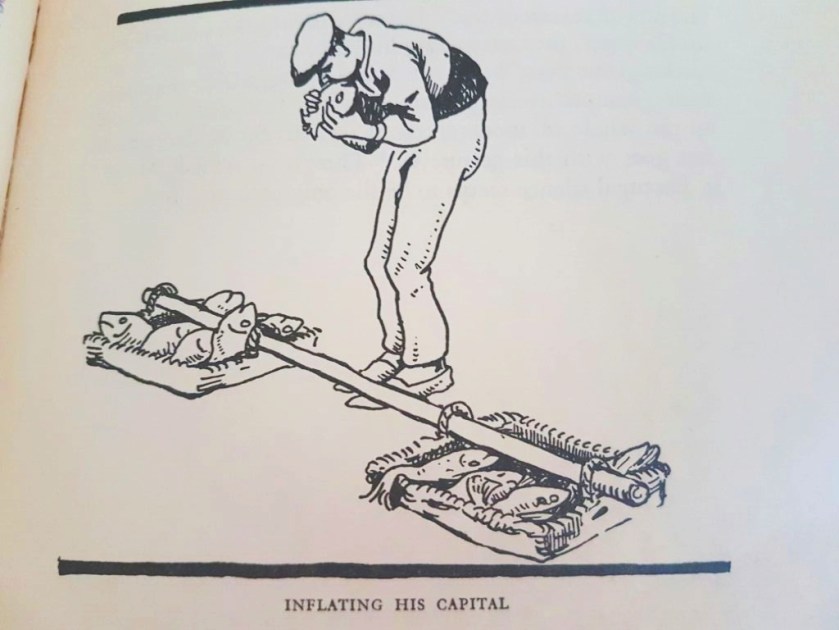
The book is actually two books, written in 1926 and 1933, detailing their travels in the country. They are reflective travellers who took the trouble to learn something of the language and to investigate their own preconceptions of the country. Along the way, they made sketches, and these are scattered throughout the chapters as illustrations. Here, for example, is a fish seller blowing into his fish to make them look bigger so he can get a better price. Cool eh?

IMG_20160510_21353

I read it yonks ago and can’t actually remember a whole lot of it, to be honest. Maybe it’s due for a re-read. What I do know is that the “Somersault” of the title is a reference to the dramatic change in the country between the two visits. 1926 was the year of the coup that overthrew the Primeira República Portuguesa and established a dictatorship which, by 1933, when they returned, had become known as the Estado Novo (New State), led by António de Oliveira Salazar.

One small, dark detail stuck in my mind that gave me a little premonitory shudder: On page 75, they meet a Portuguese girl who had been separated from her parents during the Great War and left with relatives in Germany. Growing up, she believed herself to be German. When she was finally reunited with her parents, ten years later, she was pleased of course, but it came as a huge shock to her to find that she wasn’t a German at all. What a jolt that must have been to a girl who felt herself to have a “German Soul”. Now, at the age of seventeen, she would have less freedom than before. Worse, she would have to marry a Portuguese man who wouldn’t even understand her German love. Well, I think we can all see how this sort of cultural dislocation would be a shock to anyone. What I thought was telling, though, was when she describes her disappointment at finding out that she wasn’t who she thought she was:

“They want me to be a nice Portuguese girl but I can’t because, you see, I’ve been brought up as a German girl, and I was taught in the school that the Germans are the higher race, aren’t they? Do you see that?”

Jan and Cora note this as a minor personal tragedy but don’t comment on the idea that Germans are teaching children to feel themselves superior to everyone else. And this just ten years from German bombs falling on neighbouring Spain at the start of the Civil War, thirteen years from the start of the Second World War. The Salazar government was neutral in both, but gave military and logistical support to the Nationalist (and German) side in Spain and was broadly sympathetic to Hitler, only staying out of World War Two because of long-standing alliances with Britain.

Well, it’s easy for me, with the benefit of hindsight, to read more into this incident than the Gordons did. I certainly don’t mean to suggest that they should have seen the future in that one little tale, but I thought it was a fascinating little glimpse into what was happening under the surface of Europe in the inter-war years.

Posted in Portuguese

Dois Artigos

This iTaki notebook entry is pretty thin stuff as politics goes but it was a good way of challenging my vocabulary, so…

25abrilHoje, dois artigos no jornal “Publico” chamaram a minha atenção. Nos dois o objecto é Portugal e a sua lugar em Europa. O primeiro artigo se publicou ontem, no aniversario do “revolução dos cravos”. Este artigo diz que um quinto da população do Portugal têm saudade do “Estado Novo” (o governo de Salazar e, depois dele, Marcelo Caetano, que dominaram o pais entre 1933 e 1974). Surpreendi-me. Não entendo como tanta gente num pais como Portugal podem sentir simpatia por um governo que tinha muitas características do fascismo! O artigo sugere que uma razão importante atrás desta simpatia de autoritarismo está a crise económica. E esta conclusão parece razoável: Nos tempos difíceis, as vezes, algumas pessoas voltam-se aos partidos que oferecem respostas fáceis, mensagens claros e uma imagem de força. Felizmente, a maioria dos Portugueses não concordam. Eles orgulham-se do seu pais e da sua revolução.
Entretanto, um outro pais de Europa, nomeadamente Polónia, já há um governo da direita. O partido Lei e Justiça ganhou as eleições de 2015, prometendo as medidas fortes contra a imigração. Eles afirmam que os migrantes muçulmanos do meio-oriente ameaçam o seu modo de viver. (Como se diz em Português “Pffff!”?) De qualquer maneira, alguns dias atrás, um estudante Português do programa “Erasmus*” foi atacado por um homem. Este homem (um militar) chamou-lhe “lixo” e lhe puxou pelo cabelo e pela roupa. O motivo, segundo o artigo, foi racismo. Pode ser que o homem não gostou do seu sotaque, sua pele… não sei.
Este artigo é o mais popular no website de Publico hoje. É um lembrete a todos para que as nações da Europa rejeitaram o fascismo muitos anos atrás. Somos melhores, mais fortes, quando trabalhamos juntos, ajudando uns aos outros.

Os Artigos
Crise leva um quinto dos portugueses a terem saudade dos tempos antes do 25 de Abril
Estudante português terá sido vítima de ataque racista na Polónia

*= Erasmus é um programa do UE para deixar as estudantes aprenderem nos outros países da união.


Thanks to Rubens for the corrections.

Posted in Portuguese

O Sistema de Transporte Em Lisboa

Hoje li este artigo no website do jornal Portugues “Publico”
http://p3.publico.pt/actualidade/ambiente/20282/rede-de-metro-alargada-e-seis-mil-novas-bicicletas-nas-cidades

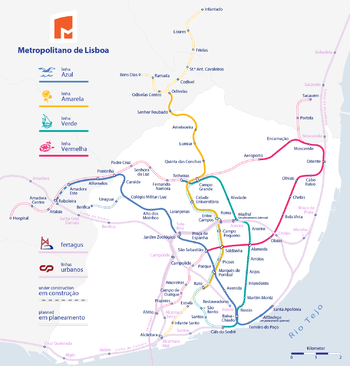
O artigo afirma que tanto Lisboa como Londres vão aumentar o seu sistema de transportes. Especificamente, o governo decidiu alargar as redes do Metropolitano e promover outras formas de transportes, incluindo veículos eléctricos e “car-sharing” (no que os trabalhadores que conduzem até ao local de trabalho dão uma boleia uns aos outros e por isso usam um carro em vez de três ou quatro) para melhorar o ar e reduzir níveis de dióxido de carbono e outros poluentes desagradáveis.
Além disso, a coisa que mais me interessa é onde o artigo menciona a intenção de melhorar as condições para o uso de bicicletas. Como muitas cidades no mundo desenvolvido, Lisboa reconhecer o problema de der demasiados automóveis nas ruas. Esta situação é prejudicial para o ambiente e para a saúde pública, e pode atrasar o crescimento da economia local por causa de impedir do movimento livre dos trabalhadores entre a sua casa e o seu emprego. 350px-Metro_Lisboa_with_suburban_railway_lines

Mas infelizmente, como
mostrado por a experiência em Londres, marcar um novo caminho de bicicleta com tinta azul não basta. Se a gente não nos sentimos seguros para dar uma passeio de bicicleta, não vamos usá-las. É importante fazer caminhos segregados, e considerar o desenho de todo o sistema de transportes na cidade, para criar um ambiente onde todos os utentes da estrada possam viajar em segurança.

Espero que estas medidas deem certo e melhorarem as condições nas cidades mais importantes de Portugal

Thanks Sophia, Rubens and Bruna for helping me with corrections when this appeared on iTalki.


Posted in English

A Revolução

It’s quite rare that I actually understand tweets in Portuguese. Something about the condensed format, I suppose. I enjoyed these ones though.