Following yesterday’s blethrings about someone else’s sonnet, Português em Foco was like “OK, so why not try one yourself?”
Happy to report the number of errors was pretty low, which is a relief, because it would have been hard to correct without knackering the syllable count! Thanks as always to Cristina for helping weed out the mistakes.
Os anos passam, a vida avança,
Piso sempre esta minha trilha,
Olho com saudades a maravilha
Desta, minha sempre-crescente pança.

Estamos neste baile, então, dança
Até perderes uma sapatilha.
Tu és a minha única filha
Ainda que já não sejas criança.

És mulher, cada dia mais capaz
Mais bela e forte do que toda a gente
Igual ao teu pai, brilhante e sagaz.

Segue os teus sonhos. Por mais que tente
O tempo nunca anda para trás
Então, filha, vive e anda em frente.
Há um capítulo do Português em Foco que explica alguns pontos altos da literatura portuguesa. Um destes pontos altos é o Soneto. Esta forma de poesia é conhecida tanto em inglês quanto em português. Shakespeare escreveu muitos e neste exemplo o seu primo zarolho, Luís Vaz de Camões* também escreveu. Creio que tem mais influência em Portugal, Não tenho nenhuma perícia neste campo mas não acho que houvesse poetas famosos a escrever sonetos em Inglaterra no início do século XX. Em Portugal, sim**.
Um soneto consiste em 14 versos*** arranjadas em quatro estâncias – duas quadras e dois tercetos. Cada verso tem 14 decassílabos. Que raio é um decassílabo? Não faço a mínima ideia mas 14 deles é igual a dez sílabas. Neste exemplo, a rima segue um padrão: ABBA ABBA nas quadras e CDC DCD no tercetos (assinalado acores no transcrito infra), mas este padrão não é obrigatório. O poema “Rústica” de Florbela Espanca que memorizei em 2021 e que tentei, com o hubris dos ignorantes recitar ontem numa aula porque não tinha feito o TPC é um soneto mas corre ABAB ABAB CCD EED.
A forma poética é importante; o autor do livro afirma que “estamos perante um soneto perfeito” por causa do modo em que o poeta distribui os conteúdos pelas estrofes de maneira que cada estância tem o seu próprio tema.
O título do soneto é igual ao primeiro verso:
Mudam-se os Tempos, Mudam-se as Vontades (Times change, intentions change)
Mudam-se os tempos, mudam-se as vontades, Muda-se o ser, muda-se a confiança: Todo o mundo é composto de mudança, Tomando sempre novas qualidades.
Continuamente vemos novidades, Diferentes em tudo da esperança: Do mal ficam as mágoas na lembrança, E do bem (se algum houve) as saudades.
O tempo cobre o chão de verde manto, Que já coberto foi de neve fria, E em mim converte em choro o doce canto.
E afora este mudar-se cada dia, Outra mudança faz de mor espanto, Que não se muda já como soía.
*Obviously joking about their being cousins but this made me wonder if they were contemporaries. Sort of. They overlap by 16 years. Camões was about forty years old when Shakey was born.
**I don’t think I’ll be writing a history of anglo-lusitanian poetry anytime soon though, so definitely take this with a pinch of salt!
***OK, well here’s the first false friend for you: Verso doesn’t mean verse, it means a line of the poem.
As I’ve probably said, I’m a bit of a philistine when it comes to poetry, but the book I am reading on-and-off at the moment, “atirar para o torto” by margarida vale de gato* “dá água pela barba” and my dictionary is taking a real beating. Translating this one in full because there are so many unknowns in it that I lost track. Words outlined in orange are the ones I had to look up
This galaxy will soon be a glowing coal
Our earth sparks - I think this
In the environ** of the street, feeling faint
Words beating in my head
About the cone*** of this planet - oh
warming marble with only one iris****
Fertilising the egg of the moon, steep
curdled, wounded***** red.
I'm going
when i arrive to lock myself out, key
inside, to sleep with the beasts in the dew
and just one bottle - I ought to break it
by the neck to heal
with a ruby in my mouth and anaesthesia
the bluff or another apocalypse
Incidentally, I happened upon a thesis published online where the author cites this poem in full as evidence of “an apocalyptic tone adopted recently in portuguese poetry”
*Should be in title case, I know, but she writes it in lower case on the cover so maybe it’s deliberate, I dunno.
**This is a pretty terrible translation since enlevo is more like enchantment, rapture, that kind of thing but I can’t quite find an english word that works in context. This is why I am not a professional translator!
***Another surprising one. The umbra and penumbra of an eclipse form cones, so she might be referring to that but it’s not clear to me
****I want “iris” to mean the little squiggle of colour inside an old-school marble, but I don’t see any evidence of that online.
*****Coalho was the only word I really didn’t know but it’s hard to see what she’s getting at here. Ingreme usually means steep but can be a high point, coalho means coagulate but can also be a thistle flower of all things. So maybe she means the blood moon looks like a thistle high up in the sky…. nah… i don’t see it.
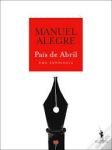
Este livro surpreendeu-me, porque, pelo título, tinha assumido que fosse uma homenagem à revolução que decorreu em Abril de 1974, mas não é! O poema que deu o seu nome à antologia foi escrito em 1965! Mas o poeta teve um papel ativo na luta contra a ditadura, portanto aquele espírito revolucionário permeia a sua obra, quer durante aqueles anos escuros, quer nos poemas escritos após o estabelecimento da democracia. Portanto, eu não estava assim tão longe da verdade!
Como já disse, estou a participar numa maratona literária e uma das categorias é “um género que não costumas ler” e eu escolhi uma antologia de poesia de Manuel Alegre. Sendo homem*, não me dou com poesia, mas o dia 21 deste mês era o Dia Mundial da Poesia, portanto decidi engolir o sapo. Li metade do livro, incluindo este verso na página 20:
“Meu amor disse que eu tinha uns** olhos como gaivotas”. Esta metáfora marcou-me não por ser valida*** mas por não fazer sentido. Porque é que o amante compara os olhos da amada a umas gaivotas? As gaivotas fazem muito barulho. Roubam batatas fritas dos turistas na praia. São brancas. É verdade que voam no céu azul, mas quem tem olhos azuis com íris**** brancas? Ou íris azuis com pupilas brancas? A adequação da expressão terá a ver com a distância, o isolamento ou a vigilância de uma gaivota no céu? Não percebi bem. O amante é um marinheiro e talvez tenha uma perspetiva diferente do que a que nós, que passamos a vida em terra firme, temos.
Mas afinal, esta metáfora é uma metáfora mesmo? Costumo pensar em qualquer expressão deste género como uma “metaphor” em inglês, mas sei bem que temos uma outra palavra, menos eufónica, nomeadamente “simile”. Os professores nos anos oitenta adoravam explicar a diferença, mas não sei se ainda existe nos currículos do século XXI.
E os portugueses também fazem esta distinção? Sim! E a palavra “símile” existe e tem o mesmo significado mas regra geral usa-se “comparação”. O site Ciberdúvidas tem vários artigos sobre metáforas mas nem uma única referência à palavra “símile”, dizendo “comparação” no seu lugar. Veja-se, por exemplo*****, este artigo.
Sei bem como explicar em inglês mas vou pedir um empréstimo ao Ciberdúvidas de certas palavras para preencher as lacunas no meu vocabulário!
Uma metáfora (“metaphor” em inglês) é uma aproximação entre dois termos ou dois objetos sem usar uma partícula de comparação. Assim a aproximação é implícita. Por exemplo
O nosso parlamento é uma pocilga.
Uma comparação (“simile” em inglês) é quase igual, mas, neste caso, usamos a partícula para criar distanciamento do objeto da comparação.
O nosso parlamento é como uma pocilga.
Ambas as figuras de linguagem usam-se na poesia, mas é importante em certas situações, saber a diferença.
*This is a silly joke and not meant any more than I’d I’d said “being British, I never ever use grammar” or “like most people born in the nineteenth century, he had never heard of sexual intercourse because it had yet to be invented”
**The grammar checker doesn’t like this and I suspect it might be an example of poetic language not being like normal spoken language
***I lazily write “apta” as in “an apt metaphor”. Whoops! That seems to be a false friend because that’s not really a thing, and apto has more a sense of “capable”. Valido seems better or possibly adequado (which is another of those words that has a similar meaning but a slightly different weight in Português than its equivalent – “adequate” – in English.)
****Íris is the singular and the plural when it’s used in this sense.
*****I keep putting “por exemplo” et the end of the word, regardless of what else is going on in the sentence but that’s not really how it’s done in portuguese. It’s viewed as an adverb so it gravitates toward the verb. Here’s a Ciberdúvidas article about Por exemplo.
Testing Reader Theories
Thanks to Cristina of Say It In Portuguese for the help with this text. Quite a lot of mistakes crept into the first version. I’m sort of surprised it wasn’t even worse, though, because it’s always hard describing complicated aspects of Portuguese in portuguese.
I came across this quotation by Adília Lopes in a video discussion between Bruno Nogueira, Miguel Esteves Cardoso And Rita Blanco (respectively, a comedian, a journalist/writer and an actress). It’s from a book called Bandolim and I’m not sure but I think it might be a whole poem. “Os ricos são foleiros”. I didn’t recognise the word “foleiro”, which is why I started looking at it more closely. A foleiro is someone who makes or sells “foles”. What is a fole? A leather bag, a device for squeezing air into an organ, a bellows, the bag part of a bagpipe (“gaita-de-foles”) or the interior of an accordion… You get the idea. It’s windy. But foleiro, informally, can also mean ordinary, bad quality, shabby, corny… that kind of thing. It’s the fourth definition in priberam.
Adília Lopes
So the general gist of the ‘poem’ is that the rich are corny, uninteresting and not really worthy of admiration; they just know about money. Well, I can’t argue. Like all extremely true things, it isn’t true, or at least not always but it feels like a good, satisfying, sweeping generalisation and if you’ve ever spent any time reading the twitter feeds of certain silicon valley gazillionaires you’ll know what she’s driving at.
Is exactly the sort of thing I love. The writer is Ricardo Araújo Pereira, comedian, columnist and all round good guy (well, as far as I know) Anyway, in the passage above, he’s describing a song by Chico Buarque and saying that if a foreigner were to hear it, although they would rightly spot that it sounds lovely, they probably wouldn’t understand it and certainly wouldn’t notice that the last word of every line is “proparoxítona”* and nor would they understand that the word “proparoxítono” itself is proparoxítona**. And he’s right: it is a lovely song and when I read this in bed last night I had no clue what Proparoxítono meant but I knew I had to find out as soon as I woke up.
First of all, let’s hear the song
Oh my god, that is the good stuff alright. I know it’s Brazilian Portuguese, not Portuguese Portuguese but Jesus Christ it’s good. Inject it directly into my veins! There is something slightly strange about the rhythm of the verse though isn’t there? And I never would have spotted what it was.
Before I get I to it, let’s lay a bit of groundwork by thinking about where the stress falls in a Portuguese word.
The vast majority of words in Portuguese put the stress on either the final syllable (if the last letter is r, l, z, u or i ) or the penultimate one (basically, all other letters). Any exceptions to the rule need an accent to be added as a hint to the reader. So for example there are a lot of words that end in – ável or – ível that are pronounced with the stress on the a and the i respectively. If the accent wasn’t there you’d have to say incrivEL and confortavEL. But it’s pretty easy and you get used to it, and before you know it, you’re just used to the rhythm of Portuguese speech without even being conscious of it.
Proparoxítono means that the stress falls on the antepenultimate (last-but-two) syllable. These always have to have an accent because they break the normal rules, like bêbado (BÊ-ba-do) and mágico (MÁ-gi-co) and sábado (SÁ-ba-do) and última and único and tímido and… Well, and every other word he finishes a line with in the song, which is why you get this effect that’s really unusual in a Portuguese song, where the last two syllables of every line are unstressed.
Oh my god, that’s so satisfying. I love it! It’s the most value I’ve ever got out of a single paragraph, I think: a new word, a new song and a new way of noticing the rhythm of Portuguese music.
Anyway, if you want to know more, this video has some good analysis. It’s in Brazilian Portuguese too, so be warned if you’re trying to avoid the dialect. It’s worth making an exception for though.
*it has an a in the end here, unlike in the title, because its an adjective and palavra is feminine
**Now I know what you’re thinking: “Isn’t that the stuff Bret Weinstein and Heather Heying think should be used to cure Covid?” Close, but no, it’s not that either.
Translating one of the poems I’ve been learning. It’s by Ricardo Reis, one of Pessoa’s Hetronyms. I found it a bit inspiration-postery at first but it’s really grown on me, especially the last two lines of the first verse and the last two lines of the last:
Portuguese version
Translation
Segue o teu destino. Rega as tuas plantas. Ama as tuas rosas. O resto é a sombra De Arvores alheias.
Follow your destiny Water your plants Love your roses The rest is just the shadow Of other people’s trees
A realidade Sempre é mais ou menos Do que nós queremos. Só nós somos sempre Iguais a nós próprios.
Reality Is always more or less Than we want We alone are always Equal to ourselves
Suave é viver. Grande e nobre é sempre Viver simplesmente. Deixa a dor nas aras Como ex-voto aos deuses.
It’s easy to live It’s great and noble always To live simply Leave pain on the altar Like a votive offering to the gods
Vê de longe a vida. Nunca interrogues. Ela nada podes Dizer-te. A resposta Está além dos deuses.
Look at life from afar Never question it It can’t tell you Anything. The answer Is beyond the gods
Mas serenamente Imito o Olimpo No teu coração. Os deuses são deuses Porque não se pensam.
But serenely Imitate Olympus In your heart The gods are gods Because they never think of themselves
I mentioned a few days ago that I was trying to memorise poems in both English and Portuguese. Well, today’s is a Portuguese one: Rústica by Florbela Espanca. As with so many of these poems, reading it through once a couple of years ago, I was my usual poetry-reading self: “Yes yes, very poetic. Next!” But now that I’m immersing myself in them, I’m starting to get the point of poetry. Here is the original:
Rústica
Ser a moça mais linda do povoado. Pisar, sempre contente, o mesmo trilho, Ver descer sobre o ninho aconchegado A bênção do Senhor em cada filho.
Um vestido de chita bem lavado, Cheirando a alfazema e a tomilho… – Com o luar matar a sede ao gado, Dar às pombas o sol num grão de milho…
Ser pura como a água da cisterna, Ter confiança numa vida eterna Quando descer à “terra da verdade”…
Deus, dai-me esta calma, esta pobreza! Dou por elas meu trono de Princesa, E todos os meus Reinos de Ansiedade.
There are a few unfamiliar words in it so I’ll have a go at translating it:
Rustic
To be the prettiest girl in the village To walk contentedly on the same trail To see descending on the cosy home* The blessings of the Lord on every child
A calico** dress, well-washed Smelling of lavender*** and thyme With the moonshine quenching the thirst of the cattle**** Giving the doves the sun in a grain of corn
To be pure as the water in the cistern To believe in a life eternal When I go down to the land of truth*****
God, give me this calm, the poverty I’ll give them my princess throne And all my kingdoms of anxiety
*=The word used in the original is “ninho” which means nest, but I think in this context its just a folksy way of saying home.
**=my paper dictionary says chintz, but I think chintz is made of calico (?) and that calico goes more with the vibe of the poem. But I’m not an expert in cloth, so I could easily be wrong.
***=I’ve been saying “lavandas” for lavender but I think that might be a brazilism because according to the wiki this is the word used in Portugal.
****=matar a sede means kill the thirst, literally, but quench seems better. And it’s not “a sede do gado” (the thirst of the cattle) but ao gado (to the cattle) , another example of Portuguese speakers using prepositions in a way that are just a little different to what an english speaker would expect.
*****=Descer in this sentence is the future subjunctive, not the infinitive, and I believe its “when I go down” not “when he/she/it goes down” but I can only get that from context since there no way of telling grammatically! I’m not sure what the land of truth means here either. If it’s heaven, why is she descending and not ascending? I’ve read the bible and spent a lot of time in church but this makes no sense to me I’m afraid.
Here’s an analysis I wrote of the poem, in Portuguese, for today’s writing challenge (thanks to Dani Morgenstern for the help)
O Poema de hoje é Rústica de Florbela Espanca. O poema fala do anseio da poeta por uma vida mais bucólica, numa aldeia onde ela seja “a moça mais linda” e o ar seja perfumado de ervas e flores. Este desejo, esta saudade duma vida sem ansiedade e sem problemas é, no entanto, pouco realista porque a vida numa aldeia tem as suas próprias ansiedades e nem todas as moças podem ser a mais linda. Mas isso não contraria a mensagem do poema nem a vontade que todos nós temos de afastar-nos da vida moderna. O poema tem quatro versos: dois de quatro linhas e dois de três, e tanto quanto sei, este padrão é muito comum na obra desta poeta. Usa imagens da natureza (o que é pouco surpreendente neste caso!) e temas religiosos. Aliás, a religião não é apenas um tema: a saudade da religião faz parte da saudade da vida simples. É como se Deus não tivesse poder nenhum na cidade e só soubesse tocar o coração de quem vive nalguma quinta.



 Luso
Luso 