Posted in Portuguese

A Inaudita Guerra da Avenida Gago Coutinho

A Inaudita Guerra da Avenida Gago Coutinho

Este livro reúne seis contos que têm elementos de humor e do realismo mágico. São divertidos e cheios de surpresas. Já falei da história sobre o chimpanzé que digitou o “Menina e Moça”. São todos iguais. Loucuras e mais loucuras.

O último conto custou-me ler porque tem lugar no passado e com resultado é sobrelotado com palavras desconhecidas. Por exemplo, olha esta jóia:
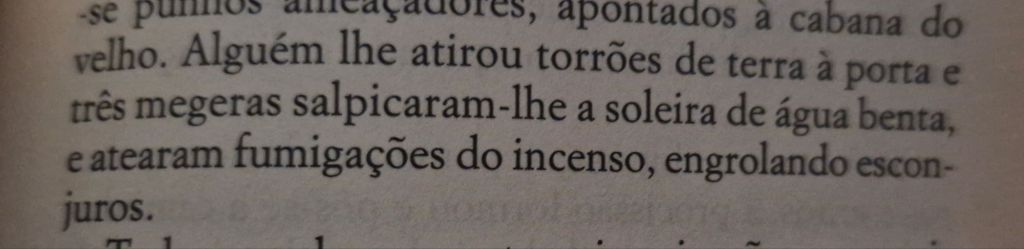
Desconheço…

  • Torrão = pedaço de terra aglomerada.
  • Megera = mulher antipática
  • Atear = Lançar fogo, fomentar
  • Engrolar = Dizer ou fazer mal à pressa
  • Esconjuro = Exorcismo

E não tinha toda a certeza sobre

  • Soleira = limiar da porta*
  • Bento = abençoado

Nem sequer me lembro de há quanto tempo li uma frase com 5 palavras desconhecidas e 2 pouco-conhecidas. Sinto-me como um noviço.

Também quase gritei quando vi esta gramática.
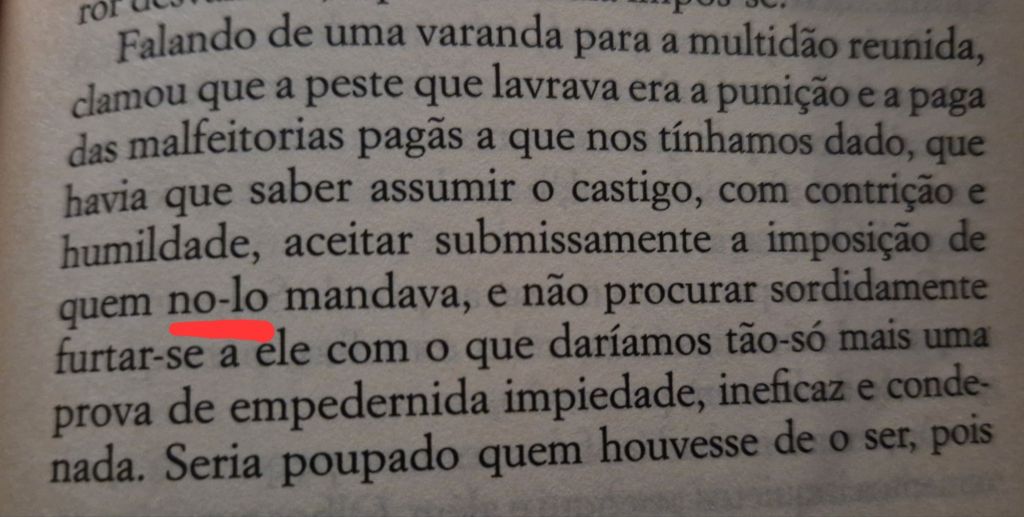
Já agora, eu sabia, teoricamente, que a contração de “nos” e “(l)o” existia, mas nunca me tinha deparado antes com tal coisa. Ainda por cima, o substantivo ao qual se refere o “lo” é o “castigo”** mas há nada mais nada menos do que três substantivos femininos intervenientes. Que fonte de confusão! Perdi sono por causa desta frase, malta.

*it’s hard to even define this one without resorting to other hard words. It’s a doorstep though, mmmkay?

**In case anyone is reading this who is not a fan of pronoun ju-jitsu and can’t follow my explanation, the bottom line is that no-lo means “it to us” so it goes”…know how to accept the punishment […] to accept submissively the imposition of whoever gives IT TO US”. Oof.

Posted in English, Portuguese

Doing my homework online

Shamelessly just doing my homework on here because I am short of time and shorter of ideas: synonyms from a passage from “Casa do Beco das Sardinheiras”, whose author, Mário de Carvalho seems like someone who likes to use interesting words, making him a challenging read.

I’m going to go above and beyond and do everything that I don’t already know, or am a bit vague about. If the word has multiple meanings I’ll use the one i think is closest to the original meaning in the text.

(Update – Quite a few corrections…)

Farejar => Caçar pelo olfato

Precaver-se => Ter cuidado

Precatar => Acautelar

Gaiato => Miúdo

Tareco => Traste, objeto de pouco valor (e também pode ser um gato doméstico, informalmente)

Eriçado => Levantado, ouriçado

Patorra => Pata grande

Avantajar => Ultrapassar

Surdir => Emergir

Poiso => Esconderijo

Escanifobético => Esquisito

Lá ser é => Isso é verdade

Taludo => Robusto (Pode ser “gordo” também, mas no fundo da página 61, a mulher do chefe da família diz “lá que o Gigas está magrinho par o tamanho)

Alforria => Libertação

Amarrotar => Amachucar

Alvoroço => Agitação

Estraçalhado => Despedaçado

Fera => Criatura feroz

Medonho => Terrível

Algazarra => Tumulto

Arribar => Chegar

Agastar-se => Ficar irritado

Temo-la armada => Vamos ter problemas

Para Cascos de Rolha => Para um lugar afastadíssimo

Notívago => Noturno

Espavento => Assombrado

Prontos! => Combinado!

Quite => Desobrigado *

Lamúria => Lamento

Polícias de Giro => Polícias que andam a pé?**

Botar => Lançar para fora***

Amanhar-se => Adaptar-se

*interesting one, this. It’s plural in the passage: “quites” and I thought it was borrowed from English, like “we’ll call it quits”. It seems not. There must be some common ancestry there though, because it’s too specific to be a coincidence. It’s quite a hard one to come up with a synonym. I’ve gone with Desobrigado but we’re really looking at an “I have now scratched your back after you scratched mine and further backacratching is no longer required”

**Esta frase é poço usada e existe um “Grupamento de Intervenção Rápida Ostensiva” (GIRO) no Brasil mas acho que não tem nada a ver com isto.

*** Os significados desta palavra são muitos e fazem parte nesta canção humorística. “A bota a gente calça e a calça a gente bota” (TW: Brazilian Portuguese)

Posted in Portuguese

Ronda Das Mil Belas em Frol

Ronda Das Mil Belas em Frol - Mario de Carvalho

Este livro de Mário de Carvalho é uma coleção de contos sobre sexo. O narrador tem relações com uma nova mulher de seis em seis páginas, o que há de ser cansativo. Ainda por cima, utiliza palavras de cinquenta euros. Acho que abri o dicionário dez vezes por página. E amiúde encontrei-me a fitar uma folha sem a definição de que estava à procura. Talvez esteja na hora de comprar um dicionário maior.

Posted in English

Frol With It

In English, as you know, FROL stands for Farting Raucously Out Loud, but I came across the same word in the title of a book I’m trying to read (God the vocabulary though – I don’t know how much more of this I can take!)

The book is Ronda Das Mil Belas em Frol by Mario de Carvalho. Here it is ony my Insta, but obviously the caption is just a silly joke.

Apparently Frol can refer to the foam on a wave: sea-spume, something like that. But it’s also an archaic spelling of “flor”, apparently. So they’re beautiful women in bloom. Makes sense. I find it really odd that the old spelling is so much like a joke, as if someone has deliberately swapped two consonants for a laugh and it caught on.