Posted in English

Wales & Portugal – Not As Different as You’d Think!

I’ve been doing Welsh Duolingo for about two months now. I’m not planning to go all the way to fluency, but the company who makes the software that is my bread and butter have recently sold it to a host of Welsh local authorities so I thought it would be useful to try and get familiar with the language in case I end up working with them.

Wow, the AI really smashed it with this one, didn’t it! The Galo de Barcelos should probably be a bit darker, and the dragon a bit redder, but still, it’s an impressive setup!

So far, I haven’t had any real breakthrough moments like I did when I learned Scots Gaelic during lockdown. Back then, I wrote a blog about the surprising parallels between a Gaelic, a celtic language, and Portuguese, a romance language. This time, I’m not having quite the same experience and it’s not as much fun, frankly, as the Scots Gaelic course. But it’s interesting all the same. Time spent learning stuff is never time wasted.

Duolingo is a great tool, which is why it’s such a shame their Portuguese course is so Brazilocentric. I’m making really good progress with Welsh, but the nuances of why I have to pick a word like Ydy instead of Mae or Roedd sometimes eludes me, so in my efforts to get a bit more background about the grammar and logic of the language, I found myself watching this guy’s videos and – oh look! He has one about the celtic influence on portuguese. It’s super-intersting and I’ve found myself getting enthused all over again for Welsh.

Linguistics is a really fascinating subject. I can’t remember if I’ve mentioned it already, but John McWhorter’s lecture series on linguistics really opened my third eye to this stuff and I definitely recommend it if you want to add a new dimension to your studies.
Well, this is a low effort English post. My resolution to write in Portuguese every day didn’t last as long as I’d hoped. Hi ho. I actually have quite a few ideas in my head but it’s just finding time to sit down and write them when we’re still living out of a suitcase. The builders have at least finished now, so we just need to slap some paint on the walls, move all our stuff out of the bedrooms and into their usual resting places and things will get back to normal, more or less.

Posted in English

Subjunctive Words of Wisdom

I liked what this fella had to say about subjunctives in his recent video. It’s a subject we anglophones don’t really use much, but most latin languages make a much bigger deal of it. I have read a few french books and it definitely doesn’t get as much of an airing in that language as it does in portuguese, but I think the principles and the rationale behind it carries across between languages, so the points he makes here about french, spanish and italian still hold, I think. I won’t try and summarise them – if you’re reading this and you struggling to put some junc in your trunc, have a look for yourself.

Posted in English

Linguistics

Hello! Well, I have been quiet for a few days after a long, long time of consistent language learning and consistent banging-on-about-it on here. We went to France and I had to squeeze my brain into French mode and its taken me a while to get back into the right frame of mind to get back to work on Portuguese. I’m actually still jointly reading the French translation of Six of Crows with my daughter so I’m going to be twin-track for a few weeks to come, but at least I’m starting the ball rolling again.

The Story of Human Language by John McWhorter

I’ve also just finished listening to this course about languistics, presented by John McWhorter who is an author and the host of the Lexicon Valley podcast as well as being an accomplished academic in his own right. He really brought the subject alive. I’ve been interested in the development of language for ages and enjoyed seeing how some of my pet theories, derived from learning Portuguese, French and Scots Gaelic, lined up with current ideas formed by people who actually know what they’re talking about. Portuguese is mentioned a few times, both in its relation to other romance languages and in its role as a source languages for creoles and pidgins in areas where Portugal’s empire spread its influence. Of course, knowing about linguistics doesn’t make you better at speaking another language but I feel like it adds an extra dimension to the experience and I’d definitely recommend it if it’s not something you’ve already tried. It’s on Audible’s free list, meaning if you’re a member you can just listen without spending precious, precious credits.

Posted in English

Scotland & Portugal – Not as Different as You’d Think

I’ve been really interested in the parallels between Scottish Gaelic and Portuguese. One of the first things that made me want to get familiar with a celtic language was seeing words like Llyfr and Eglwys on signs in Wales, meaning Book and Church, respectively. Both are very obviously related to French, Portuguese and Spanish equivalents. Of course, it’s less surprising when you realise that churches and perhaps to a lesser extent books were introduced to these islands by Christian missionaries arriving from the mainland in the 6th century speaking languages not that distantly removed from the language of Caesar. So the words came along with the physical objects.

But it turns out that this Latin influence is just the tip of an iceberg and under the surface is a much larger body of connected words, dating back to before the Romans because of common Indo-European origins. All sorts of nouns have echoes of other languages in them, often changed almost out of recognition by the tides of history. Even the phrase “ciamar a tha thu?” (pronounced “kimmer a ha u” and meaning “how are you?”) which I’ve seen a few times in videos online turns out to be basically cognate with “como estás tu?” which seems obvious now but I’d never been struck by it before. It’s a link between Gaelic and Portuguese, not because Gaelic is a romance language but because both come from an even more ancient root.

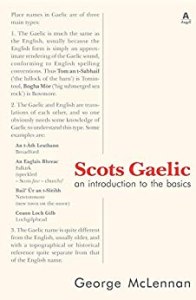
Scots Gaelic an Introduction to the Basics

These moments of epiphany are coming to me courtesy of an excellent, and very concise introduction to the language, “Scots Gaelic – an Introduction to the Basics” by George McLennan. It’s exactly what I need right now: definitely not a how-to book, but one that maps out how the language works and why. Now that I’ve got to a certain point with Duolingo, I have a lot of questions and this is answering most of them in a very satisfying way.

8AM. Mrs Luso is up now and is telling me about Korean (which she’s learning) and we’re comparing notes. Language-learning is freaking amazing.

Posted in Portuguese

Segredos da Língua Portuguesa (Marco Neves) #4

No quarto capítulo do seu livro “Doze Segredos Da Língua Portuguesa”, Marco Neves lista as dez línguas de Portugal (Dez? Sim. dez, embora algumas sejam faladas só..hum… em Espanha) e faz uma tentativa de responder à pergunta “há línguas piores do que outras?” Aprendi muito com esta primeira secção. Como o autor diz, as dez “nem sequer inclu[em] o inglês algarvio”, e não fazia ideia que havia tantos idiomas no país. Quanto à segunda parte… hum… considero que a sua explicação do mecanismo que torna as línguas mais ou menos complicadas não seja completamente convincente. Pois, claro, como estrangeiro, estou a tornar a língua mais simples pelo método de fazer tantos erros (querido leitor, imploro-te não impeça este processo por corrigindo-os!) mas quando tento imaginar um processo que possa tornar o inglês mais complicado, não consigo. Será que alguém introduziria uma sistema de géneros arbitrários se não invadíssemos um outro país nos próximos séculos? Acho que não.

Mas, diga-se o que se disser, devo admitir que não tenho a sua formação em línguas e é mais do que possível que esteja enganado, e como sempre, tenho muito interesse no assunto, e opiniões polémicas são sempre bem vindas, embora nem sempre concorde!

Posted in English

Portuwelsh

I’m in Wales for the Hay festival and… Made a linguistic observation….

Posted in English

Aliens: Spoiling It For Everyone

The night before last, Mrs L suggested we watch a film called Arrival, starring Amy Adams as a brilliant linguist supported by Jeremy Renner as Jeremy Renner and Forest Whittaker chewing the scenery in a very enjoyable way (him and Jeff Goldblum: as far as I’m concerned, they should be in everything)

Anyway, this isn’t a blog about movies, so why am I mentioning it? Well, Amy Adams starts her first scene in a lecture theatre with the opening lines of a lecture she’s about to deliver about Portuguese and why it sounds so different from other romance languages. I was all like…

But sadly at this point the movie was ruined for me when a siren sounded, heralding the arrival of twelve alien space ships who have come to… Well, I’d best not let slip any spoilers, but suffice to say they hadn’t come to help answer the question, and Amy Adams found her priorities had shifted somewhat so she didn’t even move on to the second paragraph.

I hunted around and found a reddit discussion about the lecture. I think there’s a lot of copy/pasting from Wikipedia going on here, coupled with some diversionary chatter from Brazilians who don’t see what all the fuss is about because everyone in South America sounds more-or-less the same, but it’s good to know I’m not the only one who wanted more. Maybe one day there’ll be a director’s cut with the whole lecture included. I live in hope.