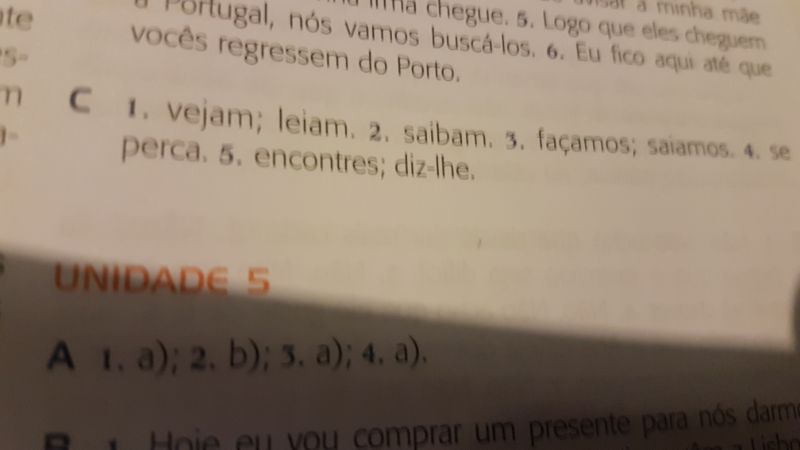
Well, I said the other day I was going to do more grammar exercises and that’s just what I’ve been doing. I’m well into “Gramática Aplicada” and I have found two mistakes in an exercise on subjunctive verbs.
As you can see, I’ve use Infitivo Pessoal in both the first and second sentences. The answers given both use P de C though. It seems to be an error. Both would be right if you chucked a “que” into the original sentences. Worse, the second one is in third person plural instead of second person singular. I checked with two actual Portuguese people to confirm I was right before dashing to social media to brag shamelessly though.
I’m getting quite a lot of study time in the bank but still find myself frustrated at the lack of progress. A lot of this is down to the fact that I have a pretty bad memory generally, but I definitely could be using the time better. I’m writing a lot and reading a lot but not putting myself through the hard stuff: learning vocabulary and challenging my grammar with written exercises. I need to do a lot more of both because my written texts are starting to sound like newspeak with the same basic words put together with “not” or “very” instead of using interesting synonyms. I’m still aiming for an exam at the end of the year but can’t decide whether it should be a better B2 or really stretch for the C1, which would need a hell of a lot more work in the next 4 months or so.
A semana passada foi cheia de mudanças para a minha família. Desde que a minha filha nasceu, a sua mãe tem sido dona de casa e não voltou ao trabalho excepto durante três meses por causa do seu contrato que tinha com o seu empregador de antes da sua gravidez. Esta semana, afinal, ela recebeu uma oferta e começou a trabalhar num novo escritório no centro de Londres. No mesmo dia, a minha filha começou a sua escola nova. Ela está tão crescida agora! Não posso acreditar! Cada dia da semana, ela organizou um encontro com a sua amiga, e ambas andaram até à paragem de autocarro.
Felizmente, hoje em dia, trabalho a maioria dos dias em casa, e por isso é relativamente fácil arranjar os nossos negócios. A Sra Lusk sai do apartamento às oito menos um quarto de manha, enquanto que a Olivia fica a comer o pequeno almoço. Passado pouco tempo, ela sai também e eu continuo a trabalhar. Às vezes, faço uma pausa, e faço uma tarefa qualquer que precise de ser feita, ou talvez leia um livro ou escutar um podcast português. No fim do dia escolar, a Olivia e a sua amiga regressam ao apartamento e faço-lhes umasanduíche enquanto que ela me diz sobre o seu dia e sobre as suas amigas novas. Mais tarde, a minha esposa volta também. Tenho cozinhado todos os dias desde o começo da escola. Gosto deste novo estilo de vida porque posso passar mais tempo com a minha filha e ao mesmo tempo, tenho muito tempo em casa sozinho em que consigo trabalhar muito. Existem outras vantagens também: vamos ganhar mais dinheiro, a Olivia tem mais independência, e ora bem, acho que a minha esposa estava um pouco aborrecida em casa todos os dias, mas agora tem um novo desafio. Sem dúvida, vamos encontrar muitos problemas no futuro porque falar-nos-á tempo fazer tudo que devemos, mas claro que muitos casais em toda parte têm problemas mesmos. Se tivermos problemas, não importa o que, lidaremos. Aconteça o que acontecer, vamos lidar com eles. Todos temos de fazer sacrifícios Espere. Um momento. Lembrei-me… Oh meus deuses! Terei de passar a minha roupa a ferro ! Se ela não aceitasse este trabalho, eu não teria de fazer isto! 😦
So I followed my list of gender rules and (bar a couple of occasions when I got it wrong myself) the only one where I applied a rule correctly and it was wrong was “um(a) sanduíche”. It’s a concrete noun ending in – e so in theory should be masculino but it’s not. Well, I said that rule was crap and this certainly seems like a good illustration of the point.
In the third of what I am now definitely thinking of my Four Evil Exes articles, here’s what I can find on the subject of remembering which nouns are masculine and which feminine. It turned out to be easier than I thought, although I’m sure the exceptions will plague me. I wish I’d done it ages ago, actually, but that’s the trouble with the 4 evil exes: they are boring and difficult and don’t have fun workarounds I can use, so it was just a case of ploughing through the literature – in this case, “Portuguese – an Essential Grammar” by Amélia Hutchinson and Janet Lloyd, with some supplemental examples cribbed from Fun With Portuguese and My Five Romances. I also got some tips from Benny the Irish Polyglot and read an entertaining post on the subject by Lady of the Cakes, whose blog is a great deal prettier and better-written than mine. Her post is a bit more pessimistic when it comes to finding patterns in this mess, but on the plus side does have (a) a picture of some cake and (b) rude words.
As you can see, most of the rules have exceptions, so it’s not as if I can be guaranteed to never screw up again if I learn them but if I don’t happen to know a word, it might boost my hit-rate a few percentage points.In most cases, more specific rules seem to override more general ones. So for example, “milhão” is masculine because it meets the “all numbers are masculine” rule even though it’s an abstract noun ending in -ão.
Oh and sorry about the colour-scheme, but… well, you know…
Rule
Examples
Exceptions
Dependent:
Male and Female animals/people depend on individual’s sex*
o touro / a vaca
o irmão / a irmã
Dependent:
Ordinal numbers depend what’s being counted
o primeiro (dia)
a segunda (noite)
Masculine:
Nouns ending in
-o (nb, not -ão though)
-r
-l
-z
o lugar
o valor
o papel
o final
o rapaz
a foto
a tribo
a gravidez (understandably enough…)
Masculine:
Concrete nouns ending in
-e**
-ão***
o sangue
o clube
o coração
o chão
o órgão
a fonte
a árvore
a mão
a televisão
Masculine:
Names of Lakes, Rivers, Mountains etc
o Tejo
os Himalaias
o Brasil
o Atlântico
o Tamisa (despite the -a ending!)
Masculine:
Car brands**** & types of wines
o porto
o Ferrari
a Mercedes
Masculine:
The seasons*****
o verão
o inverno
o outono
a primavera
Masculine:
Weekend days
o sábado
o domingo
Masculine:
Words from greek, usually ending -a: most usually in
-ema
-grama
-eta
o programa
o problema
o sistema
o poema
o cometa
o planeta
o dia
o mapa
o clima
o telefonema
Masculine:
Letters
o a
o p
Masculine:
Cardinal numbers
o um
o cento
o milhão
Feminine:
Most words ending in
-a
a dúvida
a água
a palavra
a terra
Feminine:
Words ending
-dade
-ie
-tude
-gem
-ice
-ã
a cidade
a viagem
a garagem
a juventude
a espécie
a velhice
Feminine:
Abstract nouns ending in
-e
-ão***
a crise
a parte
a gente
a lição
o norte
Feminine:
Names of towns & countries
A Madeira
A Rússia
A França
A Suiça
A Islândia
A Londres
Places specifically named after male things:
O Rio de Janeiro
O São Paulo
O Porto
Places consisting of a male noun + adjective
Reino Unido
Os Estados Unidos
Feminine:
Names of the Arts and Sciences
a medicina
a matemática
a biologia
o teatro
o cinema
Feminine:
Names of days during the working week
a segunda feira
a terça feira
*=This rule supersedes all others. So “a mulher” is feminine even though it ends with r, for example
**=When looking for samples of nouns ending in -e as examples to use of concrete (masculine) and abstract (feminine) it was striking how many exceptions there were to this rule on the list. I’ve left it in because it’s in the textbook but, at least with the more common nouns, it seems like feminine outnumbers masculine for most -e nouns, even the concrete ones
***=When looking for samples of nouns ending in -ão as examples to use of concrete (masculine) and abstract (feminine) it was striking that the first twenty or so -ão words on this list were all abstract, feminine ones
****= Jeremy Clarkson would love this, I’m sure
*****=one exception out of four words is pretty shonky though. It’s only one away from a 50-50 split! Maybe best remember these by their endings and pretend the rule doesn’t exist!
This is the second of my brainstorms about the four intractable problems I identified last week, trying to wrestle with the subject by putting it into a post, because explaining something to someone else is usually a pretty good way of learning it yourself.
Quite often in Portuguese, the word “Se” crops up in unexpected places, hanging around verbs. In some cases, it just means “if” and that’s easy enough to spot, but when it’s acting as some sort of pronoun things get a little weirder. Here’s a breakdown of some of the related grammar:
As a word meaning “If”
As I said, this is the odd one out, really. In this case, the word happens to be hanging around the sentence and maybe the verb will have to change as a result but in this case it’s not really strongly interacting with the verb, so you can just translate it in your had as “if” and move on. If you’re at B2 level and don’t already know about the subjunctive imperfect, go and have a read. Otherwise, forget it.
As a reflexive pronoun
Se is one of the pronouns used in the construction of reflexive verbs. Reflexive verbs. Reflexive verbs are just verbs in which the subject and the object can be the same thing. For example, “I can dress myself”. I am the one who is doing the dressing, and I am the one being dressed, so it’s a reflexive verb. In Portuguese and other romance languages, reflexive verbs seem a bit counter-intuitive.Sometimes they are used in situations you wouldn’t expect and sometimes they mean “each other” instead of “oneself”.
Of course, it’s not always “se”. The complete set of pronouns looks like this:
me
te
se
nos
vos
se
Here are some examples of reflexive verbs:
Standard
Meaning
Reflexive
Meaning
lembrar
to remind
lembrar-se
to remember
amar
to love
amar-se
to love one another
apaixonar
to fall in love
apaixonar-se
to fall in love with each other
deitar
to lay (something) down
deitar-se
to lie down
levantar
to lift
levantar-se
to get up
pentear
to comb
pentear-se
to comb oneself
banhar
to bathe (someone)
banhar-se
to have a bath
chamar
to call (someone)
chamar-se
to be called/named
lavar
to wash something
lavar-se
to have a wash
sentar*
to put someone in a sitting position?
sentar-se
to sit down
sentir
to sense something
sentir-se
to be conscious of something
voltar
to turn, return, re-do
voltar-se
to turn around
servir
to serve
servir-se
to help oneself to
vestir
to dress someone
vestir-se
to get dressed
**
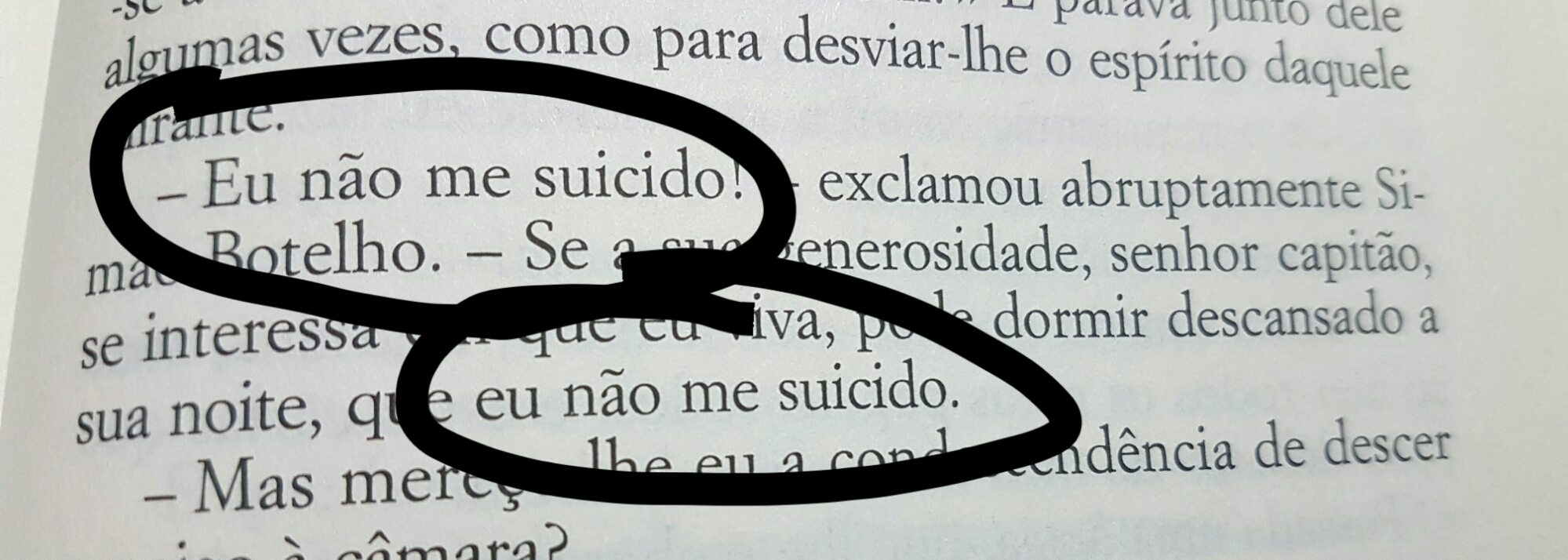
suicidar-se
to kill oneself
cortar
cut
cortar-se
to cut oneself
*sentar apparently exists but it’s not used often
**suicidar doesn’t seem to exist as a non-reflexive verb, for reasons that are probably pretty obvious….
—update—
Of course, by sod’s law, within hours of publishing this post, I see this:
Há pessoas que se quiserem suicidar, tudo o que têm que fazer é saltar do seu ego para o seu nível de QI
Hm… Now I was going to write a whole section on “se” being used as another kind of pronoun but I had a look at the examples and decided that they were all specimens of either those ones *points up* or these ones *points down*. OK, cool, well that’s one piece of confusion that has been expelled by writing this post, so… bonus!
As part of a sentence in the passive voice
Passive voice is when you use a phrase like “it was done”, “mistakes were made”, “a murder was committed” instead of the more direct “He did it”, “We made a mistake” or “Someone committed murder”. I quite like this form of words and use it in writing but some people find it vague and evasive, and for that very reason it’s popular in political speech and PR briefings.
In portuguese there are two ways of writing the passive voice and one of them looks a lot like the reflexive verbs I mentioned above:
“O livro publicou-se” means “the book was published” but you could equally read it as a reflexive verb “the book published itself” which it didn’t of course, but you can see how the connection is made. Another way of expressing the same thing in Portuguese looks much more like an English construction: “O livro foi publicado”
Em Portugal bebe-se muito café (A lot of coffee is drunk in Portugal)
Language exchanges might just be the best thing about the Internet. We don’t need to go to lessons anymore, we can just reach out to other people through apps like Hellotalk or iTalki and learn from them as they learn from us, and it doesn’t cost a penny. It has taken me a while to get going but these days I have a really good network of people I chat to, or whose instagram and twitter feeds I read.
The aspect of it that might seem like a drag – having to answer other people’s questions for half the time – is actually one of the best bits because it makes you realise how utterly clueless most of us are about what we say and why. I’ve lost count of the number of times someone has asked me a question and I have been floored. For example, one of the most common questions I get from lusophones is when do we use the various types of of past tense:
I worked
I have worked
I was working
I have been working
On the face of it, this is quite simple, but the more you think about it, the more you realise that it’s not. We use them in ways that don’t seem to fit with their textbook definitions, and yet that use and misuse isn’t arbitrary or wrong. If someone uses the wrong tense, it stands out a mile. The whole business of tenses is much more involved than it seems. We also use the present tense in place of the past (in jokes mostly) and in place of the future tense (all the time) and don’t even realise it. We have different future tenses and different presents and they’re deployed in ways most of us can’t even begin to explain.
I’ve also been asked what we say at the end of conversations and online chats – the equivalent of the Portuguese “beijinhos” (kisses) or “um abraço” (a hug). I couldn’t answer because it’s so dependent on your age, how well you know the person, where you are, what you’ve been talking about and half a dozen other things. There must be some deep-seated rule that we’re all more-or-less aware of but writing them down would be impossible, and even if you could do it, it would be out of date within a year.
Portuguese people are the same. Quite often I’ll ask a question of three different people and get three different answers, or the person I’m speaking to will think for a bit and give a very hedged, ambivalent answer. I’ve recently written a couple of blog posts about grammar that are stitched together from several written and oral sources and I really got a sense of how subjective these things were.
Ultimately, though, it doesn’t really matter. Knowing the rules helps us to an extent but it’s not everything. We really need to use the language *a lot* to get familiar with it and get a sense of what feels right.
Ser and Estar are two little words that cause a lot of people a lot of pain because they both mean “to be” but they’re used in different situations. Usually they’re pretty straightforward but there are some weird hinterland cases I often struggle with so I am going to use this page to list some of them. I’ll add to it as they crop up.
Backing up a bit for the benefit of any newbies who are reading this (srsly dudes, you’re in the wrong place)
Ser
Ser comes from “Esse” in Latin and it’s cognate with the english word “Essence”. You use it when you are talking about some essential qualities a thing or a person has that are permanent and unchanging
He is tall
You are intelligent
I am the Walrus
It is made of wood
Are all examples of phrases that tell you something about someone’s or something’s essential nature so they all take “ser” in Portuguese
Estar
Estar is from the latin “stare” and it’s cognate with “status” so you use it when you’re talking about a situation that a person or thing is in now.
He is in the bathroom
He is ill
It is on fire
Are all examples of phrases that tell you something about what state something is in at a fixed point in time, so they all take “estar” in portuguese.
Ficar
There’s a third word “ficar” which actually means “to remain” but it can also be use for geographical sentences
Lisbon is in Portugal
The shop is in Kingston
In each of these the portuguese would use Ficar because the geography is fixed and it ain’t moving.
You can also come across it in some other situations like “ficou feliz quando leu a carta”, which can be confusing since it looks like we’re using the “geographical is” to describe a very transitory emotion. Here, the person isn’t saying “he was happy” but “he became happy”.
Don’t blame me, I don’t make the rules.
So What Are the Weird Situations?
So far, so easy, but when you start to think about these things it starts to get a bit perplexing though. Here are some conundrums and the suggested solutions
Weather
“It’s a beautiful day”
Ser or Estar?
Well the weather changes, so that sounds like Estar. Ah, but today is today. The weather might change tomorrow but tomorrow is tomorrow. Today is beautiful. It was always destined to be beautiful. And when I look back on the selfies I took today I will remember how beautiful it was, from start to finish.
To cut a long story short, you’re basically safest using “estar” for anything weather-related. I have seen “é um dia muito bonito”, so the ser form isn’t completely crazy but estar seems to work in basically any situation, so I would suggest sticking to the idea that the weather is fleeting and slathering estar all over it.
The View Out the Window
Heraclitus said “You Can Never Step In the Same River Twice”. If you step into the Thames tomorrow, the water that was in it today will have flowed away and been replaced by new water. There’ll be new leaves, new ducks, new discarded coke cans. Every day, I thank the Lord that I don’t have the job of translating Heraclitus into Portuguese.
This past Tuesday, I was on the train and I wanted to describe the view. Is a view out the window a transitory phenomenon like Heraclitus would have said or a more permanent one like his pal Permenides might have said*? The hills and trees are as permanent as a thing can be, and the fact that the train is moving past doesn’t change them. Does that matter? I decided it was probably estar because the view from the window would sometimes be of the back of a Morrisons supermarket or a junkyard or a giant poster of Boris Johnson.
The view in question. Heraclitus asked me to make this an animated gif, but I’m with Parmenides on this one
So are all views from all windows always estar? No matter where the window is, the weather will change and so the view will change from day to day? Well, I raised this in a discussion and my good friend Márcio helped me (as he always does) to get my head around all this, confirming and clarifying what I was trying to think through. If you live in a house on a hill, one of the selling points of that house might be its view across a lake or a meadow. In that case, it would be fair to say that the view from the house was a beautiful view always and ever, despite fluctuations. That’s it’s defining characteristic, even when the fog is temporarily obscuring it.
A vista pela janela do comboio estava linda
A vista pela janela do meu apertamento no 23° andar era linda
Jobs
Sou profissional de informática. That’s what I’m trained for, and if I move from place to place, that’s what I’ll remain. Even if I get a job as a postman, temporarily, because I have found myself between contracts in December when the Christmas rush is on, I will still be a profissional de informática who happens to be delivering your graze box this morning.That seems fine for people who have chosen a career path, or who have had specialist training of some sort. But what about transitory jobs we do for a few weeks? What about jobs we do but feel no affinity for and don’t identify with; jobs, in other words, that just pay the rent?
Again, there’s no room for estar here. Estar is never (?) used to just make a simple link between two nouns; if it’s not paired with an adjective then “ser” is what you need., so if you wanted to say you were a postman you’d still say “Sou Carteiro”. Does this seem odd that you can be both a Profissional de Informática and at the same time um carteiro? Well, apparently not, although if you wanted to stress the temporary nature of the gig you could rephrase it by saying “I am working as a postman” instead of “I am a postman”, which, thinking about it, is probably what you’d do in English, too.
*= I happen to know Parmenides used Southeastern Rail and long hours of being completely stationary were a formative influence on his views on this matter.
Last week I identified four stubborn problems that – like Scott Pilgrim and the 7 Evil Exes – I had to battle to the death. One of those was to do with fiddly small words in front of infinitives. A lot of this seems to have to do with compound verbs vs ordinary, run-of-the-mill infinitives.
So let’s dive straight into compound verbs…
Compound Verbs
Compound verbs are verbs that are treated as one action but are made up of two verbs glued together. A familiar example is this harmless Pretérito Perfeito Composto
eu tenho chorrado*
You just take part of the verb “ter” and glue it onto your verb and magic happens. We have the same thing in English: “I have overslept”, “I had forgotten to set my alarm clock”. These are pretty easy to use so I’m not going to write any more about them because I don’t fund them confusing at all. In fact, their easier to use than most types of verbs. If you’re not familiar with them, don’t worry, you’ll meet them soon enough and you won’t have any trouble.
Where it gets trickier is when you have verbs made up of some other verb, followed by a short joining word and then an infinitive. There are lots of different ways of classifying them but I’m going to divide them up into groups according that have similar types in, and crucially, each member of the group uses the same joining words. If you don’t like the way I’ve done it, try this page from Ciberdúvidas instead. It has a totally different approach.
[A] Compound verbs showing an action that’s starting or ongoing:
Estar, Andar, Ficar, Começar or Continuar + a + infinitive
Estou a escrever este blog
Anda a aprender
Ela continua a dar aulas
Começo a ler a revista
Ficar a olhar
I would think of these as “Starting to do…” or “Continuing to do” so the “a” fits nicely because it means “to”
[DE] Compound verbs describing an action that’s abandoned
Deixar, Acabar or Terminar + de + infinitive
Deixa de fumar
Acabou de ler o livro
Terminar de tocar a guitarra
I would think of these as “leaving off of doing something” and “de” means “of” so that makes sense
[DE] Compound verbs describing something you have to do
Ter or Haver + de + Infinitive. In the case of haver it’s a slightly vaguer and more speculative kind of obligation: something you ought to do at some point rather than something you’ve got to get done right now.
Hei-de ler “Matadouro Cinco”
Tenho de cozinhar esta noite
I would think of these as “I have to do something”. I want to squeeze an “of” in there to make the “de” fit but I can’t, sorry… By the way, is it just me or is Haver the most freakishly unpredictable and incomprehensible verb in the language?
[] Compound Verbs Describing Potential for Action
Ir, Poder or Dever +[No joining word] + Infinitive
Vou ganhar o prémio
Posso ajudar?
Deve estudar
I would think of these as “I’m gonna do something”, “I could do something” and “I should do something” so no joining word needed.
Things That Look Like Compound Verbs But Aren’t.
Some verbs can take an infinitive as their object and so the joining word will depend on the verb in question. So for example
Gosto de ler
Preciso de ler
both look a bit compound verby but Gostar and Precisar are the main verbs of the sentence and ler is basically being treated as a noun. Both take a de because the verbs are a bit strange. It’s easiest to understand gostar as meaning “to be pleased” so Gosto de ler means “I am pleased by reading” and Precisar is more like “Have a need” so precisar de ler means “I have a need for reading”
Adoro ler
means the same as gosto de ler but it doesn’t need the de because it’s a bit more direct. “Adorar” means “to adore” and you don’t need to adore of something or adore by something, you just need to adore it.
Likewise in the song Deixa-Me Rir, I asked my teacher** why it wasn’t “Deixa-me de rir” like in the example above: “deixe de fumar” but here he’s not talking about letting go of something, he’s talking about being allowed to do it,so Rir is being treated as an object again
Some of the harder-working irregular verbs can be used with prepositions in a way that changes their meaning and in some cases they can be used with infinitives. These buggers are a law unto themselves
Dar + para= to be suitable. Essa caneta não dá para escrever uma carta
Ficar + por= to fail to do something: Fiquei por escrever o meu livro
Passar + a= to change: Depois do desastre, passei a ser outra pessoa
Other Structures Involving Infinitives
In other situations, infinities can be preceded by joining words but it seems even more random.
Quem me dera falar português como a minha esposa
Who will give me speaking portuguese like my wife? (No joining word)
Estou contente por saber que a sua equipa ganhou o tri-campeonato, seja lá o que isso for.
I am content through knowing….
Or
Estou contente em saber que a sua equipa ganhou o tri-campeonato, seja lá o que isso for.


 Luso
Luso 
