Revi alguns exercícios do livro “Qual É A Duvida” sobre passar o discurso direto para o discurso indireto. Não é assim tão difícil mas escaparam-me determinadas “regras do jogo”, sobretudo que não só preciso de mudar o tempo verbal mas também o sítio onde os eventos descritos aconteceram. Quando fazemos estes exercícios, imaginamos que estamos num outro lugar, a contar a história que contem o diálogo.
Por exemplo, na frase seguinte
19. Para ele ter vindo cá, teria de ter passado pela segurança e não há nenhum registo. Portanto é que não veio
Rescrevi com mudanças do tempo verbal, mas retive o “cá”, mas estou a descrever eventos que aconteceram algures, sabe-se lá onde.
A. Eles afirmaram que, para ele ter ido lá, teria de ter passado pela segurança e que não havia nenhum registo. Portanto, era porque ele não tinha ido.
Igualmente “este” passa para “aquele”, “isso” para “aquilo” e assim por diante, porque o objeto referido pelo pronome demonstrativo está longe de nós os dois, o narrador e o ouvinte.
18 Se ele tivesse dito isso, eu seria a primeira a saber
A. Ela disse que, se ele tivesse dito aquilo, ela seria a primeira a saber.
Tudo isto é mesmo óbvio mas tinha-me esquecido de tudo, portanto valeu mesmo a pena fazer os exercícios mais uma vez.
É-me interessante que chumbei dolorosamente em tantos exercícios mas logo que encontro um texto de um autor cujos livros conheço e cujo sentido de humor aprecio muito, não fiz um único erro. Será que a simpatia que eu sinto face ao autor me dá uma vantagem em desenroscar a gramática do texto? Faço figas na esperança de receber um exame com textos de Ricardo Araújo Pereira e letras dos Deolinda!
Este livro reúne seis contos que têm elementos de humor e do realismo mágico. São divertidos e cheios de surpresas. Já falei da história sobre o chimpanzé que digitou o “Menina e Moça”. São todos iguais. Loucuras e mais loucuras.
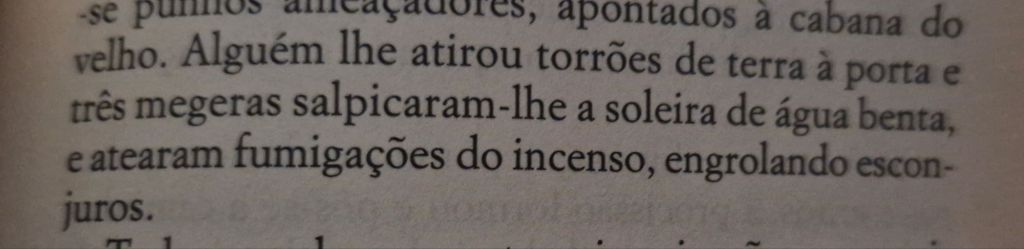
O último conto custou-me ler porque tem lugar no passado e com resultado é sobrelotado com palavras desconhecidas. Por exemplo, olha esta jóia:
Desconheço…
Torrão = pedaço de terra aglomerada.
Megera = mulher antipática
Atear = Lançar fogo, fomentar
Engrolar = Dizer ou fazer mal à pressa
Esconjuro = Exorcismo
E não tinha toda a certeza sobre
Soleira = limiar da porta*
Bento = abençoado
Nem sequer me lembro de há quanto tempo li uma frase com 5 palavras desconhecidas e 2 pouco-conhecidas. Sinto-me como um noviço.
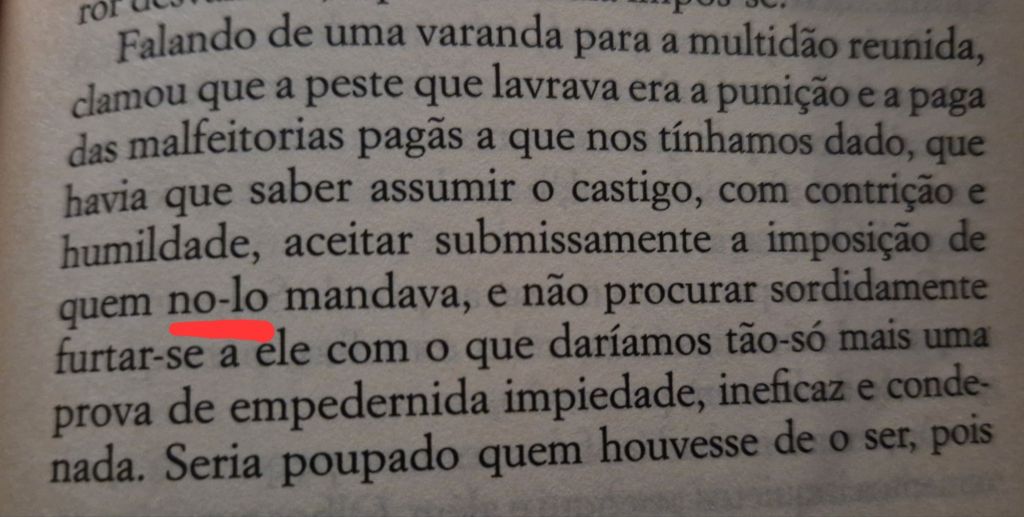
Também quase gritei quando vi esta gramática.
Já agora, eu sabia, teoricamente, que a contração de “nos” e “(l)o” existia, mas nunca me tinha deparado antes com tal coisa. Ainda por cima, o substantivo ao qual se refere o “lo” é o “castigo”** mas há nada mais nada menos do que três substantivos femininos intervenientes. Que fonte de confusão! Perdi sono por causa desta frase, malta.
*it’s hard to even define this one without resorting to other hard words. It’s a doorstep though, mmmkay?
**In case anyone is reading this who is not a fan of pronoun ju-jitsu and can’t follow my explanation, the bottom line is that no-lo means “it to us” so it goes”…know how to accept the punishment […] to accept submissively the imposition of whoever gives IT TO US”. Oof.
I don’t really know what the rule is here, so was expecting at least one to be knocked back but got them all right first time. I suppose it’s one of those things where reading books just makes it “feel right” in a particular order.
I was just arguing with someone about whether the common Brazilian use of the word “falar” exists in European portuguese. In Brazil it is often used interchangeably with “dizer” ao you get hideous travesties like “‘Dá-me uma banana’ falou o macaco”. The first time I encountered this I was shocked to the core but then I mentioned it to a portuguese guy and he said it exists in Portugal too, albeit less common. Priberam seems to back this up – it’s the second definition – but the guy seemed to think I’d been misinformed. Maybe he’s right, I dunno, I’m only going by what I’ve been told.
Aaaaaaaaanyway, while I was searching this blog for the post I wrote about it at the time, I came across this post that I had forgotten all about because i have the memory of a goldfish. It’s about a different controversy. I wonder if part of the reason I make so many mistakes is that I spend too much time trying to unravel weird edge cases like this and not enough learning the genders of common nouns ending in e.
This sentence flummoxed me for two reasons. Firstly because the overall gist didn’t seem to make any sense and secondly the grammar was baffling. I had to ask an expert to explain some it to me.
It’s from Uma Aventura nas Férias da Pascoa, and the lady who’s speaking is exasperated that some kids are making a lot of noise outside her door. The “Francamente!” is there to underscore her disapproval.
Let’s do the grammar first.
So firstly, obviously, we have the usual anglophone confusion of “gente” meaning people but it’s a singular word because of course it is. That’s pretty basic though, so didn’t throw me too badly.
“Pegue” is subjunctive present. Why? Good question. It seems to be a statement about the general qualities of something, nested in a dependent clause, but it doesn’t fit neatly into my subjunctive flowchart, even though it’s recognisably the same kind of sentence structure as sentences that do. I think that’s because “por onde” (“at where”) is doing the job that would normally be done by “que”. [Caveat – I’m pretty sure I’m right about this but didn’t specifically ask so I might be misunderstanding why they’ve used this tense]
And finally, the pronouns, se and lhe right after each other. Lhe means “them” but it is singular because – again – it’s referring to gente, and se is present as an indefinite pronoun*, which is a hard concept to grasp in English. I’ve had a stab at it in this post, but I’m sure it wouldn’t hold up to much scrutiny from an expert.
So if you were to translate it word-for-word in the most literal way possible, the whole sentence is something like “These young people don’t have a place at which one might get hold of them”. Well, that could refer to something that’s so dirty that we’re afraid to touch it for fear of getting our hands dirty, but here it’s referring to people so it must be some sort of expression, right?
The expression “não ter ponta por onde se lhe pegue”, or “estar sem ponta por onde se pegue” or variations of either, seem to be translated as “to be utter nonsense” on bab.la, and I can see it used in roughly the same way in a few places around the interwebs.
What would be an equivalent expression in English? Since it’s talking about getting a hold of something, I guess something like “I can’t get a handle on it” would be pretty close. It’s not an exact equivalent though, since if you “can’t get a handle on” something in English, you’re leaving open the possibility that you just aren’t clever enough to understand, whereas this is more in the direction of “it can’t be understood, because it doesn’t make any sense”.
More than anything else, what impressed me is that it has been ages since I have come across a sentence that has caused me this much puzzlement, and yet this is a book written for children!
Well done, you’ve made it this far. Reward yourself with this music video.
*I has a query about this so here’s a bit of self-justification! First of all, I wrote “impersonal” in the first draft of this which isn’t quite the right word so I’m sorry I got that wrong. “One” is anindefinite pronoun and in very correct, posh english you use it… ahem… or rather “one uses it” as a neutral pronoun when one wants to use a verb in a very general way, without having anyone specific in mind. I think that’s the closest analogue of what “se” is doing here. Priberam defines it as a “pronome indefinido” (4th and 5th definitions here) and this page gives more detail although confusingly refers to it as a partícula (particle) which I think is incorrect. Or at least in english a pronoun isn’t a particle, but maybe portuguese grammarians have a slightly different taxonomy…?
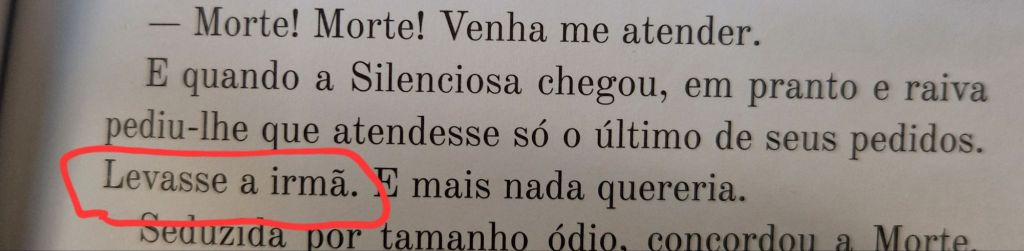
É que… Peguei neste livro porque apeteceu-me ler algo fácil, mas embora seja um conjunto de contos infantis, com 94 páginas e muitas ilustrações, está cheio de palavras desconhecidas e gramática emaranhada.
Ora bem, segundo todos os livros que já estudei, a frase “Levasse a irmã” não deve* existir, mas olha, lá está na página. Que raios? Pensei muito e acho que percebo. A autora está a “reciclar” a gramática da frase anterior: “pediu-lhe que atendesse (…) o último (…) pedido” e depois, esclarecendo a ação implicada, podia ter dito “ou seja, pediu-lhe que levasse a irmã” mas ela não queria repetir as primeiras palavras, portanto limitou-se a acrescentar as palavras reveladoras.
Dito isso, acho que seria melhor se a frase fosse separado da frase anterior com uma vírgula em vez de um ponto final, mas não sou o rei da gramática e talvez esteja completamente errado!
*I originally wrote “deve não existir”, trying to imitate a sort of modern, affected way of emphasising the strength of feeling in english by shifting the “not” to another part of the sentence: “It needs to not exist” instead of “it doesn’t need to exist”. This seems not to be a thing in portuguese. Oh well, it was worth a try.
Now that I’ve finished Qual É A Dúvida I’ve returned to the bloody awful, boring “Português Outra Vez“, aimed at C1/C2 level students. On the face of it, there’s no reason it should be so dull: both books are just page after page of exercícios lacunares (missing word problems), but they’ve ordered it into three sections and within each section they’re all the same *kind* of missing words. I’m currently part way through 60 pages of verb+preposition. I have a copy of the Guia Prático de Verbos com Preposições for any that I don’t already know. Helena Ventura is co-author of both books, so the examples are often quite similar.
Now, that much repetition could be useful if it was drilling the variations of dar+preposition or passar+preposition but there’s surprisingly little repetition of those. Dar appears just twice, I think, and ser, passar, ficar seem only to be there once. Instead we’re doing easy things like gostar de, precisar de, plus some fairly obscure ferns that only ever take one preposition anyway. It’s not ideal and I am finding it much harder to stay motivated. I’ll see how it goes but I might just open a window and fling it at the pigeons outside.
The other two sections are expressões idiomáticas and vocabulário. I feel like this is all good meat-and-potatoes stuff, necessary for building core competencies for the advanced exam, so I hope the pigeons enjoy it.
More practically, I suppose I should hope between sections to break up the monotony or something.
Aaaaanyway, enough moaning. I’m writing out some that I got wrong, hoping they’ll stick in my mind better:
Não Conseguimos convencê-lo; ele torce pelo Benfica e não muda de ideias. I got torcer por, but failed to realise that Benfica needed a definite article. Torcer por =Ser adepto de = to be a supporter of
Todas as pessoas devem ser compassiva e solidárias, olhando a quem está em situação de pobreza e depende da ajuda dos outros. Again, i got the right formula – olhar a – but I used the imperativo. That probably would have worked if there were a full stop after “solidárias” but it doesn’t make sense as it is and I should have rethought it. Olhar a =ter em consideração =to look out for
Quantas costeletas tocam a cada pessoa? Parecem-me poucas para tanta gente. I had no clue here and just guessed badly. Tocar a = calhar a =to… Hm, it’s a difficult one to translate neatly but the whole sentence is like “How many cutlets are there for each person”. It can also mean “to have to do with” or “to compete for”
O António foi falar com o chefe e foi pedir-lhe pela colega da receção, para que o chefe a promovesse, pois ela merecia. I got the wrong end of the stick with this one. I didn’t realise Antonio was a worker in the same firm. I thought he was a customer who was recommending the receptionist for promotion. Conseqiently I messed it up. Pedir por =interceder a favor de= to ask on behalf of, to act as an intermediary.
Há pessoas tão ambiciosas que não olham a meios para atingir os fins. I missed the relevance of this. And used “ser contra” instead. Olhar a =atender a = care about. So in this case they don’t care what means they have to use to achieve their ends. We’ve all met people like that, eh? Some people are so ambitious to be a good portuguese students they will even stoop to doing the actual exercises diligently.
Não compares um Ferrari com um Toyota! São completamente diferentes! I used a in place of com. Classic overliteral translation from English. Compare x WITH y, not x TO y. Comparar com = colocar em igualdade com =Make a comparison. The way this is phrased implies that the comparison will always be of equality, but priberam is much closer to the English notion of comparing. Ie, you can make an unfavourable comparison, but even though “this is a million times better than that” is a comparison, people will often be opposed to you comparing Shakespeare to Dan Brown or whatever, feeling that Shakespeare is somehow demeaned by being spoken of in the same breath as such a terrible writer, and I assume that’s what’s going in in the example.
César from the Homo Causticus blog gave me a challenge a few days ago, to write about Brazilian Portuguese. Since this is a blog about European Portuguese, I thought the best way to do that would be to compare the two flavours. I’ve written it in English and then translated each paragraph into Portuguese as I go, just for the challenge. Thanks to dani_morgenstern and butt_roidholds for the corrections, but it’s quite long so if I have missed any errors, that’s all on me.
I quite often see people online asking what is the difference between Brazilian and European Portuguese and sometimes people will reply “there’s no difference, it’s just the accent”. Well, up to a point, Lord Copper. The accents certainly are different, but there’s a lot more to it than that. If you’re starting out on your Portuguese journey, you should definitely stick to just one version at first, at least until you have a good grounding in the language, because in addition to the accent you’ll find Brazilian Portuguese has quite a lot of differences in vocabulary, slightly different grammar, differences in spelling, even after the Acordo Ortográfico. They even have different ways of saying “you”. Brazil is a larger country with a more powerful media industry so I think Brazilians are probably less aware of the differences than Portuguese people are because they are less likely to be exposed to TV or movies in the other dialect.
Muitas vezes, vejo pessoas online a perguntar qual é a diferença entre Português brasileiro e Português europeu, e às vezes a resposta é “não há diferença, só há sotaques diferentes. Hum… Até certo ponto, Senhor Cobre*. Os sotaques são mesmo diferentes mas há mais do que isso. Se estiveres no início da tua “viagem” portuguesa, recomendo que permaneces com um único dialeto do idioma até ficares mais confiante porque, além do sotaque, irás achar que o português brasileiro tem diferenças de vocabulário, uma gramática ligeiramente alterada, algumas variações de ortografia (apesar do AO) e até uma outra maneira de usar o pronome da segunda pessoa singular. Brasil é um país maior com uma mídia mais ativa, portanto acho que os habitantes estão menos conscientes da distância entre os dois, porque estão menos expostos aos meios de comunicação do outro lado do Atlântico.
Of course, both countries have a range of accents, but in very general terms, Brazilians tend to be a lot easier to understand. They pronounce a lot of things in really surprising ways, but once you tune into it, it’s at least pretty clear. They don’t swallow as many letters, and you don’t find yourself struggling to pick out four or five words that have all been run together. The main thing that sounds weird to European ears is the way Ds and Ts sound when they appear before an E or an I. The D in a word like Divertir, say, sounds like a hard J, or like the DG sound in the English word “edge”. Meanwhile, the T in the same word sounds like the CH sound in a word like “Chips” . Check this page for an example. Brazilians also tend to hit vowels with a bit more emphasis, including the last syllable in a word ending in e. A word like “verdade” for example would be a two syllable word in Portuguese because the final E practically disappears and the D has a pleasing breathy quality to it (I really like it!). The same word in Brazilian has three syllables and sounds like “verDADgee”. There are examples of both on this page for you to compare. The effect is that Brazilian Portuguese has a “bouncier” rhythm to it.
Claro que ambos os países têm um leque de sotaques, portanto não faz sentido falar de “sotaque português” e “sotaque brasileiro” mas, regra geral, os brasileiros são mais fáceis de entender. O seu modo de falar tem aspetos muito estranhos (aos nossos ouvidos anglófilos), mas uma vez que nos acustomamos aos sons e aos ritmos, é bastante claro. Não engolem tantas letras e não deixam as palavras aglomerarem-se umas com as outras, dizendo “quéq tázafazer” em vez de “O que é que estás a fazer”. O que mais marca um aluno europeu é a sua maneira de pronunciar os Ds e os Ts que vêm antes dum É ou dum I. O “D”, numa palavra como “Divertir”, soa como um J duro ou o DG de “edge” em inglês. Os brasileiros também pronunciam os vogais com mais stresse, inclusive a última sílaba duma palavra que termine com E. Uma palavra como “verdade”, por exemplo, tem duas sílabas em português de Portugal. O “E” final quase desaparece e o “D” soa suave e ofegante (adoro!). No Brasil, a mesma palavra tem três sílabas distintas porque o “E” é mais forte. Além disso o “D” antes do “É” muda para DG como já disse: verDADgee. Isso significa que o português brasileiro tem um ritmo mais…hum… saltitante, digamos assim…?*
*Throughout this paragraph I originally used feminine articles for the names of letters “a D” and so on, because the word letra itself is feminine, but apparently when you use the name of the letter in its own you’re really indicating symbol /sign so you use male articles “o D”. I was referred to a Ciberdúvidas article on the subject.
You /Tu
There are lots of different ways of addressing someone in the second person. In European Portuguese it’s usually Tu for informal situations but there are gradations of formality that require “você” ou “o senhor” or whatever, and the verbs all get conjugated in the third person. There’s also this weird pronoun “vós” that most textbooks just ignore. Let’s try not to even think about that one. In Brazil, on the other hand, it’s just você across the board, and you only really need to learn first and third person verb endings. These people learning Brazilian Portuguese have it easy eh?
Há muitos métodos de falar com alguém na segunda pessoa em português. Em Portugal, é geralmente “tu” no dia-a-dia, mas em situações mais formais, usa-se você ou “o senhor” ou algo do género, que exige um verbo na terceira pessoa. Ainda por cima existe o pronome vós que se usa em determinados contextos (embora a maioria dos livros sobre gramática portuguesa para estrangeiros o ignorem) mas nem pensemos nisso. No Brasil, pelo contrário, usa-se sempre você. Aquelas pessoas que aprendem português brasileiro têm uma vida fácil, né?
Vocabulary /Vocabulário
Like US English, Brazilian portuguese has evolved slightly differently and diverged from its European cousin. In some cases, it has retained aspects of the language that the Portuguese have dropped (sorry, I’m not going to give any examples of this because I’d be out of my depth but I’ve been told it’s true). In other cases, they have developed new words over the course of years, based on preference, contact with other languages and just the sheer passage of time. Of course, this is going to be most obvious in slang. My favourite example of diverging vocabulary is the translation of “The Girl on the Train” by Paula Hawkins. In Portugal it’s called “A Rapariga No Comboio” but nobody in Brazil says Comboio, even though it’s a legitimate word in Brazilian Portuguese, they say Trem instead, and although Rapariga does exist it’s… Not a nice word. So the book is called A Garota No Trem instead.
Assim como o inglês americano, o português do brasil evoluiu diferentemente e afastou-se do seu primo europeu. Em determinados casos, retém aspetos antigos da língua, que já desapareceram do português europeu (desculpa, não tenho exemplos mas ouvi falar disto). Noutros casos, desenvolvem-se novas palavras e expressões ao longo dos anos, por causa de preferências regionais, do contacto com outras idiomas e da passagem de anos. Claro, este fenómeno é mais óbvio no calão. O meu exemplo preferido de divergência de vocabulário é a tradução do “The Girl on the Train” de Paula Hawkins. Em Portugal, o título do livro é “A Rapariga no Comboio” mas no Brasil ninguém diz “comboio”, mesmo que a palavra exista, antes dizem “trem”. E rapariga existe também mas no Brasil, é uma palavra feia. Portanto o livro foi intitulado “A Garota No Trem”
Grammar /Gramática
There are only a couple of differences in the actual grammatical structure, so far as I’m aware, but feel free to shout out any others in the comments. Firstly, in Brazilian Portuguese, the object pronoun basically always comes before the noun, so it’s more consistent. So “I bought it” = “o comprei” in Brazil and “I didn’t buy it” is “não o comprei”, whereas in Portugal it would vary according to context: “comprei-o in most cases, but it flips in negative sentences (“não o comprei”) or a few other contexts (more detail here if this is not familiar).
The other big one is the use of the gerund. Again, I’m afraid this is another area where Brazilian is probably easier than European Portuguese, at least for English speakers. In European Portuguese if you want to say “I’m talking” you say “estou a falar”, which is fine, but falar is an infinitive so if you translate it literally you get “I am to speak”. Brazilians just say “estou falando”. Falando is a gerund, so it is really equivalent to “talking”, in English, so in short, it’s much more like English grammar.
Tanto quanto sei, há apenas duas diferenças de gramática. O primeiro tem a ver com a próclise e a ênclise. A próclise aplicar-se quase sempre em português brasileiro – ou seja, o complemento vem sempre antes do verbo (O comprei /Não o comprei) . Em Portugal, por outro lado, a posição depende do contexto (Comprei-o /Não o comprei)
A segunda diferença é o uso do gerúndio em tempos verbais do presente contínuo. Este é mais um exemplo dum aspecto da língua no qual o português brasileiro é mais fácil (para nós anglófonos) do que o europeu. O brasileiro “estou falando” soa mais parecido com o inglês “I’m talking” ao contrário ao português europeu, no qual se usa o infinitivo, tipo “estou a falar” que soa estranho aos nossos ouvidos.
Spelling / Ortografia
And so finally we reach spelling. Well, that’s easy, the AO has sorted it all, right? Sadly, no, there are still a few spelling variations around. Brazilians seem to like circumflexes (^) more than the Portuguese do but there are far fewer than there once were.
Finalmente chegamos à ortografia. Foi tudo resolvido pelo AO, certo? Infelizmente não, porque ainda existem várias diferenças de ortografia. Acho que os brasileiros gostam mais do acento circunflexo, mas, hoje em dia, não há assim tantas diferenças entre os dois dialectos.
Here are a few more texts from the Writestreakpt subreddit with some notes. Thanks as ever to Teafvigoli and Dani Morgenstern for the corrections.
First off, James Bond. It’s my second time writing about this topic. I’m obviously obsessed. I should start a campaign. #jamesBondSoOld
Streak 007
Na minha voltinha pelas avenidas do Twitter nesta madrugada outonal, percebi que estamos novamente a falar sobre a questão de atores negros (como o Idris Elba) a protagonizar personagens brancos (como o Comandante James Bond do serviço secreto)

Sou velho e falta-me a paciência para os apoiantes* dos dois lados desta questão:
Por um lado: "Olha pá, os livros (que já li, acredita!) descrevem um homem branco. É branco"
Por outro lado: "O público é cada vez mais jovem e cada vez mais diverso. Precisamos de um Bond jovem e mais (gay/femino/negro/qualquer group demográfico)"

Sou fã de livros e até certo ponto concordo com o primeiro grupo. Mas eu realmente li alguns livros de Ian Fleming e sei que o protagonista tinha lutado na segunda guerra mundial antes de se tornar espião. Em 2021 o gajo deve ter mais de 100 anos! Portanto este raciocínio de vamos-seguir-os-livros só faz sentido se os filmes todos se desenrolassem nos anos cinquenta/sessenta. (E eu asistiria a um filme desses! Soa fixe!)
Entretanto sugiro que os novos filmes tomem uma nova direção. Deixemos o Bond em paz para usufruir da sua reforma. Criemos novos agentes de géneros e raças diversas e vamos aproveitar algo novo!
*=i originally wrote “para os dois lados” and it was corrected to “para ver os dois lados”. Hm, OK, I guess my original wording isn’t good Portuguese but the second one isn’t quite right: it’s not that I don’t have patience to see the argument from both sides, I’m just annoyed by the way the question gets turned into a sort of litmus teat of patriotism vs iconoclasm. So I changed it to “don’t have patience for the supporters of either side”. I hope this is better but I haven’t gone back to pester the person who made the corrections.
The next uses a sentence I found in my book as a model, trying to make new sentences in the same format, using the “gerundio”
Três frases segundo um modelo

Modelo
"A lua cheia abraçava o rio Tejo, projectando sobre ele tons frios e leitosos" (c19, "Anjos" de Carol Silva)

1

"A luz do sol banhava as árvores, iluminando-as e fazendo abrir as primeiras flores da primavera"

2

"A terra abanava furiosamente, abalando as torres do castelo e partindo as paredes de Lisboa"*

3

"O chefe gritava de raiva, borrifando os funcionários todos com saliva**"
*Although this isn’t wrong the corrector suggested “fazendo ruir os muros”. Parede does mean wall but it’s just a wall dividing one room from another inside the house, whereas muro is the wall dividing inside from outside: so the external wall of a house, a city wall, the Berlin Wall. Ruir means crumble, so it’s a good one in this context.
**also not wrong but got another suggested change: “cobrindo os funcionários de gafanhotos”. This is intriguing – so gafanhotos means grasshoppers but can also mean flecks of spit? Not according to priberam or the Dicionário Informal but I did manage to track down some examples like here for example. Excellent! I’m definitely using that at the next chance I get! “Baba” is a less formal word for drool/saliva too, so I probably should have thought to use that.





 Luso
Luso 