Além do humorista sobre o qual falei ontem, 2025 promete ser um ano cheio de música portuguesa aqui em Londres portanto decidi resumir as opções numa sequência de blogues. Hoje, viro-me para Ana Moura, uma das fadistas mais famosas nos dias que correm.
Já assistimos a um concerto dela no Barbican Centre em 2016. Aquele palco tem uma reputação de apresentar artistas muito prestigiados. É um sítio onde se encontra alta cultura e arte. Quando voltar à cidade, no dia 13 de Março, ela cantará no Electric Brixton, um espaço mais conhecido por música urbana. Não estou a criticá-la: aquele palco também é, à sua maneira, bastante prestigiado mas pergunto-me se isto representa um novo posicionamento no mundo musical: a sua apresentação é mais “pop” e mais palatável ao mercado internacional. Vê, por exemplo, a faixa mais recente dela, “Desliza“.
Dito isso, a senhora ainda sabe ser fadista, como podes ver neste vídeo!
O concerto foi assim-assim. A fadista subiu ao palco muito depois da hora da abertura. Esperei quase duas horas na igreja (mas o tempo não foi desperdiçado: entretanto fiz uma pesquisa que se tornou o teor do blogue passado). Ela cantou um leque de fados tradicionais, muitos dos quais eu não conhecia, mas reconheci o “Barco Negro” e o “Foi Deus”. Acho que a decisão dela não tocar “Chamem o FBI do Coração” foi boa estratégia porque não teria batido certo naquela sala. Ela tem uma voz incrível mas eu estava de mau humor por causa do atraso e não apreciei a música. Ainda por cima, a sua versão do “Barco Negro” foi demasiado lenta, o que me irritou.
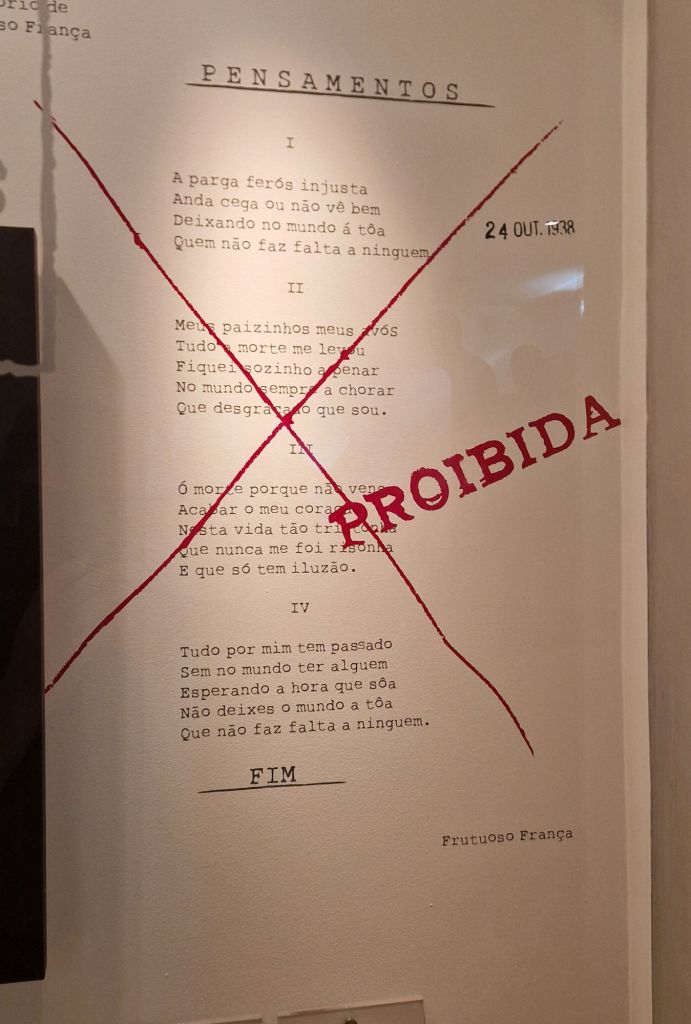
Following on from the last post – this picture I took at the Museu do Fado contains Fazer falta, and it’s prohibited so I am drawn to translate it…. Pre-AO spelling though so ironically it’s just as illegal now as it was then 🙂
The fierce, unjust heap
Is blind or doesn't see well
Randomly leaving in the world
People who won't be missed
My parents, my grandparents
Death has taken everyone from me
I was left alone, suffering
In the world, always crying
What an outcast I am
Oh death, why don't you come for me
To stop by heart
In this sad life
That was never cheerful for me
And only has illusion
Everything is over for me
Without having anyone in the world
Weighting for the hour that sounds
Don't leave the world at random
That nobody will miss
It’s interesting isn’t it? First of all, that first word, parga, is quite unusual. It’s a heap of stored hay and grain stored away from the weather (silage?). I wonder if it had some other meaning on the 1930s. Alternatively, it might even be a typo, because praga (plague) would make a lot of sense.
I’m also interested in the slight shift in wording between the last two lines of the first verse and the last two of the last. I wonder what difference it makes. I feel like there’s a shift in emphasis there but I can’t quite put my finger on it.
Acabo de ler o panfleto deste nome da autoria de Gabriele Giuga, sobre a obra de Amália Rodrigues, com ênfase na canção Barco Negro. É claro que o autor* tem melhores conhecimentos da teoria de música do que eu (o que não é grande elogio porque não sei nada). Ele escreve minuciosamente sobre a sequência de colcheias aumentadas e semicolcheias e ostinatos rítmicos e não sei mais o quê. Não entendo muito mas em suma, afirma que um fado bem escrito tem as suas sílabas dispostas de tal modo que não impedem o ritmo da música. Ou melhor, se for bem escrito, a letra terá um ritmo natural e quando é lido em voz alta, sugere a forma da música, ainda que as guitarras fiquem caladas.
Não sabia que este Fado tem raízes no Brasil. O original é chamado Mãe Preta escrito por Caco Velho. Tem um ritmo muito semelhante mas mais animado. A letra foi proibida em Portugal pela censura do Estado Novo, mas com uma letra de David Mourão-Ferreira (o criador da maioria dos fados mais famosos de Amália), o samba tornou-se uma canção de amor e o ritmo abrandou-se para ser mais adequado às casas de fado.
*apparently Gabriele Giuga is a dude. The e on the end of his first name really threw me. Thanks to Cristina for spotting this and other errors.
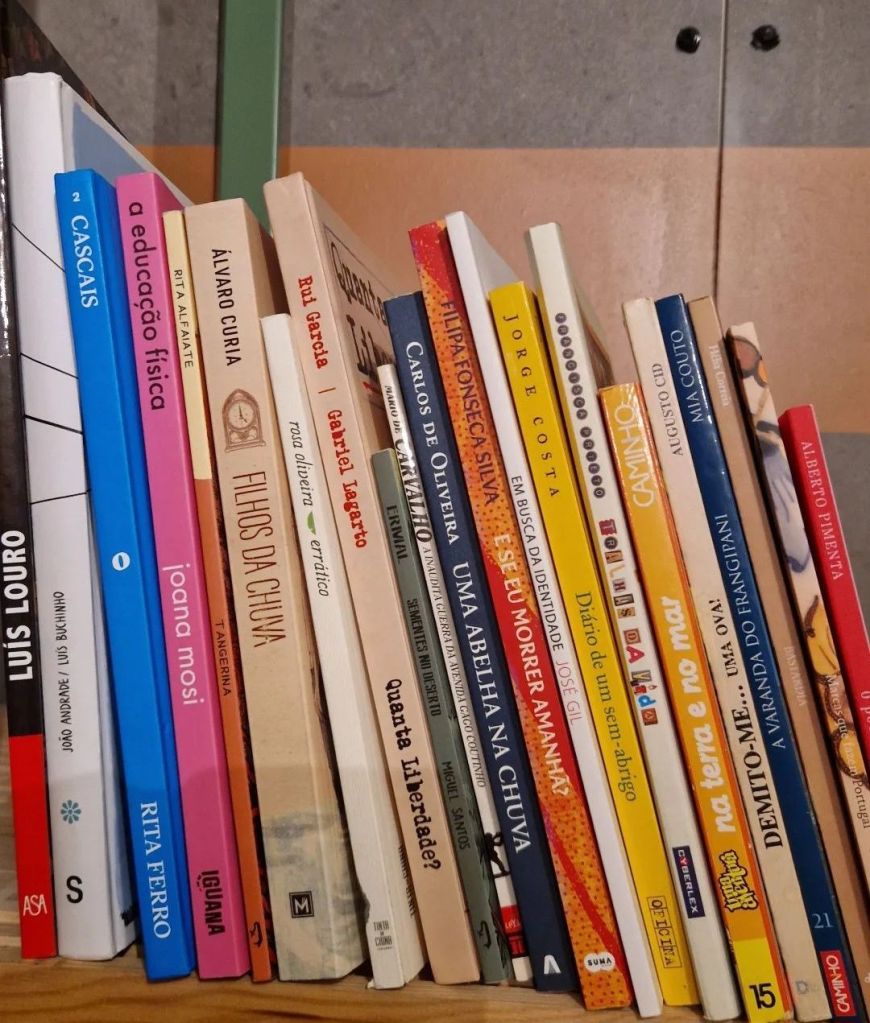
A Sexta feira foi mais um dia cheio de actividades. Tinha chovido durante a noite portanto levei um casaco impermeável e pus-me a percorrer as livrarias todas desta cidade. Consegui comprar todos os livros na minha lista e mais algumas coisas. Enfim, há tantos livros que duvido que o avião consiga levantar voo.
Além de comprar livros, tomei um chá de hortelã no café no topo da loja Pollux (recomendado por uma amiga!) que não me desiludiu.
Depois, fui de elétrico visitar o museu do Fado mas, sendo eu um rebelde virei à direita no top da escada, em vez de à esquerda e vi a história na ordem inversa. Já sabia muita coisa mas nem sequer 1% da história aqui apresentada.
A caminho do museu para mais uma livraria, havia mais chuva. Abriguei-me numa loja turística e enchi os bolsos com lixo demasiado caro.
A última livraria do dia foi a Bertrand no Chiado que, se não me engano, é a mais antigo do mundo. Não tinha planeado visitá-la mas por acaso fica perto do restaurante no qual queria jantar. Havia uma influenciadora perto da caixa que estava a tentar persuadir o empregado a dar-lhe o seu crachá como lembrete. Coitado. Provavelmente tem a mesma conversa 17 vezes por dia. Eu assegurou-lhe que não queria qualquer parte da sua roupa, e falámos um pouco sobre o livro que vim buscar. Recusei a oferta do carimbo da loja no livro, e saí da loja. Havia mais uma influenciadora à porta da livraria a tirar uma* selfie. Desviei-me para evitar o ângulo da câmara, pus o meu pé num buraco e caí no chão.
Baralhado, cheguei ao restaurante. É uma casa de fados chamado Adega Machado. Escolhi-o porque é o lugar onde foi gravado este vídeo incrível. Estava cheio de turistas, claro. Apesar de ser uma sala velha onde Amália cantava antigamente, tudo muda neste mundo caído. Fazem o seu dinheiro a vender uma experiência a quem paga, e como turista, não tive a mínima esperança de encontrar uma “autêntica” (ou seja livre de turistas) casa de fados, porque o mundo não é assim. Penso muito sobre a cultura “pura” no contexto da imigração e do turismo. É um assunto interessante. Talvez seja um tópico de uma série de 30 blogues no futuro.
(Edited this and the previous one. Lots of typos recently. Sorry. All this typing while walking and typing while on the bus is taking its toll, apparently. Thanks to Cristina for the corrections)
O concerto de ontem foi esmagador. Ela cantou muitas canções que adoro, como por exemplo “Gente da Minha Terra”, “Senhor Vinho” e “Estranha Forma de Vida”. Havia quase dois mil portugueses na sala mas eu sentei-me ao lado de dois brasileiros. Que azar! Aproveitei a oportunidade de lhes ensinar o básico da língua portuguesa.
Após a última música, ela voltou ao palco para cantar mais uma que não conheço, mas deve ser muito famosa. Porque toda a gente cantou em uníssono. Vou estudar as letras em breve.
I’m trying to get familiar with Carolina Deslandes’ back catalogue now that I have tickets to see her. When I reached “Dois Dedos de Testa” I was intrigued by the title, which means “two fingers of forehead”. What could it mean? I went down a few dead-ends when I researched it: the first site I found was explaining that having dois dedos de testa (ie, a forehead that’s more than two fingerwidths deep) was a sign of whether or not a fringe would suit you. But I was pretty sure the sing wasn’t about hair styling. I finally found this page which sums it up in the first line
Ter dois dedos de testa costuma ser sinónimo de gente inteligente, com boa cabeça
The scientists in this old ad for Tefal appliances were rocking a solid oito dedos de testa.
So I think that’s the relevant meaning: being clever, having common sense. I’m going to translate “ter dois dedos de testa” as “to be smart” in the lyrics for simplicity’s sake and because “to have two fingerwidths of forehead” would sound ridiculous.
The video also starts with “fátima futebol fado”, which was the Estado Novo’s equivalent to “bread and circuses”: the way of focusing the population’s attention away from thoughts of revolution. She changes it to one she likes better.
All in all, I really like the lyrics. Sometimes I do these translations and the lyric are baffling, sometimes they’re too easy, but I like that this had some mysteries that could be solved and led me to discover new things.
Dois Dedos de Testa
Português
Inglês
Ser mulher aqui é ser mulher de quem? Ter um papel assinado pra ser alguém Ser decente, quem se apresenta à mãe Mesmo que o filho não valha a mulher que tem
Being a woman here means being who’s wife?* To have a role assigned to be someone To be decent, someone fit to meet your mother Even though the son isn’t worthy of the woman he has
Ser mulher aqui é ser submissa Rezar o terço, dizer sim e ir à missa Não ter opinião, ser bonita Ser tão nova quanto o estado e andar bem vestida
To be a woman here is to be submissive Pray the rosary**, say yes and go to mass Don’t have a opinion, be pretty Be as young as the state*** and be well-dressed
E eu que tenho a liberdade debaixo dos braços Tenho brasas a arder debaixo dos pés Pus uma pedra sobre o meu passado E se o que eu sou ofende quem és
And i who have freedom in my grip**** I have coals burning under my feet I put a stone on top of my past***** And if who I am offends, who you are
Deixa-me abanar a cabeça, põe mais vinho nesta mesa Que eu, eu quero esquecer Quero ser o centro da festa, o assunto da conversa Eu, eu quero aparecer
Let me shake my head, put more wine on this table Because me, I want to forget I want to be the centre of the party, the subject of conversation Me, I want to appear
Deixa-me abanar a cabeça, põe mais vinho nesta mesa Que eu, que eu hoje faço um brinde Quero ser dona da festa, tenho dois dedos de testa Sou a voz e nem sou boa ouvinte
Let me shake my head, put more wine on this table Because me, I want to make a toast I want to be the mistress of the party, be smart I’m the voice and I’m not a good listener
Foi deixada, abandonada É carente e mal amada Está tão triste e tão sozinha Pobrezinha
She was left, abandoned She was needy and barely loved She’s so sad and so alone Poor thing!
Sem apelido e sem marido E de quem será o filho? Está cansada, ela trabalha Coitadinha, coitadinha
Without a surname, without a husband And who’s child is it? She’s tired, she works Poor thing, poor thing!
Deixa-me abanar a cabeça, põe mais vinho nesta mesa Que eu, eu quero esquecer Quero ser o centro da festa, o assunto da conversa Eu, eu quero aparecer
Let me shake my head, put more wine on this table Because me, I want to forget I want to be the centre of the party, the subject of conversation Me, I want to appear
Deixa-me abanar a cabeça, põe mais vinho nesta mesa Que eu, que eu hoje faço um brinde Quero ser dona da festa, tenho dois dedos de testa Sou a voz e nem sou boa ouvinte
Let me shake my head, put more wine on this table Because me, I want to make a toast I want to be the mistress of the party, be smart I’m the voice and I’m not a good listener
E eu que tenho a liberdade debaixo dos braços Tenho brasas a arder debaixo dos pés Pus uma pedra sobre o meu passado E se o que eu sou ofende quem és
And I who have freedom in my grip**** I have coals burning under my feet I put a stone on top of my past***** And if who I am offends, who you are
Deixa-me abanar a cabeça, põe mais vinho nesta mesa Que eu, eu quero esquecer Quero ser o centro da festa, o assunto da conversa Eu, eu quero aparecer
Let me shake my head, put more wine on this table Because me, I want to forget I want to be the centre of the party, the subject of conversation Me, I want to appear
Deixa-me abanar a cabeça, põe mais vinho nesta mesa Que eu, que eu hoje faço um brinde (brinde) Quero ser dona da festa, tenho dois dedos de testa Sou a voz e nem sou boa ouvinte
Let me shake my head, put more wine on this table Because me, I want to make a toast I want to be the mistress of the party, be smart I’m the voice and I’m not a good listener
* This sentence loses a lot of its cleverness in the translation, I think
***Another one that loses some of its force in english – it’s another reference to the Estado Novo, if I read it correctly
****Debaixo do braço is a set phrase meaning grasped under the arm, next to the body, so I am picturing her holding liberdade like a rugby ball
*****This one smelled like an expression too. Most results return as “colocar uma pedra sobre” and “pôr” is less common but obviously scans better. You can find both on this page. I think we’re meant to imagine the stone as a paperweight you put on your work when you’ve finished writing or something. It means what we would now call “drawing a line under” the subject, basically, putting a full stop to the sentence.
A tradução de hoje é “Fado Português”. Se Amália cantou alguma canção, acho que convém usar a versão dela como base duma tradução, mas não existe um vídeo dela a cantar esta, e olha, a versão de Sara Correia é ótima, então porquê é que estás a resmungar? Vi-o na app Lingoclip, que estou a usar diariamente. Para ser sincero, é frustrante. Prefiro usá-la no modo especialista porque é mais fácil digitar tuuuuudoooo do que andar de um lado para o outro entre as letras e as opções, mas é preciso ter dedos extraordinariamente rápidos! Mas um fado é mais fácil do que um rap, portanto, se gostares de experimentar, recomendo que comeces com algo deste género.
Português
Inglês
O Fado nasceu um dia Quando o vento mal bulia E o céu o mar prolongava Na amurada dum veleiro No peito dum marinheiro Que, estando triste, cantava Que, estando triste… cantava
Fado was born one day When the wind was barely stirring And the sky held back the sea On the hull of a sailing ship In the breast of a sailor Who, being sad, was singing, Who, being sad, was singing.
Ai, que lindeza tamanha Meu chão, meu monte, meu vale De folhas, flores, frutas de oiro Vê se vês terras de Espanha Areias de Portugal Olhar ceguinho de choro
Oh so much beauty My ground, my mountain, my valley With leaves, flowers and golden fruit See if you see the lands of Spain, Sands of Portugal Vision nearly blind from crying
Na boca dum marinheiro Do frágil barco veleiro Morrendo a canção magoada Diz o pungir dos desejos Do lábio a queimar de beijos Que beija o ar e mais nada Que beija o ar… e mais nada
In the mouth of a sailor Of the fragil sailing boat The tortured song, dying Tell of the torment of desires From the lip burning with kisses That kisses the air and nothing else That kisses the air and nothing else
Mãe, adeus, adeus, Maria Guarda bem no teu sentido Que aqui te faço uma jura: Que ou te levo à sacristia Ou foi Deus que foi servido Dar-me no mar sepultura
Goodbye mother, goodbye Maria Remember what you see and hear* That here I make an oath That I will either take you to the sacristy Or it was God that served me By giving me a grave in the sea
Ora eis que embora outro dia Quando o vento nem bulia E o céu o mar prolongava À proa doutro veleiro Velava outro marinheiro Que, estando triste, cantava Que, estando triste, cantava
Well so it was that the next day When the wind was hardly stirring And the sky held back the sea At the prow of another sailing ship Sailed another sailor Who, being sad, was singing, Who, being sad, was singing.
Ai, que lindeza tamanha Meu chão, meu monte, meu vale De folhas, flores, frutas de oiro Vê se vês terras de Espanha Areias de Portugal Olhar ceguinho de choro
Oh so much beauty My ground, my mountain, my valley With leaves, flowers and golden fruit See if you see the lands of Spain, Sands of Portugal Vision nearly blind from crying
*Not very literal at all but I couldnºt make it make sense if I did it word for word.
Here’s a translation of a relatively upbeat, but very traditional Lisbon Fado written by Ricardo Borges de Sousa in the early years of the twentieth century and sung here by Maria Teresa de Noronha. It is well-enough regarded to be the subject of a whole episode of “A Trilogia do Fado” on RTP, but it isn’t the only version of the song; there seem to be lots of variants each with their own set of lyrics.
🇵🇹
🇬🇧
Quem me dera que voltasse O doce tempo de além Sentada junto à lareira A ouvir cantar minha mãe
If only you would came back The sweet, far-off time Seated together at the fireside Listening to my mother sing
Ó tempo, tempo ditoso Da vida eterno sorriso Que tornas em paraíso Um mundo tão enganoso Quando à minha mãe, choroso Após um beijo na face Lhe pedia que cantasse Uma trova de bonança Esse tempo de criança Quem me dera que voltasse
Oh time, happy time Eternal smile of life That turns in paradise Into such a deceptive world When my mother, tearful, After a kiss on the face was asked to sing A soothing song** That time of childhood If only it would come back
Tempos que não voltam mais Da nossa infância ridente Em que eu vivia contente Correndo atrás dos pardais Das paredes dos casais Que a nossa aldeia contém Branquinhas como a cecém Mudas como a gratidão E recordam com paixão O doce tempo de além
Times that will never come again Of our laughing childhood When I lived happily Chasing sparrows From the walls of couples That lived in our village White as lillies Mute with gratitude And they remember with live The sweet far-off time
*I really struggled to make sense of the first four lines when I was following the lyrics on letras.com because it has the word “ternas” in place of “tornas”, and fair enough, it does sound like that, but I couldn’t make it make sense. Why is it feminine and plural? is he talking about herself and her friends? But how does that follow on with the line before and after? It was definitely fishy but it could make sense if she was talking about that idyllic scene turning into a deceptive world, so maybe “torna-se”, but that would have the “se” in front of the verb because it’s after que. Tornasse? But why would it be subjunctive? I had a look around but most online sources seem to have screen-scraped letras.com so they had the same word. Then I found a site that used “terras”. I hate that less, but I still don’t buy it. And then finally I came across this site that uses “tornas” and I am absolutely ready to believe that!
**I wasn’t sure about this one, but when you look up trova and bonança, it makes sense. I tried the whole line in gtranslate and it said “a thunderous bonanza” which doesn’t really fit the mood.
I think this is originally by Amália and based on a poem by Camões, but I like this version a lot. That pianist really needs to sort his posture out though. I’ve never really been that interested in Camané but the Humanos videos I’ve been watching have really made me warm to him.
English
Portuguese
Com que voz chorarei meu triste fado Que em tão dura paixão me sepultou Que mor não seja a dor que me deixou o tempo Que me deixou o tempo de meu bem desenganado De meu bem desenganado
With what voice will I cry my sad Fado That has entombed me in this hard passion May the love not be pain that allowed me the time Allowed me the time of my disenchanted lover Of my disenchanted lover
Mas chorar não se estima neste estado Aonde suspirar nunca aproveitou Triste quero viver, pois se mudou em tristeza Pois se mudou em tristeza a alegria do passado A alegria do passado De tanto mal, a causa é amor puro Devido a quem de mim tenho ausente Por quem a vida e bens dele aventuro
But crying isn’t appreciated in this state Where I never took the time to breathe I want to live sadly because it turned into sadness It turned into sadness, the happiness of the past The happiness of the past Pure love is the cause of so much evil Owning to the one who is away from me For whom I risk life and all its benefits
Com que voz chorarei meu triste fado Que em tão dura paixão me sepultou Que mor não seja a dor que me deixou o tempo Que me deixou o tempo de meu bem desenganado De meu bem desenganado, desenganado
With what voice will I cry my sad Fado That has entombed me in this hard passion May the love not be pain that allowed me the time Allowed me the time of my disenchanted lover Of my disenchanted lover





 Luso
Luso 