Do the exam modelos Cristina gives me Hm, I’ve only done one so far. Not very impressive.
Go through the list of key structures in the C2 syllabus here, and try and figure out what I need to work on, possibly in the lessons Na, sod that for a game of soldiers. Honestly, it’s an enormous list and full of set phrases you’re supposed to use and I honestly don’t think I’ve even seen most of them in the books I’ve read, or heard them said anywhere. Afinal, empreguei a arte subtil de saber dizer que se foda.
Just general tidying
I have some lists of structures I often get wrong and structures that get used a lot in portuguese that I never use because I keep forgetting about them, so try and make sure I get as many of them as possible into blog posts instead of just treading the same old familiar linguistic pathways that I rely on in everything I write. Been a bit lax with this one, I’m afraid!
Try and bribe my wife to speak to me in her beguiling madeiran accent. Poached eggs will probably work. She loves a good poached egg. Rekindled marital lusophonia and managed a few exchanges.
Daily Anki deck usage
General Input
Reading – I have an english book I am committed to reading for family book club and a couple of audiobooks that I am already part way through, but when those are finished, no new english books, just portuguese ones. Probably not many though, because I don’t really need much practice – just bedtime reading, and just things that seem like they will expand my brain. Like I have a Gil Vicente play in BD form, but I looked at it earlier and it’s much too archaic so I’ll save it for after the exam. Managed to finish a couple of books this week!
Podcasts – Portuguese only till after the exam. I might even unsubscribe to some of the english language ones to remove temptation. Listening to quite a lot of audio this week: mostly on youtube, but also some episodes of Extremamente Desagradável
Eat-Rep exercises – I’m going to drop some of the morning quizzes I do and watch a quarter of Os Gatos Não Têm Vertigens instead – that’s about two watches per week. try to do some “scratching” in the first weeks and move toward “copycat” exercises in later weeks. Contrary to what I said last week, I decided that the repetition was useful and I find myself digging deeper into expressions I hadn’t really noticed before. I’ve lost count of how many times I’ve watched it now. 4? 5? I am pleased with my choice. It is a good film. The cafe scene is brilliant.
Exercises
This weekend
Start final chapter of Português em Foco done
“Puzzle Brain” activity – listen to portuguese audio while doing a jigsaw Finished the second puzzle and thinking of doing a third. A Viúva is doing my head in though. It is very different from Saramago’s other work, but that wouldn’t matter if I was using a better player. Bertrand’s audio app is pants. It crashes for no reason and when you open it again it has forgotten where you were and opens at the start or wherever you last left a bookmark or at some random place, and you have to spend ages finding the right place again. Infuuuuuuriating!
W/E 27-10-2024
Finish Português em Foco exercises in the main book (meant to do these before Lisbon really, but…) done
Start the (self marked) grammar exercises in the Caderno de Exercícios done
W/E 03-11-2024
Finish the grammar exercises in the Caderno de Exercícios Done
“Scuba Diving” exercises with text and audio of “Amor de Perdição” Not done. I did the extra Eat Rep instead and I don’t think that was a good choice.
W/E 10-11-2024
Non-thorough run through of the paper exercise books I have, looking for grammar exercises that look like they might be beneficial.
The remainder of the vocabulary and verb tenses sections of Português Outra Vez, (the expressões section is rubbish and I can’t be bothered with it)
The C1 sections of “Vamos Lá Continuar” and
Some of the more challenging exercises from Qual é a Dúvida. I finished this book ages but there were some exercises that left me floored, so I’ll be interested to see if I find them just as hard the second time around!
Happy first day of GMT. Here’s all that sun you missed. 🌞🌞🌞🌞🌞🌞
Marking off what I’ve done from the plan I made.
Raw Exam Prep
Do the exam modelos Cristina gives me Done only 2 exercises form the first.
Go through the list of key structures in the C2 syllabus here, and try and figure out what I need to work on, possibly in the lessons Started but… Oh my god, it’s absolutely massive!
Just general tidying
I have some lists of structures I often get wrong and structures that get used a lot in portuguese that I never use because I keep forgetting about them, so try and make sure I get as many of them as possible into blog posts instead of just treading the same old familiar linguistic pathways that I rely on in everything I write. Doing pretty well with this!
Try and bribe my wife to speak to me in her beguiling madeiran accent. Poached eggs will probably work. She loves a good poached egg. Only one day of this so far
I also started an Anki Deck for unfamiliar vocab
Went back to revise some of my favourite past blogs – like this one for example. I feel like I did a better job than most basic level explainers written by native speakers – bug claim, I know, but they tend not to be very nuanced and I unpacked a lot of weird stuff that gets left out. I um (checks notes) understood the assignment. I (checks notes again) ate and Er… Left no crumbs. (peers at notes a third time)… Slay!
General Input
Reading – I have an english book I am committed to reading for family book club and a couple of audiobooks that I am already part way through, but when those are finished, no new english books, just portuguese ones. Probably not many though, because I don’t really need much practice – just bedtime reading, and just things that seem like they will expand my brain. Like I have a Gil Vicente play in BD form, but I looked at it earlier and it’s much too archaic so I’ll save it for after the exam. I’ve read lots and written a few reviews too
Podcasts – Portuguese only till after the exam. I might even unsubscribe to some of the english language ones to remove temptation. Lots of audio going on at the moment, including some really difficukt regional accents
Eat-Rep exercises – I’m going to drop some of the morning quizzes I do and watch a quarter of Os Gatos Não Têm Vertigens instead – that’s about two watches per week. try to do some “scratching” in the first weeks and move toward “copycat” exercises in later weeks. Two and a half run-throughs so far and I’m enjoying it. Part of me wants to move to another film though because I notice myself not paying enough attention because I already know the gist of the plot. Should I trust the process or my instincts? 🤔
Exercises
This weekend
Start final chapter of Português em Foco done
“Puzzle Brain” activity – listen to portuguese audio while doing a jigsaw enjoyed this much I have started a second puzzle and a second audiobook – A Viúva by José Saramago
W/E 27-10-2024
Finish Português em Foco exercises in the main book (meant to do these before Lisbon really, but…) done
Start the (self marked) grammar exercises in the Caderno de Exercícios done (4 chapters in)
W/E 03-11-2024
Finish the grammar exercises in the Caderno de Exercícios
“Scuba Diving” exercises with text and audio of “Amor de Perdição”
W/E 10-11-2024
Non-thorough run through of the paper exercise books I have, looking for grammar exercises that look like they might be beneficial.
The remainder of the vocabulary and verb tenses sections of Português Outra Vez, (the expressões section is rubbish and I can’t be bothered with it)
The C1 sections of “Vamos Lá Continuar” and
Some of the more challenging exercises from Qual é a Dúvida. I finished this book ages but there were some exercises that left me floored, so I’ll be interested to see if I find them just as hard the second time around!
Já terminei o Português em Foco (yasss!!! Fico tão feliz!). Vou continuar com os exercisio da gramática mas quanto aos conteúdos do livro, não tenho de criar mais documentos no GDrive, nunca mais. Estou livre! Hoje é o meu dia 25 de Abril.
Ouvi mais áudios portugueses mas menos do que nos dias passados, terminei o livro de Mário de Carvalho (a opinião segue-se amanhã) e mais uma visualização d’Os Gatos Não Têm Vertigens. Estou a gostar cada vez mais, apesar dos defeitos. O final é muito comovente.
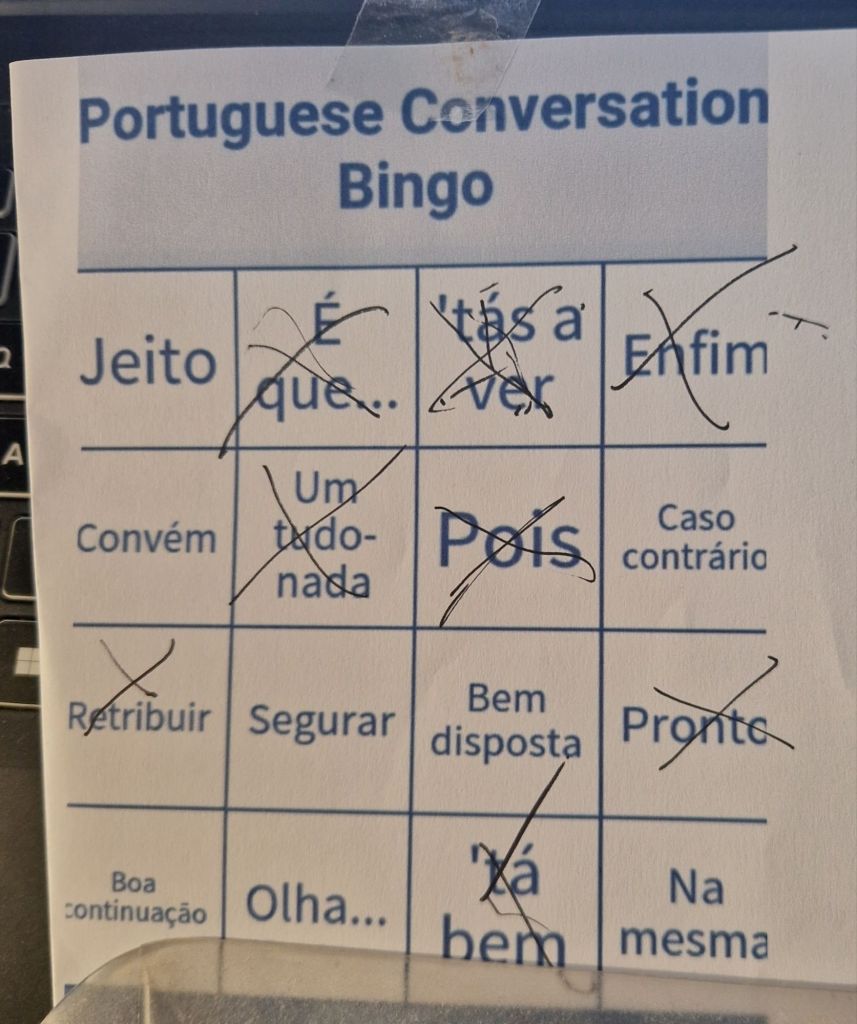
Hoje de manhã fiz mais uma aula. Esqueci-me de trazer o meu cartão de Bingo, e como resultado esqueci-me de abrir o jogo com “Bem disposto?”. Ainda por cima, não tive oportunidade de encerrar a conversa com “boa continuação”. Porquê? Eh pá, foi mesmo chato: terminámos cedo porque Ian Internet desapontou-nos. Mas há males que vêm para o bem: logo depois, tive uma conversa com a Catarina em português (um acontecimento raríssimo!). Caso queiras saber, ela estava bem disposta (mas cansada).
A minha palavra nova do dia é “vadio”, que é tipo “preguiçoso” mas mais enfatica – em inglês diríamos “layabout”. Usou-a para descrever determinados colegas dela que não fazem nada, mas fingem estar gastos por estar tão, mas mesmo tão atarefados durante o turno inteiro.
Eis o cartão de Bingo.
Marquei um miserável 8/16. Buuu. São palavras/expressões comuns de que me esqueço sempre porque fico preso num trilho de palavras aborrecidas. Digo “OK” em vez de “tá bem” ou “certo” que não é errado mas é preguiçoso. Igualmente “se não” em vez de “caso contrário”, “pegar em” em vez de “segurar”, Sim, sim, sim, em vez de pois, pois, pois é, e assim por diante.
Ouvi uns podcasts, li o álbum de Tamara Alves, e vi não só um quarto d’Os Gatos Não Têm Vertigens, mas o filme inteiro, com subtítulos. O diálogo é muito rápido, e há pessoas de várias gerações a falar cada um à sua maneira – adolescentes a usar palavrões e calão, bêbados a gritar e velhos a murmurar ternamente um ao outro. Precisei dos subtítulos mas em breve espero que continue sem a “muleta” do texto!
Dei por várias coisas interessantes que não tinha percebido antes, como por exemplo “Balelas”, que significa “mentiras” ou algo semelhante.
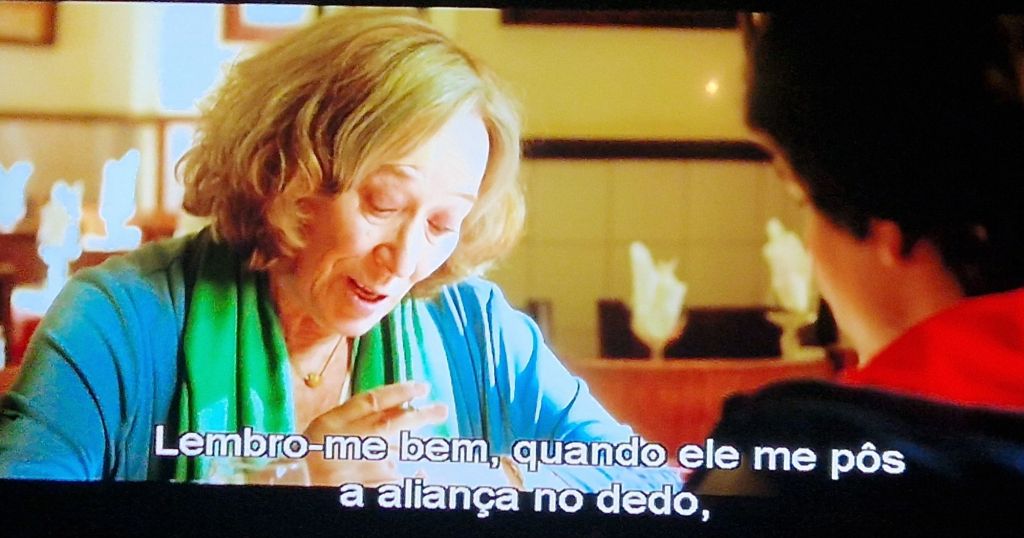
Simpatizo com a Dona Rosa nesta cena. O genro dela é um idiota.
Também vim a saber* que “aliança” não só significa um compromisso entre dois países ou grupos para colaborar um com os outros mas também é o anel que simboliza um casamento.
O filme também me lembrou desta canção que já ouvi, porque a Catarina gosta dela. Um dos protagonistas, o Jó, vai com a Rosa numa barca pois ela queria espalhar as cinzas do seu marido mas uma vez que é** ilegal, Jó tem de distrair um homem que está por perto. Pede-lhe lume*** e fala com ele sobre o futebol mas o homem está a ouvir a canção Não Venhas Tarde de Carlos Ramos na Rádio Amália.
Gosto do facto da protagonista ser uma velha. Acho que há poucos filmes que ousam destacar atores mais velhos em papéis como este. A outra personagem, Jó, é secundária e, no início do filme, é mesmo chato. É membro de um grupo de jovens criminosos que lhe roubaram a mala, e é assim que o Jó vem a conhecer a Rosa. Não é muito simpático de todo, mas a Rosa, que é uma pessoa com uma história longa e interessante, vê algo nele que a incentiva a lhe dar um hipótese de redenção.
O Jó tem de superar a sua relação com os seus amigos, que não servem para nada, e com o seu pai, que é um filho**** de puta, mas afinal a Dona Rosa tem razão: o puto consegue endireitar-se e acaba por ser escritor.
O filme não é perfeito mas é mesmo bom e gostei mais desta vez do que quando o vi a primeira vez, anos atrás.
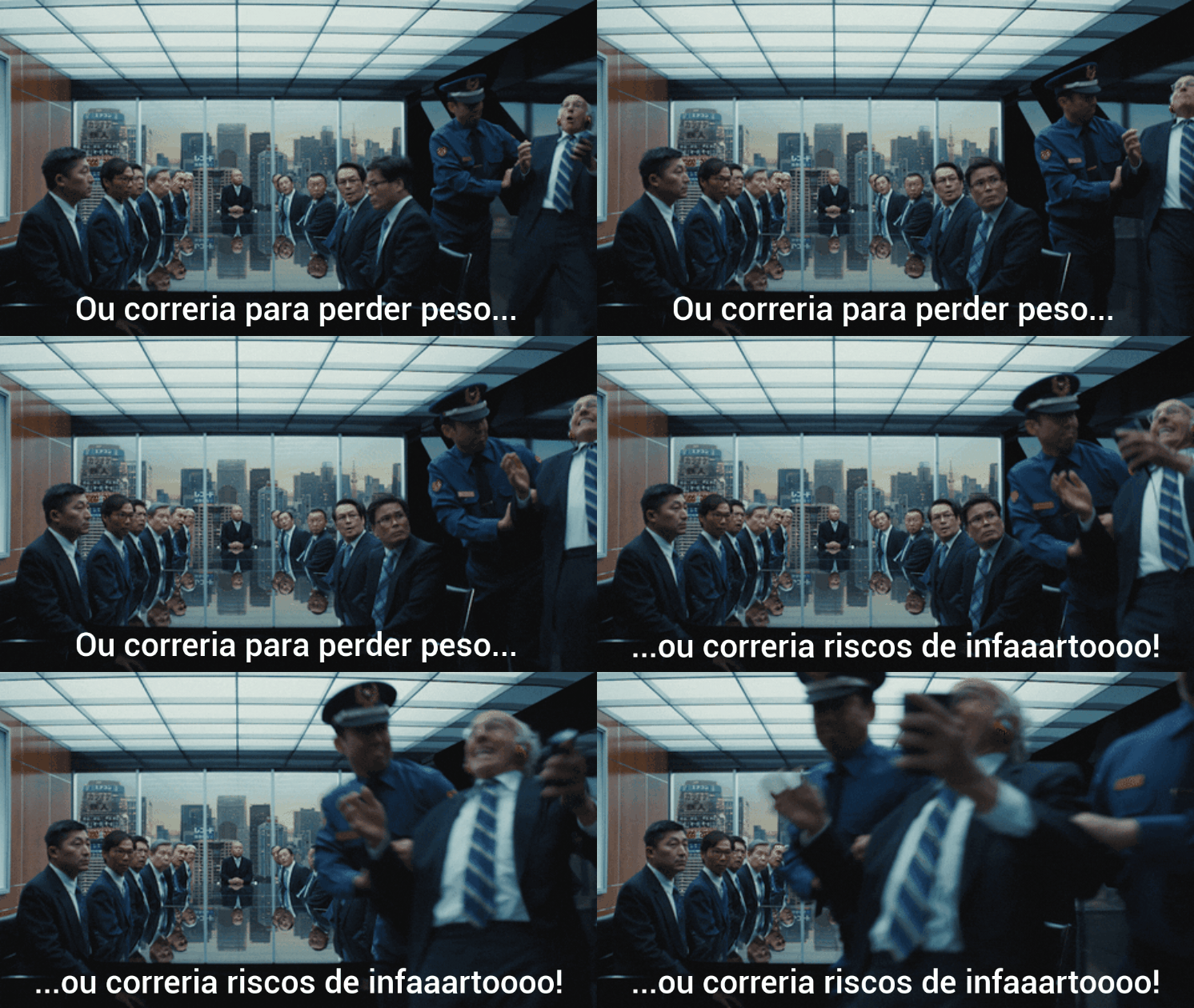
Também curti este trocadilho.
Ao fim do dia, fiz o exercisio de Puzzle Brain, ouvindo o Quarto Livro de Crónicas de António Lobo Antunes enquanto fazia um Puzzle de mil peças. Que malandrice! Segundo o Goodreads o livro, tem 328 páginas mas o audiolivro não dura mais de uma hora! Então, não é a obra completa. Mas por outro lado, é um pouco deprimente e não preciso de mais!
Amanhã, exercícios! Bora lá!
*Shout out to 2021 Colin, who wrote this article that I came across today and had forgotten all about.
**Surprised this wasn’t subjunctive after “uma vez que”. It seems like it depends slightly on how hypothetical you’re being.
*** “Lume” Not “um lume” – too literal translation from “Hev yew got A loight boy?” (This guy is long overdue for a revival IMHO)
****Embarrassingly I wrote uma filha de puta. Have I really sunk so low that I am making nouns agree with other nouns? Dear oh dear.
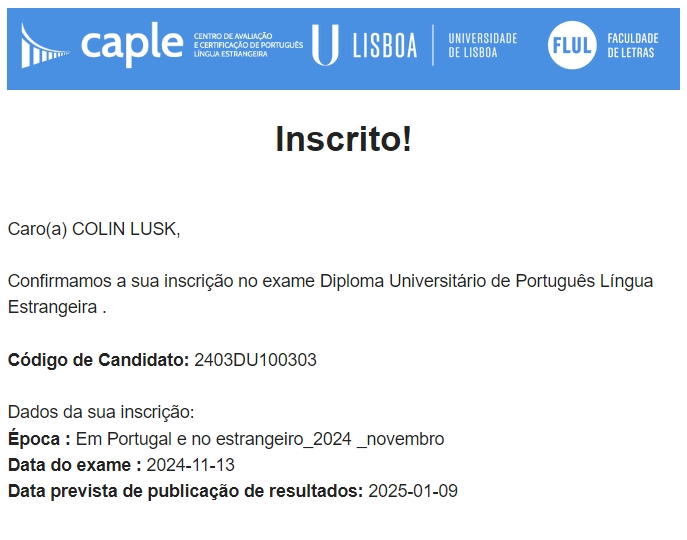
OK, the exam is on the 13th of November. To be honest, I wish I’d gone for May next year, but here we are… I’m going to be taking another of the Say It In Portuguese CAPLE Exam preparation courses. I need to use the remaining time wisely so I’m going to try and cut out a lot of unnecessary stuff, put a few things on hold till the second half of November to make more time for learning, especially listening and speaking (using some of the techniques this fella lays out in this video) and I’ll add this lot to my Planner app:
Raw Exam Prep
Do the exam modelos Cristina gives me
Go through the list of key structures in the C2 syllabus here, and try and figure out what I need to work on, possibly in the lessons
Just general tidying
I have some lists of structures I often get wrong and structures that get used a lot in portuguese that I never use because I keep forgetting about them, so try and make sure I get as many of them as possible into blog posts instead of just treading the same old familiar linguistic pathways that I rely on in everything I write.
Try and bribe my wife to speak to me in her beguiling madeiran accent. Poached eggs will probably work. She loves a good poached egg.
General Input
Reading – I have an english book I am committed to reading for family book club and a couple of audiobooks that I am already part way through, but when those are finished, no new english books, just portuguese ones. Probably not many though, because I don’t really need much practice – just bedtime reading, and just things that seem like they will expand my brain. Like I have a Gil Vicente play in BD form, but I looked at it earlier and it’s much too archaic so I’ll save it for after the exam.
Podcasts – Portuguese only till after the exam. I might even unsubscribe to some of the english language ones to remove temptation.
Eat-Rep exercises – I’m going to drop some of the morning quizzes I do and watch a quarter of Os Gatos Não Têm Vertigens instead – that’s about two watches per week. try to do some “scratching” in the first weeks and move toward “copycat” exercises in later weeks.
Exercises
This weekend
Start final chapter of Português em Foco
“Puzzle Brain” activity – listen to portuguese audio while doing a jigsaw
W/E 27-10-2024
Finish Português em Foco exercises in the main book (meant to do these before Lisbon really, but…)
Start the (self marked) grammar exercises in the Caderno de Exercícios
W/E 03-11-2024
Finish the grammar exercises in the Caderno de Exercícios
“Scuba Diving” exercises with text and audio of “Amor de Perdição”
W/E 10-11-2024
Non-thorough run through of the paper exercise books I have, looking for grammar exercises that look like they might be beneficial.
The remainder of the vocabulary and verb tenses sections of Português Outra Vez, (the expressões section is rubbish and I can’t be bothered with it)
The C1 sections of “Vamos Lá Continuar” and
Some of the more challenging exercises from Qual é a Dúvida. I finished this book ages but there were some exercises that left me floored, so I’ll be interested to see if I find them just as hard the second time around!
Exam Week!!!!
I’ll keep this free for whatever I think needs shoring up
I mentioned a while ago that I was starting the Say it in Portuguese CAPLE Exam Prep course. I thought it would be worth taking a really focussed course to try and get myself match fit instead of winging it. In case anyone is in the same boat, thinking of taking it for a future exam, here’s what it’s like:
The course took place over 4 weeks because that’s how long I had from enquiring to the date of the exam. Following an introductory meeting, Cristina offered a range of three options, based on what I said my weak points were. There were different levels/prices, depending how much support I wanted and I went with the middle one. I won’t say what the prices were in case it’s a trade secret, but I’d definitely call it very good value.
As you might already know, there are four sections in the exam*, and I felt reasonably comfortable with the reading comprehension but decidedly iffy about some of the others, so the really important stuff for me was in the form of four weekly drops of one sample paper from the written part of the exam and a recording and set of multiple choice questions from the aural comprehension section. I completed them in my own time and emailed them back. Very detailed feedback would then arrive the following day for me to work through.
On Fridays we had an online meeting where we’d go through some of the homework feedback and also did a simulated parts 1 and 2 of the “produção e interação orais” exam format. Mistakes made in the meeting would prompt more feedback via email, including actually recording the lesson and doing a step-by-step feedback recording that I could listen to and hear my mistakes.
Cristina does other courses and she’s also host of one of the earliest portuguese podcasts, so she’s an experienced teacher, but I think I was one of the early adopters on this specific DAPLE course, and there were a couple of teething troubles – a few typos in the questions – which I fed back and will no doubt have been corrected by the time the next person takes the course. In the post-exam debrief, I also suggested she might change the order the aural papers were given in, since I think the first one was a real past paper and the later ones were close simulacra. They were very good recordings and sounded almost exactly like real exam questions, but the questions were a tiny bit less ambiguous and tricksy, so I thought maybe it would be better to start with those and finish on the real past paper.
The course definitely boosted my confidence and helped me approach the exercises in a more controlled, less panicky way. Yeah, the exam could have gone better, but it could have gone worse too, and it definitely would have if I hadn’t done the course! I would definitely recommend it to anyone planning on taking a CAPLE exam, especially if you’ve never taken one before and are not familiar with the format.
Yesterday was the day of the DAPLE (C1) exam. Usually when I do one of these exams I write it up straight away, but I’ve left it till the next day because I was feeling a bit miserable. It all went a bit piriform, I’m afraid. Let’s take it step by step:
I arrived at the embassy half an hour early. Better than half an hour late, I suppose, but they don’t open the gates till nine. No exceptions. Even when their own staff arrived the secrity guy wouldn’t answer the buzzer till nine sharp. I was in need of a wee, and I had a congested nose, so being out in the cold did not help at all. And then a brazilian and a…. venezuelan(?) guy arrived and started speaking spanish. I tried to ignore them. I don’t need to hear spanish today, lads!
When we were let in, she showed my to a nice reception room – much nicer than the noisy, echoey office the exams have been held in previously. I was the only student there, so I was just sat at a table, with the invigilator about fifteen feet away at a different table. My face was bunged up, I had to breathe through my mouth a lot of the time, and I had to keep blowing my nose noisily.
The Compreensão da Leitura went well. 90 minutes, 60 marks. There were some extracts from articles about modern life: an overview of the work of António Damásio and a missing paragraph exercise based on a story about how portuguese kids coped with remote learning during lockdown. The missing paragraph thing is quite annoying: it soaks up a lot of time for only 5 marks. I was worried that I was behind schedule but of course it was fine: The last 40 marks are fill-in-the-blank questions, which are much quicker than the ones where you have to read the text, so you don’t have to be strict about hitting one mark every minute and a half. It was definitely challenging, but I had done the preparation and I reckon I got most of the marks.
Break. Water, toilet, blow nose, eat a square of chocolate, suck a menthol sweetie.
Next came the Produção e Interação Escrita. 90 minutes, 3 exercies. I found myself getting writer’s block at first, suddenly doubting my spelling of almost every word. I wrote a formal letter to the local council, telling them they shouldn’t close the library, recycling as much from the question itself as I possibly could.
Next up was a discussion stemming from this article from the Expresso (the section beginning “O problema não é a ansiedade dos jovens quanto o futuro…”). I decided to branch off in the middle and talk about George Bernard Shaw’s novel “Back to Methuseleh” which takes as its premise that if you could only extend the human lifespan to hundreds of years then everyone would suddenly be incentivised to really work at dealing with entrenched, long-term social problems. This seemed like quite a fun diversion: the trouble with always having to write about environmental issues is that it can feel a bit preachy, so I was glad I made it more interesting. Generally, if you bore the marker they are less likely to give you the benefit of the doubt. With hindsight, I think I might have confused some of the plot points with “The Trouble with Lichen” by John Wyndham, which is also about extending human life, but never mind; I doubt the marker will have read both, so I think I’m pretty safe.
The third of the three exercises was the usual mechanical rewriting of sentences into different forms: passing direct to indirect speech, switching in and out of subjunctive and using gerunds. I’ve done a shit-ton of fiddly grammar exercises lately in Qual é a Dúvida: about a hundred pages of them, in fact, so I felt really confident about my answers. Done, dusted, 5 minutes left over, so I skimmed the first and second texts, strafing the errors. Some really stupid ones! Probably saved myself about ten lost marks there.
Break. Water, toilet, blow nose, eat a square of chocolate, suck a menthol sweetie.
Hey, well, it’s all going well so far right, as the optimist said as he fell past the thirteenth floor.
Next up was squeaky bum time: the Compreensão do Oral, which is always everyone’s least favourite. It’s 40 minutes and 25 points. I have done six of these for practice recently and was starting to feel quite confident, so I just tried to stick to my new system and keep a cool head. I couldn’t though – I felt like I was swimming around in a sort of soup of words. And the questions were really ambiguous too, For example, there was a passage about the rehabilitation of the Iberian Lynx (I can’t find the exact recording but here’s a podcast that deals with the same situation). At one point he talks about a kind of rabbit called the Coelho Bravo which he said was essential to the Lynx because it was so specialised that the Coelho Bravo was “almost its only food” but he didn’t say what else it ate. The answers included one that just said it was “essential” and one that said it was essential because it was the lynx’s “only food”. I didn’t like the first because it’s not specific enough about why the rabbit is essential, but the second seemed to be overstepping the mark so I played it safe and stuck with the first.
Then there was one about wolves in portugal (I’ve listened to an audiobook about them, but it didn’t help much I’m afraid), a section from this interview with the author of a book called “Adeus Futuro”. The invigilator told me afterwards that even she couldn’t answer the questions for this section (cool cool cool cool cooooool).
And finally an interview with friend of the blog Marco Neves. I’ve read one of his books, actually had another of his books on order at the time, and I once did a course he taught so I have a pretty good idea of the way he thinks. And Ainda bem, because the fourth question in the section was about a specific word – I can’t remember what it was but it began with “des” and the question was about whether the des- was there to reinforce the root word or contradict it. I didn’t catch it the first time around so I listened out for it really carefully the second time and I swear, dead ass, as the young folk say, that he didn’t bloody say it. I mean, I know he must have, but I didn’t hear. I made an educated guess, but I dunno. I was gutted. I’ve been scoring 17-20/25 lately and I’d be surprised if I got 15 in this. Horrifying.
Break. Water, toilet, blow nose, eat a square of chocolate, suck a menthol sweetie, say, when asked how I am, that I just want to die.
The final part of the exam is the shortest, but it’s quite nerve-wracking because it’s recorded on video: Produção e Interação Orais. 25 minutes, and you’d think it would feel like hours, but it doesn’t, it feels like about twelve seconds. With hindsight, I wish I’d written some reminders to myself on a card about controlling the rate at which I speak, and slipped it into my backpack. so I could have read it before that part of the exam and refocus my thoughts before the real thing.
Again, I’d spent quite a bit of time preparing for this and I had developed an apresentação which I hadn’t memorised but reckoned I could use all or part of in talking about myself. Weirdly, though, she didn’t really give me much room to expand on my answers. It was just Where were you born, where do you live now, how long have you lived here, how long have you been learning portuguese and a few other things. I even got cut off if I said too much. Gutted! I’d been prepared to give my silly discussion of running in the park, talk about the books I’ve read and maybe even get into talking about the comedian I’d seen on the previous evening, but I didn’t get a chance. My answers were fine, but I thought this would be my chance to shine and it wasn’t.
Me trying to finish my Apresentação before embrassy security throws me out in the gutter
The next part of the interaction is a visual prompt and I was handed most boring picture in the world, with two men and a woman sitting at a desk and almost no other objects visible in the shot. I talked about meetings and how a lot of work meetings were happening online now, and how I quite liked that as an introvert. I did some light-hearted banter about what it’s like when you’re trying to write an email and someone says your name but you have no idea what they are asking you because you weren’t listening. Not exactly comedy gold but it was reasonably grammatically correct. I suspect there were a lot of Umms in there though. I hadn’t quite filled the time, so she gave me a follow-up question: did I think there was a gender pay gap in the workplace. Oh shit, I thought, was that what I was supposed to talk about? Women in the workplace? Oh well, I started saying it depended on the specific company and that in my industry, social services, women were really well represented in senior positions, but that was as far as I got because we hit the time limit again. Probably just as well, really, I don’t normally want to give pat answers so I think I would have got into lifetime earnings after that and come a cropper on the vocabulary.
Lastly, we had to do an interaction about starting an export business. Normally, you’d do this with another student but since there weren’t any, it was me and the invigilator, with a third person taking notes. Why did they need to take notes when it was all on camera? I dunno.
The scenario was that I wanted to export olive oil and she had to persuade me to export cork instead. Wha’? What do I know about the relative profitability of those things? I didn’t really follow the sequence properly and kept fighting my corner even though the script said I was supposed to agree with her in the end. I finally took the hint but I was in the middle of saying that my wife has lots of bags but she doesn’t have one made of cork, so I turned on a dime and said that, now I thought about it, maybe I’d but her a nice cork bag. Except I started a clause with “talvez”, and the subjunctive circuits of my brain creaked into action, creaked to a halt again and I remember really clearly hearing myself entone in slow motion… “de…ver….ia…” and knowing it was wrong but just feeling so out of control at this point that I didn’t even try and correct myself. Feck.
They stopped the tape and asked me if I felt it had gone well and I said no, definitely not and I stood up. They asked me some more things while I was gathering my pens, stuffing menthol sweeties into my mouth, nose and ears and wriggling my coat on. I coudn’t even string a sentence together. At one point, I turned to them both and said “Juro que falo melhor do que…” and then couldn’t even think how to finish the sentence. Oh well, the recording had stopped so whatever.
I had lunch in Comptoir Libonais, then home, where I watched a movie and had some more nice food. First booze in months, too, but I’d earned it. Nose still streaming. Finished the rest of the menthol sweeties. Oh and there was a parcel. It was that Marco Neves book I’d ordered. God is mocking me.
Well, I guess it could be worse. There were some real low points but it could be a lacklustre pass. I’m not even pausing, I’m going to set my sights on DUPLE in May and start work now. I know I’ve said this many times before, but I absolutely have to talk more. I’ll never get there if I can’t talk naturally.
Here’s another letter. This one is written in a slightly less formal, less stylised way than the last one, but still fairly formal. I’m rewriting it in order to pick up the corrections. I’ve written it as me from the future, which is why I claim to be retired, fully fluent, etc.
Exmo Senhor
O meu nome é Colin Lusk e sou inglês mas tenho dupla cidadania portuguesa como consequência do meu casamento com uma portuguesa.
Somos reformados mas estamos à procura de um novo projecto ao qual podemos dedicar uns dois ou três anos da nossa “terceira idade”. Portanto, ficámos muito entusiasmos com as notícias oriundas de Angola. Segundo um artigo publicado no jornal Público, foram descobertos, no Sul do país, restos de uma aldeia que é capaz de iluminar o nosso entendimento da vida dos seres humanos mais antigos que já conhecemos*. Fizemos uma pesquisa e descobrimos que o projecto precisa de voluntários e de estagiários para apoiar o trabalho dos arqueólogos e dos historiadores que estão a fazer a maior parte do trabalho lá no planície.
A minha mulher era enfermeira e conselheira** e eu era consultor de informática. Acho que temos competências que podem ser úteis no sítio para salvaguardar a saúde dos trabalhadores e para manter a infraestrutura informática.
Além das nossas competências, falamos várias línguas: francês espanhol, italiano e inglês. É claro que falamos português também. Ela é nativa e eu consegui o nível C1 com a classificação de “Muito Bom” em Novembro 2023 graças a uma professora ótima. Portanto acho que não haverá problemas com a nossa interação com os outros membros da equipa de trabalhadores.
Anexo os nossos currículos.
Sem outro assunto e agradecendo antecipadamente a sua atenção.
Colin Lusk
*I originally wrote “dos quais já sabemos”, thinking of them as subjects of an objective study that we would know facts about, but that seems not to be the right way to go!
**Not Aconselhadora. That word does exist but it’s not what you call a counsellor.
I can’t tell you how hard it was not to make a reference to how much I enjoyed bridge and the music of Crackdust.
Environmental issues come up a lot on the produção e interação escrita section of the exam. This is about whether or not you separate your rubbish. Rewriting to make the corrections stick on my head.
Costumo contribuir para a recolha diferenciada de lixo. Comecei muito cedo, nos anos oitenta. Naquela altura não havia opções de diferenciar lixo doméstico mas eu era membro de um grupo chamado “Os Amigos da Terra” que mensalmente arranjava uma camioneta que seria estacionada no parque de estacionamento para que os moradores do bairro pudessem reciclar papel e garrafas.
Mais tarde, fiquei desiludido. Perdi a minha fé em Deus e no futuro, portanto deixei de fazer qualquer esforço para aumentar a sustentabilidade do nosso pequeno planeta. Mas ao longo dos anos o meu otimismo voltou. Quando a minha esposa deu à luz a nossa filha, este sentimento cresceu cada dia mais.
Por isso nos dias de hoje, presto muita atenção ao que deitamos fora: vidro, plástico, papel, baterias, metal* e mais. É tudo capaz de ser reutilizado ou reciclado. Para além disso, livros e roupas podem ser vendidos pelas** lojas de caridade; e borras de café, cascas de batatas folhas e saquinhos de chá tornam-se ração para a minha pilha de compostagem de estimação!. Mas fico convencido de que uma recolha diferenciada, ainda que seja necessária***, não é suficiente. Temos todos de prestar mais atenção ao que compramos e ao que desperdiçamos no nosso dia-a-dia. O nosso modo da vida é que tem de ser sustentável.
*Thanks to my terrible handwriting, the corrector read this as “metas”. I like the idea of having a special recycling facility for finish lines.
**I originally wrote this as ‘vendidos nas” but that seems to have conveyed idea that i was planning to sell them to the charity shop, which would be a bit rubbish!
***Bit risky having this adjective so far from the noun it’s modifying. I got the concordância wrong!