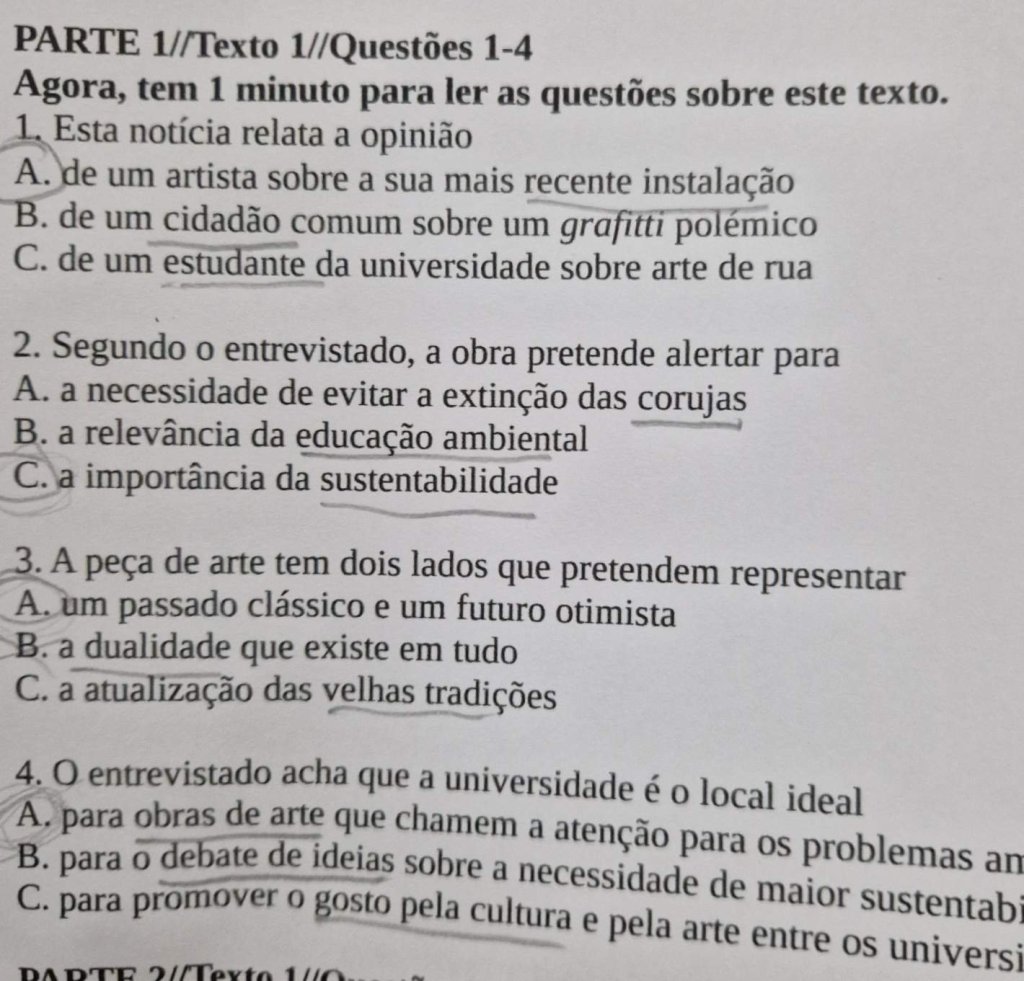
I have been practising Compreensão do Oral tests recently. They’re th hardest part of any CAPLE exam because even if you have read the answers, you still find yourself having to parse each one while trying to listen to what the recording is saying. This is nigh on impossible, and so it’s easy to drop marks.
What I’ve been finding works really well is to use the minute to scan each answer and underline one or two words that act as key words for the whole thing. That way, when the speaker answers the question, you only need to look at he underlined words. If its more ambiguous, maybe it’ll need more work, but over all, I find I can answer without wasting so much time, which means I don’t end up feeling left behind and panicky.
I find it works pretty well. I’m not getting perfect marks or anything but I feel much more in control and I am definitely going to use this in the DAPLE exam itself.
Formal letter – I’m rewriting this with some pointers. This text will probably still have a few errors in it because I’m typing it on a phone from terrible handwriting and referring to someone’s else’s notes at the same time. I hope it won’t be too terrible though, and the somos to make me think about the mistakes, so if there are a few typos, well, tanto faz.
Exmo Senhor
Venho por este meio pedir a sua atenção urgente no assunto do estado dos prédios na minha rua.
Quando eu e a minha família* mudámos de casa para este bairro, or prédios tinham paredes e portas de cores harmoniosas**. Ao longo dos anos, perderam a sua beleza. Ficámos envergonhados qia do convidámos os nossos amigos para jantar connosco em casa onde estamos rodeados por um amontoado de riscos, assinaturas e desenhos multicolores. Onde havia azulejos, hoje encontramos um quadrado vazio onde os azulejos desapereceram.
Considero isto um flagelo e um atentado à propriedade privada. Falamos com os nossos vizinhos que concordam, quase todos.
Por isso, encontrar-se anexado a esta carta uma lista de assinaturas. Todos nós pedimos que estabeleça uma sistema de segurança. Quer consistia em câmaras de vigilância, ou de agentes de segurança privada, as facínoras*** que cometem estes atos de vandalismo devem saber que não vamos tolerar seu comportamento.
Tendo estabelecido lei e ordem, mande uma equipa de empregados para pintar os prédios, encher os vazios e concertar as vidraças.
Para além disso, pedimos uma devolução dos custos do manutenção porque parece-nos que não foram bem gastos os últimos anos.
Sem outro assunto e agradecendo antecipadamente a sua atenção, subscrevo-me****
Colin
xxx
* This is a pretty bad start, actually, because the letter I’m supposed to be writing is meant to be on behalf of a residents group and I am whiffling on about my family here and don’t even remember to mention the group till much later because I hadn’t noticed that bit. Oh well… Never mind, but note to self: read the bloody question first, not half way through!
**Not a word I use often but I used Mr Bennett’s top tips and recycled a lot of words from the questions here and I’m the following paragraph.
***Bit of a strong word, this, but I was channeling Mel Smith’s energy from this sketch.
**** The opener and closer are off-the-shelf phrases to use in formal letter but there’s nothing to tell you how many kisses to put at the end so I’ve just guessed.
Corrected letter from a C1 DAPLE exam paper. It’s a letter to the president of the local council about CCTV cameras being used to combat graffiti. The argument I’m making is sort of stupid, but there are no ponta for being right. Oh and my handwriting is shit so she might not have caught all the mistakes so… You know… Caveat emotor and all that!
Exma Senhora Presidente
Venho por este meio explicar a minha opinião sobre a recente decisão de autorizar câmaras de vigilância no centro comercial.
Embora entenda as razões dadas para apoiar a decisão, parece-me improvável que este método sega o mais eficaz.
Antes de mais um estudo feito pela universidade de Londres em 2017* demonstrou que a taxa de sucesso é muito baixa. A maioria dos jovens participantes na cultura de graffiti usam ou capuzes ou bonés. Muitas vezes usam ambos. Além disso, os crimes** têm lugar durante a noite. Claro que estas circunstâncias juntas resultam em poucos criminosos presos.
Por isso tudo, as câmaras não representam um bom investimento***. Seriam um desperdício dos nossos impostos! Antes, sugiro um aumento do número de agentes de polícia ou, se não for possível, agentes de segurança privados****. Se bem que está alternativa sega mais cara, é mais eficaz. Ainda por cima, a população da nossa cidade sentir-se-ia mais segura se houvesse pessoas reais ao seu redor à procura de criminosos, de qualquer tipo, não só artistas de graffiti.
Com os melhores cumprimentos
Colin Lusk
* Nota do autor que não faz parte da carta: claro que este estudo não existe, mas se este carte fosse verdadeira, eu teria feito uma pesquisa adequada à situação
**The marker said this was a bit strong, but I’m middle aged and crime is crime and they should string ’em up by their goolies.
***I originally said they represented “bom valor” but that doesn’t seem to be a thing.
****I think my natural instinct is to make “privada” concordant with “segurança” but it seems to be the agents who are private, not the security.
Well, I had that exam prep lesson with Cristina from Say It In Portuguese and it was really helpful. We did a dummy “interação oral” test and gave me good feedback about what I’d done wrong in some written work, along with some advice about how to avoid stupid mistakes by – say – writing in an illegible scrawl. I’ve booked a few more over the next few weeks to get some more practice in. I’m determined to get a “very good” mark for a change.
Oof, well I’ve finished working my way through the exam paper. That aural comprehension part remains an absolute bastard. The DAPLE paper is like the rest I’ve come across: it doesn’t leave you much time to read, some of the answers seem purposely ambiguous, but I just about held on. But the fifth section has really long, detailed sentences. I’m sorry, but I just don’t see how it’s possible to answer them all. I’m going to take a prep course from the Say it in Portuguese site that I mentioned a few weeks ago to try and hone my technique. I suspect that best strategy is probably to look at the later questions in each group and make little one-word notes about each, because by the end you’re more likely to be lost so you’ll be glad of the help. Then do teh same for any long questions so you don’t have to try and parse them while the person is talking. Maybe there’s something to be said for not even trying to answer the questions on the first reading; just make notes about what the person says and then use that in teh second round…? I dunno, that feels like a high-risk option though. Maybe divide the answers in half and try to answer the first half in the first reading and the second half in the second reading?
I’ve had a bit of a crisis of confidence recently, but it’s been quite useful in prompting me to reexamine my routine and make some changes.
I’ve been feeling for a while that, as much as I was enjoying the portuguese writing subreddit, I wasn’t really challenging myself very much. I tend to write the same kinds of things and yet I was making a lot of the same mistakes. Not only that, but the fact that it takes an hour or so each day means that I didn’t really have time for much else. Recently, some of the teachers have taken a well-earned break from correcting. There aren’t really enough to keep up with the number of students and so it seemed like a good time for me to withdraw, let some newer learners benefit from the experience, rather than hog it all for myself. Maybe I’ll go back to it later but for now, I think it’s time for a pause.
In the meantime, what I’ve decided to do is focus much more on book learning. I’ve been doing a couple of hours of grammar exercises in “Qual é a Dúvida” per day, just trying to get the nuts and bolts of the language right and firm up some of the things I’m still crap at.
I also – and I know I’ve said this a thousand times before – need to spend more time talking. It remains the achilles heel of my language learning. I’m an introvert anyway, so my smalltalk game is pathetic, even in English. When I try to speak Portuguese it’s even more stilted and unnatural. Actual, proper lessons are called for!
I’d like to do the DAPLE exam (that’s the C1, advanced diploma) in about 5 weeks but the experience on the podcast a few days ago has really shaken my confidence.
Interested to see a new course on offer from Say It In Portuguese (home of the very fine podcast about idiomatic expressions) which focuses on CAPLE exam technique. Bookmark that one for later…
I’m not really aware of anything similar. Even the official Instituto Camões site is quite brittle and limited with no proper test simulation, so although it’s worth taking, I pity anyone going into the exam having only done that, especially at C2/DUPLE level, because they don’t even offer that.
And I’ve added a new section about exam prep to the online learning resources page, since that seemed like a useful addition.
Cheating in an exam isn’t something I’d ever encourage, but if you’re going to cheat, you need at least to be sure that the person whose answers you’re copying knows more than you. So we can only envy any would-be cheater who was lucky enough to be sat next to Liz Sharma in the A2 exam and managed to peep over her shoulder when she wasn’t looking. Liz is the host of Talk The Streets, the popular YouTube series and she recently took the exam as part of a citizenship application and vlogged about it. Anyway, I know one of the most frequent questions I get is about where to find exam resources so I am officially designating this video as pretty flipping useful. A lot of what she says backs up what I said in my previous posts about the form of the exams but she’s obviously much more advanced than I am now, let alone how I was when I did my first exam. That means she’s got a bit more detachment from the stress-factor, which allows her to be cool and calm about the advice she gives, whereas I think my blog posts probably read like someone who has just escaped from being held hostage!
Here’s my review of the Portuguese for Foreigners Online Self Study course for level C1, also known as DAPLE, offered by Camões Instituto da Cooperação e da Língua. I finished the course on Saturday so it seems like a good idea to get it out of my head and onto a blog post while it’s still fresh.
What’s she even doing?
The Instituto offers courses at all levels of the CAPLE framework from A1 (beginner) to C2 (God-mode). It also caters for different kinds of packages: this review is just the self study option, but for a further €140, I could have gone the de luxe route and added some tutor interaction. See here for more details about the options. I haven’t done any of the other courses so I don’t know whether or not my opinion of this one applies equally to the whole range. I mean I guess so, but who knows?
The obvious attraction of doing a course created by the organisation that designed the exam curriculum, is that you’re getting it “straight from the horse’s mouth”. You know that they will be teaching subjects the exam board think are important at this level so there’s a good chance they will come up in the exam. That’s great, and I think it’s undoubtedly one of the strongest selling points of the course: it gives you a road map of what you need to know. And it doesn’t just teach you about grammar and vocabulary, it tries to weave those together with the major themes you need to know about. The topics for each of the twelve units are
Ourselves and others – interpersonal interactions
Carpe Diem – enjoying free time
A healthy mind in a healthy body
From the field to the city – different ways of life
Thinking about the future – training and professional development
Giving new worlds to the world – immigration and emigration
Science and religion – allies or enemies?
New information technologies – solitary closeness and collective isolation
Portugal and my country – festivals and traditions
Portugal and the arts
Portugal today
Portugal and the world
I think the course is definitely worth doing for this reason alone: insofar as learning a new language entails learning about the culture, the place and the people, it’s useful to have someone walk you through how Portugal sees itself and its place on the world. Whenever I see lessons about Portuguese culture it tends to be Fado, recipes for cod, o Galo de Barcelos, and all that tourist-friendly stuff. Interesting, no doubt, but this course gets down into how trust works in neighbourhoods where shopkeepers know their neighbours and extend credit where it’s needed, and what is it that makes such trust possible; the migrant experience and the role of Portugal and its former colonies in the wider world. In other words, it goes deeper. It also gives you tools to be able to describe challenges that all countries face, like the rise of social media, the decline of religion and the challenges of international cooperation.
How does this map onto the exam itself? Well, the cultural knowledge will come in handy in the fourth (spoken) part, which seems to be where you’re most likely to describe your knowledge of some cultural or social trend. Even though you’re not speaking in the course, you’re getting used to thinking about the ideas and making use of the vocabulary.
As for the other three sections*, there are audio/video components that are going to be useful in developing your listening skills for the aural comprehension. It’s far, far easier than the aural comprehension section of the exam because of the time available and the relatively simple questions you’re asked, so don’t get lulled into a false sense of security. Likewise, the written comprehension is quite a bit easier than in the exam. OK, the way I’m talking, I expect it sounds like I got full marks and I definitely didn’t, but I feel like I lost more marks through carelessness than because I was unable to interpret an ambiguous or tricky question.
When it comes to the written work, there are some exercises based on grammar but they’re quite minimal. Each new structure it introduces is covered in a very basic way and the students is only really expected to do one question for each, which isn’t really enough to push it into your long term memory.
So summing up: It was €180 well spent, but it’s not a perfect course. But I could have guessed that. No one learning tool is ever going to tick all the boxes and we always need to look at multiple sources. This one has no speaking component, but I could have got that by signing up for the premium course. Or I could use an online tutor on a site like italki or Polytripper or even just ask around on one of the many Facebook groups for Portuguese learners like this one (European only but heavily moderated) or this one (freer and easier but includes Brazilian Portuguese). It’s a little weak on grammar, but that’s what exercise books are for, and a book won’t mark you down if you accidentally make a typo or if spellchecker changes your right answer to a wrong answer. The book I’m about to start using (Português Outra Vez) doesn’t have any audio component but it’s very text-heavy so I’m expecting it to be able to boost my grammar levels up a notch or two using it.
So if you’re considering going in for one of the exams, definitely consider one of these courses as a sort of route map, but don’t make it the whole of your learning plan: be prepared to take notes for further study afterwards. You’ll probably need it.
*=If you haven’t already taken an exam, have a look at one of my descriptions of the exam process for more background on what is in each section. Here’s the B1 exam, for example.
I’ve quite nearly finished the C1 course, y’know. I wasn’t expecting to be ready for the C1 exam this spring, but I might just sign up in May because it’s going well: the advanced material is not so hard and I think I can pass with another 3 months to play with, despite still, still, making so many mistakes and never quite feeling ready, I have passed almost all the in-course tests first time.



 Luso
Luso 