It’s quite rare that I actually understand tweets in Portuguese. Something about the condensed format, I suppose. I enjoyed these ones though.
Tag: culture
Os Feijões: Uma Poema
Eis uma tradução dum poema de William Shakespeare para praticar as minhas orações proporcionais
 Os Feijões, os feijões
São bons para o coração*
Quanto mais os comeres
Mais te peidas
Quanto mais te peidares
Melhor te sentes
Portanto vamos comer feijões
Em todas as refeições
Desculpem-me, os meus amigos, mas menti. Não foi escrito por Shakespeare. Eis a verdade, crua e nua:É um poema do pátio da escola, mas “O Cisne de Avon**” teria o escrito se não estivesse ocupado em escrever todas estas peças de teatro!
I’m slightly embarrassed at how many people offered corrections on this and saw me at my worst, telling fart jokes I remembered from 1977, but never mind. Anyway, footnotes:
*=I want this to be “os corações” for the rhyme but tbh, “for the hearts” doesn’t really make sense unless you happen to be a Time Lord, so poetry loses out to biology in this case.
**=”The Swan of Avon”. I have no idea if this phrase means anything at all outside of this little island.
Thanks again to Sophia, Rubens and Beatriz for corrections on iTalki
Concordância
I am becoming increasingly obsessed with Deolinda. There’s just something intoxicating about understanding a song in another language. I cottoned on to one called “Concordância“, which seems to be about grammar. Intrigued, I went looking for a translation but there wasn’t one. So I sat down and I wrote one. As it turns out, it’s quite witty. She starts with “I am a pronoun, a personal pronoun” and goes on to state what she wants from this man who is trying to subsume her into a nós. She demands “complementos diretos” which are both direct objects and also have the double meaning of complements that we use in english. “Nome” also means both “noun” and “name” and of course adjectives change depending on the noun, so you can see there’s stuff going on here that probably has more resonance if you’ve been taught Portuguese grammar at a Portuguese school.
There’s a website called lyricstranslate where people can post lyrics and others can translate them so I submitted one for Concordância and you can read it here if you’re so inclined.
Through the Looking Glass
This morning I stumbled on a series of videos by someone calling herself Marianareads on Youtube, about reading books in English. On closer inspection, it seems she is Brazilian rather than Portuguese, which put me off slightly, and also she seems to have a thing for vampires. She seems very enthusiastic and her massive subscriber list means she must be doing something right, but she’s not for me, so I moved along. Youtube then spent some time trying to interest me in a whole string of brasileiras novas, before I finally hit paydirt in the form of an actual, 100% authentic Portuguese vlogger, discussing easy books for Portuguese readers to improve their English vocabulary. This seemed interesting to me because of course it’s the inverse of what I’ve been doing in some of my posts on here.
Intrigued?
Little House of Books on “Wonder” (which I’ve read) and “A Monster Calls” (which I haven’t read yet and… what’s Portuguese for “Spoiler Alert”? *googles* “alerta de spoiler”, apparently) and some others
Diário da Chris on “A Christmas Carol” (Alerta de Spoiler: he gets a bit nicer at the end) “Wonder” again and “The Fault in our Stars”, to name but three
ACromaDosLivros – I’m not sure but from previous linguistic detective work, I think “Croma” or “Cromo” means nerd, so this must be “the book nerd”. I think. The first video of hers I watched was about The Curious Incident of the Dog in the night Time though, so she’s got good taste.
The Sound and the Fury
 I mentioned in a previous post that the Portuguese seem to use “Tiquetaque” in place of “Tick Tock”. This made me dig out my old Astérix comics and check out the sounds made by people and things during the course of a story
.
Here’s the one I remember best ->
So apparently Portuguese roosters say “Cocorocóóóóó” instead of “Cockadoodledooo!” I think this is much cooler. There’s a Portuguese family who have a rooster that crows in the allotment behind the rowing club I’m a member of and now I’ll be able to address him in his own language.
 Dogs, I’m less sure of. Dogmatix is called Ideiafix in Portuguese (Asterix character names, on their own, are probably a subject for a blog post for someone with more linguistic skillz than I have now). In the books I have, the only noise he makes is “CAiMM!” but that sounds more like a yelp than a bark. I googled it and apparently the more conventional dog noise is “Au Au”. OK, I can believe that.
 Moving on to inanimate objects, how about knocking on a door?
“Truz Truz Truz” is apparently le mot juste. That’s just bizarre though. Are we sure that’s really knocking? Maybe Cacafonix (Cacofonix) is playing his harp outside the door? 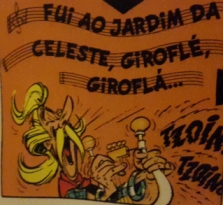
Well no, I promise you, that’s knocking and anyway Cacofonix’s harp goes TZOIN (or is there a last letter there? I can’t see because it’s cut off by the edge of the panel. It looks like a rounded letter so I want to make it “TZOING” but I think that’s just my English prejudice coming through to make it as much like “Twang” as I can possibly manage. TZOINO? Ach, who knows.

This one, at least, looks familiar. The crac(k) of a tree as it is pulled down by slaves

And here, the pathos of the Roman centurion reduced to tears
The trouble with Astérix, though, is that you’re never quite sure what is a survival from the original French or perhaps something that the translators made up…


For a more cerebral look at the sounds made by animals in different languages, try this article in the Guardian
Comentários Sobre Um Filme: Ossos
Estou a ver um filme de Pedro Costa que se chama “Ossos” para praticar a compreensão. Até a este ponto (vinte e dois minutos, treze segundos) houveram talvez quatro linhas do diálogo. Por isso, não aprendi muito até agora!
Além disso, actores: parem de resmungar! Falem claramente!

After I wrote this, it didn’t get much better. There are great long stretches in which people
- brood
- smoke fags
- lurk in the dark
- stare silently into the horror of it all
- brood while smoking a fag and holding a baby
- gas themselves
And all this time, barely a word is spoken for five, ten minutes at a time. When there is dialogue it is mumbled and nobody changes their facial expression or gives any visual clue about what they’re mumbling about. In short, I don’t recommend this one as a way of practising aural comprehension!
Muito obrigado Sophia, Ruan, Fabio, Caio e Felipe pelas correcções quando apareceu em iTalki
Amor de Perdição – Free Download!
Fiquei feliz de encontrar o livro audível de Amor de Perdição de Camilo Castelo Branco, disponível de fazer o download gratuitamente em Librivox ontem. Librivox é um projecto voluntário para narrar vários livros de domínio público e distribui-los na internet. Há também outras obras Portuguesas, incluindo Os Lusiadas mas parecem narradas por Brasileiros, assim evito os seus sotaques pelas razões habituais. Espero ouvir isto cedo!
O Comentário em Librivox diz:
Amor de Perdição é uma das obras mais marcantes de Camilo, um dos mais importantes e proliferos romancistas portugueses. Inspirado nos amores de Romeu e Julieta, Camilo conta-nos a história do amor proibido de seu tio Simão, de intrigas, crimes e desespero. Mas a história relata-nos também o seu próprio sofrimento, já que Camilo a escreve na Cadeia da Relação do Porto, onde está preso por um amor proibido
…or in English…
I was really pleased to come across a free download of the audiobook of Love of Perdition* by Camilo Castelo Branco on Librivox the other day. Librivox is a voluntary project to record audio versions of public-domain works for distribution via the internet. They have a few other Portuguese works too, including The Lusiads but they seem to be recorded by someone in Brazil so I’m avoiding the accent for the usual reasons. I’m looking forward to this though!
The Librivox blurb says:
Love of Perdition* is one of the most remarkable works of Camilo, one of the most important and prolific Portuguese novelists. Inspired by the loves of Romeo and Juliet, Camilo recounts the history of the forbidden love of his uncle Simão, of the intrigues, crimes and despair. But the story tells us also of his own suffering, because Camilo wrote it in the Cadeia da Relação in Porto, in which he is imprisoned for a forbidden love.
*=I believe it’s known as “Doomed Love” in the standard translation, actually.
Thanks again for Sophia for help correcting the original version of this.
 Luso
Luso 