Posted in Portuguese

Free Buarquing

Já publiquei uma tradução de outra canção de Chico Buarque, mas ouvi falar desta em relação às comemorações do aniversário da Revolução dos Cravos. Hum… não me sinto grande fã deste artista, mas cada vez que escuto com mais atenção uma música dele, adoro-a e aprendo muito. Acho que chegou a hora de ouvir os seus discos todos.

(Ah ah ah, discos, sim, escute os seus discos, avô, nós estamos a ouvir no Spotify)

“Tanto Mar” é uma música que ilustra certas coisas sobre a época e sobre a relação entre os dois países, Portugal e o Brasil. Existem duas versões na Internet, e eu pensei, “está bem, a segunda é uma gravação nova da mesma canção”. Mas não é! O cantor escreveu a primeira versão em 1975, um ano depois da revolução e dedicou-a ao povo português – ou melhor, à revolução em si. Naquela altura, o Brasil também estava em plena ditadura militar (um governo que permaneceu em vigor desde 1964 até 1985), portanto a revolução no país menor deu motivo para esperança no maior. As letras refletem aquela esperança mas por isso mesmo, foram censuradas pela ditadura brasileira.

A segunda versão foi lançada 3 anos depois, em 1978, mas desta vez com letra atualizada. Existe um sentimento agridoce perante a crise de 25 de Novembro, o enfraquecimento dos objetivos da revolução e a realidade que a passagem dos anos trouxe. Mas apesar de tudo, a esperança é ainda evidente.

Em baixo, traduzi as duas versões. Gosto da simplicidade da poesia. Um escritor menos talentoso teria tentado escrever algo maior, e teria enchido cada verso de sentimentalismo e cliché, mas esta letra é curta e limpa e não tem uma única palavra a mais.

Just a reminder, obviously, this is in PT-BR, so in case anyone is avoiding brazilian accents on their learning journey, allow me to sound the 📢#BRAZILIANPORTUGUESEKLAXON📢 as a warning.

PortuguêsInglês
Sei que estás em festa, pá
Fico contente
E enquanto estou ausente
Guarda um cravo para mim
I know you’re having a party, man
I’m glad
And while I’m away
Save a carnation for me
Eu queria estar na festa, pá
Com a tua gente
E colher pessoalmente alguma flor
No teu jardim
I wanted to be at the party, man
With your people
And pick a flower in person
in your garden
Sei que há léguas a nos separar
Tanto mar, tanto mar
Sei também quanto é preciso, pá
Navegar, navegar
I know there are miles* between us
So much sea, so much sea
And I know how much we’d have to
Navigate, navigate**
Lá faz primavera pá
Cá estou doente
Manda urgentemente
Algum cheirinho de alecrim
It’s spring there, man
Here, I’m sick
Send, urgently, some
Fleeting scent of rosemary
PortuguêsInglês
Foi bonita a festa, pá
Fiquei contente
Ainda guardo renitente
Um velho cravo para mim
It was a great party, man
It made me happy
I still hold stubbornly
An old carnation for myself
Já murcharam em tua festa, pá
Mas certamente
Esqueceram uma semente
Em algum canto de jardim
The (flowers) withered at your party man
But certainly
They left a seed
In some corner of the garden
Sei que há léguas a nos separar
Tanto mar, tanto mar
Sei também quanto é preciso, pá
Navegar, navegar
I know there are miles* between us
So much sea, so much sea
And I know how much we’d have to
Navigate, navigate**
Canta a primavera, pá
Cá estou carente
Manda novamente
Algum cheirinho de alecrim
Sing the spring, man
Here I am in need
Send me again
Some fleeting scent of rosemary

* =Léguas is more like leagues but it would sound confusing in english so I fudged it

**Maybe I should have fudged this one too: naveger is much more specifically about travelling in a ship, as opposed to english where it’s more like “finding your way”


Posted in English

Brarrogate

Wow, this girl is really smashing the bilingual life! She lives in Harrogate but speaks Brazilian portuguese, having been raised bilingual, so she seems to have become a bit of a celebrity in Brazil, describing English lifestyle to a Brazilian audience in what is apparently a perfect regional accent. Harrogate is the posh bit of North Yorkshire, but even so, I feel like she’s a bit more Downton Abbey than the average nine year old even in her home town. But no worries, it’s YouTube and I love that she’s made that connection across the Atlantic! You go, girl!

Posted in English

Punning with the Brazilians

I really like being able to make puns in another language. That’s me, the first comment u der the main post.

As you probably know, or can probably guess a Centavo is a hundredth of a Real (Brazilian currency)

I think the people following up are mocking the collapse of the Argentinian Peso. It’s lost more than half it’s value in the last year including a sharp drop-off when the sensible candidate got knocked out if the election race.

Posted in Portuguese

Capitães da Areia de Jorge Amado – Opinião

I hope its clear from the review, but in case it isn’t, this is a great book to read, but don’t spend time studying the grammar because it’s a million miles from anything you’ll want to write in a PT-PT exam. See this post for the most glaring example but it’s not the only thing by any means.

Capitães da Areia

Raramente leio livros brasileiros porque português brasileiro é tão diferente. Ainda por cima, o português neste livro é longe do padrão de português brasileiro: há montes de calão, expressões regionais e gramática específica à região onde a história tem lugar. Mas apeteceu-me ler porque ouvi tantas coisas boas sobre este autor e esta obra sobretudo. O livro conta a história dum grupo de jovens e meninos abandonados que moram num trapiche(1). Recordei-me dos “Lost Boys” de JM Barrie (o líder ate se chama Pedro, a versão português de Peter) ou as carteiristas do Fagin no Oliver Twist de Dickens. Mas o tom do romance é mais escuro.

São criminosos, temidos pela gente da cidade, mas ao mesmo tempo, são crianças que sentem saudades da segurança e da felicidade de um lar e uma família. São sempre à procura de uma “mãezinha” e querem ir brincar no carrossel. Sem hipótese de viver como crianças, tornaram-se homens, mas não só homens: criminosos. Roubam viúvas, exploram pessoas simpáticas, lutam com navalhas e punhais. A personagem principal, com quem o autor pretende nos simpatizemos, até viola uma rapariga, o que é contado de maneira gráfica, e fica surpreendido quando depois ela o pragueja.

Ao longo dos meses, as personagens andam pelos seus percursos – há tragédia e redenção, mas o pano de fundo contra o qual o enredo se desenrola é a violência e caos na sociedade brasileira nos anos trinta do século XX, e o autor retrata esta sociedade muito nitidamente. É um livro virtuosístico.

(1) Entendi esta palavra como “armazém” mas ao que parece, tem um outro significado em PT-BR: um cais. Acho que armazém faz mais sentido neste contexto porque não consigo imaginar dezenas de pessoas a dormir num cais! Mas vou ver o filme em breve e espero entender melhor depois.

Posted in English, Portuguese

Brasuguês Portuleiro

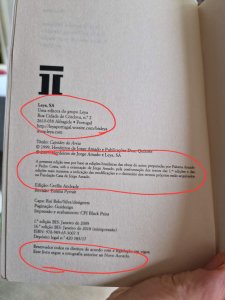
The book I’m reading right now is a classic Brazilian book, “Capitães da Areia” by Jorge Amado, about a group of street kids in Salvador da Bahia in the 1930s. My edition was published by a portuguese company called LeYa, and advertised under the government’s Ler+ initiative. At first, I thought someone at the publishing house had tweaked the language to make it more understandable to portuguese readers. Let me explain why, and why I was wrong.

As you probably know, (check here if you don’t) Brazilians typically address each other as “você” in their conversation and change the verb endings accordingly. “Tu” is more common in Portugal.

What’s weird about this book is, the characters all address each other as “tu”, after the European style, but the verb conjugations all use the você form. This looked like a mistake to me, so I went online to ask if maybe someone had screwed up at LeYa HQ.

Here’s my question in portuguese, and I’ll put a summary of the answer down below in English.

Capitães da Areia - Folha da Guarda

Estou a ler um livro brasileiro chamado Capitães da Areia, mas ao que parece a editora, Leya, mudou determinadas frases para soarem mais naturais a um leitor europeu. O resultado é… Surpreendente. Ou pelo menos eu fiquei surpreendido. Há montes de diálogo onde o pronome é “tu”, como se usa em Portugal, mas o verbo fica na terceira pessoa como se seguisse o pronome “você”

“Tu quer me fazer um favor”

e

“Tu liga para guarda?”

e

“Tu sabe, Sem-Pernas, que ele é um bicho calado”

Isto tudo está errado ou eu estou a enlouquecer? Ou… Talvez haja uma explicação melhor. É normal em PT-BR? A maior parte da história parece-me como o original (calão e vocabulário brasileiros, “trem” em vez de “comboio”, etcetera. Até há um daqueles “us” com hum… Umlaut… (Google) Trema! U com trema, que nem sequer existe em PT-PT, nem antes do AO nem depois.

Many of the replies said yes, this was a horrible disgrace, but there were quite a few brazilians who told me that all this is normal: it’s just a dialect spoken in some parts of southern Brazil. Besides, they added, the street kids haven’t really had the benefits of education, so it’s no surprise that they don’t have immaculate grammar.

There are a couple of ways of approaching the question of how to define good use of a language. The first is prescriptivism, which says there is one correct way of speaking and anything that deviates from it is wrong. The second is descriptivism, which starts from the premise that if people are speaking in a non-standard way and being understood by the people around them then they are just speaking a different version of the language, using different rules, and the linguists’s job is to describe what they’re doing, not to tell them they’re wrong. Most linguists and dictionary writers tend to be descriptivists on principle* with some exceptions**. I tend to be mostly descriptivist until someone tells me that ‘literally’ can mean ‘figuratively’, at which point I reach for my kalashnikov.

So, for example, you could argue that Brazilian portuguese is bad portuguese because it has diverged from the standard form of the language, spoken in Lisbon. But you could equally well say the same about Madeiran portuguese, or. Scouse English. In fact, if you wanted to be very hard-line about it, you could say portuguese is badly-spoken Latin since it has deviated from the language the Romans brought there in the third century BC.

Let’s say, for the sake of argument, that portuguese is it’s own language now, and that Brazilian portuguese is one among many dialects of Portuguese spoken in Portugal and it’s former colonies. But what about within Brazil? Is this Salvador de Bahia variant a separate dialect that has diverged and formed its own rules or are it’s speakers just hicks whose babbling would be scorned by educated people in Rio, let alonwle Coimbra?

The answer probably depends on your personality and your politics, but for me, as a learner, I just have to appreciate the book for what it is: a milestone of literature in portuguese. Let the linguists argue over the details.

If you’re studying a language, you should probably think like a prescriptivist because the people marking your work will be following a standard. If you use a você verb ending with someone you’ve addressed as tu, they won’t treat that as a delightful regional variation, they’ll just deduct marks. I made this point in what I thought was a light-hearted way to a strong descriptivist who told me “right and wrong don’t exist” when it comes to questions of language, but I got downvoted, suggesting most people disagreed. 😂

Cancelled for my prescriptivist tendencies

* If you haven’t read “The Meaning of Everything” by Simon Winchester I can recommmend it, and it addresses why early lexicographers made this choice.

**There have been some famously sarcastic and biased definitions in English dictionaries in the past. More recently, prescriptivist tendencies have come out in attempts by activists to get the meanings of words changed in order to short-circuit debate and bring about social change in a more top-down way. The most famous was this one in the aftermath of the George Floyd murder.

Posted in English

Let Us Now Learn From Absolute Bellends

So according to my socials this morning, this comedian guy has been thrown off Instagram for making a Barbie joke. Let’s pick it apart and extract the juicy vocabulary goodness within.

“A Mattel lançou uma Barbie com Trissomia 21, uma edição especial. Não é uma ideia original, toda a gente sabe que os chineses já vendem bonecas com defeito”

The what now?

Trissomia rang a bell but I couldn’t quite place it so I looked it up, but of course I should have just read the text below, because it’s explained there: Downs Syndrome. Oof. OK, well if you’re going to go there, you’d better make it a good joke, because people don’t tend to be very sympathetic if you’re just going to be pointlessly spiteful and cruel.

The joke hinges on the word “Defeito”. I looked it up in some Brazilian and portuguese dictionaries to see if there was a meaning of defeito that would make it gel into a joke. For example, is “defeito” a standard, non-insulting way to describe a learning disability? If so, it would still be a shitehawk joke, but at least we’d be able to see that he was going for an actual double-meaning and the the joke would just about work as a critique of Chinese manufacturing. It doesn’t seem to be though. Learning disability in portuguese is “deficiência mental”, which, if you translate it to its english cognates still sounds pretty off but obviously words have slightly different weights in different cultures, so I can only assume it doesn’t sound insulting to native speakers. When I look up “pessoas com defeitos”, all the listings relate to people who are arrogant or lazy or have some other character defect. So it doesn’t really work. I get that he’s having a pop at Chinese manufacturing but in the process I think he’s just saying people with Down’s are defective. Which just seems cruel to me.

So yeah, it’s just a shitehawk joke. I don’t think he should have been thrown off Instagram for it though. People like Jimmy Carr and Frankie Boyle have been making shittier jokes than that for years and they never seem to be short of work. Of course their jokes are also quite well crafted, so there’s that.

Instagram could have just left it there and let the lack of laughs and the virtual heckles act as their own negative reinforcement mechanism, but that’s not how it played out.

Posted in English

As Someone…

…who likes to prance about pretending to be a scientist, even though my degrees are in barely, tangentially scientific subjects, I enjoy reading this twitter account. It’s Brazilian, so I have to keep my wits about me, but the memes are actually pretty funny, even if about one in ten go completely over my head. And as a bonus, I get familiar with sciencey words without having to torture myself by working through a memrise deck of chemistry terminology or whatever.

Posted in Portuguese

Tony Blair

Ouvi uma entrevista hoje com um jornalista chamado Peter Hitchens. Durante a conversa, o jornalista falou dum encontro com Tony Blair antes de passar a primeiro-ministro.  O Senhor Blair acabara de fazer “selfies” * com um grupo de jovens e o jornalista perguntou “quem eram aquelas pessoas?”

“São brasileiros” respondeu Blair. “Muita gente gosta de mim no Brasil”**

“Então o senhor deveria aprender português” aconselhou o jornalista.

“Hum… Português?” questionou Blair.

E foi então que o jornalista constatou que o futuro primeiro-ministro não sabia que o idioma que se fala no Brasil não é espanhol.

* Agora que penso nisso, provavelmente foram fotos tradicionais porque a selfie é um fenómeno mais moderno, não é?

** Probably because his surname is almost an anagram of their country.

Posted in English

Mansplaining Pronouns to an Actual Linguist

A video drifted into my feed yesterday by someone I’d never heard of before and it looked interesting so I listened to it while I was getting ready to go out. The chap who made the video is a linguist and he decided to weigh in on the controversial topic of pronouns and how they are being used, mainly in English, mainly by younger people in relatively affluent communities. If you don’t know why pronouns are controversial, well, consider yourself lucky, but basically whether we refer to people as he or she or something else, and under what circumstances is currently occupying a lot of social media and traditional media output. Frankly I’m baffled, but middle-aged people being baffled by stuff the youngs are obsessed with isn’t exactly news, is it? 🤷🏼

Anyway, as weird as it is in English, it’s even weirder in languages like portuguese where gender-specific pronouns are ascribed not only to people but to pens, apples, books and the concept of liberty*.

I’ve written a few posts about pronoun shifts a while ago um… Now where did I leave those? I started with this one, and a few people said the pun on the word “neuter” was problematic but that doesn’t seem to have stopped me repeating the crime a few weeks later when I really expanded on the subject here and then for a little reprise here.

Anyway if that kind of thing is something that interests you, I can recommend the whole video: it’s full of thought-provoking stuff. On the other hand, if you’re not, no worries because I only wanted to focus on a few seconds in the middle anyway. So, let me at least tell you why I decided to contradict him despite the fact that he is an expert and I am not.

At around 8 minutes and 25-ish seconds, he is discussing instances of relatively new pronouns that have been drafted into languages, relatively late in their development and he says “Portuguese has the impersonal ‘a gente'”. Except he says it in a Brazilian accent so it’s more like “a Genchee”.

Why, Brazilians? Why?

Gente is a feminine, singular noun that refers to a group of people but it’s true that portuguese speakers do use “a gente” as a stand-in for a group of people in place of “we”. It makes the grammar simpler because you don’t have to wrap your tongue around the nós form of the verb, you can just conjugate it in the third person singular – “a gente fala…” in place of “nós falamos”. It sounds a bit odd to English speakers but it works. As far as I can tell, it’s much more common in Brazil but it does exist in Portugal too. Of course it’s very informal, but I think it’s wrong to say it’s a pronoun. Even though it’s playing a similar role in the sentence – filling in in place of what could be a list of names, you could say the same about other collective nouns. Take “The family” as in “The family are getting together for Christmas” which could easily have been “We are getting together for Christmas”. Or what about “guys” in situations like “It’s just the guys, together again” or “hello guys, and welcome to another video”. Definitely not pronouns, right, but they are really fulfilling the same role as “a gente”.

Using nouns as stand-ins for people happens in formal speech too. You will almost certainly have heard people addressing each other as “o senhor” or “a senhora” or even “o doutor” Again, these are behaving in a fairly pronoun-like way, but they’re both nouns. You’re just talking to the person in the third person. “How is the gentleman?” instead of “How are you?” It’s the same kind of thing.

I felt like I was being a but of a reply guy, challenging someone in their academic discipline. Luckily we are both dudes, so I can’t be accused of mansplaining but even so, it’s a bit… Well, let’s say “hubristic”.

The Results Are In, You Bastards

Mansplaining cat

So, I made a reddit poll to ask native speakers on r/português to tell me if I’m right in my thinking. To my huge annoyance, judging by the early results, ‘yes, it’s a pronoun” seems to be winning over “no, it’s just a noun”. It’s a pretty close result in Portugal but overwhelming in Brazil.

In my defence, democracy is overrated. But if that brilliant argument doesn’t convince you, the explanation someone gave is that although “gente” is a noun, “a gente” os technically known as “uma locução pronomial” with “the same value as the personal pronoun ‘nós'” só it’s not a pronoun per se, but it works like one. Meh, I can live with that form of words, I think.

Finally, a European speaker said he was taught never to use it as a pronoun because it was “extremamente errado” and whenever he used it his grandpa would say “A gente? Agente é da polícia!”

Preach it!


*Respectively: lady, lady, gentleman, lady, if you’re keeping score.

Posted in English

A TARDIS Full Of Braz

Brasil / Brazil

Following on from yesterday’s whingeing about South Americans behaving like North Americans, here’s an interesting linguistic side note from the same Instagram account. Sorry, I’ll get back to european portuguese soon, I promise!

My first assumption was that maybe this was some sort of racist graffiti in Portugal – after all, the hashtags talk refer to xenofobia and “brasileiro em Portugal”. So, I asked around, but it turns out to be something else entirely. They’re all in Brazil and the different spelling is down to the difference between people’s perception of Brasil and the reality for average Brazilians. Brasil is a very unequal society with a lot of poverty and a lot of social problems, but also with an amazingly wide variety of plants and animals, as well as indigenous cultures. Brazil is the international spelling used by the United Nations, so in this context it has come to represent some other version of the country. Some people in the discussion said it was a stand-in for “the international elites”, whereas others see it as representing outsiders’ view of Brazil: tourism, beaches and a big statue of Christ the redeemer. In BraZil all the men are sexy helicopter pilots and all the women are beautiful, tanned and interestingly waxed. So, spelled with a Z, it represents either the rich who are ruining the country or the fantasy that is eclipsing the reality. Either way, there’s a dichotomy between the real Brasil and this fake Brazil that doesn’t understand it, is killing it, and doesn’t deserve it.

The specific phrases come from a song by Elis Regina called “Querelas do Brasil”. Querela can be a libel, an indictment, a dispute or a sad song. I’ll let you make your mind up about what, specifically, she’s going for here. It certainly doesn’t sound like she’s railing against the one percent: it sounds very upbeat, but Brazil has its own rhythms so that doesn’t necessarily mean it’s not serious. She spends a lot of time listing things she likes about the country. I must admit, I didn’t recognise half the words but there are a lot of wild animals in there, an indigenous hero, some places… So I get the idea that at least some of it has to do with Brazil the state not deserving Brasil the paradise on earth, but I’m sure there are layers to it I’m missing.