Posted in English

The Final Boss

So this is it, the final boss of Portuguese language exams: The Diploma Universitário de Português Língua Estrangeira (DUPLE) which is the highest level (known as “C2”) of the Portuguese proficiency testing system. Like all the earlier exams, it has the usual four parts: reading comprehension, written communication, aural comprehension and verbal interaction, but they’re all longer than the previous exams, so the lunch break comes after the first two sections, then there are two more, and you finish after 3PM.

Last-minute exam prep didn’t go as planned. I didn’t get through everything I intended to cram in on Tuesday evening. I tried to get to bed early but between the endless faffing and the fact that my nose was blocked, I didn’t sleep well, missed my alarm and didn’t get up till 7, by which time I hadn’t had more than about 4 hours of sleep. Oh well, never mind, at least when I finally woke up, my nose was unblocked so I didn’t have to struggle through the exam sniffing and wheezing.

Me leaving the house.

The exam took place at the Portuguese embassy near Green Park. When I got there, I was surprised to find I was one of four candidates! Three is the most I’d had before and I assumed at this level there wouldn’t be many people wanting to take the test, but obviously I was wrong! Before we started, they checked our ID and made us sign a piece of paper. One of the names on the list was very, very Portuguese, which piqued my curiosity. I spoke to him later, in one of the breaks, and he said he was from Madeira but had been in the UK since he was about 8, so he needed to refresh his language skills. Then there was a fellow northerner, but a proper one who still lives up there and had come down from York for the exam. Like me, he’s married to a Tuga who refuses to speak Portuguese with him. Why are you so mean to us, Portuguese ladies? The fourth member of our crew said he’d done C2 Spanish a few years ago and, having done the boring iberian language, decided to level up his language-learning experience by doing the whole thing again but on hard mode.

Four guys, four pencils. OK, let’s see how much of the exam I can remember…

Compreensão de Leitura

Let’s see… There was a text about feeling envy for the lifestyle and the bling of richer people in different social classes. After the exam, I searched online faor some key phrases and it’s this if you’re interested. The text is easy to follow but the questions were phrased very ambiguously and there were usually multiple answers that seemed right to me, so I just followed my instinct where I needed to.

Next up… Oh my god, I was so happy! There was text by Mario de Carvalho! I just finished reading a book by him a few weeks ago so I was quite tuned in to his writing style and sense of humour, which helped a lot. Better yet, he was writing about vocabulary, so he had deliberately filled the text with interesting and unusual words, many of which were new to me, but one of them was “obnubilação” and I chortled because that’s the noun form of this word, which I noticed while I was reading the book and turned into a mini-blog! I felt like the gods of language-learning were smiling on me. I can’t find the text online unfortunately; it must be in one of the books, I suppose. I’d like to read it.

Then there was a short story by Sophia de Mello Breyner Andresen about someone called Monica. It came across like she was talking about an Instagram influencer, but it was written long before social media. When I went searching for it, I found a lot of people talking about it fondly. There are a few copies of it dotted about online but only in very unexpected places. Here for example.

The most annoying part of this section of the exam is the one with the paragraphs removed from a text. There is usually one spare paragraph that you have to ignore but they had made it even worse in the C2 by adding two extras. The text was something to do with pet turtles being released in Lisbon parks, setting in train a series of events culminating in some ducks being eaten by falcons. Oh lord. It was awful. I swear they could go in almost any order. After a while, I gave up, put in some random guesses and decided to come back to it.

C2 has an extra kind of question that doesn’t exist at other levels: they give you a text that has some extra words hidden in it and you have to identify the words that aren’t needed. I had done one of these on Tuesday and I was glad I had because it helped me understand that I’d been including words that could be removed rather than focusing on words that absolutely had to be removed. I’m pretty sure I got most of the marks there.

Luckily I had quite a lot of spare time when I’d finished the remaining missing word rounds, so I went back to the bloody turtles and I think made a decent job of it.

I’m a content creator now.

Produção e Interação Escritas

As usual, the challenge here is to cram 250 words into a space that is only really big enough for 150, and still have the result be legible. The first activity was a formal letter to the British activist Les Knight, whose cause is making humans extinct in order to save the planet. Given that we are both British, I’m not even sure why I would be writing this in Portuguese, but I suppose it would make no difference anyway since people who start organisations aimed at human extinction tend not to be very open to rational argument, whatever language you use. I had a go, but my heart wasn’t in it.

The second section had three options: AI, social networks and the changing nature of the traditional family. I opted for the third one since it seemed least likely to lead me into a rat’s nest of filthy, dirty nuance. I described how the nuclear family had come about and the critique that came out of feminism. The trickiest part was talking about how it might change in the future. You can only do that if you point to some faults in how things work now. And since exam markers have families, you run the risk of offending someone. So, I tried to keep it at arms length by prefacing it with “some critics have pointed out…” and making sure to only talk about what dads could be doing differently. Nobody ever lost points for criticising men, so I think I’m on solid ground there.

The last part of this section was the usual ten sentences that need to be rewritten. Quite a hard one, I thought.

Finished with 20 minutes spare, so I went through the essays. Twice in one case. Found a lot of errors and fixed them carefully.

Lunch

I grabbed a sammidge from Waitrose and got chatting with two of the other candidates.  I’m an introvert so I wouldn’t usually choose to spend time with colleagues; I usually like to spend the lunch break reading out loud to keep myself in the zone, but I hung out with them and we ended up speaking English. See, this is why having friends is bad.

Lovely fellas, though, both of them. They both said they were struggling a bit, especially with the Breyner Andresen story, but that’s OK, none of us have a citizenship application riding on this, so although it would be good to pass, it’s not the end of the world if we don’t: it’s been a great incentive to learn.

Lunch over, we went back to wait at the door. We met a woman who was there to take the B1 test in the afternoon. It was her first time. Another one learning a language to impress a Portuguese wife. That movie “Love Actually” has a lot to answer for.

They put us in a different room, with terrible acoustics, for the afternoon session. Great.

Compreensão Oral

This was by far the least stressed I have ever been in a Compreensão Oral test. It’s usually the part of the exam when I start sweating and blindly guessing answers, but today I felt in control, and calm.

There was a clip from a podcast called Palavras Cruzadas, featuring a crazy astrology lady. This episode.

There was a fragment of an interview with José Eduardo Agualusa about his short story collection O Livro dos Camaleões, which was very hard to follow. The recording wasn’t great, his accent is a little different, and in that room it all sounded very muddy and hard to understand. I got most of it, I think, but this was definitely the hardest one.

Then there was a piece about AIs being asked to predict whether AIs would be better at governing human society than humans are. Fuck off, Robots. Oh wait, I just remembered who the president of the USA is again. Wait, come back, robots. Please, save us, shiny metal overlords! And then there was an interview with a priest talking about the best way to console people who are grieving. That was weird because the answers to the questions were all in the first few minutes of the recording and then it ran on and on for 3 or 4 minutes with us listening to see if we’d missed anything, but there was nothing. I don’t know why they did that. Couldn’t they have just cut it off?

And… I can’t remember what the fifth recording was.

Produção e Interação Orais

We were paired up by the examiners and filmed in a small room, interacting with each other. They asked us both a few personal questions such as what was our name, where were we from and what was the airspeed velocity of an unladen swallow, that sort of thing. I mentioned in a previous blog that the invigilators are really helpful, and kind to the terrified candidates in the oral test: there was a good example today. The guy I was with looked blank when he was asked about his use of “dispositivos” and seemed to have momentarily forgotten what the word meant, or misheard it or something, so the Professora who was working the camera held her phone up and jiggled it as a hint, and that got him back on track.

Then we moved on to discussing images. I got a picture of an amphitheatre. It was a big one and very well preserved. I guess it was the coliseum in Rome but I’ve never been there and it seemed weird to ask about Italy in a Portuguese exam. Is there one that big in Portugal? I have to admit I’ve never heard of it. Anyway, rather than commit, I said that there would have been structures like this in a lot of places because the roman empire spread over the whole of Europe and parts of Asia and Africa and went on to talk about the influence of Latin on the languages of Europe, most obviously the romance languages but also in English and even in celtic Fringe languages, where you wouldn’t expect it. It was a good speech and I felt really pleased when I stuck the landing. Unfortunately I’d spoken much to quickly, so the camera lady made a sort of rolling hand gesture to indicate I should carry on to fill the remaining time. Shit, I’d already done everything I’d planned. Sudden mental gear change. Luckily, I was in pretty good form so after a couple of seconds of awkwardness I got straight back into talking about how they were making a sequel to gladiator and how the original actually had some real historical figures and… Yes, it was a bit of a lame follow-up, but I think they could see I was capable of talking well and hopefully they’ll make allowances for nervous ad-libbing.

The smart move, of course, would have been to talk about património monumental. That’s a big theme in the cultural part of the test spec. Unfortunately I just didn’t have the vocabulary at the tip of my tongue, so I didn’t dare lock myself in to 4 minutes of that.

Finally, we did a dialogue where we were given an outline of a script: you’re members of the same family and you have inherited a piece of land. There are 7 possible things you can do with it, and here are the stages you have to go through in the discussion.

The other chap was supposed to get the ball rolling, so he started saying we should just sell the thing because it was a hassle to look after it. I came back with a suggestion that it would be good to help plant more trees after the fires had destroyed so many, so maybe we should plant sobreiros and start a cork business. Horrible two seconds where I couldn’t remember the word “cortiça” but I recovered. He then said nah, too much work, let’s just sell it and go off to the beach to drink beer. I said that sounded good, but I still wasn’t on board, so instead suggested we try and rent the land to a solar panel company. That way we meet both our objectives, avoiding work while simultaneously helping save the planet with green energy (debatable, but never mind). It was a great dialogue. Unfortunately I made a slightly lame ending, saying “Então, estamos em… concordância”. What? Who talks like that? Oh well, never mind, it still went well, I thought.

My dialogue partner spoke really well: slower than me (good strategy) and with a good accent, nice nasalisation, and I’m sure he got a good mark.

Aaanyway, that was that. Said our goodbyes and I went off for a wander before hopping on the train. I stopped at a posh cafe and ordered a coffee and a macaroon. A Portuguese couple sat next to me and I felt weirdly like I wanted to order in Portuguese, which would have confused the waiter. In the end, I confused them even more by forgetting to pay! I had to email them and say sorry, send me the bill. I don’t know why I bothered because they’re right opposite Harrods and they probably make a fortune selling millefeuille to Saudi royals, but you’ve got to do the right thing, so I did.
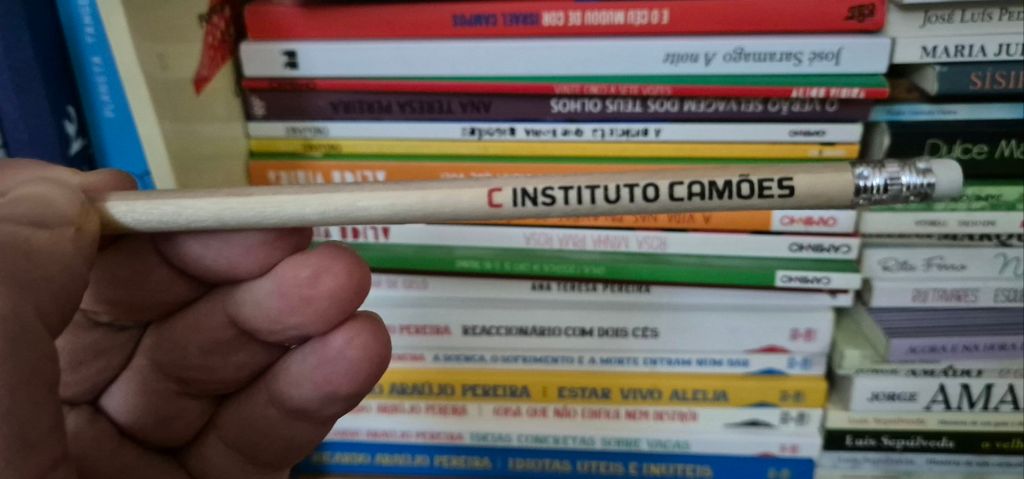

One of two things I’ve stolen today, but we were allowed to take these so my conscience is clear.
Posted in Portuguese

Sentinel – Luís Louro

Convém lembrar que ninguém consegue trabalhar sem pausa. Prescindir de descanso aumenta os níveis de stresse até estarmos prestes a saltar pela janela fora. Dito isso, a não ser que estude, vou chumbar no exame e logo vem aí a depressão, o sofrimento e a vergonha.

Tendo em conta estas duas conclusões desoladoras, larguei as canetas e, a partir da 1h30 da manhã do Domingo, escovei os dentes e deitei-me na cama com uma banda desenhada portuguesa. Pus-me a ler.

O Sentinel é a sequela do Watchers e é igualzinho: tem desenhos giros de uma Lisboa realista, no sentido de ter prédios, lojas e ruas idênticos à cidade verdadeira, mas também irrealista com elétricos voadores, e “bichinhos” (mini-girafas, hipopótamos pequeninos, elefantes de bolso) por todo o lado e árvores a irromper pelos telhados. Esteticamente, lembra-me de mais uma BD, a “Dog Mendonça e Pizzaboy”, que tem a mesma mistura de realismo, magia e humor.

Sentinel Luís Louro

O artista também tem o seu lado galhofa, como pequenos pormenores engraçados escondidos nos cantos dos quadrinhos. É claro que Luís Louro nasceu para desenhar BDs. Tem um jeito incontornável.

Então, que pena que a história não tenha pés nem cabeça.

Encontramo-nos num mundo futurista, em Lisboa, algum tempo depois dos eventos do primeiro livro. Os discípulos do “Sentinel” querem continuar a sua interpretação da sua missão por… Ora bem, não me lembro bem o primeiro livro, mas mexem nas vidas das pessoas com os seus drones de espiam-nas com as suas câmaras em prole da sua ideologia patética. Em suma, é uma chatice.

Certo dia a esposa de um homem morto no primeiro livro decide consertar o seu coração despedaçado por vingando-se da memória do Sentinel. Saca uma arma (De onde? Como? Sabe-se lá!), calça um fato de girafa (De onde? Como? Sabe-se lá!) e aprende as competências de um espião ou um agente do Serviço de Informações de Segurança* (DO? C? S-SL!). Em breve, mete-se em sarilhos mas conta com a ajuda de um bandido ucraniano que ela encontra durante um assassínio de um discípulo. Basicamente dá por ele porque está a tentar dar cabo de uns criminosos. Salva-lhe a vida. Ele quer retribuir o favor. A sua deformação profissional é exatamente o que ela precisa para continuar a matar os pilotos dos drones.  Durante este tempo todo há uma espécie de coro grego na forma de mensagens numa rede social qualquer. Adoro isto. Não devia funcionar mas funciona mesmo contrariando todas as leis de Deus e do Diabo**.

Infelizmente, a vingança é um beco sem saída. Por fim, ela assassina um inocente a tiro e pinta o símbolo dela na parede com o seu sangue. Os dois ficam presos e temos de enfrentar a reviravolta mais rebuscada e mais parva de sempre.

Quando sair o terceiro tomo, espero que o autor largue as citações cinemáticas (bué cringe) e adicione mais uma semana de reflexão sobre o enredo e o diálogo, porque com mais investimento de tempo pode criar algo verdadeiramente impressionante.

*I should have just written it SIS but since it was followed by a string of abbreviations I thought I’d spell it out in full. Portuguese MI5, anyway.

**I originally wrote “de Deus e do Homem ” (all the laws of god and man!) but this is the actual expression, apparently. I was just being lazy and translating literally.

Posted in Portuguese

Apresentação Atualizada

There’s no point messing with perfection, so I’ve updated the presentation from C1 but not really altered it much.

O meu nome é Colin. Tenho 55 anos. Sou escocês por nascimento mas quase sempre morei em Inglaterra. Estou casado com uma madeirense e temos uma filha com dezanove anos que é escritora. Sou consultor de informática. Gosto de correr. Não sou muito desportivo mas cheguei a uma idade na qual fiquei com uma escolha: ou correria para perder peso ou correria risco de infarto e outros problemas de saúde. A corrida é um desporto solitário e não sou fã de desportos da equipa, portanto a seleção da atividade foi fácil. Adoro correr logo de madrugada quando há pouca gente no parque, apenas veados, coelhos, pássaros e outros homens gordinhos de meia idade. Consigo pensar, ouvir um audiolivro, e ver o sol nas copas das árvores. Treino forte e feio para aumentar o meu desempenho, mas é difícil porque como bolos a mais. Em Outubro, participei na Maratona de Lisboa. Não batei nenhum recorde, mas foi um dia incrível.

Comecei a aprender português a sério em 2016, mas já tinha feito algumas tentativas esporádicas anteriormente. Embora a minha esposa fale inglês fluentemente, a sua tia não falava e eu queria comunicar com ela.

Pedi dupla cidadania em 2019, mas houve um problema por causa da minha residência outrora nos Estados Unidos e o processo foi por água abaixo durante a época da pandemia. Fiz um segundo pedido mais recentemente e estou à espera da resposta. Não gosto de voar e por isso, fui a Portugal poucas vezes, mas visitei Lisboa, Cascais, o Porto, Coimbra, o Algarve e a Madeira que é, sem dúvida o meu lugar favorito, e não só porque a minha mulher vivia lá!

Sendo um pouco introvertido, falo pouco com outras pessoas mas gosto de ler, e isso, para mim, é o meu principal contacto com a língua portuguesa: leio muito. Há uma citação de Fernando Pessoa que diz “A minha pátria é a língua portuguesa”. Identifico-me com este sentimento, porque estou a pedir dupla cidadania mas acho que passo mais tempo a ler livros portugueses do que passei no país. É uma situação invulgar.

Às vezes, quando comecei, custava-me muito ler livros como “Bichos” de Miguel Torga (que tem muito vocabulário desconhecido que tem a ver com a vida bucólica), “A Costa dos Murmúrios” de Lídia Jorge (cujo estilo é um pouco denso) ou os livros do João Reis, que é um autor moderno e muito simpático (falamos no Instagram de vez em quando), mas achei o seu humor difícil de entender. Mas fui melhorando pouco a pouco e, nos dias que correm, é raro perder o fio à meada. Até me apetece voltar a ler alguns livros que li há anos e mal entendi. Leio qualquer espécie de livro: adoro os livros de Ricardo Araújo Pereira, de Miguel Esteves Cardoso, de João Tordo, e de Djaimilia Pereira de Almeida mas também leio não-ficção: uma Biografia do Marquês de Pombal, a Brevíssima História de Portugal e vários ensaios sobre a língua, a história e a cultura do país. Também li um livro sobre a corrida, escrito pela atleta portuguesa Jéssica Augusto.

Sou membro da Sociedade Anglo-Portuguesa, a qual tem os seus encontros ali no outro lado da rua. É um bom método para ficar a par de aspetos da cultura, mas convém lembrar que existem muitas maneiras de nos encontrarmos com a cultura portuguesa em Londres: concertos de Fado, restaurantes, exibições de arte, como a de Paula Rego que decorreu no Tate há um ano, e até existem comediantes portugueses que montam espetáculos em Londres, porque como há tugas suficientes aqui eles encontram público disposto a ouvir comédia no seu próprio idioma.

Em resumo, pretendo viver uma vida interna que é meio portuguesa, mesmo que não fale muito.

Posted in English

Into the Final Stretch

Two full days left of study.

It’s been a busy weekend. I’ve had some work I needed to do and it’s distracted me from study but I’ve had quite a bit of lazy listening time, a little reading and worked through one of the Modelos. That’s 3 of the 5 done now. I definitely want to do the last one because it’s the real CAPLE one but I might be more selective with the other. I still haven’t done the Amor de Perdição Scuba Diving exercise and I’ve decided I’m not gonna. I’ve also only done one of the three batches of old fill-in-the-blank exercises I wanted to do this week. I’d still like to have a whack at those because they account for quite a big chunk of the compreensão da leitura exam as well as just generally boosting my competence.

I’ve got the house to myself though because Mrs Luso is in Madeira getting her passport renewed. I would have liked to go with her, but I’ve already blown my budget on Lisbon. Anyway, tough luck, no bolo do caco for me. 

Well, while I’m weeping into my porridge, if I can be strategic about switching between work and revision I can really focus and get stuff done.

Planning this fairly ambitious pile of stuff:

Monday

  • Practice my apresentação 20 minutes
  • Watch last half of Gatos, practice, do copycat exercise on some of her dialogue (definitely not his!)
  • Modelo 4 compreensão do Oral
  • Half hour “scratching”
  • 1 hour fill-in-the-blanks, probably using some of the material from Modelo 4 and maybe some of Portuguese Outra Vez if I still have time.
  • 1 hour writing. Why not do one of the written production exercises? Because I want to hit some of my list of words and phrases to practice, so I’m going to pick a subject that gives me some elbow room to do that.

Total 4.5 hours work

Tuesday

  • Early Doors Produção & Interação Escrita
  • 9AM lesson, verbal interaction
  • Lunchtime, Compreensão Oral
  • Afternoon, Compreensão da Leitura
  • Half hour “scratching”

Total 5.5 hours work. Annoyingly I have a residents association meeting in the evening. Terrible timing, but it’s quite an important one because we’ve got a council rep turning up to help us deal with the HA. I’ll go, but I’ll tell them one hour cut off and then I’m bouncing no matter what is happening.

Ugh, this is stressful. I might need some downtime in Thursday and Friday.

Posted in English

Materiais

Just typed something in which I mention using materiais when I really mean matérias and look, the very next thing I read has a correct example of how to use it.

Incidentally, material *can* be a noun, just doesn’t mean material in the sense of raw materials. Priberam.

Posted in Portuguese

Retyping with Corrections

This is a Produção e Interação Escrita essay for a DUPLE exam. I’m retyping it with fixes to help me remember them. I did a letter too, but I’m not retyping that because I decided what I’d actually said in it was brainless.

By the way, something else I’m noticing with these: maybe it’s better to avoid subjects you care about. I find it tempting to write about things I have strong opinions about, because I feel like I’ve thought them through already. The trouble is, when I do that, I want the essay to be fair and accurate and the effort to do that channels my brainpower away from my efforts to write grammatical sentences. Maybe it’s better to pick boring topics where I can write something bland, not offend anyone and just express my milquetoast opinions on beautifully accurate Portuguese. I think I’ve done that in this case in another modelo, I wrote one about social media influence on elections. Just a few days after Trump, I think that was probably a mistake.

OK, here we go. The topic is whether the tourism industry is bad for a region.

É verdade que a indústria do turismo tem custos significativos, mas também há benefícios. Enquanto alguns lugares dinamizam a sua economia por minando carvão ou urânio, o turismo fornece uma oportunidade para gerar vastos lucros sem perigo de morte, sem poluição do lençol freático e sem fumo, ruído ou vibração. Basicamente a cidade, a zona ou o país está a ser pago só por existir e por ser o que é. É perfeito, não é?

Até certo ponto.

Infelizmente, nesta indústria, o produto é a cultura e as matérias* primas são os cidadãos e o espaço onde vivem. Em breve a cidade torna-se um parque de receios; restaurantes têm ementas em 5 línguas, casas de fados abrem as portas exclusivamente aos estrangeiros que não se importam de pagar cinco vezes mais do que os locais, e os apartamentos tornam-se quartos do “Air B&B” enquanto aumenta o número de sem-abrigos**.

O desafio para as câmaras municipais é exigente: como usar os lucros que os turistas trazem (em forma de impostos nas empresas no sector turístico) para construir novas casas, estabelecer novas infraestruturas*** e impedir que a cidade perda a sua personalidade.

Isto não é apenas uma estratégia defensiva. Também se trata de “sustentabilidade”, porque se a cidade perder os seus aspectos únicos, deixará de ser fixe**** e perderá os turistas também.

*I’m pretty sure it isn’t the first time I’ve done this but I used “materiais” as if “material” was the noun and not an adjective.

***Spelling challenge for English speakers: spell this word without forgetting the e. Difficulty rating: a million.

**Sem-abrigos = “the homeless”, but if you want to go for people it’s “pessoas sem-abrigo” , not “pessoas sem abrigos”. O suppose I was fooled because in English homeless is an adjective so I was trying to make it agree with pessoas. And that’s obviously stupid, because pessoas is femimine, so it would have to be “sem-abrigas” wouldn’t it, and that’s not going to fly at all!

****In a way, this is the right word, and I chose it because I had Lisbon in mind and Lisbon keeps getting voted as the coolest city in Europe, but it’s also a very informal word and I probably should have given it a bit more context otherwise it would probably seem quite jarring in an exam situation.

Posted in Portuguese

Cuca Roseta

O concerto foi assim-assim. A fadista subiu ao palco muito depois da hora da abertura. Esperei quase duas horas na igreja (mas o tempo não foi desperdiçado: entretanto fiz uma pesquisa que se tornou o teor do blogue passado). Ela cantou um leque de fados tradicionais, muitos dos quais eu não conhecia, mas reconheci o “Barco Negro” e o “Foi Deus”. Acho que a decisão dela não tocar “Chamem o FBI do Coração” foi boa estratégia porque não teria batido certo naquela sala. Ela tem uma voz incrível mas eu estava de mau humor por causa do atraso e não apreciei a música. Ainda por cima, a sua versão do “Barco Negro” foi demasiado lenta, o que me irritou.

Posted in English

Another Brick In Na Qual

Getting driven mad by the sense that although I usually know roughly when to use (o) qual and when to use que, I don’t really know why and I sometimes used to get pulled up by Dani on the Portuguese subreddit for getting it wrong, so I’m doing a data dump in a post to get it straight in my head. It’s going to be rambling. If you found this page on Google and you think I’m a teacher, LOL, go back to the search results, buddy, because I’m not that reliable.

The examples I’m thinking of are when que and qual are being used as “relative pronouns”. In other words, they are mostly dealing with situations where in English you would use “which”, when taking about a person or thing. “The parlous state to which American democracy has sunk”, “enjoy the tax breaks for which you have traded your freedom”. That kind of thing

There are other uses of qual (“Qual é a dúvida” for example) and lots of other uses of que (“o que é que é?”) but they are easier to deal with so I won’t be going into those. Nor do I have any trouble with words like quem, onde and cujo, which sometimes to the same job in English but only when dealing with people (quem =who), places (onde =where) or ownership by people (cujo=whose).

Está bem, vamos meter as mãos na massa. Começo com as notas no livro Qual é a Dúvida

Que

Used after monosyllabic prepositions – em que a que, com que, de que, por que. So “in which”, “to which”, etc

Qual

Used after other prepositions “para o qual”, “sobre o qual” (“for which”, “about which”). So far so good. It is “partitive” in other words, it singles something(s) out for discussion from among a larger group.

Here’s an example of o qual from…. Um… Somewhere:

“O lavrador sobre o qual falei” O qual is a relative pronoun here. The speaker has mentioned a ploughman earlier and he wants to refer to him again so he says “The ploughman about which (sobre o qual) I spoke…” The relative pronoun is a way of singling him out without having to do all the work of reintroducing him in the story.

So, relative pronouns usually come after prepositions but be careful, because there are some things that look like relative pronouns but aren’t. For example:

Confuso sobre qual palavra usar“. Qual seems like a relative pronoun here but it’s not. He is wondering “qual palavra usar?” and he’s confused about that, and the qual ends up being after sobre, but it isn’t doing the same job. In English it’s the difference between “I’m confused about which word to use” and “Ah, so this is the new Fado about which the critics are losing their shit”.

O qual differs from que in these situations because it always has an article (‘o’) tacked on, which means it’s going to change with the gender and number of the thing it’s referring to, so it could be “a qual” or “as quais” or whatever, whereas que is always que.

Hm, ok, we’ll, moving on, let’s see if we can find anyone else with some light to shed.

This Ciberdúvidas page discusses em que and no qual as substitutes for onde in a sentence. So you might choose to say “the University in which I studied” instead of “the University where I studied”. The correspondent reckons it comes down to what sounds best.

This (Brazilian) teacher advises that o qual  is mainly useful for avoiding constantly repeating the word “que” every five seconds. Que is a very overused word in Portuguese and there might be situations where you’ve used it so often in a sentence that using it again is going to confuse things, perhaps…?

This page for school-age children focuses specifically on “no qual” but doesn’t shed much light except to show examples of cases where o qual is basically synonymous with que, and you can check whether you are using it correctly by substituting “que” and seeing if the sentence works.

So is that it then? At bottom, it’s not really a grammar rule as such, just a question of what sounds gooder?

I poked around some more because I couldn’t quite believe it. This Ciberdúvidas page gives a few situations where it’s important to use one or the other, and I thought maybe he would be more rulesy, but, on closer inspection, he was just ruling out some of the other uses of qual and que discussed above:

O rapaz que tinha medo do escuro venceu os seus obstáculos

O qual wouldn’t fit here, but that’s because it isn’t really acting as a relative pronoun anyway. It’s a determiner I think. In English we would use “that” or “who” instead of “which”

And he goes on to talk about prepositions of one syllable…

‘A verdade é um postigo/ A que ninguém vem falar.’ (Pessoa)

Versus prepositions with two…

‘Tinha vindo para se libertar do abismo sobre o qual sua negra alma vivia debruçada.’ (Torga)

And that’s really just a question of which sounds better, again.

Well, that was a bit of an anticlimax. I thought it would be more complicated than this, but that’s OK. I feel a bit more confident in using them after this deep dive.

Posted in English

On Living In the Moment (aka Being a Disorganised Mess)

Às vezes, a minha esposa goza comigo por causa da minha falta de planeamento. Tem razão até certo ponto. Faço planos quando é preciso fazer planos (por exemplo, um exame, a reforma, o pedido de cidadania, as plantas que quero plantar no próximo ano) mas noutras situações, vivo aleatoriamente. Hoje, estava a trabalhar na sala de estar às cinco horas de tarde, quando o meu telephone me chamou a atenção. Ergui a cabeça. Um aviso acabou de aparecer: Cuca Rosetta, Hackney Church, 19:00. Que surpresa! Tenho bilhetes para um concerto que o eu-do-passado tinha comprado e até fez jus a arranjar um lembrete para que o eu-do-futuro não se esqueça.

Continuei com o meu trabalho até às 17.45, levantei-me, vesti-me rapidamente e saí da casa, voltando apenas uma vez para apanhar os meus auscultadores (esqueço me sempre de alguma coisinha ou duas… Ou três, na verdade). A Catarina riu-se quando expliquei, mas ficou contente por ter o apartamento, livre de maridos, durante 4 horas e tal.

Estou no comboio para Hackney. Espero que valha a pena após toda esta cuidadosa preparação.

Posted in English

Podcast

The free recording of Amor de Perdição I listened to a while ago seems not to exist any more, but I had a dig around and there’s a podcast called Livros Para Ouvir, available in a few places, including on Spotify. It’s no longer active, but there are a few whole books there, all old classics (and, presumably therefore public domain?)

  • O Primo Basílio
  • A Cidade é as Serras
  • A Abóbada
  • Amor de Perdição
  • O Crime do Padre Amaro
  • Os Maias