In keeping with yesterday’s historic Brexit vote, I have decided instead of learning Portuguese I’m just going to speak loudly and clearly to foreigners: “Don’t you speak English?” I will shout as I order my tea and crumpets.
Portuguese Views of Brexit
Here in the UK, everyone’s nerves are shredded. It’s the 22nd of June, the day before the referendum. At this stage, nobody is going to change their mind and on Twitter, conversation quickly moves from disputing the veracity of a statistic to name-calling, blocking and general unpleasantness.
That being the case, I thought I would go further afield and look at some Portuguese reporting on the Brexit on the grounds that looking in from the outside might give some useful perspective. A few days ago, I blogged about the delightful description of Boris Johnson by Miguel Esteves Cardoso in a column in Público (cf “Learning from the Brexiteers“) but I have come across some other examples, too. As you would expect, it’s a mixture of fear for the future of the EU and the Western Alliance more broadly, versus a sort of mystified bafflement about why we are having this collective hissy-fit, and I’ve even seen a few saying “sod ’em” and describing the UK as “the Crying Child of Europe”. It’s a fair cop.
First of all, I was interested to see some views from Portuguese people living in Britain. Here’s one in the Jornal de Notícias, and another in Bom Dia Europa. The worry for existing residents is twofold. First of all, although it’s unlikely there would be mass deportations, nobody knows what post-brexit Britain will be like, so it’s not impossible, and with the mood getting as ugly as it is. I know my wife and some of her friends are already sensing a higher level of ambient resentment against them from people whose opinions are formed by the Daily Mail and Daily Express. Secondly, Portuguese people will have a higher level of hassle and inconvenience moving about,. Presumably it’ll be the same for Brits living in Spain who will be lose a lot of their current rights and entitlements. And we haven’t even got into things like VAT harmonisation and the nightmare small businesses will face dealing with paperwork, reclaiming money and on and on. Some of the interviewees are small business owners and there’s a level of concern about the unknown consequences as they see the remain campaign being forced onto the back foot by the giddy, unthinking optimism of the leave campaign for some ill-defined future. Some are considering leaving.
Next, let’s look at a blogger – César Agosto – who writes for Homo Causticus on WordPress. He has blogged a few times on the referendum and related matters such as the last general and mayoral elections. I don’t know anything about him but I guess he must live here, or visit often, or at least be a keen bifewatcher because his blogs draw on a knowledge of history and pop culture. In “As Propostas Por Favor” he rightly highlights the lack of a clear sense of what is to come after Brexit, and the problem that causes in trying to decide whether or not you want to support it. In Life on Mars he uses the TV show of the same name as a jumping-off point to illustrate differences between the seventies, when the first EEC referendum took place and the modern world, where we are now holding the second one on the European Union. The first is typified by the famous debate between Tony Benn (much-revered eccentric hero of the left) and Roy Jenkins (mainly remembered, I think, for his speech impediment). Each one is measured and forceful, defending their views (basically: economics vs democracy) without rancour (just as well… I don’t like to think what would happen if Roy Jenkins were to say “Rancour”).
What he could add, but kindly doesn’t, is that the second is typified by the sight of useless, workshy UKIP MEP Nigel Farage telling Herman Van Rompuy ” I don’t want to be rude but, really, you have the charisma of a damp rag and the appearance of a low-grade bank clerk”. And this is what our country has come to after forty years. Other modern figures get a mention too, and not just the usual suspects. Redwood gets a mention, and Cameron’s Eton demeanour is contrasted with Sadiq Khan, famously the son of a bus driver. Bizarrely, he is described as charismatic, although to me he seems to disappear into the background on any stage he’s on, even when he’s actually speaking, but hi ho.
In the news media, there is some sympathy for the idea that the EU is in need of a good kick in the arse. For example, José Pedro Teixeira Fernandes says “Long Live the European Union – and Down with the technocracy of Brussels and Frankfurt” while José Vítor Malheiros proclaims “The EU has turned Europe into a brothel” and argues that the brexit might just cause a welcome return of democracy to the region. Portugal, of course, has had its fair share of problems with the EU, and has more cause for complaint than our whining. With that in mind, Paulo Pisco calls the brexit vote “A national egoism” and defends the humanist spirit of the European project against the xenophobia and selfishness of one nation that seems to want to dominate it completely. Actually, Público is buzzing with columnists looking for an angle on the story, so you can take your pick, really.
Finally, there’s an article I can’t even read in its entirety because it has a paywall but I liked the first few lines. As you know, last week some deranged idiot, driven on by some misplaced sense of fighting against “traitors” shot and killed his local Member of Parliament, Jo Cox, near a constituency surgery. There was – and still is – a heated and rather nonconstructive debate about the extent to which the tone of the Leave Campaign’s rhetoric fed a climate of violence that led to the attack. In “I am Jo“, João Duque invokes the memory of “I am Charlie” to stand with her against violence and for European values. Paraphrasing the first three sentences:
If Jo Cox died because she believed the UK is important to the EU then I am Jo
If she believed that a more diverse Europe can be richer and more stable then I am Jo
If Jo Cox believed that democracy will allow wisdom to prevail then I am Jo
Bad Advice
This post from Lady of the Cakes is good fun if you’re tired of trying to implement someone else’s great ideas. No, it’s not just you, and no, there are no shortcuts.
Book Review
Europe In or Out: Everything You Need to Know by David Charter
Original (and more detailed) review in English here
 Estou a escrever este comentário três dias antes do referendo, por isso, se pensa em lê-lo, venha logo!
David Charter é um jornalista do “The Times” em Londres com um impressionante conhecimento do funcionamento interno do UE. É cético sobre o assunto, mas com uma certa forma de ceticismo: Quer investigá-lo e descobrir o que acontece lá, ao contrário da outra definição de ceticismo, que significa odiar a UE e todas as suas obras para as razões viscerais.
O livro é dividido em duas partes. A primeira parte trata de argumentos a favor e contra o “brexit” que se referem às maiores áreas do mundo político: a segurança, a prosperidade, a paz, a cooperação com os nossos vizinhos no continente, a democracia e algumas coisas assim. Não é surpresa que as maiores dúvidas (a economia, a influência mundial) apoiam a ideia de ficar na UE. Por outro lado, o assunto da democracia é mais difícil de resolver, e depende de como acha do com promisso entre a cooperação, a falta da democracia em Bruxelas e as problemas de segurança por causa das fronteiras porosas. A segunda parte concentra-se nos maiores sectores económicos como o financiamento, a agricultura e a pesca. Claro que o sector dos serviços financeiros será confuso sem as ligações à UE, e é mesmo para a agricultura. Além disso, a pesca, apenas tem muitas regras más, não conseguirá ganhar muito por causa do “brexit”.
O leitor pode fazer as suas próprias conclusões, e os prós e os contras são resumidos para ajudar a avaliá-los.
Uma coisinha que não concordo com o autor é o assunto de dúvidas sobre a situação após o “Brexit”. Ele afirma que esta incerteza vai assustar-nos e por isso vamos ter medo de mudar, mas parece que a verdade é o oposto: a incerteza ajuda a campanha de brexit. Acho que cada “brexiteer” tem uma diferente visão individual da vida no futuro. Algumas esperam que o Reino Unido vá estar na Área Económica Europea (EEA), outros na Área Europeia de Comércio Livre (EFTA) e mais algumas creem que apenas devemos ter um acordo de livre comércio com o continente.
Estas opiniões têm um certo apelo para vários grupos dentro do campo de Brexit, mas não pode acontecer a todos, e por isso, muitas pessoas vão ficar desapontados. Votarão para as suas próprias utopias, mas receberão um governo escolhido por uma pequena minoria.
Esta é a razão pela qual os britânicos devem de ter medo.
Learning from the Brexiteers
I learned a fantastic new word today from Miguel Esteves Cardoso’s piece “Não ao Brexit” in the Portuguese tabloid Publico. In it, he’s describing the contrasting personalities of the two main Brexit advocates, Gove and Johnson. The word is “queque” which I think is pronounced like “cake” with perhaps a bit more tail on the end. It literally means cupcake and he uses it in the sentence “Johnson é simpático e queque.” Johnson is likeable and cupcake. So what does that mean, I ask my wife. Basically it means… well, someone like Johnson – vain, snobbish, wanting public admiration. I guess the closest english equivalent would be “toff”, not that it’s exactly the same word, but it’s in the same area and of course has a link to confectionery (being short for “toffee nosed”).
Johnson doesn’t get off so lightly as this sentence though. All the way through, Cardoso seems to be contrasting Gove’s honest nationalism and intellect with Boris, who he describes as “um aldrabão” (a crook), “um palhaço esperto, indolente e mentiroso” (an expert clown, lazy and dishonest), and “um traidor e um oportunista” (a traitor and an opportunist). In summary, to contrast the two “Johnson é um Trump educado e europeu enquanto Gove é um Larkin prosaico e incapaz de poesia”, all of which is so close to the English that even if you don’t speak Portuguese, you probably get the gist, but in case not “Johnson is an educated, European Trump, while Gove is a prosaic Larkin, incapable of Poetry”.
Such a great character sketch and yes, I’m definitely saving that word, queque for later.
Edimburgo
[Este caderno é o meu primeiro escrito em Português desde o exame. Desculpem os meus erros!]
Eu e a minha família passamos uma semana em Edimburgo. Precisámos de algumas férias após da semana anterior: Eu tinha feito o exame “DEPLE” (Português B1), a minha esposa tinha feito a prova final da universidade aberta e a herdeira da minha grande fortuna tinha ido à costa do sul com a sua escola, fazer aventuras ao ar livre e nunca dormiu.
Edimburgo é a capital da Escócia. Fica a quinhentos quilómetros do norte de Londres e por isso o tempo normalmente é terrível, mas durante as ferias, o sol brilhava todos os dias. Entretanto em Londres, foi pior, frio, cinzento… Quando voltamos a casa, estavamos bronzeados.
Durante as férias, ficamos num apartamento acima dum restaurante italiano. Visitamos alguns castelos e um museu, demos um passeio de barco para vermos focas e papagaios-do-mar e fomos a uma festa com alguns amigos. A minha filha fez anos (ela tem onze agora!)
Infelizmente, amanhã tenho de voltar ao trabalho.
:^(
Imagem: A vista do topo da montanha “Arthur’s Seat”

UrbanGay – Portuguese Blog
I came across another site via Twitter and a shared interest in Practice Portuguese. Urbangay covers Portuguese as one of its main strands- along with running and gay culture in general. If you are gay and studying Portuguese, you’ll almost certainly be interested in some of his posts on the history of gay life in Portugal, or on the Lisbon scene (have a look here), but even if you’re not, there are plenty of interesting blog posts, including one about language-learning resources. It covers some of the same ground as my “Language Hacks” post but he has some other ideas and I’ve plundered it for my own study. Go and have a look.
Get on the Membus
Hi all,
And hi, especially, if you’ve arrived via the Practice Portuguese Facebook page where Joel kindly endorsed this blog the other day. I hope you find some of my burblings useful. Do say hello, won’t you? I’d love to hear from other travellers on the road to lusophone fluency!
I’ve been in a break since the exam and I’ll probably keep a low profile for a few more days while I finish some projects and read some books about the EU Referendum which is coming up in a few days. Then it’s back to the books!
In the meantime, I’ve been keeping myself ticking over with some podcasts, youtube videos and what-not. The thing I’m most excited about is the Membus Tour. Have you hear of it? There’s a group of people travelling around Europe in a bus recording native speakers saying words and phrases. I think the idea is to make this a part of the Memrise app so that paid subscribers can get a more immersive experience. They’re currently in Portugal and they keep popping up in my instagram feed and stoking my enthusiasm.
Instagram
More about Membus
Lying to Examiners for Fun and Profit
Reflecting on my exam experience, I had another idea that might be of use to potential CAPLE candidates: Lie.
Lie through your teeth!
Lie like a lying liar who lies!
Embrace your inner Jeffrey Archer!
What do I mean by this? Well, sometimes questions come up about issues in life that are tricky to explain. Sometimes it’s better to not explain those things and instead just simplify the whole answer. For example, I had already decided that if they asked me “Tem animais de estimação?” I was going to say no. OK, I can talk about the guinea pigs (“A minha família e eu tínhamos alguns porquinhos da Índia. Eram muito fofinhos, mas só viveram até aos cinco anos.” etc) but there was no way I was going to tell them that hoje em dia we have stick insects. Every time I’ve mentioned stick insects in Portuguese it has resulted in bafflement and me needing send pictures and explain that, no, I’m not talking about termites or locusts or anything else. It’s a guaranteed recipe for confusion and it’s just not worth the hassle.
During the exam today, I mentioned that I was born in Edimburgo. The invigilator asked did I ever go back there to visit. Now, as it happens, we are planning to go back quite soon. Why? Well, the truth is that A Minha Esposa had intended to do the Edinburgh Marathon but she had a cold during peak training times and then some other things came up and all in all, she wasn’t fully prepared, so she dropped out, but we’d already booked accommodation at mate’s rates so we decided to…
Now, do I want to start explaining this, off the cuff in an exam? If it were a lesson, I might have a go. I could probably pull it off but it’s a complicated sentence with far too much potential for getting snookered by grammar, so I just lied and said she was going to do the Marathon. That’s a much easier sentence. I can do that, easily. Go!
As I was leaving, she offered these words of encouragement
Verificaremos que a sua esposa terminou a maratona. Se não, o Senhor Colin está desclassificado.
I’m not sure what it means, but I think she was wishing us a happy holiday.
Este é o Verdadeiro Teste
I’m writing this on the way home from the DEPLE (Portuguese B1) exam at the embassy in Knightsbridge, feeling slightly frazzled. I thought I’d jot down what I can remember while I can still remember it because – let’s face it – knowing what I’m like, that won’t be long. Maybe it will be helpful to future students. There isn’t much material out there telling you what it’s like to take the test, after all.
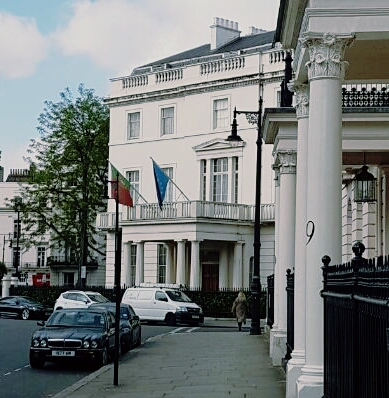
The embassy is an impressive building, as you would expect, with grandfather clocks and all kinds of fancy stuff in the hall and big stacks of Super Bock tucked away in side rooms. The staff are all Portuguese of course, but speak very good English to guests. I had been prepared to speak to the receptionist in Portuguese but he detected my Anglo Saxon demeanour and went straight into English mode.
I wasn’t expecting there to be many fellow students, but I was a bit startled to find I was the only one! I sat in a room, opposite a very friendly and helpful embassy official who handed me the papers and occasional glasses of water. There were textbooks and teaching materials all over the place. I believe they do lessons for expat children, so I guess that’s what those were for.
All the usual exam rules apply: read the question carefully before you start and try not to spill a glass of water on the answer sheet. I stuck to these rules… Mostly.
The first part of the exam was as expected: a series of multiple choice questions based on written texts. Easy enough. I didn’t make great use of my time, unfortunately, and had to rush a bit at the end, but that’s OK. This is by far my best subject.
Next up is a written exercise: write an email and a note based on a scenario they give you. The best technique here is to reuse as much of the question text as possible, just changing the verb endings. They’ve already constructed the sentences for you so why would you want to rewrite it from scratch. Thanks Mr Bennett, secondary school French teacher, for that advice; it got me about 20% of the word limit and then I had to start thinking, and it went reasonably well, I think. One thing to remember is that you don’t really have enough space for the 120-140 words they ask for, so keep your writing small and neat or you’ll end up like me, having to cram the last ten words into a centimetre of remaining space. I’m exaggerating… Actually, no, I’m not. There’s plenty of time though, so don’t forget to use it to go back and check your concordância.
On to part 3. This was the biggest shock for me. Up to now, I had done pretty well in all the “modelos” by allowing myself time to read the questions. Now, in the exam, the first three recordings each allowed one minute for the student to read the questions, but that’s not really enough, and the remaining 5 recordings didn’t allow any time at all. I was trying to read and listen at the same time, got hopelessly muddled and the result was a bit of a mess, I think. If you’re about to take the test, you should consider doing some speed tests, trying to cope with information rushing at you in a flood and strategies for coping with lack of time. Another tip I can give you is to do with the sound quality. The office isn’t noisy but it’s an old building and the acoustics aren’t great. Add to that the traffic noise the general quality of the recordings themselves, and a couple of people wandering in and out and you’ve got a recipe for distraction. When I do the next one, I’m going to ask if I can use headphones to shut out external sounds and see if that helps. I would suggest you consider doing the same if you are planning to take the exam. As for me, in the interval between the third and fourth sections, I went to the casa de banho and cursed the fact that embassies have bars on all the windows so I wasn’t able to escape. When I got back to the room my hands were shaking.
The final section is a ten minute conversation with the examiners. The modelos I’ve done have all had three components to the “expressão oral” but, to my intense relief, in the real thing, they had dispensed with the other two! Yippee!
I had spent the last couple of weeks working on conversation generally, and the last two days cramming intensely for the 1:1 questions, and it paid off in bucket loads. I’m sure I made mistakes but I flew through it, spoke fairly fluently, managed a couple of jokelets and a couple of expressões idiomáticas (examiners bloody love those, whatever the language might be). Best of all, I resisted my natural inclination to improvise and get myself into convoluted subclauses with no way out. I stuck to the sentences I had practised, kept it simple and it went very well indeed.
I must say, the invigilator was really helpful in the conversation. Obviously she didn’t actually help, but she made me feel very at ease and gave lots of positive feedback to let me know that, yes, I was still making sense and not burbling. That sort of thing makes a big difference, because if you lose confidence in that situation it’s quite difficult to get back on track.
All in all, I think I did pretty well,in spite of the setbacks in the third section. I don’t know how picky they are, or what the marking criteria are but I have a good feeling about it. Unfortunately, I won’t find out for sure until September.
September!!!
SEPTEMBER!?!?!
When it was all over, I thanked the invigilator and went to a fancy-schmancy café for a fancy-schmancy sandwich and some well-earned beer*.

*=Peroni, not Super Bock. Yes, I was tempted but their security was too tight.
 Luso
Luso 