Posted in English

Music and Toilets

Listening today:

Ana Moura, because she’s coming to the Barbican Centre in September and I’m going with Mrs Lusk. I think a Ana’s possibly a bit uncool, like a Portuguese Mariah Carey, but I’m not bothered and I’m calling it homework

Luisa Sobral, because she seems like fun. I think she does songs in English as well as Portuguese, and for children as well as adults. I would dearly love to know what this is about, for example. Is it educational in some way? Just a fun thing to sing? What? I actually have a podcast of her talking about it so I’ll try and decipher that rather than take the coward’s way out and ask Mrs L.

Beatriz Gosta, because I was told it would be good to mix it up a bit with the podcasts. I listen to a lot of news and serious programming from Antena 1, but of course it’s all in one tone of voice and a narrow vocabulary, so I tried Antena 3 which is a hotbed of filth and depravity and shrieking yoof presenters. Well, it’s broadened my vocabulary, even if none of the words are usable in most conversations I’m likely to have in the queue to see Ana Moura.
Posted in Portuguese

Uma Nova Língua

Well, my Arabic lesson was interesting, and here’s a report (in corrected portuguese) of my daughter’s Japanese lesson:

Estou a fazer o “iTalki Olympic Language Challenge” (o desafio Olímpico de línguas). Quando estava a falar com a minha filha sobre este assunto, ela disse que queria estudar uma língua também.
– Que bom! Filho de peixe peixinho é! E qual é a língua é que queres aprender, fofinha? Português?
– Não, Japonês!
Fiquei surpreso mas ela disse que tem um grande interesse pela língua e a cultura japonesa. Por isso, hoje de manhã, teve a sua primeira aula com uma professora japonesa. Ela gostou muito dela e aprendeu muitas palavras. Marcamos cinco aulas para as semanas seguintes.
É possível que ela se farte de japonês após* cinco aulas. Não sei, mas estou muito contente de vê-la encontrar novos interesses.


*=I keep writing “após de” and it keeps getting corrected but I keep doing it.

Thanks to Sophia, Lilian and Bruna for their corrections

Posted in Portuguese

Comentários Sobre Um Filme: Os Imortais

No sábado*, vi um filme de António-Pedro Vasconcelos que se chama “Os Imortais”. Gostei muito dele. O argumento concerne quatro soldados da guerra em Moçambique. Após a guerra, voltaram a Portugal mas acharam difícil voltar à vida quotidiana. Para lutar contra o aborrecimento,  eles discutem, jogam a poker e passam o tempo com mulheres que maltratam. Afinal, tornaram-se ladrões. Roubaram um banco usando armas militares e um deles matou um segurança.

A protagonista é um “chui” – um policia velho protagonizado*** por Nicolau Breyner, um gordo, velho, e que sempre fuma um cigarro como um detective clássico! Não se importa pelo roubo, ou até mesmo dos assassinatos (de um soldado e uma mulher francesa) que seguem. Apenas quer resolver a mistério antes da sua aposentadoria, e antes do seu colega – um polícia jovem, que tem muitos certificados, e usa computadores em vez do trabalho tradicional da policia.

*=according to Rita, who kindly corrected this, “Segundo o Novo Acordo Ortográfico, os dias da semana deverão ser escritos com letra minúscula”. Good God! No wonder the Portuguese are so cross about it!

**=lit. “A security”. I originally wrote “um guarda de segurança” because that’s what wee would say in English but… nope.

***=I wrote “jogado” which was stupid because “playing” a game isn’t necessarily the same as “playing” a part in a film in every language. A Brazilian user corrected it to “interpretado” which looks more natural to me but Rita is Portuguese so I’m trusting that the weird-looking “protagonizado” is right.


Posted in English

Key Learnings 4 – Um Falso Amigo

Today’s lesson included the word “admirar” in an article about all the different types of coffee on offer in Portugal. I can’t remember the exact wording but it was something like

Não admira que as turistas preciso de um dicionário quando pedem um café!

The meaning seems to be “I’m not surprised the tourists need a dictionary when they order a coffee”. So “admirar”, which is obviously cognate with “admire” has obviously diverged in meaning somewhat from its English cousin.

In the same lesson, we also came across “vasculhar” which looks like it has something to do with “vascular” but if you’re expecting it to mean “to pump blood” or something then you’ve been had by another false friend. It actually means to search – not specifically searching for something but having a good old look round in general, in the way a thief might if he got into your house and was looking around to see what there might be to steal. A related word is “remexer” which means “rummage”.

Finally, “Rever” which is obviously cognate with “review” means “look again at”. It must be related to “revista” but “revista seems only to mean “magazine” now and has lost its connection tio what we think of as a review as in a book review – they use “comentário” instead.

Posted in English

The Olympic Language Challenge – Sit Rep!

I decided – for some reason – to just do the last part of the challenge and sign up for lessons in other languages. I have Arabic and BSL on my radar for after Portuguese so I booked a trial lesson in each, and my daughter said she wanted to learn Japanese, so I used my credits to book her a lesson on condition that she finds out how to shout “Row faster!” at my rowing partner, who is Japanese. I have deliberately avoided European languages that are too similar to Portuguese and might confuse me even more.

The main body of the challenge is going pretty well and I have been making some good progress on subjunctives. Today, I watched the movie “Os Imortais” which is a really excellent film, did some reading and listened to some of the new Practice Portuguese episodes aimed at new learners. It’s mostly pretty easy but they spend time explaining the finer points of common words like “pois” and the difference between trazer and levar, so I’m learning new things anyway.

Posted in English

Trying to Subscribe

Trying to book an exam through the CAPLE site is proving tricky. Their website shows some exams happening in November but if I try to book one it tells me it’s full. It isn’t full though, they just haven’t added the slots onto the site and won’t until later in the year, I’m told. I find this problematic because I want it to be done and mentally crossed off my list but I just have to live with

Posted in Portuguese

Portanhol

Hoje de manhã, ethcutei uma gravathão de “Jothé e Pilar” para praticar Portuguêth. Infelithmente, ethquethi-me que a Pilar del Rio, a ethpotha de Jothé Tharamago era ethpanhol e por itho, agora falo Portuguêth athim.

Posted in Portuguese

Key Learnings 3 -A Pair of Ears and a Stray à

Today’s top two new things were:

Orelha and Ouvida: I have known for a while that there were two words for the ear but I had lazily assumed they were synonyms. But in fact, Ouvido is the bit you hear with and Orelha is just the flappy bit on the outside.

This sentence:

Em casa da família de acolhimento é melhor que o estudante tenha a idade aproximada à das crianças da família.

was baffling to me because the à [a+a], immediately followed by das [de+as] seems to mean “to the of the children” until I finally wrapped my head around what it was doing. The à is actually “to it” not “to the” because an a can be a pronoun as well as an article, so the sentence means

In the house of the host family it’s better that the student be of the same age as it (i.e “as the age”) of the children in the family.

As for the actual statement itself, OK, I know, I’m not sure why that would be true, but when I had the initial conversation about this I thought “família de acolhimento” meant a foster family, so it made a sort of sense. I think it’s more like a host family in some sort of school exchange program though.

Posted in Portuguese

A Bicicleta

[Uncorrected Portuguese Klaxon]

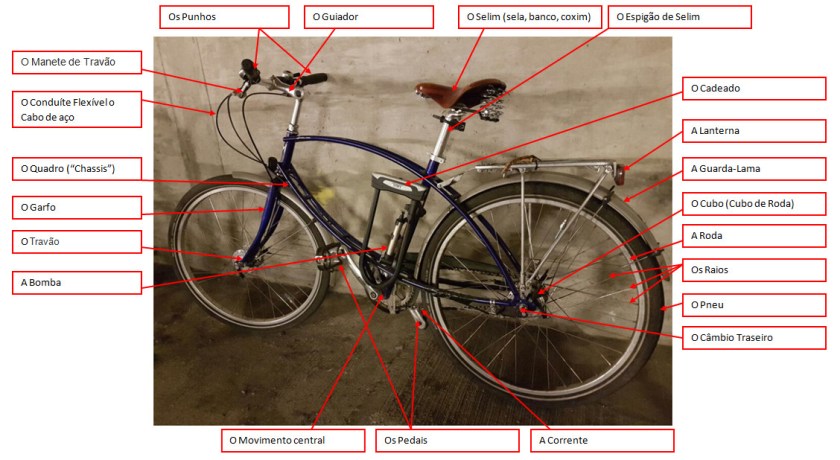
Percebi que o website Cycling Fallacies (“As Falácias Sobre A Bicicleta”) tem sido traduzido ao Português e tinha a motivação a fazer alguma coisa que estava a planear desde o mês passado: classificar e rotular as peças de uma bicicleta para ensinar-me algum vocabulário útil.

bicicleta

Nesta imagem, utilizei o vocabulário especifico a Portugal da Pagina Wikipedia Português, acrescentado pelas palavras da Loja Das Bicicletas. A imagem está diminuída por o blogue mas espero que possa lê-lo.

Posted in Portuguese

Aconselhamentos

Caro Rui*,
Estou muito feliz de ouvir que pensas visitar-me aqui em Londres. Ainda que não tenhas muito dinheiro, vem**! A libra está muito baixa hoje em dia por causa dos “Brexiteers” e por isso tudo é muito barato.
Eis as minhas regras para uma viagem a Londres:
É necessário que tragas um guarda-chuva porque chove muito aqui.
É possível que compres um “Oyster Card” na estação de comboios. Com isto, é possível fazeres viagens todos os dias sem pagar.
É viável andares de comboio (a rede de comboios subterrâneos de Londres chamar-se “The Tube”) porque convém evitar o tráfego*** nas ruas.
Não é provável que encontres o Stephen Fry no supermercado mas se é que o encontras, deves levantar o seu chapéu, quer queiras quer não. Por isso, é aconselhável que tragas um chapéu. Embora tenhas dores de cabeça, usa-o todos os dias que fiques no país.

*=Just to explain why the phraseology in this is so weird, here is the note I attached to it in iTalki

Este exercício destina-se a ajudar-me a praticar três tempos: presente do conjuntivo, infinitivo pessoal e imperativo. Por isso, algumas frases não são muito idiomáticas, mas não faz mal. Acho que a gramática é pouco especifica a Portugal. Pode ser que a gramática do Brasil seja diferente. Eu ficaria muito contente em receber correcções do Português de Portugal. Muito obrigado

**=I can’t believe this is the 2nd person imperative form of “vir”!

***=I originally wrote “tráfico” but that means traffic in the sense of “drug trafficking”