Posted in English, Portuguese

Manta Para Dois

O mundo está fodido, portanto vamos ouvir os Deolinda. Há anos que sou fã desta banda e nunca me farto de ouvir as suas músicas e sentir as emoções – neste caso a felicidade turbulenta do casal imperfeito que é o assunto da canção. Talvez, apesar de tudo, o mundo não esteja assim tão fodido.

PortuguêsInglês
Às vezes és bruto
Rezingão, tosco, inculto
Insensível, um ingrato, um ruim
Rude e casmurro
És teimoso como um burro
Mas, no fundo, és perfeito para mim
Sometimes you’re crude
Grumpy, coarse, ignorant
Insensitive, an ingrate, a meanie
Rude and pig-headed
You’re stubborn as a mule
But, deep down you’re perfect for me
Às vezes, também, eu tenho o meu feitio
E sei que levo tudo à minha frente
E por essas e por outras
Quase que nem damos conta
Das vezes que amuados
No sofá refastelados
Repartimos a manta sem incidentes
Sometimes, too, I have my ways
And I know I don’t listen too anyone*
And for those things and others
We almost never notice
The times we grumpily,
On the sofa, all snug,
Share the blanket without incident
Às vezes és parvo
Gabarola, mal-criado
É preciso muita pachorra para ti
Cromo, chico-esperto
Preguiçoso e incerto
Mas, é certo, que és perfeito para mim
Sometimes you’re foolish
Boastful, spoiled
It takes a lot of patience to deal with you
A nerd, a smartarse
Lazy and uncertain
But it’s certain that you’re perfect for me
Às vezes, também, sou curta de pavio
E respondo sempre a tudo muito a quente
E por essas e por outras
Quase que nem damos conta
Das vezes que amuados
No sofá refastelados
Repartimos a manta sem incidentes
Sometimes, too, I am short on temper
And I reply to everything heatedly
And for those things and others
We almost never notice
The times we grumpily,
On the sofa, all snug,
Share the blanket without incident
Às vezes, concedo
Que admiro em segredo
Tudo aquilo que não cantei sobre ti
Mas o que em ti me fascina
Dava uma outra cantiga
Que teria umas três horas p’ra aí
Sometimes, I admit
That I admire in secret
All those things I haven’t sung about you
But what fascinates me about you
Would make another song
That would be three hours long
Às vezes, também, sou dada ao desvario
Mas vem e passa tudo no repente
E por essas e por outras
Quase que nem damos conta
Das vezes que amuados
No sofá refastelados
Com os pés entrelaçados
E narizes encostados
Já os dois bem enrolados
Brutalmente apaixonados
Repartimos a manta sem incidentes
Sometimes, too, I am give to madness
But he comes and it all passes suddenly
And for those things and others
We almost never notice
The times we grumpily,
On the sofa, all snug,
With our feet intertwined
And our noses touching
And both of us rolled up
Brutally in love
Share the blanket without incident

*I struggled to translate this – I sweep all before me? I barge everything out of my way? Levar tudo à (sua) frente is what a tractor or a bulldozer does, so the idea you get is of someone just charging through everything and not taking account of anyone else…. but it’s difficult to boil that down to the length of a lyric!

Posted in Portuguese

Hora H

“Hora H”… Antes de mais, pessoalmente, tenho o hábito de ler as letras em inglês “Hora aitch”. Se também fizeste isso quando leste o título, faz uma pausa e repete três vezes: “hora agá! hora agá! hora agá!”

Mas Hora H tem a sua origem em inglês. Costumamos falar do Dia D (“D-Day”), o dia mais importante no qual algo muito antecipado (e talvez perturbador) vai acontecer, como por exemplo o primeiro dia de um novo emprego, o lançamento do nosso primeiro livro, ou o nascimento de um filho.

A origem é bem conhecida: o Dia D foi o dia marcado para o desencadeamento da Operação Overlord, que deu início à invasão da Europa pelos aliados. Mas já sabias que também havia uma H-Hour (Hora H) durante aquele dia? Por incrível que pareça, eu com 55 anos não me lembro de ter ouvido falar da H-hour. Certamente não é uma expressão quotidiana em inglês, mas em português é muito comum ouvir consumidores a falar com entusiasmo da Hora H, na qual haverá descontos para todos.

Livros + Descontos = Felicidade

Neste sentido, a frase é muito parecida com a nossa “happy hour”, mas também pode ser equivalente à nossa “zero hour” noutras ocasiões importantes na vida incluindo:

  • Ele estava à espera da hora H para meter a cebola no tacho (=o momento certo)
  • Ele estava confiante para falar em público mas na hora H, amarelou*” (=o momento da verdade)

E… Ora bem, basta dizer que, quando fiz a pesquisa no Insta para a imagem supra, havia montes de fotos que se referiram à hora H como um encontro sexual, estes encontros sendo geralmente muito antecipados pelos participantes, e menos assustadores do que um encalhamento numa praia francesa debaixo de fogo de centenas de metralhadoras**.

Tanto quanto me lembro, não ouvi este uso da expressão em Portugal. Pode ser um brasileirismo, não tenho certeza mas recomendo que tenhas cuidado.

The German generals took their defeat at Normandy badly

*amarelou =turned yellow = chickened out. This is also a Brazilian usage I’m afraid, but the person who gave this example also confirmed that hora H is very commonly used to mean sexy-sexy time there. No portuguese users came forward to say whether or not they ever used it, so it’s still a mystery I’m afraid!

**Although if this is your thing, who am I to judge?

Posted in English

Goodbye Memrise, Hello Anki

I occasionally witter on about vocabulary apps. Followers of this saga will know I used to be a fan of Memrise when it was a straightforward flashcard app, but as they have developed it into a more rounded app they have quietly jettisoned “Mems” and moved away from the whole idea of flashcards. Flashcard decks created in the old system are now almost impossible to find and they are due to be thrown under a bus at the end of this year. Ho hum. I installed Anki Pro instead. It’s a much better flashcard app, with a much better spaced repetition system, but I was a bit cheesed off because, although I’d learned most of the Memrise courses, I had a few I’d made that I wanted to carry on with and I couldn’t really be bothered creating them all again from scratch.

Anyway, I recently came across this app, developed by some helpful dude, that lets you download old courses in a format that allows them to be imported into Anki.

The process for downloading the Memrise course is pretty straightforward – just follow the instructions on the page. Importing them seems more of a hoo-ha, but luckily I don’t really have any fancy bells and whistles like mems or audio. Also, Anki Pro* seems to be a bit easier to use than normal Anki, so it was a doddle. I’ll list the steps I used below.

Basically it’s just

  • Log into Anki Pro
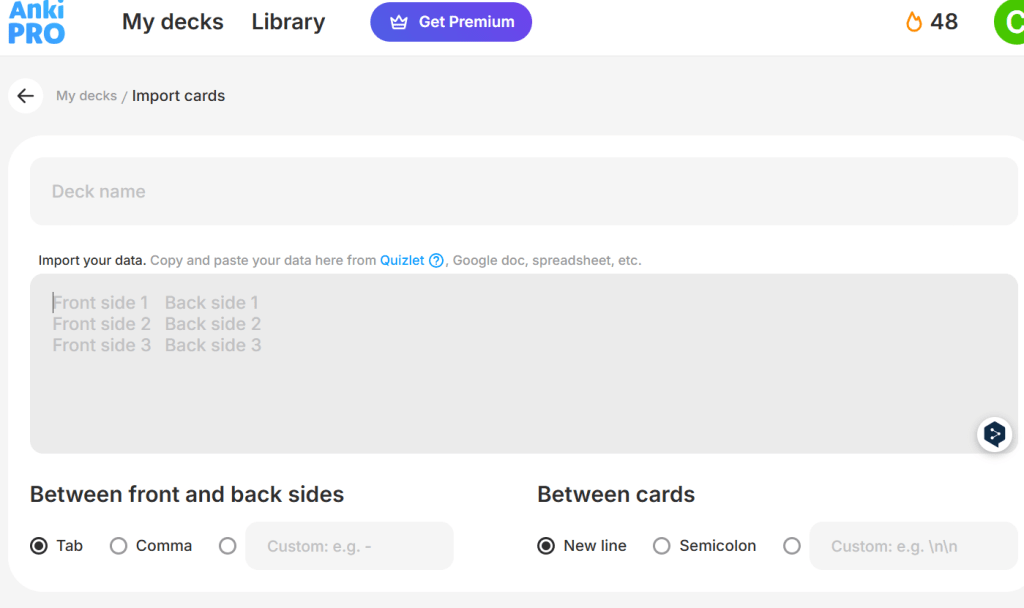
  • Go to this screen (which you get to by creating a new deck then choosing “import cards!” and then “csv”)
  • Write the name of the course in the top box
  • Open the csv file you downloaded from Memrise. It will probably open in something like Microsoft Excel or whatever equivalent you have.
  • You can ignore everything but the first two columns
  • OPTIONALLY swap the two columns around. Why would you want to do this? Well, I prefer Anki to show me an english word like “babble” and then I type in “balbuciar” as a response. But when I opened the csv it had english words on the left and portuguese on the right, so I had to swap them around, otherwise it would have made me type english answers to portuguese prompts, Boooo!
  • Copy and paste the whole block of cells containing the words and their translations from the csv into the lower box on the memrise screen.
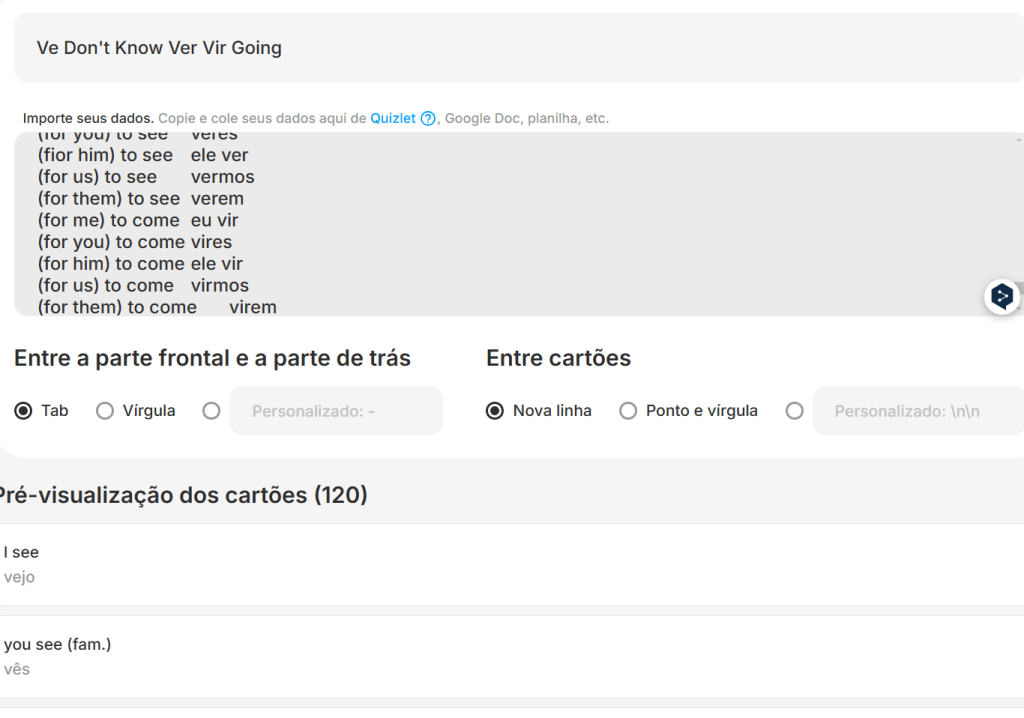
  • It will automatically take the pairings and create a course from them – check the image below, showing a course for remembering the various conjugations of ver and vir. You can see at the bottom of the picture, what it is interpreting as the prompt and answer and it seemed to get them all right first time, which is nice!
  • Make any changes you want to make (There’s a typo in the screenshot – “fior” instead of “for”, because it was like that in Memrise, and I was able to tweak that)
  • Click import

I’ll attach a csv of the ver-vir course hir i mean her, I mean here, in case you want to try it for yourself before investing the time in installing the tool. I thought it was extremely useful though and am going to hit his “buy me a coffee” link as soon as I finish this post. Buying people coffees is always a good idea! (here’s mine in case you are good at taking hints! 😊)

*Why is it called that by the way? It doesn’t cost money so what makes it more Pro than normal Anki? Oh never mind, it’s just one of life’s mysteries, I suppose!

Posted in English, Portuguese

Homework Corrected

I published this a few days ago and the corrections to my corrections were pretty extensive so I thought rather than quietly correcting the original, I’d repost the whole thing with notes in red showing what I got wrong for ease of reference.


I hope I can quote a whole article here under… what? Fair use? It’s Manuel Cardoso, writing in the Expresso under the headline “Os portugueses lêm bem” and I’m not stealing it, I’m fixing it because – unless I am making a massive idiot of myself by misunderstanding, he has deliberately put lots of errors in it, and that’s the joke. Even the title has an error in it. It should say “leem“, not “lêm”. What’s really interesting about this is that most of these are the kinds of mistakes a native speaker would make, and they are usually different from the mistakes we made as learners. They are mistakes you make when you’ve learned a language by listening instead of by studying books.

Anyway this is a learning blog so I’m going to use it as an exercise and try to fix it. I WILL DEFINITELY GET A LOT Wrong yep so rather than erase the original text, I will put what I think are the right answers in the footnotes and then if any other students are reading this you can play along and see if you get the same answers as me, and, if not, tell me about it in the comments!


Segundo a OCDE, a literacia dos adultos do nosso país está abaixo da média. Talvez póssamos(1) refletir um pouco sobre o assunto. Dizer(2) que não confio nada nestes resultados. Houveram(3) pessoas a afirmar que não ficaram surpreendidas, mas eu fiquei perplexo. Na minha opinião pessoal (This is a redundancy too – you don’t need “pessoal” when you’re talking about your opinião) , os portugueses têm excelentes capacidades de interpretação de texto. Acreditaria neste estudo se tivesse sido feito à(4) cinquenta anos atrás, mas a verdade é que, nas últimas décadas, avançámos muito para a frente(5).

Julgo que tudo isto é muito suspeito, porque o esforço para aumentar a literacia em Portugal tem partido de ambos os dois(6) lados políticos. Este atual governo (atual is a redundancy because “este governo” implies it’s the current one alresdy) até já interviram (plural verb, singular noun – and in top of that, intervir is based in vir not ver so it should be intervier(am)) no sentido de(7) resolver os problemas de fundo da educação. Certamente que a OCDE vai retratar-se(8): os resultados devem estar errados, derivado a erros. Caso contrário, não vejo outra alternativa senão sair para fora dessa organização. Se tivesse nas minhas mãos, eu faria-o(9).

É óbvio que a divulgação deste estudo causou mau-estar(10). Esta notícia estragou-me o dia, que até estava solarengo(11). Não tenham dúvidas: condeno veemente(12) a postura da OCDE. É ofensivo que um organismo(13) internacional trate os cidadões(14) portugueses como uns analfabetos quaisqueres(15). Aonde(16) fica a dignidade? A mim, pessoalmente, admira-me que isto não tenha despoletado manifestações. Para receber resultados como estes, para a próxima nem vale a pena partilhar os dados. Hades(17) cá vir, OCDE.

Não nego, há pequenos pormenores a afinar. No que toca à avaliação dos alunos, temos de subir para cima (redundancy – subir implies you’re going up) os indicadores(18). Por exemplo, os exames de matemática deste ano podiam ter corrido mais bem(19): não houve poucas(20) notas negativas. De facto, dá vontade de perguntar uma questão (redundant – fazer or colocar uma questão. You don’t need to use perguntar with the nouns questão or pergunta in Portuguese) aos nossos estudantes: o que é que fizes-te(21) no ano lectivo(22) passado? Em todo o caso, temos concerteza(23) capacidade para inverter esta situação e sair deste ciclo vicioso(24). Confiem, OCDE: a gente vamos(25) dar a volta a isto.

(1) possamos doesn’t need an accent

(2) I think he means “diz-se” “diria

(3) Looks like the wrong tense. Educated guess would be that he means “Haverão” No, you berk, it’s haverá because haver should always be third person singular when it’s used in this sense, as a substitute for “existir”

(4) Should be há. The “atrás” later in the sentence is redundant too, I think

(5) Hmmm…. this looks fishy too. Avançar implies the frente so that seems redundant, and “para” instead of “em” seems surprising so I think this is another mistake

(6) Tem partido seems to be OK (it looked wrong in the first version) but “ambos os dois” is a redundancy of course.

(7) Not a grammar error, I think but seems like a misuse of the expression “In the sense of”. It gets misused a lot in english too.

(8) Surprisingly not an error. Retratar-se can mean tratar-se novamente. Pre-AO it would have been retractar-se But it has been changed. Hm… Confusing. OK, I’m blaming the AO for this. It’s like para all over again.

(9) Looks like we’re in mesoclise territory: Fá-lo-ia

(10) Mal-estar

(11) I’m starting to get paranoid and feel like I’m missing loads. I don’t quite know what the joke is here but this is such an odd word that it has to be a wrong. I know it can mean sunny, but its just not a word I’ve heard before so I smell shenanigans.

(12) Ha! It hadn’t really occurred to me but although veemente is an adjective, the presence of the “-mente” at the end makes it look like an adverb. It should be veementemente! Vehemently.

(13) Organização, presumably

(14) Cidadãos

(15) Popular general knowledge quiz answer, which is the only word in the language that is pluralised in the middle, not the end, quaisquer, not quaisqueres!

(16) Just onde

(17) Getting a bit lost here. I know it’s quite common that people write “há des” instead of “hás de” but I haven’t seen it without a hyphen so maybe he really means Hades is coming. Oh wait, no, apparently people really do write Hades – example here. The sentence immediately before this one seems impenetrable and I feel like there’s something wrong with it but I don’t know what

(18) So it looks like the indicators/standards have to go up but he starts off saying “we have to go up…” so I think maybe it’s just that the verb doesn’t match what I take as being the subject of the verb…?

(19) Melhor

(20) There weren’t few… seems like a double negative, no? (OK, looking at it again, it’s a triple negative There were not a few bad marks meaning there were a lot of bad marks, which is in keeping with what he’s saying. Fair enough. I’m my opinion, this many switchnacksnin a sentence is bad form because it’s confusing but fair enough, not an actual error!)

(21) Fizeste is a common mistake apparently (see here for example) but it’s been pointed out that he might be addressing all the students at once, instead of one at a time, and reading for the vós form: fizestes. Not how o imagined it, but yep i can see that.

(22) Looks like a pre-AO spelling

(23) Com certeza

(24) The expression is “Circulo vicioso” not “ciclo vicioso”

(25) A gente takes third person singular verb endings: a gente vai, not vamos

Posted in Portuguese

Manual SOS – Madeirense Puro

Comprei este livro educativo porque queria desvendar os segredos daquela criatura admirável, a Madeirense. E estepilha, não me desiludiu! Ua cão!

O texto dá muitos exemplos das expressões idiomáticas e do vocabulário do arquipélago, assim como da cultura, mas, para mim, as páginas mais úteis são as que explicam o sotaque e que realçam as diferenças entre o da Madeira e o da ilha de São Miguel nos Açores*. Já ouvi montes de madeirenses a falar e sei que existem semelhanças entre os dois sotaques mas não percebi especificamente como a voz madeirense diverge da voz micaelense. Em suma é isto: fala de boca bem aberta. Esta dica, combinada com as páginas sobre a substituição de vogais dá para entender porque os madeirenses falam assim.

As páginas do livro têm imensas cores, com ilustrações bonitas e, em algumas há códigos QR para ligar a uma gravação ou um recurso online para esclarecer algum tópico. O livro é muito divertido e elucida muitas dúvidas. Recomendo aos homens que têm uma esposa madeirense e como resultado “têm tude“. Se não entendes patavina quando ela fala precisas disto!

Ah mãe, ca cagança!

*Nunca antes me perguntei “porque é que se diz OS Açores enquanto são ilhas e ilha é feminina?” É porque existe uma regra de que lugares como O Porto e A Costa do Marfim, cujos nomes se referem a uma coisa específica tendam de adotar o género daquela coisa, e neste caso um açor é uma espécie de ave de rapine (o nosso “goshawk”)

Posted in English

Podding Along

I’ve mentioned the podcast Say It In Portuguese a few times, mainly because its creator, Cristina, coached me through C1 and C2, but also before that, because it’s just a very good podcast for more advanced learners who want to explore the huge range of expressions in Portuguese.

Anyway, I wrote a blog post recently about the expression “Cuspido e Escarrado” and joked that I was copying the style of the podcast, and… Long story short, it ended up being an episode! I adapted it for the format, and put a sound effect in place of the gif, and it sounds OK, though I say so myself. It’s here if you want to listen:

Say it in Portuguese: Cuspido e Escarrado

By the way, full disclosure, when I was looking around for the blog post that became the podcast, I found an older post where I’d mentioned the phrase earlier. It was only as a sidebar to a post discussing a different expression, “Cara de um, focinho do outro“. I’d completely forgotten about this. Having a terrible memory makes it hard to learn languages but it does have the advantage that I can be surprised by a new and interesting fact even after having written a blog post about it!

Anyway, in the earlier blog, I’d given a slightly different explanation: that it comes from. “esculpido em carrara” but the sources I looked at this time around described that origin as “less likely” which is why I didn’t mention it in the later one.

In truth, these sorts of etymological explanations are a lot of fun to speculate about but often they are just attempts by modern speakers to explain the inexplicable. Sometimes expressions are just weird and they don’t make sense, so it’s best to treat the explanations with caution!

Anyway, now that I’ve recorded a podcast about it, hopefully I’ll remember it this time, but don’t be surprised if I write another blog about the same expression next year and seem just as amazed by it then as I was last week!

Posted in Portuguese

Para!

Vislumbrei nas redes sociais um exemplo raro dá mudança mais odiada do AO: retira-se o acento de “pára” (que faz parte da conjugação do verbo parar), deixando a palavra com a mesma grafia como “para” (a preposição)

Até os aderentes do AO tendam a ignorar esta regra porque semeia confusão em situações como a cantiga “Ninguém para o Benfica” que, nas palavras de um português “refer[e]-se claramente a uma janela de transferências pouco produtiva”

Posted in English, Portuguese

It’s a Joke But it’s Also Homework

(Update: corrected version here)

I hope I can quote a whole article here under… what? Fair use? It’s Manuel Cardoso, writing in the Expresso under the headline “Os portugueses lêm bem” and I’m not stealing it, I’m fixing it because – unless I am making a massive idiot of myself by misunderstanding, he has deliberately put lots of errors in it, and that’s the joke. Even the title has an error in it. It should say “lêem”, not “lêm”. What’s really interesting about this is that most of these are the kinds of mistakes a native speaker would make, and they are usually different from the mistakes we made as learners. They are mistakes you make when you’ve learned a language by listening instead of by studying books.

Anyway this is a learning blog so I’m going to use it as an exercise and try to fix it. I WILL DEFINITELY GET A LOT WRONG so rather than erase the original text, I will put what I think are the right answers in the footnotes and then if any other students are reading this you can play along and see if you get the same answers as me, and, if not, tell me about it in the comments!


Segundo a OCDE, a literacia dos adultos do nosso país está abaixo da média. Talvez póssamos(1) refletir um pouco sobre o assunto. Dizer(2) que não confio nada nestes resultados. Houveram(3) pessoas a afirmar que não ficaram surpreendidas, mas eu fiquei perplexo. Na minha opinião pessoal, os portugueses têm excelentes capacidades de interpretação de texto. Acreditaria neste estudo se tivesse sido feito à(4) cinquenta anos atrás, mas a verdade é que, nas últimas décadas, avançámos muito para a frente(5).

Julgo que tudo isto é muito suspeito, porque o esforço para aumentar a literacia em Portugal tem partido(6) de ambos os dois lados políticos. Este atual governo até já interviram no sentido de(7) resolver os problemas de fundo da educação. Certamente que a OCDE vai retratar-se(8): os resultados devem estar errados, derivado a erros. Caso contrário, não vejo outra alternativa senão sair para fora dessa organização. Se tivesse nas minhas mãos, eu faria-o(9).

É óbvio que a divulgação deste estudo causou mau-estar(10). Esta notícia estragou-me o dia, que até estava solarengo(11). Não tenham dúvidas: condeno veemente(12) a postura da OCDE. É ofensivo que um organismo(13) internacional trate os cidadões(14) portugueses como uns analfabetos quaisqueres(15). Aonde(16) fica a dignidade? A mim, pessoalmente, admira-me que isto não tenha despoletado manifestações. Para receber resultados como estes, para a próxima nem vale a pena partilhar os dados. Hades(17) cá vir, OCDE.

Não nego, há pequenos pormenores a afinar. No que toca à avaliação dos alunos, temos de subir para cima os indicadores(18). Por exemplo, os exames de matemática deste ano podiam ter corrido mais bem(19): não houve poucas(20) notas negativas. De facto, dá vontade de perguntar uma questão aos nossos estudantes: o que é que fizes-te(21) no ano lectivo(22) passado? Em todo o caso, temos concerteza(23) capacidade para inverter esta situação e sair deste ciclo vicioso(24). Confiem, OCDE: a gente vamos(25) dar a volta a isto.

(1) possamos doesn’t need an accent

(2) I think he means “diz-se”

(3) Looks like the wrong tense. Educated guess would be that he means “Haverão”

(4) Should be há. The “atrás” later in the sentence is redundant too, I think

(5) Hmmm…. this looks fishy too. Avançar implies the frente so that seems redundant, and “para” instead of “em” seems surprising so I think this is another mistake

(6) Tem partido can’t be right but I’m not sure what it’s meant to be

(7) Not a grammar error, I think but seems like a misuse of the expression “In the sense of”. It gets misused a lot in english too.

(8) They’re going to draw a portrait of themselves? Unlikely. I think the verb should be retrair.

(9) Looks like we’re in mesoclise territory: Fá-lo-ia

(10) Mal-estar

(11) I’m starting to get paranoid and feel like I’m missing loads. I don’t quite know what the joke is here but this is such an odd word that it has to be a wrong. I know it can mean sunny, but its just not a word I’ve heard before so I smell shenanigans.

(12) Ha! It hadn’t really occurred to me but although veemente is an adjective, the presence of the “-mente” at the end makes it look like an adverb. It should be veementemente! Vehemently.

(13) Organização, presumably

(14) Cidadãos

(15) Popular general knowledge quiz answer, which is the only word in the language that is pluralised in the middle, not the end, quaisquer, not quaisqueres!

(16) Just onde

(17) Getting a bit lost here. I know it’s quite common that people write “há-des” instead of “hás-de” but I haven’t seen it without an apostrophe so maybe he really means Hades is coming. The sentence immediately before this one seems impenetrable and I feel like there’s something wrong with it but I don’t know what

(18) So it looks like the indicators/standards have to go up but he starts off saying “we have to go up…” so I think maybe it’s just that the verb doesn’t match what I take as being the subject of the verb…?

(19) Melhor

(20) There weren’t few… seems like a double negative, no?

(21) Fizeste.

(22) Looks like a pre-AO spelling

(23) Com certeza

(24) The expression is “Circulo vicioso” not “ciclo vicioso”

(25) A gente takes third person singular verb endings: a gente vai, no vamos

Posted in Portuguese

Um Trocadilho de Dois Idiomas

Gosto desta piada madeirense que depende de um conhecimento da língua francesa: Comment s’appelle (=como se chama) soa como “come-se a pele” e comprends (compreendo) soa como compro, daí a confusão do vendedor!

Na realidade, o tabaiba, também conhecido por Figo-da-Índia é o fruto de uma espécie de cacto* chamado “tabaibeira”, portanto a pele é espinhosa e provavelmente não seria muito gostosa.

*A grafia desta palavra é uma daquelas que, de acordo com o Acordo Ortográfico de 1990 deve perder um C mas o Priberam diz cacto, e cato é feia portanto escrevi assim.