Vejo que a Websummit está a decorrer* em Lisboa onde, todo os anos os convidados apresentam novas ideias sobre tecnologia, a Internet e fintech. Embora saiba o significado de “Fintech” (utilizamos a mesma palavra cá em Inglaterra) “fin” significa “barbatana” e acho isso muito engraçado. Tenho uma imagem mental de um golfinho no palco a dar palestras**.
“k-k-kkk-k-k” diz o golfinho (porque não fala português) e depois o tradutor explica “No futuro toda a gente será capaz de nadar”
“kkkk-k-kk-k’k”
“com as nossas barbatanas robóticas”
(salva de palmas e barbatanas)
“kk-k-k-kkkkk”
“adeus Lisboa e obrigado pelo bacalhau todo”
His only porpoise in life is to disrupt the market
*=I used “passar-se” but “decorrer” or “ter lugar” (literally “take place”) work better for events
**=I used “dar discursos” but it’s “fazer discursos”. The corrector also suggested “dar palestras” where a palestra is a verbal exposition on. A specific theme so I switched to that cos it’s a new word.
Em Inglaterra, quando eu era jovem, se quiséssemos insultar alguém, além de simplesmente dizermos “vai-te blabla”, mostraríamos um gesto de mão com o indicador e o dedo médio estendidos assim ✌️ mas no inverso – ou seja com a parte de trás da mão apontada para a vítima. Hoje em dia, o sinal vai-se tornando cada vez mais raro porque a gente utiliza mais o gesto americano equivalente que é igual mas só tem um dedo – o médio.
Por isso, já existe um dia chamado National V-sign Day (Dia Nacional do Gesto de V???)
Closely related to the post about vir and chegar: what’s the difference between “vir a saber” and “vir saber”? Well, I’m glad you asked!
Vir a saber, as you’ll know if you read “The Spy Who Chegged Me” is a way of saying that you came to know something, perhaps in a slightly roundabout way, by chance, but the light dawned and then you knew.
Vir Saber is more like “I came to find out”.
This is good because I had been wondering how to interpret a line in one of the poems (it’s a song, actually: Flagrante by Antonio Zambujo) that I learned a week or two back. the people in the next room either “finally got to know about us” or “came to find out about us”. Well, now I know so here we go with a translation of the whole thing
Portuguese
English
Bem te avisei, meu amor Que não podia dar certo Que era coisa de evitar
I gave you fair warning, my love That this wasn’t going to turn out well And it was something best avoided
Como eu, devias supor Que, com gente ali tão perto Alguém fosse reparar
Like me, you have to suppose That with people so nearby Someone was going to notice
Mas não Fizeste beicinho E como numa promessa Ficaste nua para mim
But no You made a pouty face And as if in a promise Got naked for me
Pedaço de mau caminho Onde é que eu tinha a cabeça Quando te disse que sim
Bit of a wrong turn Where was my head at When I said yes to you
Embora tenhas jurado Discreta permanecer Já que não estávamos sós
Although you had sworn To remain discreet Since we weren’t alone
Ouvindo na sala ao lado Teus gemidos de prazer Vieram saber de nós
Hearing in the room next door Your moans of pleasure They came to find out about us
Nem dei pelo que aconteceu Mas mais veloz e mais esperta Só te viram de raspão
I didn’t even know what had happened But being faster and smarter They only caught a brief glimpse of you
A vergonha passei-a eu Diante da porta aberta Estava de calças na mão
I went through the shame In front of the open door With my trousers in my hand
It’s great isn’t it! Lots of really good stuff in there. The one line that I really had trouble understanding was the first line of the last stanza “A vergonha passei-a eu” which seems like he’s saying “I passed her the shame” as if he were trying to blame it all on the girl, but that doesn’t make sense for all sorts of reasons. The “-a” on the end of passei is actually referring to “a vergonha”. So it’s like “The shame, I passed through it”. Normally in conversation you’d say “passei pela vergonha” but poetic license applies. Here’s the full thing. I’ve probably posted it on here before but I just love it so much it’s worth repeating.
Structures I’ve seen in books and never been quite sure how to parse. According to Ciberdúvidas,
Vir + A + Infinitive
Is a periphrastic form of a verb. Wait, wait, hold it right there, what is a periphrastic form? It just means you use extra words to give the verb a slightly different dynamic or even to change the tense. In english it’s things like “You shall go to the ball” or “I do like chips”. It might change the verb’s tense or it might just make it sound more complete and more dynamic. Maybe like in English: How do you come to be in a place like this? It has the sense of ending up somewhere by chance, and it sounds more interesting than “How did you get here?” or “Why are you here?”
There’s an example in the book I’m reading now. Talking about Bolsonaro’s attempts to blame minorities for everything Ricardo Araújo Pereira says “Acredito que a gente ainda venha a descobrir que há inúmeros gays negros e índios na Lava Jato”.
Chegar + A + Infinitive
“Chegar a”, on the other hand is more like “finally managed to…”. It’s stressing the end of the action coming after a long time or a strenuous effort. Searching for an example similar to the one above, I hit on this one which is from a religious website talking how, after a lot of prayer, the believer can finally come to understand the project that God has laid out:
A oração também se torna caminho para o discernimento vocacional, não só porque Jesus mesmo convidou a rogar ao dono da messe, mas porque é somente na escuta de Deus que o crente pode chegar a descobrir o projeto que Deus mesmo traçou: no mistério contemplado, o crente descobre a própria identidade, «escondida com Cristo em Deus»
I felt sure when I saw this t-shirt from Cão Azul that it would turn out to be some sort of idiomatic expression but as far as I can tell, it’s not. “Fazes-me tanta falta como o dedo mindinho” just seems to be something they decided would be a cool slogan. Interesting vocabulary though
Fazes-me tanta falta como… = I miss you like
Dedo mindinho = little toe or little finger. You can specify “dedo mindinho do pé” if you like, but I guess they thought it wasn’t necessary with the picture.
I have already done a post about the names of fingers a little while ago but it’s not vocabulary I use very often so I’d forgotten all about it, and I see I used a different word – “Dedo Mínimo” at the time. I checked in priberam though, and either will do. Neither is brazilian or anything, it’s just like we use “little finger” and “pinkie finger”.
Incidentally, if you don’t already know this, walking around with a portuguese t-shirt on is a great way of announcing to everyone around you that you speak portuguese. That’s nice if you like boasting, but it’s even better if you want portuguese speakers you happen to meet out in the real world to say “Oh! Do you speak portuguese?” whereupon you can clutch at their elbow and not let them go until you have wrung half an hour of conversation practice out of them. For more terrible ideas like this, have a look at the portuguese language hacks page.
Anyway, the point is, I recommend Cão Azul as the internet’s most useful language learning resource.
I’ve been trying to tune my ears in to this series of videos. The character is called Bruno Aleixo and he has appeared in a few different shows. It’s sort of surreal humor. I would really like to be able to follow it but even with my wife’s translation there are big chunks I can’t make out. It’s got a really strong regional accent – you can hear the would “ouvir” has an extra syllable and sounds like ouviree, for example, and a lot of the words are run together so it’s hard to disentangle them.
There are two parts. I’ll put what she says it means and what I think I actually hear. Before she clued me in to what it meant I could only make out about a third of it, now I’m at about 80% but can’t quite make my ears hear the rest.
FIRST BIT If you have a brother, show him these tips (se tivesse algum irmão, mostra-lhe estes conselhos) / if you have a sister, don’t show her because they aren’t for girls (se something irmã não mostre something coisas something ouvir) / if your grandmother hears it she’ll hit me (se tua avó apanhe isto something-me)
SECOND BIT If you catch your uncle Horatio drunk, take the chance to steal his money (se apanhasse (? Tense?) o teu tio Horácio bêbedo aproveita para (re)tirar dinheiro) But careful, if he catches you he’ll hit you hard (Mas cautela, se ele te apanhe (? Tense) dá something… Oh wait, its cabeçadas isn’t it! com força) and the money is from France so you’ll have to exchange it at the bank (e a dinheiro é da França, tens something trocar ao banco – actually sounds like à banco but that can’t be right)
I’ve been watching the TV adaptation of Mário Zambujal’s novel, A Crónica dos Bons Malandros (the chronicles of the good… scoundrels…? hmm… it doesn’t sound as good in english though does it?), about a bunch of chancers who set out to steal some valuable jewels from the Museu Calouste Gulbenkian. It’s on RTP1 and it has portuguese subtitles which helps when the dialogue is fast (most of the time) but even so, it’s really challenging. Lots of slang, lots of period detail from the early eighties. Here are a few words and phrases that I collected along the way. It’s pretty far from being a full glossary, but they were the things that caught my intetrest
Os Bons Malandros – the Portuguese Ocean’s Eleven
A trouxe-mouxe
In a disorderly manner, helter skelter
Isso são pilha-galinhas. Vamos embora
When the gang get arrested early in the series, the cops get a call on the radio a abiut a more serious crime and so they decide to let them go because they are just “pilha-galinhas”: small-fry, literally chicken thieves.
Gamar
To steal something in a sneaky way. Nick it, pinch it, ‘ave it away.
Enxame
A swarm of bees. You can’t really miss this one because when they release it there are bees everywhere
Prateleira
Usually means shelf but it comes up in a slightly surprising context. According to Priberam it can also mean “Os seios”
Isto é uma cena muito política, ‘tás a ver? Cunhas
Cunhas just means wedges, and when people use it like this it’s meant to convey that the person has contacts who can help them get a foot in the door. In other words, it’s a gripe about being treated unfavourably by insiders making way for their friends.
Carlinhos dança que se desunha
Literally “desunhar” is what it sounds like: unhas are nails, as in fingernails, so des-unhar might literally mean to remove someone’s claws or nails, but more likely, when used as a pronomial verb with se, as in the example, it means working so hard that your nails come off. So Carlos dances a lot, puts everything into it. It doesn’t necessarily mean he’s good (although he seems to be that too!)
Trigo limpo, farinha Amparo
This one comes from an old advertising slogan for Amparo, a brand name of a kind of wheat meal popular in the seventies and eighties. I think when it’s used in the show he’s using it to mean it’s all good, nothing to worry about.
Pentelho
A public hair – or by extension any trivial, insignificant thing
Borla
Literally means a tassel, but can also mean a freebie. I’m not sure how informal this is though: the character who says it is asking a prostitute if she’ll “fazer uma borla” and I think he’s asking for a freebie as a regular customer. Whether you can use the same expression when asking your friend to fix your laptop for free, I don’t know. Caveat emptor.
“És anti-religiosa?” / “Nao, sou anti-mirones”
Said by Zinita when o doutor turns the statue of Jesus to face the wall. A mirone is a rubbernecker, peeping tom, lookie-loo, that kind of thing
Alcunha
This one comes up a few times and it means nickname
The nose, mouth area of an animal – the snout or the muzzle, so when the guy in the prison yard says he’s going to esmagar Flávio’s fuça he means he’s going to give him what PG Wodehouse would call “a poke in the snoot”
Olarila
Something like “oh yes indeed” although I don’t think the justiceiro means it when he says this to the fascist banana seller because in the next line he reminds him that his father is…
A gritar bravos ao Botas no cemitério do Tarrafal
Tarrafal was a concentration camp in Cabo Verde where the Estado Novo kept its political prisoners, so if someone was shouting bravo there they were probably a collaborator or a lickspittle of some kind. I’m not sure who or what Botas was – I can’t find a reference to him in any of the pages I’ve seen.
Bófia
The cops, the fuzz
Futre
Is just the name of a footballer. You probably already know gthat but I’m a bit slow on the uptake. I think the joke is that they’ve just heard about the robbery on the news and they ask Justiceiro his opinion but he’s distracted by another story, about the footie.
Engavetar
This one is pretty straightforward and just means to put something in a drawer (Gavete), but can also be used the way we might talk about “shelving” something – just put it aside and ignore it. In episode 6 there’s a scene where the police officer who has arrested Bitoque asks him if he will “engavetar” his grandmother and he’s using it in another sense, namely, to put someone in jail. So he just wants him to give them information about her crimes.
Defendo que Camarate foi um atentado
This comes during a really confusing scene half way through the last episode where there’s been a double cross, and nobody know where the jewels are or what’s going on, and people are pretending not to be able to understand each other’s accents and slinging around insults. Barbosa accuses his son in law of being an esquerdalha (leftist) and he replies that “I support the theory that the Camarate Case was an act of terrorism”. I’m not quite sure how this situates him on the political map TBH. The Camarate Case was a plane crash in the Camarate district outside of Lisbon in 1980. the then prime minister, Franciso Sá Carneiro and his finance minister, Adelino Amaro da Costa were both among the dead. This was shortly after the Carnation Revolution and there was a lot of shady stuff going on. Some think he was killed by the CIA because he was going to stop America from using the Açores as an air base, (that was a huge deal at that stage of the cold war), but I’ve also spent an awkward taxi ride listening to the taxista rant about how it was that bastard Mario Soares who had him killed. Soares was in the Partido Socialista whereas Sá Carneiro was in the Partido Social Democrata. You can read more about it here (Portuguese) or here (English). Or just ask a taxista.
I’ve really got quite evangelical about this Chico Buarque song, you know. I insist that everyone should learn Portuguese so they can appreciate its greatness. Here’s something I wrote about it in WritestreakPT, and this probably won’t be the last time I mention it either!
Acabo de ler um capítulo do meu livro (“Idiotas Úteis e Inúteis” de Ricardo Araújo Pereira) no qual o autor descreve uma canção do cantor brasileiro Chico Buarque chamada “Construção”. A letra da canção tem um ritmo ligeiramente diferente do que o padrão. Porquê*? Seguindo o Ricardo, é por causa de… Hum… uma palavra desconhecida. Ainda por cima, mal consegui pronúnciá-la! Estava a ler na cama e o dicionário na mesa de cabeceira também a desconhecia, portanto tive de aguardar até hoje de manhã.
A palavra era “Proparoxítono”**. Significa que a palavra tem o acento tónico na antepenúltima sílaba. Todas as palavras de cada linha são proparoxítonas. Em resultado disso, a canção soa muito diferente de qualquer outra canção portuguesa que já ouvi. Que colheita boa! Num único capítulo, aprendi uma nova palavra, ouvi falar duma nova canção (que é mesmo bonita – acreditem!) e ganhei um novo ponto de vista sobre a língua.
* miraculously the corrector found only one single error in this entire thing except that they thought this should change to “por quê?”. This surprised me a bit because explanations of the various types of por/que usually have only 3 forms and “por quê” is not one of them. According to ciberdúvidas it can be used if you are asking “for what?” but it doesn’t mean “why” according to Elsa Fernandes’s book so at the risk of sounding arrogant, I don’t think the corrector was quite on the mark here. [UPDATE – A better corrector came along and agreed that yes, I was right about Porquê, but they have also pointed out some other mistakes which I have since corrected in the text above. It wasn’t terrible…]
** Amazingly there is a second word for this. Two words meaning “having the accent on the antepenultimate syllable”! It’s like the Eskimos and snow! The other word is Esdrúxulo.
And finally if you’re wondering what you call words that have the stress on the final or penultimate syllable they are oxítono and paroxítono respectively.
Is exactly the sort of thing I love. The writer is Ricardo Araújo Pereira, comedian, columnist and all round good guy (well, as far as I know) Anyway, in the passage above, he’s describing a song by Chico Buarque and saying that if a foreigner were to hear it, although they would rightly spot that it sounds lovely, they probably wouldn’t understand it and certainly wouldn’t notice that the last word of every line is “proparoxítona”* and nor would they understand that the word “proparoxítono” itself is proparoxítona**. And he’s right: it is a lovely song and when I read this in bed last night I had no clue what Proparoxítono meant but I knew I had to find out as soon as I woke up.
First of all, let’s hear the song
Oh my god, that is the good stuff alright. I know it’s Brazilian Portuguese, not Portuguese Portuguese but Jesus Christ it’s good. Inject it directly into my veins! There is something slightly strange about the rhythm of the verse though isn’t there? And I never would have spotted what it was.
Before I get I to it, let’s lay a bit of groundwork by thinking about where the stress falls in a Portuguese word.
The vast majority of words in Portuguese put the stress on either the final syllable (if the last letter is r, l, z, u or i ) or the penultimate one (basically, all other letters). Any exceptions to the rule need an accent to be added as a hint to the reader. So for example there are a lot of words that end in – ável or – ível that are pronounced with the stress on the a and the i respectively. If the accent wasn’t there you’d have to say incrivEL and confortavEL. But it’s pretty easy and you get used to it, and before you know it, you’re just used to the rhythm of Portuguese speech without even being conscious of it.
Proparoxítono means that the stress falls on the antepenultimate (last-but-two) syllable. These always have to have an accent because they break the normal rules, like bêbado (BÊ-ba-do) and mágico (MÁ-gi-co) and sábado (SÁ-ba-do) and última and único and tímido and… Well, and every other word he finishes a line with in the song, which is why you get this effect that’s really unusual in a Portuguese song, where the last two syllables of every line are unstressed.
Oh my god, that’s so satisfying. I love it! It’s the most value I’ve ever got out of a single paragraph, I think: a new word, a new song and a new way of noticing the rhythm of Portuguese music.
Anyway, if you want to know more, this video has some good analysis. It’s in Brazilian Portuguese too, so be warned if you’re trying to avoid the dialect. It’s worth making an exception for though.
*it has an a in the end here, unlike in the title, because its an adjective and palavra is feminine
**Now I know what you’re thinking: “Isn’t that the stuff Bret Weinstein and Heather Heying think should be used to cure Covid?” Close, but no, it’s not that either.
My Portuguese practice texts are in Hallowe’en mode, and I’m still getting good mileage out of a book called “Between the Spreadsheets” which I read and reviewed on my other blog, The Data Swarm. Its last chapter is called “Data Horror Stories” and that seemed like a pretty good subject to work with. This one is quite a lot less serious than the data swarm one but it was a lot more fun to write [props to Dani Morgenstern for the corrections]
Cover of “At The Spreadsheets of Madness” by X L Lovecraft
Na semana passada, li um livro chamado “Entre as Folhas de Cálculo” (“Between the Spreadsheets” em inglês) que explica o problema dos “dados sujos” em projetos* informáticos e como resolvê-lo antes de ligar o novo sistema.
No último capítulo, a autora fala de “contos de terror” em relação aos dados que prejudicaram as reputações das empresas e causaram problemas graves aos funcionários. Mas parece-me que “conto de terror” não é a analogia certa. Os terríveis monstros dos clássicos do terror nunca utilizaram folhas de cálculo. Por exemplo, quando o Drácula foi apanhado com a boca na botij….hum…na senhora**, era só por causa da sede. Se tivesse um portátil com uma janela aberta com o MS Excel, a história seria muito diferente. Melhor? Pior? Quem sabe?
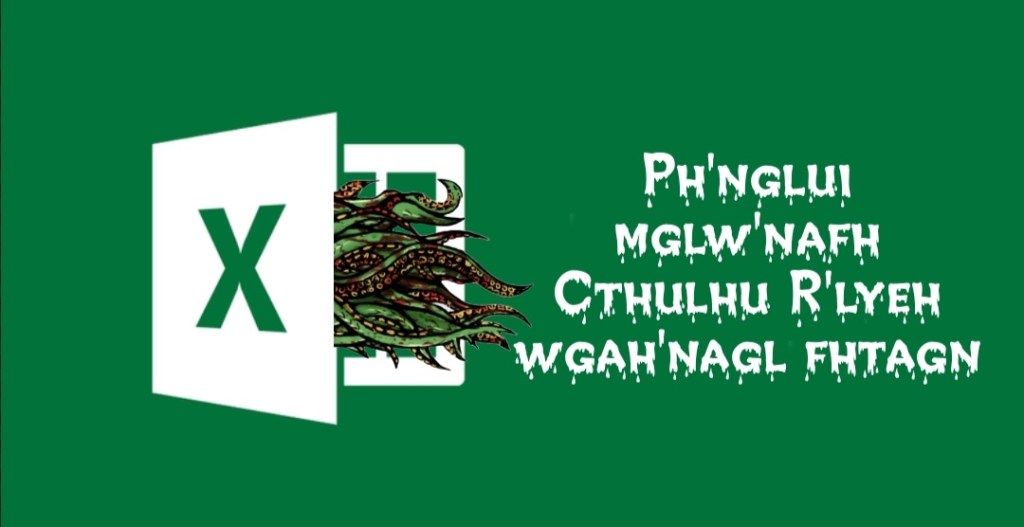
Igualmente, se o Chthulhu e os seus amigos não fossem deuses antigos mas sim contabilistas, teriam inspirado um sentimento de pavor nas mentes dos seres humanos com as suas tabelas dinâmicas arrepiantes e isso seria… Diferente…
Acho que todos nós podemos concordar que há apenas duas coisas piores do que um deus antigo que utiliza o MS Excel: (1) uma bruxa licenciada em gestão de projetos e (2) um lobisomem que quer explica os seus motivos com ajuda do MS PowerPoint durante 3 horas.
*=I’m not sure if anyone’s noticed but when I used to write my texts in italki the person who did most of the corrections hated the AO and always insisted I used old spellings. In this case it would have been “projectos”. But on WritestreakPT they are a bit more modern. This is probably for the best since the AO is the standard you should use for tests and so on.
**= “Apanhado com a boca na botija” means “caught with your mouth on the bottle” and it’s equivalent to “caught red handed” except in this case, he’d be caught red-mouthed slurping blood from the neck of his helpless victim.
OK OK I know botija isn’t strictly speaking a bottle it’s a sort of big jar thingy but it’s hard to translate OK, leave me alone.







 Luso
Luso 