I’ve often wondered what it is about my wife that makes her so madeiran. Apparently it’s her madeirensidade – which, according to Priberam, basically means “Madeiranness” or “Madeirantude” or maybe “Maderianicity”. I’m definitely planning to sneak this word into a conversation tomorrow and see what happens.
Category: English
#excitedface

(I know I mentioned this already but it’s so good when you get the actual paper in your hand…)
Corre Bem Até Agora
Well, Salvador Sobral is smashing the Eurovision…
https://www.instagram.com/p/BUC8Qhqjmz9/
—update—
Ganhou! Tão bom! Uma vitória para o Salvador e para o povo português. Parabéns!
What Language Are We In?
I’ve just heard two people speaking Spanish, and as we were stuck in a lift together I tried to dredge up some of the Spanish I learned at uni. “Espanhóis?” I asked, falling at the first hurdle. And it went downhill from there, with Portuguese words tumbling out one after the other.
Although it was a but toe-curling, I was secretly pleased since it usually happens the other way around – I’ll wish an in-law Feliz Cumpleanos or something. So, progress of sorts! They were Argentinian by the way. I told them I hoped they enjoyed their stay. In English.
—-Later—-
Hm, I’m starting to fret now that maybe they thought that I thought they speak Portuguese in Argentina. Maybe they are in a room in the 4th floor now saying indignantly to each other “What, does he think we’re a southern province of Brazil or something?”
*sigh*
Birds and Bad Words (Pássaros e Palavrões)
Today I had a lesson with a Portuguese teacher via Skype. She follows me on Instagram so she asked me about a picture I’d posted of some birds that have made a home in a nesting box on our allotment. So I described them, but I hit a problem fairly early on: I don’t know the names of many birds. Let’s see… umm… corvo (crow), pomba (pigeon), farm birds like Ganso, Pato, Galinha, Peru, um… what else? Ostrich, I think is avestruz, eagle is… águia (I needed spellcheck’s help even on that one), owl is coruja (I only know this from reading Harry Potter e a Pedra Filosofal), and melro-preto I know from a song is a blackbird. That’s about it. Sadly, the nesting birds were not blackbirds, nor owls, much less ostriches, so that put paid to that. So I went to my old friend google translate to find out how to say “blue tits”. If you’re british you know blue tits and great tits are real birds whose place in the comedy double-entendre pantheon of our island nation is inestimable. But the reason the liked of Benny Hill have been able to exploit their comic potential is that “tit” also means something else.
Here’s what I got:
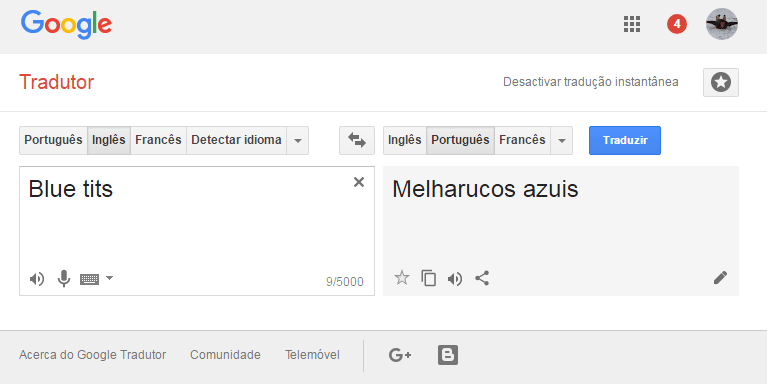
I was none the wiser. Should I just blurt it out and hope she didn’t burst out laughing? I blurted, while simultaneously plugging the words back into google search and was reassured to see lots of images of actual feathery blue tits. This is one of those times when the choice of tools matters though because if I’d used Bing Translate I would have got this…

…which actually does mean blue breasts (bit not the cruder “tetas” which is more of a direct equivalent for “tits”).
Bird names are a minefield, actually. There’s a bird called a shag and another called a booby. It’s almost as if, when Adam named all the animals, he started getting bored by the time he reached the birds and decided to see what he could get away with.
So what’s the message? Something about not letting Bill Gates teach you how to speak a language, I think.
Portuguese With Carla #newPodcastKlaxon
I came across a new European Portuguese podcast today.  Well, truth be told, it has been around since 2014 but it took a huge break for a couple of years and has just rematerialised on iTunes. It’s called Portuguese With Carla. It seems pretty easy, suitable for beginners, so if you’re at the A1/A2 level you should definitely give it a look. I don’t know that I am going to follow it because I think I’m past the point at which it can help me but I’ll try some of the later episodes first though, to see if it’s a bit more challenging. I could use a new podcast now that Say it in Portuguese has introduced a brazilian co-host (boooo!) and Practise Portuguese has slowed its output while the boys build their infrastructure and their business.
May I Be Of Assistance?
I’ve always thought of the verb Assistir as a straightforward false friend, meaning, as it does, to attend or spectate at an event, and has nothing to do with helping or supporting any way. But today I was reading the book “Trilby” by George Du Maurier, written at the back end of the nineteenth century and I came across this sentence
And, indeed, here was this immense audience, made up of the most cynically critical people in the world, and the most anti-German, assisting with rapt ears and streaming eyes at the imagined spectacle of a simple German damsel, a Mädchen, a Fräulein, just “verlobte”—a future Hausfrau—sitting under a walnut-tree in some suburban garden
That really sounds like a very Portuguese use of the word “assist”. So I looked in my trusty Chambers and it turns out that assist had, in Shakespeare’s day, much the same meaning as its cognate does in Portuguese. What’s more, when I checked the priberam online dictionary I found that Assistir has several senses, including the British one. They give as it’s synonyms Ajudar, Socorrer and Cooperar.
So what we have is a word with two distinct meanings, in the process of diverging, where one sense is dominant in English and the other in Portuguese, but while the lesser sense is still used in Portuguese, the lesser sense in English has all but faded away to nothing.
Miguel Araújo
I’ve got tickets for this. *excitedface*
https://www.barbican.org.uk/music/event-detail.asp?ID=21055
It’s that same guy I posted about a few months back when I found his video for “Os Maridos das Outras“. I’ve heard a few of his albums now and definitely grown to like him, so when I heard he’d be in town I went online and got three tickets in the second row, and they were just twenty quid each. 🙂
A Vida Nos Livros
“A Vida No Livros” de José Jorge Letria – Tradução
Nem dez vidas me bastaram, eu sei
Ten lifetimes wouldn’t be enough, I know
para ler os livros que fui arrecadando
to read the books I’ve been collecting
e que me desafiam para que
and that challenge me because
me perca neles como um peregrino
I lose myself in them, like a pilgrim
nas rotas de um mitigado desespero.
on the trails of a muted despair
Sou eu que pertenço aos livros
It’s me that belongs to the books
e não o contrario, já o disse tantas vezes
and not the other way around, I’ve said it many times
pois o que eles vão entesourando
because the treasure they are hiding
é a pequenez do tempo que me resta
is the shortness of the time that remains to me
para os ler e neles me encontrar.
to read them and find myself in them
Os livros falam de vidas e de guerras
The books speak of lives and wars
e eu só falo do que os livros contam,
and I only talk about what the books tell me
esquecido que ando do que vivi
oblivious that I’m wandering from what I lived
e bem podia e devia contar-vos.
and can and should tell you
São os livros que me acenam
It’s the books that move me
apontando-me para os mostradores
pointing me to the faces
dos seus relógios imóveis e opacos,
of their motionless, opaque clocks
assim como quem diz: por mais que vivas,
as if they were saying: no matter how you live,
por mais que faças, tu partirás
no matter what you do, you will depart
e nós, bem ou mal, havemos de ficar,
and we, good or bad, have to stay
porque não nos cansámos de viver
because we never got tired of living
a ficção de que são feitas estas vidas.
the fiction from which these lives are made
Tradução
Translation of the song in the last post
Se um dia alguém, perguntar por mim
If one day anyone asks about me (#futuroDeConjuntivoKlaxon)
Diz que vivi para te amar
Say that I lived to love you
Antes de ti, só existi
Before you, I only existed
Cansado e sem nada para dar
Tired and with nothing to give
Meu bem, ouve as minhas preces
My love, hear my prayers
Peço que regresses, que me voltes a querer
I’m asking you to come back and love me again
Eu sei, que não se ama sozinho
I know that you don’t love alone
Talvez devagarinho, possas voltar a aprender
Maybe slowly you can learn again
Meu bem, ouve as minhas preces
My love, hear my prayers
Peço que regresses, que me voltes a querer
I’m asking you to come back and love me again
Eu sei, que não se ama sozinho
I know that you can’t love alone
Talvez devagarinho, possas voltar a aprender
Maybe slowly you can learn again
Se o teu coração não quiser ceder
If your heart doesn’t want to surrender
Não sentir paixão, não quiser sofrer
Doesn’t want to feel passion, or to suffer
Sem fazer planos do que virá depois
Without making plans for what comes after
O meu coração, pode amar pelos dois
My heart can love enough for both of us
 Luso
Luso 