Boring English Post today. Tugaposting will resume shortly.
This post is going live on Saturday when I’ll be in Inverness. That’s further north in Britain than I’ve ever been before so I am very excited. I’m doing the Loch Ness Marathon and I am getting sponsored for a homeless charity called Cyrenians. We’ve probably all noticed there’s been a rise of homelessness as a result of a few different social trends coming together in the last few years. It takes me back to the early nineties when I used to work in a night shelter in King’s Cross. We had a few good years in between, when things seemed to be getting better, but it’s all gone sour again and it’s disappointing too see.
Anyway, as you probably know, giving money direct to homeless people can sometimes be a bit problematic, but giving to an organisation that provides services is a good way of really helping in sustainable, observable ways, and that’s why I chose this charity.
So, if you’d like to help out and help me meet the (ahem) slightly ambitious target I have pledged to meet, here is the page! Contributors get access to the selfies I am planning to take with the monster if I am lucky enough to meet him. Thanks in advance!
It didn’t help that I didn’t… hey, I’m writing in English. Why? …que nem sequer sabia o título da música. Perguntei ao Shazam. É isto:
O branco é Lucenzo, um português, e o negro um porto-riquenho que se chama Don Omar, ou simplesmente “El Rey”. Os dois cantam numa mistura de idiomas num iate, rodeados por uma meia dúzia de modelos aborrecidas. O vídeo, lançado em 2010, é um dos mais vistos no YouTube porque foi um grande sucesso em muitos países da América e Europa. Basicamente em todo o mundo exceto o Reino Unido.
Kuduro é uma palavra angolana e segundo o Google, pode ser uma combinação das palavras “Cu duro”. Danza, igualmente não é Português nem espanhol: acho que é crioulo.
Mas onde nasceu a dança*? Não faz parte do vídeo original. Quem inventou?
Sinceramente não faço ideia. Tentei três vezes fazer a pergunta no reddit mas cada uma foi apagado instantaneamente. Sei lá porquê. Mas tenho a certeza de que a dança é portuguesa. Outros países têm outros passos. Veja-se por exemplo este vídeo de três portuguesas e três espanholas a dançar lado a lado.
Ah ah, sou um crítico cultural, trazendo as notícias de há 15 anos. Espero não me ter enganado. Estou a ler nas entrelinhas por causa da conspiração do reddit para esconder a história deste fenómeno cultural!
*Re-reading this, I hope it’s obvious I’m talking about the dance in the video, not kuduro itself, which is also the name of a dance but is not the dance she’s doing… ai, it’s a bit complicated, sorry.
Now that I have a bit of free time on my hands, I’ve made a few updates to some of my pages. The Portuguese Audiobooks page has a few shiny new audiobooks two from Saramago and one from Pessoa, The Online Learning Resources page has a few new links and I have weeded out a couple of dead ones, and I’ve added a couple of things to the Language Learning Hacks Page too. The best bit was trawling through the Cão Azul archive and coveting all the t-shirts I could own and maybe one day will. This one, for example.
Horrified that Insta has served this idiot up to me. He’s usually speaking English and wearing ridiculous mirror shades, but this one has him saying the names of the food items in Portuguese as he shovels them into his face. I’m not even going to have a go at his accent, because glass houses, stones, etc, but calling yourself a tuga? Come on, mate, this is embarrassing.
I haven’t done a translation for a while. This one is by Capicua, although it has a guest verse by Gisela João, who I think is also the woman in the video, because it sure as heck doesn’t look like Capicua! I’m not quite sure what she’s driving at with this (Actually having been corrected on a couple of things, it’s coming a bit clearer) but she does a good job of building up a sort of menacing atmosphere!
Português
Inglês
A seca baixou as águas do Danúbio E à tona emergem barcos afundados A perda sustenta as mágoas e o repúdio E à porta batem monstros do passado
The drought lowered the Danube And all the sunk boats surfaced The loss sustained the hurt and rejection And monsters of the past beat at the door*
Não há quem não sinta (Chegar) Um cheiro a anos trinta (No ar) Não há quem não sinta (Chegar) Um cheiro a anos trinta (No ar)
There’s nobody who doesn’t feel (arrive) The smell of the 1930s** (in the air) There’s nobody who doesn’t feel (arrive) The smell of thirty years (in the air)
É o bafo do passado que arfa no pescoço Espetros no encalço, o passo apressa em esforço É bomba-relógio o ódio pelo outro O sopro da história ensinou-nos pouco Nuvens ameaçadoras É sombra da velha senhora Fetiche por homens de farda A guarda está na retaguarda
And the breath of the past that pants in your neck Ghosts on your trail, pace quickening with the effort It’s a timebomb, the hatred for another The winds of history doesn’t teach much Threatening clouds It’s the shadow of the old woman Fetish for uniformed men The old guard is at the back
Como quem conta um segredo Que se perdeu no passado Volta a frota do Mar Negro Os navios afundados Com pólvora e dinamite Prestes a cumprir a ordem Embrulhámos o presente Nas folhas do jornal de ontem
Like someone who tells a secret That gets lost in the past The black sea fleet returns The shipwrecks With gunpowder and dynamite Ready to follow the order We wrap the present In the pages of yesterday’s newspaper
Não há quem não sinta (Chegar) Um cheiro a anos trinta (No ar) Não há quem não sinta (Chegar) Um cheiro a anos trinta (No ar)
There’s nobody who doesn’t feel (arrive) The smell of the 1930s (in the air) There’s nobody who doesn’t feel (arrive) The smell of thirty years (in the air)
É tão à direita o centro que isto tomba De ressentimento é feita a bomba Na ferrugem das carcaças Descoberta pela seca Vemos novas ameaças Caixa de Pandora aberta Eis o cais, eis o caos, sente O passado todo pela frente
This falls so far to the right of centre The bomb is made of resentment In the rust of the bones Discovered by the drought We see new threats Pandora’s box, open Here’s the quay, here’s the chaos, feel it The past is all ahead of you
Como quem conta um segredo Que se perdeu no passado Volta a frota do Mar Negro Os navios afundados Com pólvora e dinamite Prestes a cumprir a ordem Embrulhámos o presente Nas folhas do jornal de ontem
Like someone who tells a secret That gets lost in the past The black sea fleet returns The shipwrecks With gunpowder and dynamite Ready to follow the order We wrap the present In the pages of yesterday’s newspaper
Eis o cais, eis o caos, sente O passado todo pela frente
Here’s the quay, here’s the chaos, feel it The past is all ahead of you
*I originally translated this as “thirty years” because i am an idiot. The change really makes the rest of the song come into focus, from a general sense of menace and unrest to a more specific reference to ghosts of Europe’s middle decades…
**I’m aware this usually means “knock at the door” but I translated it this way because… well, they’re monsters. Os monstros não usam delicadamente um batente de latão como se fossem vendedores de enciclopédias. Têm garras e tentáculos e braços compridos e escamosos. Fazem mais barulho!
Thanks to Cristina for correcting a few errors (including my use of english, which was a bit embarrassing) and also to Margarette in the comments section who was first to highlight my silly mistake over “thirty years” and “the 1930s”
I’ve been doing Welsh Duolingo for about two months now. I’m not planning to go all the way to fluency, but the company who makes the software that is my bread and butter have recently sold it to a host of Welsh local authorities so I thought it would be useful to try and get familiar with the language in case I end up working with them.
Wow, the AI really smashed it with this one, didn’t it! The Galo de Barcelos should probably be a bit darker, and the dragon a bit redder, but still, it’s an impressive setup!
So far, I haven’t had any real breakthrough moments like I did when I learned Scots Gaelic during lockdown. Back then, I wrote a blog about the surprising parallels between a Gaelic, a celtic language, and Portuguese, a romance language. This time, I’m not having quite the same experience and it’s not as much fun, frankly, as the Scots Gaelic course. But it’s interesting all the same. Time spent learning stuff is never time wasted.
Duolingo is a great tool, which is why it’s such a shame their Portuguese course is so Brazilocentric. I’m making really good progress with Welsh, but the nuances of why I have to pick a word like Ydy instead of Mae or Roedd sometimes eludes me, so in my efforts to get a bit more background about the grammar and logic of the language, I found myself watching this guy’s videos and – oh look! He has one about the celtic influence on portuguese. It’s super-intersting and I’ve found myself getting enthused all over again for Welsh.
Linguistics is a really fascinating subject. I can’t remember if I’ve mentioned it already, but John McWhorter’s lecture series on linguistics really opened my third eye to this stuff and I definitely recommend it if you want to add a new dimension to your studies.
Well, this is a low effort English post. My resolution to write in Portuguese every day didn’t last as long as I’d hoped. Hi ho. I actually have quite a few ideas in my head but it’s just finding time to sit down and write them when we’re still living out of a suitcase. The builders have at least finished now, so we just need to slap some paint on the walls, move all our stuff out of the bedrooms and into their usual resting places and things will get back to normal, more or less.
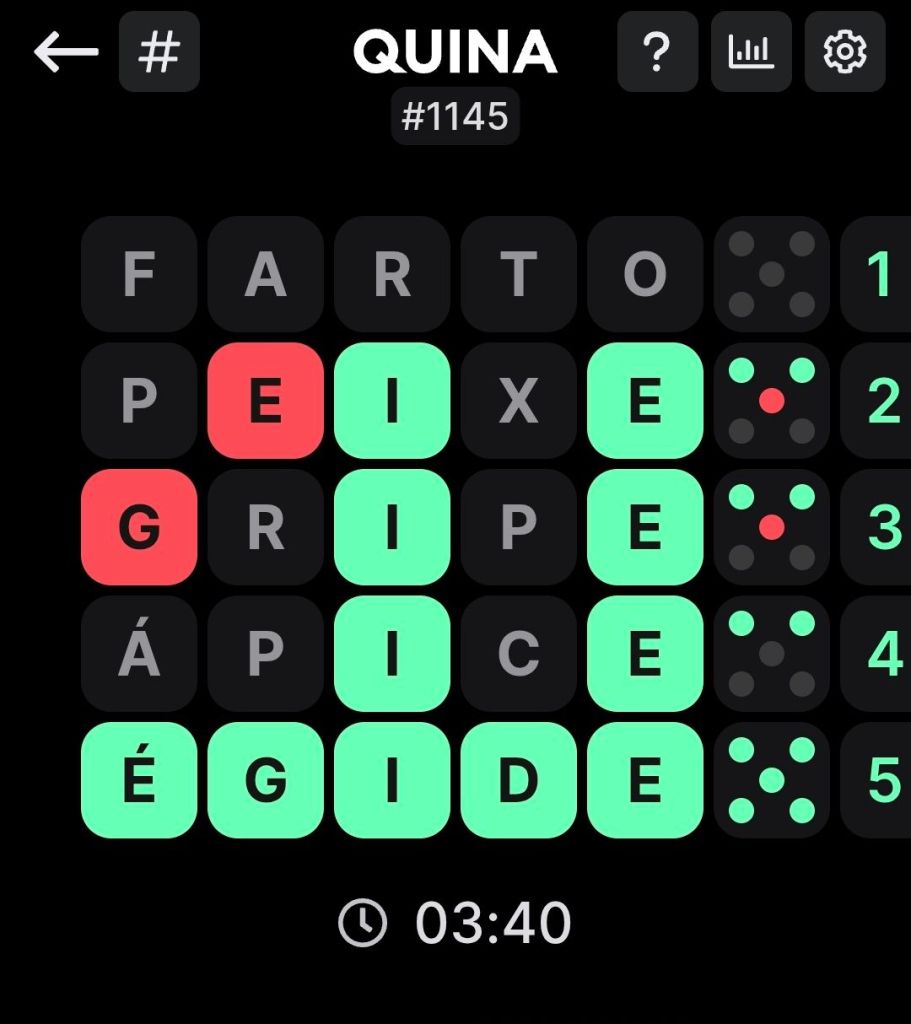
Quina keeps throwing out obscure words that I would never come across in the normal run of things. This one doesn’t even look like a Portuguese word, and in a way it isn’t, because it’s is adopted from Greek – it’s equivalent to Aegis. In other words, it’s the Greek word for shield, imported into modern usage, but only in very specific and niche contexts. “Sob a égide de…” is exactly equivalent to our “under the Aegis of”, meaning under the protection of, or within the sphere of influence of. I used that exact expression at work a couple of weeks ago. In English, not Portuguese, obviously, but it might as well have been in Portuguese because the person I was talking to had no idea what I meant and had never heard the word before. What are they teaching at school these days? O tempora! O mores!
I hope the boffins can sort out AI soon. I don’t want to be in my sixties, going in for a hip replacement and the robot doctor decides I am in urgent need of a head reversal procedure at the same time.
After writing yesterday’s blog, I looked at some more posts by the same Instagram account. The guy’s missus, who is Brazilian, has a video here in which she talks about a shitty, racist flyer that was being handed out in downtown Lisboa. She makes a lot of good points, but she seems to have caught some negative attention from social media bottom-feeders, as you can see from the follow-up post here.
In some cases, the critics have dressed up their nonsense as a complaint about non-standard Portuguese, but obviously, the underlying problem here is just straight-up xenophobia. There are racists in every country, of course. This is as true in Portugal as it is anywhere else, and weirdly Portuguese racism even extends to Brazilians, which is surprising when you consider that Brazilians are not natives of a former colonised country, they are largely the descendents of Portuguese settlers (and their slaves). Brazil, as a state, only exists because the territory now known as Brazil was colonised by the Portuguese. In short, they are you, lads! They’ve been away longer than your sobrinha who moved to Luxembourg last year, but it’s the same principle, just with a bigger time lag.
Now, I’m not saying there shouldn’t be an immigration policy that works for the country as a whole, but it has to be one that treats people as people. The minute people get into this kind of hatred, they’re on the road to a very, very bad place.
This is all by way of getting to my main point, which is that I’ve made cracks about Brazilian Portuguese on here a few times and I’ve even shared the odd meme (here for example). But I hope it’s clear that it’s not meant to be hostile. As you know, I mostly try to stick to European Portuguese as much as possible so as not to get confused, so some of the gags are about that desire to keep the other dialect at bay. But there’s also some friendly intercontinental rivalry between Europe and America, which is, at root, born of the inferiority complex of smaller less powerful countries seeing their former colonies doing more business and having more fun than us. Taking the piss out of our erstwhile cousins’ spelling and accent helps us cope with the shame of being efete and irrelevant on the world stage.
Anyway, I thought I’d better get that clear in case anyone thought I was like these pamphlet yahoos. This is a European Portuguese blog, but we love our transatlantic friends too, despite the occasional bit of teasing.






 Luso
Luso 