I have to admit I had no idea about some of these meanings
Category: English
Witches! Part 5
Este texto é o quinto sobre As Bruxas de Portugal. Veja o primeiro aqui se não te lembras o motivo
No Alentejo, a bruxa mais famosa é a Bruxa de Évora. Hoje em dia, a bruxa está mais conhecida no brasil do que na sua própria terra.
Assim como as outras mulheres descritas nesta série, a passagem de anos anda acrescentando mais camadas à lenda, mas é provável que esta feiticeira, que viveu na época de Dom Afonso Henriques, teve descendência árabe, portanto era também conhecida por “Moura Torta”. Como resultado da antiguidade, a lenda teve tempo o suficiente para crescer e para se enfeitar com novos boatos. Segundo as lendas, ela “fazia os portugueses se arrepiarem” com o seu poder. Falava árabe, português e latim e andou com um mocho no ombro; mandava demónios; voava montada não só numa vassoura mas também em animais como camelos, cães, e carneiros; tinha dois animais de estimação* – um bode e um gato, ambos pretos; era proficiente na magia dos árabes e dos célticos mas ainda por cima sabia ler e fazer matemática, que, no século XII, provavelmente parecia uma forma da magia! E há ainda mais! Em suma, era o Capitão Marvel da bruxaria portuguesa. A poder dela estava quase sem limites!
Convém lembrar que, naquela altura, os invasores árabes tinham sido afastados da terra portuguesa mas permaneceram na vizinhança, na Espanha. Numa época com pouca ciência pouca educação e a ameaça dum exercito ao outro lados das fronteiras, não e admira que havia tanto medo no ar, que acabou por se colar á figura da bruxa de Évora. Por isso, o mais surpreendente é que apesar de tudo a gente buscava a sua ajuda no amor, na vida e para curar doenças.

English Translation
In the Alentejo region, the most famous sorceress is the Witch of Évora although nowadays, she is better known in Brazil than in her own country.
Like the other women described in this series, the passage of years has added more layers to the legend, but it is likely that this sorceress, who lived during the time of King Afonso Henriques, had Arab ancestry, therefore she was also known as “Moura Torta” (Crooked** Moor). As a result of its antiquity, the legend has had enough time to grow and be embellished with new rumours. According to legends, she “made the Portuguese shudder” with her power. She spoke Arabic, Portuguese, and Latin and walked with an owl on her shoulder; she commanded demons; she flew riding not only a broomstick but also animals such as camels, dogs, and sheep; she had two pets – a goat and a cat, both black; she was proficient in Arab and Celtic magic but also knew how to read and do mathematics, which, in the 12th century, probably seemed like a form of magic! And there’s more! In short, she was the Captain Marvel of Portuguese witchcraft. Her power was almost limitless!
It’s worth remembering that, at that time, the Arab invaders had been driven away from Portuguese territory but remained in the vicinity, in Spain. In a time with little science, little education, and the threat of an army on the other side of the borders, it’s no wonder that there was so much fear in the air, which ended up clinging to the figure of the witch of Évora. Therefore, the most surprising thing is that despite everything, people sought her help in love, in life, and to cure illnesses.
*I checked if the word “familiar” was used in the same way as it appears in english, to describe a witch’s guiding animal, but it seems not.
**Interesting point about translation here. Torto means crooked, but when applied to a person in english “crooked” usually means “dishonest” whereas in portuguese the equivalent, torto, can mean drunk, cross-eyed, disloyal, stubborn or rude. I sort of love the idea that the witch was just a drunk lady of arab heritage walking around shouting mad stuff and being believed by everyone, but my guess would be that it’s similar to the way it’s used in “Que Mulher É Essa” by A Garota Não, when she lists all the kinds of women who are excluded from certain high-status roles.
A preta não entra
A baixa não entra, não
A velha não entra
A torta não entra, não
Quanto talento gasto em vão
So I think she’s talking about someone with a physical disability or deformity who is looked on as not meeting standards of beauty – but I am not 100% sure. This isn’t a super-original idea. a conventional reading of this would be that women with disabilities would be seen as witches because they were vulnerable and a liability and people wanted to push them out, say, so that they could inherit their house (Marxist interpretation) or because of misogyny (feminist interpretation) or to maintain the invisible power structures within society (postmodern toss interpretation) or because she understood that with very little ability to defend herself physically, cultivating an image of being a powerful ally of the devil is a good way of assuring nobody messes with you in a society where there’s no real rule of law (interpretation I am currently working up into a film script to pitch to Pixar).
Witches! Part 4
Hoje, passamos pela região de Estremadura. Mas afinal, onde fica Estremadura? Porque já não existe na mapa. Estremadura é um território histórico que abrange os atuais zonas de Setúbal, Santarém e Lisboa, que (como a Lola Ramos afirmou) a sede da inquisição que perseguiu tanto as assim chamado “bruxas” quanto hereges, e acima de tudo Judeus.
A Bruxa da Arruda é uma das feiticeiras mais famosas nesta série, a lenda dela fornecendo não só uma atração turística mas também assunto de vários livros (um brasileiro e um português por exemplo) mas o que mais me surpreendeu é quão moderna é a história. A “bruxa”, Ana Loura era ativa durante os finais do século XIX e os primeiros anos do XX e praticou artes comuns a mulheres da sua profissão “curar pessoas e adivinhar coisas”. Deste modo de vida, a questão não está em causa mas ao longo dos anos mais lendas e mais boatos foram acrescentados á história verdadeira. Ela fez sair uma cobra da boca de um rapaz atormentado por doenças misteriosas, por exemplo.

Segundo um livro publicado em 1905, “A bruxa da Arruda, —A celebre bruxa costuma visitar a Ericeira por fins de setembro. É muito respeitada; dizem que é rica, a pobres não leva nada; apresenta-se com muitos ouros. Tem uma filha que já entende de moléstias. Em geral leva 300 reis pela consulta. Receita quasi sempre esfregas de aguardente e papas de pão de milho ralado. Mas isto varia em quantidade, tempo, calor, e no sítio do corpo. Ouvi também chamar-lhe a mulher do Casal das Neves, no termo da Arruda dos Vinhos. Nem precisa ver o doente, levam-lhe roupa do uso do enfermo, uma camisa ou camisola, e ela pelo cheiro conhece a moléstia e logo receita. Costuma pousar numa casa do norte da vila, e a sua chegada consta logo entre a pobre gente que a venera e teme.Já teve questões com padres e médicos, já foi aos tribunais, me disse alguém, e ficou sempre victoriosa!” (Pereira, G. A Villa da Ericeira citado nesta página)
Fico admirado por ouvir que uma bruxa andava ativa, abertamente, sob os olhos da igreja até no século XX!
English Translation
Today, we’re passing through the Estremadura region. But where exactly is Estremadura? Because it no longer exists on the map. Estremadura is a historical territory encompassing the current areas of Setúbal, Santarém, and Lisbon, which (as Lola Ramos stated) was the seat of the Inquisition that persecuted both so-called “witches” and heretics, and above all, Jews.
The Witch of Arruda is one of the most famous sorceresses in this series, her legend providing not only a tourist attraction but also the subject of several books (one Brazilian and one Portuguese, for example). But what surprised me most is how modern the story is. The “witch,” Ana Loura, was active during the late 19th century and early 20th century and practiced arts common to women of her profession: “healing people and divination.” That she chose this way of life is not disputed, but over the years more legends and rumours have been added to the true story. She made a snake come out of the mouth of a boy tormented by mysterious illnesses, for example.
According to a book published in 1905, “The Witch of Arruda—The famous witch usually visits Ericeira at the end of September. She is highly respected; they say she is rich, she takes nothing from the poor; she presents herself with many gold coins. She has a daughter who already understands illnesses. She generally charges 300 reis for a consultation. She almost always prescribes rubs of brandy and porridges of grated cornbread. But this varies in quantity, time, heat, and the location on the body. I also heard her called the woman of Casal das Neves, in the Arruda dos Vinhos area. She doesn’t even need to see the sick person; they bring her the sick person’s clothes, a shirt or sweater, and she recognizes the illness by the smell and immediately prescribes something. She usually stays in a house in the north of the village, and her arrival is immediately announced among the poor people who venerate and fear her. She has had disputes with priests and doctors, she has gone to court, someone told me, and she has always been victorious!” (Pereira, G. A Villa da Ericeira)
I am amazed to hear that a witch was active, openly, under the eyes of the church even in the 20th century!
Witches! Part 3
Ando a negligenciar este blogue e por isso a minha série sobre as bruxas de Portugal perdeu o seu dinamismo. As bruxas escaparam, e torna-se difícil seguir-lhes o rasto. Mas estou de volta com o meu nariz pronto para cheirar as feiticeiras todas. Hoje investigamos a aldeia de Proença-a-Nova na Beira.
Segundo a lenda, havia naquela zona uma viúva atraente que casou com um sapateiro. De vez em quando, nas noites de lua cheia, ela levava ao marido um chá quente, e ao beber, o marido adormeceu, caindo num sono profundo. O sapateiro ficou curioso e, uma noite dessas, não bebeu o chá. Após algum tempo, viu a sua esposa a ungir o corpo dela com ervas e óleo. Depois, abriu a janela e, cantando “Voa voa por cima de toda a folha”, começou a voar pelo ar. O marido, querendo segui-la, esfregou o seu corpo com o mesmo óleo e as mesmas ervas. Entoou as palavras mágicas mas não tinha poder igual à da esposa e acabou no chão, arranhado e machucado. Nunca voltou a falar daquela noite e passou a beber sempre o chá como ela mandou.
English Version
I’ve been neglecting this blog, and that’s why my series on the witches of Portugal has lost its momentum. The witches have escaped, and it’s difficult to track them down. But I’m back with my nose ready to sniff out all the witches. Today we investigate the village of Proença-a-Nova in Beira.
According to legend, there was an attractive widow in that area who married a shoemaker. From time to time, on nights when the moon was full, she would bring her husband hot tea, and upon drinking it, he would fall into a deep sleep. The shoemaker became curious and, one night, only pretended to drink the tea. After some time, he saw his wife anointing her body with herbs and oil. So he opened the window and, chanting “Fly fly over every leaf,” began to fly through the air. The husband, wanting to follow her, rubbed his body with the same oil and herbs. He chanted the magic words but he didn’t have his wife’s power, so he ended up on the ground, scratched and bruised. He never spoke of that night again and from then on, always drank the tea as she had instructed.
O Grão Caudilho
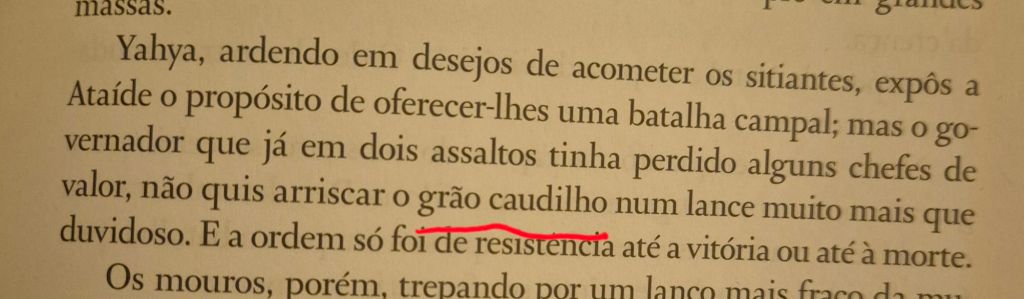
I was a briefly stumped by this. Grão means grain, normally, and caudilho looks familiar but looks like it ought to be something to do with a tail (cauda). It’s a set phrase though. Caudilho is actually descended from Spanish word meaning the chief, the head man, the dictator. So grão caudilho means… The grain chief? No, grão has a hidden secret meaning, if you scroll down a bit on its priberam page, it can be an adjective, where it’s just a form of “grande”. It’s the masculine form of Grã, as in Grã-Bretanha. So grão caudilho = the big boss, the big cheese.
Sete-Estalos and Surprising Suffixes
Reading “Natais – Contos e Narrativas” by João dos Reis Gomes and came across this phrase that seems to be unknown on the Web.

It’s just some sort of firecracker or cap that goes bang when you throw it on the ground though, according to my wife. Some sort of party snap or cap bomb, I suppose. Do they even make those any more? I haven’t seen anything like it for a while.
The book is quite challenging because it has a lot of unusual words and madeiran regionalisms. One of the new words that struck me was “indelével”.

Very obvious what that means but I don’t think I’ve come across it before and it’s surprising because I’m pretty sure I haven’t seen a word ending in “ével”. Of someone had asked me to guess how to say indelible I would have had it ending in “ível”, for sure.
Hm, I seem to be blogging in English again. Lazy.
Round ’em Up!
There are so many things to know, aren’t there? Today I found out how to say “round up”, not the kind of rounding up a cowboy does, but the kind a mathematician does
Say It In Portuguese
Oh! I must have accidentally unsubscribed to Say It In Portuguese’s email feed because I completely missed the notification about the last episode. I had been watching out for it because I’m in it, but I’ve just noticed it’s in my podcast app!
It’s this episode which deals with a song by Deolinda called Fado Toninho, and it was inspired by my attempt to grapple with the meaning of the song, in a post in February.
The podcast is definitely one you should be subscribed to if you are working toward B2 or over. It’s not the sort of thing you can listen to as a newbie, but if you already have decent skills, it gives you a wealth of knowledge about expressions and culture, all of which are essential for moving up to the next level. So, in other words, I can’t recommend it strongly enough! Cristina was my teacher for later C1 through to graduating C2, and she is very much a “friend of the blog”, but I would recommend SIIP even if that weren’t the case, because it’s excellent, it’s been around for ages and there’s nothing else like it, really.
Generally, the podcast picks an idiomatic expression and unpacks it for you, but in this one, we discuss the lyrics of a song, mainly trying to analyse the meaning of “Toninho” itself, but there are some expressions in the song too, and those are worth noticing. So if you don’t know the song already, I challenge thee: set aside some time to give the video and the podcast episode a listen and see how much you can learn in fifteen minutes.

Untranslatable
I like how this sentence is something that wouldn’t really make sense at all in English. You could say it of course, but it wouldn’t make as much sense in a language where we don’t really learn verb conjugations because our verbs are so straightforward.

He’s talking about those times in our lies when we do something for the first time ever – the first time you kiss someone, the first time you go out on your own and so on. In this paragraph, he goes onto say that those things don’t always work out as we might expect, and hoped-for first kiss turns into the first rejection.
And to do that he says the verbs “querer” and “ter” are conjugated with very different endings. I like that!
The book is Aqui Dentro Faz Muito Barulho by Bruno Nogueira
Tira-Teimas
I keep seeing the expression “Tira-Teimas” pop up in my socials. Mainly, it’s on these short videos from The Voice Portugal. What can it mean?
Well, apparently, it can mean “objeto ou meio com que se castigam os teimosos” Er… Ok, that’s a very specific thing to have a phrase for, but sure. That’s clearly not what it means here though. I think the relevant definition here is “acontecimento ou circunstância que funciona como desenlace, pondo fim a disputa, competição ou controvérsia”. So a tie-breaker then? Hm, not quite that, because that would normally only involve two people. So maybe some sort of final battle where they shake out some of ghe weaker candidates and get it down to the finalists then? Something like that I think. I certainly don’t fancy watching the whole show to find out, I’m afraid, but I think that’s the gist of it.
There seems to be a brand of disgusting looking crisps called Tira-Teimas as well. I’m not sure why. Do people punish stubborn children with wheat-based snacks?

 Luso
Luso 