Posted in English, Portuguese

Dial M for Mordam

Esta expressão foi usada no livro que terminei recentemente e já está de volta no meu livro atual (“Se Perguntarem Por mim, Digam que Voei” de Alice Vieira)

Macacos me mordam se aquele que manda as bolas ao ar não é o marçano do tio Casimiro”

Monkeys bite me if that one who’s juggling balls isn’t Uncle Casimiro’s apprentice”

So it’s obviously an expression or surprise like “well I’ll be a monkeys uncle”. Do people still say that? Probably not. Anyway, I like it and I’ll have to use it again. Hey, didn’t I start this blog post in portuguese? What happened?

Posted in English, Portuguese

Diabo na Cruz – Vida de Estrada

OK, well this is one of the bands I listened to the other day and liked enough to want to dive into their lyrics. It’s not an easy one because a lot of it is lists of things and events, like the lists in “Its the End of the World as we Know It” by REM or “We Didn’t Start the Fire” by Billy Joel and I am pretty sure I am missing some of the references. I’ll put links on the ones I recognise because it’s probably easier than writing 30,000 words of footnotes. Speaking of feet, there’s a really excellent live video out there and teh lead singer has a cast on his ankle, so well done him for not calling in sick that day!

🇵🇹🇬🇧
Siga em fila vai
Nove emprego cinco sai
Quinto império do atalho
Bomba, escola, pão, talho
Form a line, go
Nine employed, five leave
Fifth empire by a shortcut
Bomb, school, bread, meat
Trívia e televisão
Aurora do quadrilião
No ar um cheiro a esturro
Bom pró esperto, mau pró burro
Trivia and television
Glow of the quadrillion
In the air a smell of burning
Good for the smart, bad for the stupid
Perto, tão perto do oásis no deserto
Longe, tão longe de ir lá hoje
Mora, demora
O que é bom nunca é pra agora
Quem me dera ir daqui pra fora
Close, so close to the oasis in the desert
Far, so far from getting there today
Lay, delay
What is good is never for now
I wish I could get out of here and away
Trânsito no Jamor
A ouvir notícias do terror
Troika, bolha imobiliária
É cara a vida e a pensão precária
Traffic on the Jamor
Hearing news of terrorism
The Troika, a property bubble
Life is expensive, and pensions at risk
Água, cabo, net
Luz, ginásio, yoga, creche
IUC, IMI, IRS
Paga paga, esquece esquece
Water, cable, internet,
Lighting, gym, yoga, creche,
IUC,IMI,IRS
Pay, pay, forget, forget
Fraco tão fraco o sol neste buraco
Boa, tão boa a vida boa
Mora, demora
O que é bom nunca é pra agora
Quem me dera ir daqui pra fora
Weak, it’s so weak, the sun in this hole
Good, so good, the good life
Lay Delay
What is good is never for now
I wish I could get out of here
Mergulhar mãos no volante e adiante
Pra qualquer lugar
Vidro aberto, rádio alto, no asfalto
Sem me apoquentar
Saborear o mar, as serras
Cobrir-me de pó e geada
Roer o osso desta terra
Na vida de estrada
Grab the steering wheel and go
To anywhere
Window open, radio loud, on the asphalt
Without fear
To enjoy the sea, the mountains
get covered in dust and frost
Chew the bones of this land
In life on the road
Sismo no Japão
Zara, nova coleção
Espionagem, guerra, muda o tema
Woody Allen no cinema
Earthquake in Japan
Zara, new collection
Espionage, war, change the subject
Woody Allen at the cinema
Zapping e jornal
Série e logo futebol
O vizinho num concurso
A fazer figura de urso
Channel-hopping and news
Series and then football
The neighbour in a competition
To act like an idiot
Chato, tão chato papar grupo barato
Oco, tão oco o circo louco
Mora, demora
O que é bom nunca é pra agora
Quem me dera ir daqui pra fora
Annoying, so annoying, support cheap group*
Hollow, so hollow, the crazy circus
Live, delay
What is good is never for now
I wish I could get out of here
Mergulhar mãos no volante e adiante
Pra qualquer lugar
Vidro aberto, rádio alto, no asfalto
Sem me apoquentar
Saborear o mar, as serras
Cobrir-me de pó e geada
Roer o osso desta terra
Na vida de estrada
Grab the steering wheel and go
To anywhere
Window open, radio loud, on the asphalt
Without fear
To enjoy the sea, the mountains
get covered in dust and frost
Chew the bones of this land
In life on the road
Onde não há prazos nem obrigações
Não há debates nem euromilhões
Onde o sol eleva e a frescura acata
Sem consulta ao homeopata
Onde a cura é sem vacina
E a cardina é sem pesar
Por lagoas e colinas
Vê-se a lágrima a secar
Dá o vento na cara
E nada nos pára
Nada nos pára
Where there are no deadlines or obligations
No debates, no euromillions
Where the sun lifts you and the coolness follows you
Without an appointment with the homeopath
Where the cure doesn’t take a vaccine**
And the grime doesn’t weigh you down
Through lakes and hills
Feel the wind in your face
And nothing will stop us
Nothing will stop us
Perto, tão perto do oásis no deserto
Longe, tão longe de ir lá hoje
Mora, demora
O que é bom nunca é pra agora
Quem me dera ir
Quem me dera ir daqui
Quem me dera ir daqui pra fora
Close, so close to the oasis in the desert
Far, so far from getting there today
Delay, delay
What is good is never for now
I wish I could get out
I wish I could get out of here
I wish I could get out of here and away
Mergulhar mãos no volante e adiante
Pra qualquer lugar
Vidro aberto, rádio alto, no asfalto
Sem me apoquentar
Saborear o mar, as serras
Cobrir-me de pó e geada
Roer o osso desta terra
Na vida de estrada
Grab the steering wheel and go
To anywhere
Window open, radio loud, on the asphalt
Without fear
To enjoy the sea, the mountains
get covered in dust and frost
Chew the bones of this land
In life on the road

*best guess is that he’s saying you should support independent artsists

**They broke up in 2019, in case you were wondering if this was some sort of covid reference

Posted in English

The Last Day: Wrath, Ruin and Reason in the Great Lisbon Earthquake of 1755 by Nicholas Shrady.

Lazy Post, reviewing an audiobook I finished recently, about the Lisbon Earthquake.

The Last Day by Nicholas Shrady

As the name suggests, the book is organised around the event that literally shook Lisbon and figuratively shook its empire in the middle of the eighteenth century. The day itself is described well, albeit undramatically, and the Marquês de Pombal’s life and legacy gets laid out, including the grizzly bits. Smashing people’s arms and legs with hammers, burning them alive. Oh, and rebuilding the city in line with modern techniques. He’s… Well, to borrow another term from the young folk, “morally grey”.

Anyway, so far so good, but it could have been more focused. I guess his thinking was that a lot of readers wouldn’t know the background so he gives us a tour of the main points of Portuguese history but he doesn’t section it off, he just sort of rambles back in the middle of the book. Maybe the general history stuff would have been better as an optional preamble to the main book. That way, he could have really drilled down both in the horror and chaos of the day itself and on the technical details of how they recovered. I want details, dammit!

My favourite aspect was his summary of how the different groups explained the event. We sometimes think our age is uniquely divided and that the two sides in our political disputes operate with different worldviews and different sets of facts, but in 1755 we have catholics fulminating about how God sent the earthquake for allowing the protestant heretics into Portugal and meanwhile in England, at memorials services for lost Port wine merchants, the vicars are telling their flocks it’s no wonder Portugal was ruined when it is full of dreadful popish idolatry.

Some things never change.

The audiobook reader gets a solid 8/10 for trying with the pronunciation. He obviously doesn’t speak portuguese, but he’s put the effort in to learn the ground rules of portuguese pronunciation and it shows. Instead of just saying all the names like they were Mexican drug lords in Breaking Bad, he pushes in the right direction. He gets a lot wrong, but he’s tried and I appreciate that.

Posted in English

Birth Order

This will probably come in handy again one day so might as well make a note of it…. how to describe oldest and youngest siblings

Filho primogénito – the oldest son

Irmão do meio – the middle brother

Irmão mais novo – the youngest brother

O benjamim is the youngest but can also mean the favourite son, or the favourite in a group, apparently. Ugh! Why would the youngest be your favourite? The first born is clearly the best. Oh and caçula just means youngest, not favourite.

Posted in English

False Friend of the Day

Catching up on some corrections from previous lessons. I have used the word “implicar” as a substitute for “imply” and although that meaning does exist (it’s definition 5 in Priberam), it’s more usually a much more aggressive word, meaning impede, cause something to happen or just generally stir things up. Used reflexively it means to feel confused. Insinuar seems to be the better choice if you want to say something like “I don’t mean to imply…” which is what I was trying to say.

Posted in English

Teaser

Here’s a sneak preview of my guest host for the blog I’m writing for release in a couple of days. He doesn’t usually get consulted much, for obvious reasons, but there was a mystery to solve…

Posted in English, Portuguese

Fado Português

A tradução de hoje é “Fado Português”. Se Amália cantou alguma canção, acho que convém usar a versão dela como base duma tradução, mas não existe um vídeo dela a cantar esta, e olha, a versão de Sara Correia é ótima, então porquê é que estás a resmungar? Vi-o na app Lingoclip, que estou a usar diariamente. Para ser sincero, é frustrante. Prefiro usá-la no modo especialista porque é mais fácil digitar tuuuuudoooo do que andar de um lado para o outro entre as letras e as opções, mas é preciso ter dedos extraordinariamente rápidos! Mas um fado é mais fácil do que um rap, portanto, se gostares de experimentar, recomendo que comeces com algo deste género.

PortuguêsInglês
O Fado nasceu um dia
Quando o vento mal bulia
E o céu o mar prolongava
Na amurada dum veleiro
No peito dum marinheiro
Que, estando triste, cantava
Que, estando triste… cantava
Fado was born one day
When the wind was barely stirring
And the sky held back the sea
On the hull of a sailing ship
In the breast of a sailor
Who, being sad, was singing,
Who, being sad, was singing.
Ai, que lindeza tamanha
Meu chão, meu monte, meu vale
De folhas, flores, frutas de oiro
Vê se vês terras de Espanha
Areias de Portugal
Olhar ceguinho de choro
Oh so much beauty
My ground, my mountain, my valley
With leaves, flowers and golden fruit
See if you see the lands of Spain,
Sands of Portugal
Vision nearly blind from crying
Na boca dum marinheiro
Do frágil barco veleiro
Morrendo a canção magoada
Diz o pungir dos desejos
Do lábio a queimar de beijos
Que beija o ar e mais nada
Que beija o ar… e mais nada
In the mouth of a sailor
Of the fragil sailing boat
The tortured song, dying
Tell of the torment of desires
From the lip burning with kisses
That kisses the air and nothing else
Mãe, adeus, adeus, Maria
Guarda bem no teu sentido
Que aqui te faço uma jura:
Que ou te levo à sacristia
Ou foi Deus que foi servido
Dar-me no mar sepultura
Goodbye mother, goodbye Maria
Remember what you see and hear*
That here I make an oath
That I will either take you to the sacristy
Or it was God that served me
By giving me a grave in the sea
Ora eis que embora outro dia
Quando o vento nem bulia
E o céu o mar prolongava
À proa doutro veleiro
Velava outro marinheiro
Que, estando triste, cantava
Well so it was that the next day
When the wind was hardly stirring
And the sky held back the sea
At the prow of another sailing ship
Sailed another sailor
Who, being sad, was singing,
Who, being sad, was singing.
Ai, que lindeza tamanha
Meu chão, meu monte, meu vale
De folhas, flores, frutas de oiro
Vê se vês terras de Espanha
Areias de Portugal
Olhar ceguinho de choro
Oh so much beauty
My ground, my mountain, my valley
With leaves, flowers and golden fruit
See if you see the lands of Spain,
Sands of Portugal
Vision nearly blind from crying

*Not very literal at all but I couldnºt make it make sense if I did it word for word.

Posted in English

Ver Se Te Avias

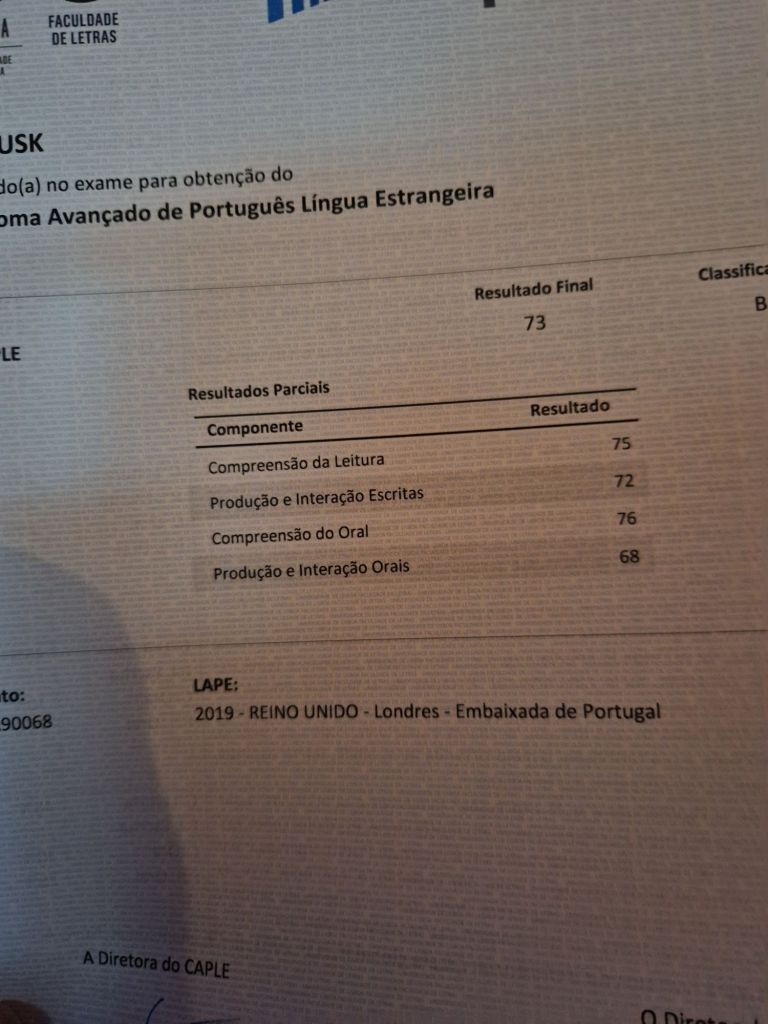
I noticed this in the book I’m reading, principally because it has a version of a verb, aviar, which had come up in a lesson. Aviar is despatch, prepare, generally get something ready to be handed over, say to a customer. So I feel like I should be able to take the phrase “ver se te avias” and translate it back into something that makes sense: “see if you prepare it” maybe, but the literal translation doesn’t do it justice because it’s a set phrase and it means something more like “a rush order” or “a high priority”. The Instituto Camões includes it in its list of expressions, so presumably it’s fair game for a CAPLE exam and therefore worth knowing.

É um ver se te avias
Significado: Temos de acelerar o nosso desempenho para cumprir uma determinada tarefa o mais rapidamente possível.

Source: Instituto Camões