Posted in English

The Dar Is Rising

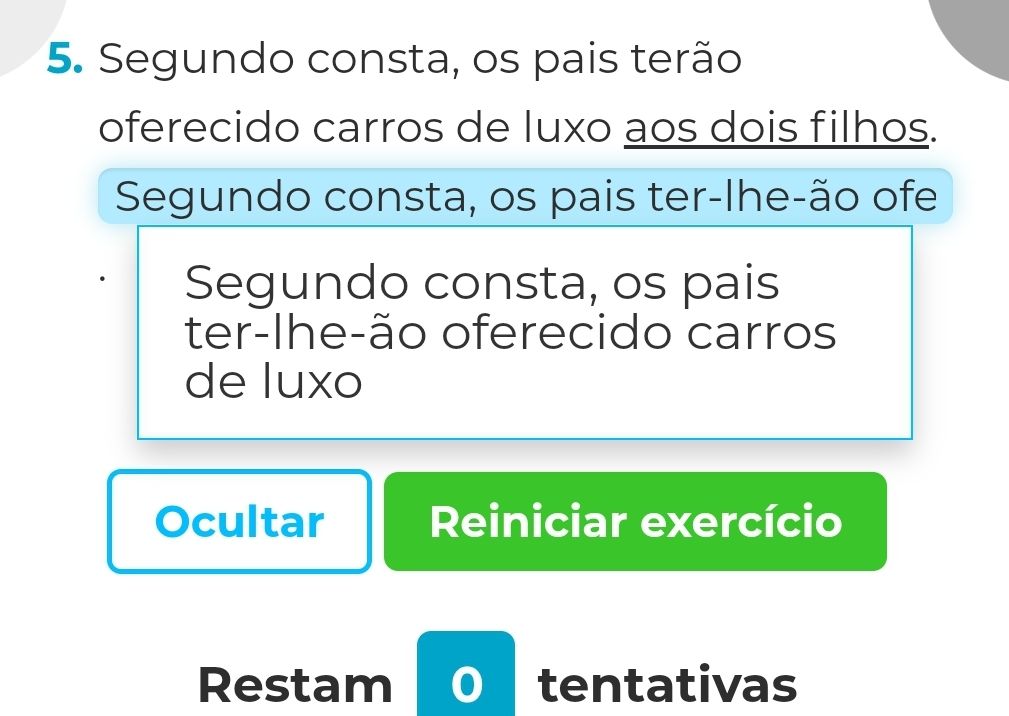
Alguns exemplos do cadernos de exercícios surpreenderam-me. Vamos dar uma espreitadela…

  • “Dar por bem-empregado” – confused me because bem-empregado can be one of those expressions like bem-feito, where it’s used to mean the person got what they deserved, but most of the translations in linguee are more straightforward but it makes sense that they think their money was well-spent.
  • “Dar de si” – Usually means “give of oneself” ie, to be generous, but Priberam gives the more figurative “a bar, ceder, desmoronar”
  • “Não se lhe dar” Um… Tricky one. There are almost no examples of this in linguee and Priberam doesn’t have it. The ever useful Guia Prático de Verbos com Preposições has dar-se a meaning to care about or make use of so não se lhe dar (where lhe is an indirect object, só it’s like “a ele”) could mean he wasn’t interested in. The fact that this example is negative, where e the Guia’s example is positive needn’t necessarily matter but but doesn’t seem super clear to me.
  • “Dar a saber” straightforward – to make someone know something. Inform them, in other words.
  • “Dar certo” Easy – to turn out right
  • “Dar para trás” Easy – to go backwards*
  • “Dar as caras” I’d never heard of this one (as far as I remember). Mostly it gets translated as”show your face” ie, turn up, but there’s a dúvida linguística on FLiP that has it meaning something more like “come face to face with”. In both cases, you’re meeting someone, so it isn’t so different, but bear in mind it can have slightly different meanings. In the flip example, if you translated it as “turned up with a lion”, well, that would be a power move in any business meeting where you wanted to intimate the person into lowering the price, but that’s not really what it means.
  • “Não se dar por achado” Another new one, and I don’t see it being used much but yeah, it means pretend not to hear something, or to pretend to be busy with something else so that you don’t notice the person.

Oh shit, I meant to write all this on Portuguese. Meh, never mind, it made me think about the expressions so with a bit of luck il remember them now.

*… Is what it means in some contexts anyway, and I’m sure it’s what it meant in the example I did, although I am informed that it can also means “knock someone back” ie, gently turn down their romantic advances!

Posted in English

Proibida

Following on from the last post – this picture I took at the Museu do Fado contains Fazer falta, and it’s prohibited so I am drawn to translate it…. Pre-AO spelling though so ironically it’s just as illegal now as it was then 🙂
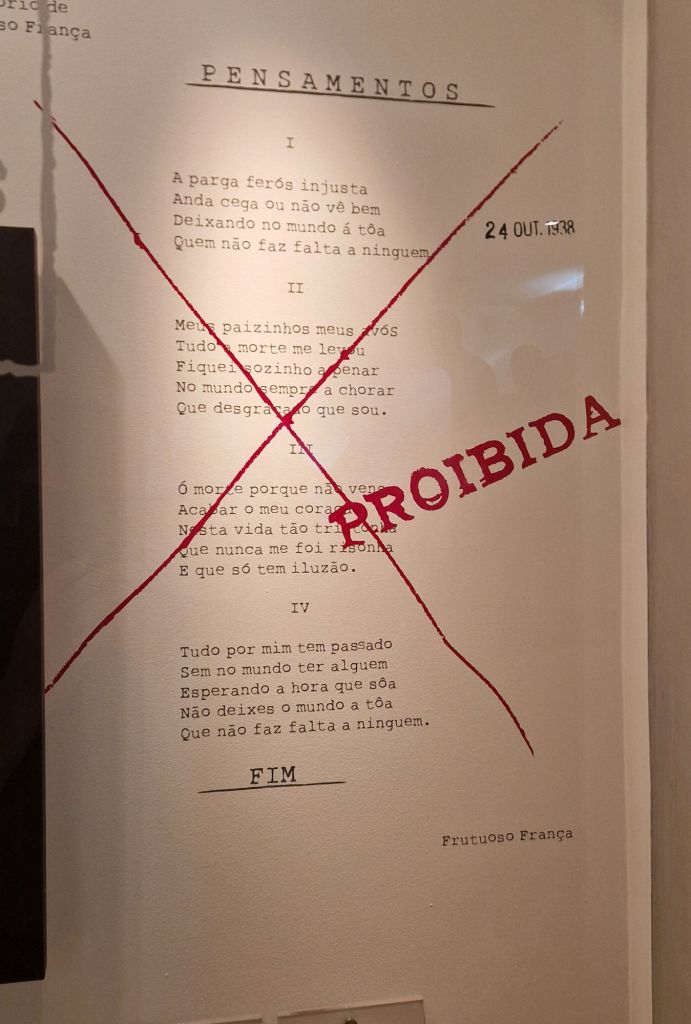
The fierce, unjust heap 
Is blind or doesn't see well
Randomly leaving in the world
People who won't be missed
My parents, my grandparents
Death has taken everyone from me
I was left alone, suffering
In the world, always crying
What an outcast I am
Oh death, why don't you come for me
To stop by heart
In this sad life
That was never cheerful for me
And only has illusion
Everything is over for me
Without having anyone in the world
Weighting for the hour that sounds
Don't leave the world at random
That nobody will miss

It’s interesting isn’t it? First of all, that first word, parga, is quite unusual. It’s a heap of stored hay and grain stored away from the weather (silage?). I wonder if it had some other meaning on the 1930s. Alternatively, it might even be a typo, because praga (plague) would make a lot of sense.

I’m also interested in the slight shift in wording between the last two lines of the first verse and the last two of the last. I wonder what difference it makes. I feel like there’s a shift in emphasis there but I can’t quite put my finger on it.

Posted in English

Falta Attraction

Fazer falta is one of those expressions I seldom use so I had a go a couple of days ago, inspired by this scene in the film I am repeat-watching (fourth time now!), but I got it bass-ackwards.

Fazer falta a alguém = be missed by the person (this is what’s happening in the movie)

Fazer falta de = cause someone to be absent (this is what I ended up writing after I tried to reframe the sentence but it’s not exactly helpful)

Sentir a falta de alguém = feel someone’s absence (what I corrected it to and tbh it’s less grammatically challenging than what I was trying to do so I will probably stick with it in future!)

Posted in English

E Afinal, Como Correu a Primeira Semana?

Happy first day of GMT. Here’s all that sun you missed. 🌞🌞🌞🌞🌞🌞

Marking off what I’ve done from the plan I made.

Raw Exam Prep

  1. Do the exam modelos Cristina gives me Done only 2 exercises form the first.
  2. Go through the list of key structures in the C2 syllabus here, and try and figure out what I need to work on, possibly in the lessons Started but… Oh my god, it’s absolutely massive!

Just general tidying

  • I have some lists of structures I often get wrong and structures that get used a lot in portuguese that I never use because I keep forgetting about them, so try and make sure I get as many of them as possible into blog posts instead of just treading the same old familiar linguistic pathways that I rely on in everything I write. Doing pretty well with this!
  • Try and bribe my wife to speak to me in her beguiling madeiran accent. Poached eggs will probably work. She loves a good poached egg. Only one day of this so far
  • I also started an Anki Deck for unfamiliar vocab
  • Went back to revise some of my favourite past blogs – like this one for example. I feel like I did a better job than most basic level explainers written by native speakers – bug claim, I know, but they tend not to be very nuanced and I unpacked a lot of weird stuff that gets left out. I um (checks notes) understood the assignment. I (checks notes again) ate and Er… Left no crumbs. (peers at notes a third time)… Slay!

General Input

  • Reading – I have an english book I am committed to reading for family book club and a couple of audiobooks that I am already part way through, but when those are finished, no new english books, just portuguese ones. Probably not many though, because I don’t really need much practice – just bedtime reading, and just things that seem like they will expand my brain. Like I have a Gil Vicente play in BD form, but I looked at it earlier and it’s much too archaic so I’ll save it for after the exam. I’ve read lots and written a few reviews too
  • Podcasts – Portuguese only till after the exam. I might even unsubscribe to some of the english language ones to remove temptation. Lots of audio going on at the moment, including some really difficukt regional accents
  • Eat-Rep exercises – I’m going to drop some of the morning quizzes I do and watch a quarter of Os Gatos Não Têm Vertigens instead – that’s about two watches per week. try to do some “scratching” in the first weeks and move toward “copycat” exercises in later weeks. Two and a half run-throughs  so far and I’m enjoying it. Part of me wants to move to another film though because I notice myself not paying enough attention because I already know the gist of the plot. Should I trust the process or my instincts? 🤔

Exercises

This weekend

  • Start final chapter of Português em Foco done
  • “Puzzle Brain” activity – listen to portuguese audio while doing a jigsaw enjoyed this much I have started a second puzzle and a second audiobook – A Viúva by José Saramago

W/E 27-10-2024

  • Finish Português em Foco exercises in the main book (meant to do these before Lisbon really, but…) done
  • Start the (self marked) grammar exercises in the Caderno de Exercícios done (4 chapters in)

W/E 03-11-2024

  • Finish the grammar exercises in the Caderno de Exercícios
  • “Scuba Diving” exercises with text and audio of “Amor de Perdição”

W/E 10-11-2024

Non-thorough run through of the paper exercise books I have, looking for grammar exercises that look like they might be beneficial.

  • The remainder of the vocabulary and verb tenses sections of Português Outra Vez, (the expressões section is rubbish and I can’t be bothered with it)
  • The C1 sections of “Vamos Lá Continuar” and
  • Some of the more challenging exercises from Qual é a Dúvida. I finished this book ages but there were some exercises that left me floored, so I’ll be interested to see if I find them just as hard the second time around!
Posted in English

Subjunctive Words of Wisdom

I liked what this fella had to say about subjunctives in his recent video. It’s a subject we anglophones don’t really use much, but most latin languages make a much bigger deal of it. I have read a few french books and it definitely doesn’t get as much of an airing in that language as it does in portuguese, but I think the principles and the rationale behind it carries across between languages, so the points he makes here about french, spanish and italian still hold, I think. I won’t try and summarise them – if you’re reading this and you struggling to put some junc in your trunc, have a look for yourself.

Posted in English

There’s Reading And Then There’s Hearing

I’ve got obsessed with this line of dialogue. There’s nothing special about it, but it feels like she’s only saying about half of what the subtitles say. If I run my eyes over it without trying to read the individual words, I can map the stream of sounds she’s making back to the text but… Well, they’re hardly words, it’s more like syllable soup.

Posted in English

Plans

OK, the exam is on the 13th of November. To be honest, I wish I’d gone for May next year, but here we are… I’m going to be taking another of the Say It In Portuguese CAPLE Exam preparation courses. I need to use the remaining time wisely so I’m going to try and cut out a lot of unnecessary stuff, put a few things on hold till the second half of November to make more time for learning, especially listening and speaking (using some of the techniques this fella lays out in this video) and I’ll add this lot to my Planner app:

Raw Exam Prep

  1. Do the exam modelos Cristina gives me
  2. Go through the list of key structures in the C2 syllabus here, and try and figure out what I need to work on, possibly in the lessons

Just general tidying

  • I have some lists of structures I often get wrong and structures that get used a lot in portuguese that I never use because I keep forgetting about them, so try and make sure I get as many of them as possible into blog posts instead of just treading the same old familiar linguistic pathways that I rely on in everything I write.
  • Try and bribe my wife to speak to me in her beguiling madeiran accent. Poached eggs will probably work. She loves a good poached egg.

General Input

  • Reading – I have an english book I am committed to reading for family book club and a couple of audiobooks that I am already part way through, but when those are finished, no new english books, just portuguese ones. Probably not many though, because I don’t really need much practice – just bedtime reading, and just things that seem like they will expand my brain. Like I have a Gil Vicente play in BD form, but I looked at it earlier and it’s much too archaic so I’ll save it for after the exam.
  • Podcasts – Portuguese only till after the exam. I might even unsubscribe to some of the english language ones to remove temptation.
  • Eat-Rep exercises – I’m going to drop some of the morning quizzes I do and watch a quarter of Os Gatos Não Têm Vertigens instead – that’s about two watches per week. try to do some “scratching” in the first weeks and move toward “copycat” exercises in later weeks.

    Exercises

    This weekend

    • Start final chapter of Português em Foco
    • “Puzzle Brain” activity – listen to portuguese audio while doing a jigsaw

    W/E 27-10-2024

    • Finish Português em Foco exercises in the main book (meant to do these before Lisbon really, but…)
    • Start the (self marked) grammar exercises in the Caderno de Exercícios

    W/E 03-11-2024

    • Finish the grammar exercises in the Caderno de Exercícios
    • “Scuba Diving” exercises with text and audio of “Amor de Perdição”

    W/E 10-11-2024

    Non-thorough run through of the paper exercise books I have, looking for grammar exercises that look like they might be beneficial.

    • The remainder of the vocabulary and verb tenses sections of Português Outra Vez, (the expressões section is rubbish and I can’t be bothered with it)
    • The C1 sections of “Vamos Lá Continuar” and
    • Some of the more challenging exercises from Qual é a Dúvida. I finished this book ages but there were some exercises that left me floored, so I’ll be interested to see if I find them just as hard the second time around!

    Exam Week!!!!

    I’ll keep this free for whatever I think needs shoring up

    Posted in English

    Madeirense

    My Missus keeps sending me homework this week so let’s have a look, shall we?

    Ei seems like the most confusing part of this, but it’s just the madeira pronunciation of “as”

    Beiças =lips.

    Obviously “vermelhe” and “ouvides” are representations of the accent, with the o suppressed.

    Bilhardeira = bisbilhoteira = gossipy lady

    Zunir =buzz, but I guess they use it to describe gossip spreading

    So: I put red lipstick on and and that busybody went and told my granny.

    Numa carreira =in a big rush, charging about

    Baldear = cair (it has lots of meanings but that seems to be the relevant one)

    Arcas = costas (specifically the lower back, I think?)

    Tratuário = passeio

    So: I was in a big rush and I fell and bumped my lower back on the pavement.

    I’ve added the site to my Instagram feed so I can get a bit of extra vocab in my life. I enjoyed finding out that vaginha doesn’t mean what it looks like. That’ll be useful next time I’m in a restaurant.

    Posted in English

    Obnubilar

    … Just means to darken. Of course it isn’t that unusual that I come across a word I don’t recognise but this one jumped out at me because it doesn’t really look like a portuguese word at all. The origin is Latin, apparently: obnubilare – and it’s related to nuvens – and were imagining the thing being obscured by clouds.