Some news about learning resources I have endorsed on here and some new ones I haven’t:
If you’ve tried the podcast “Practice Portuguese” but didn’t get into it, now might be a time to have another look. Joel is now on it full-time and quit his day-job, so there are longer episodes with a lot more explanation and new features coming out.
Say It in Portuguese has been unavailable to download for a while now but they are expecting to be back online in a few days, so it’s worth checking iTunes if you haven’t already.
A couple of teachers I know have new websites: a good friend of mine, Joana, has started teaching Portuguese face-to-face along with various other things she does, so if you live in West London and are looking for someone to help you sort out your linguistic problems – or even if you know a criança who needs a professora for some out-of-school tuition, you might want to have a look at her site, The Kew Tutor. If you don’t live in West London, Ana, a very reliable and professional iTalki tutor I have been working with on spoken portuguese has a brand new blog which you can find here.
So I’ve finished my reading for this book blogging challenge and it’s been a brilliant source of motivation to read portuguese in massive (for me) doses. I’ve written reviews of all three books on iTalki and I wanted to make a recorded version as well to make some of the vocabulary stick, and my daughter, who is an expert on vlogging, helped me record it. It’s pretty dreadful though, I’m afraid… I’ve put it down at the bottom where it belongs
The Text Versions
I’m indebted to Natan, Wagner, Samuel, Milena, Gabriel, and especially Sophia and Rubens for their excellent corrections on all these reviews
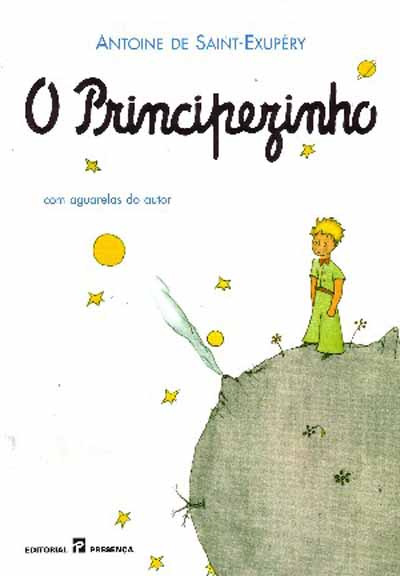
O Principezinho
O Principezinho é um livro de Antoine de Saint-Exúpery, um autor e aviador francês. Li-o em Francês quando era jovem, e mais uma vez em Inglês quando tinha uns vinte anos porque um amigo deu-me uma cópia. Agora que estou a estudar Português, comprei a versão portuguesa e li-o para parte dum desafio de leitura.
O livro é pequeno, com muitos desenhos (aguarelas) e por isso é muito fácil para um aluno com poucos conhecimentos da língua. O argumento consiste num piloto perdido no deserto. Acho que este piloto é o próprio autor do livro. O seu avião não funcionava e ele estava a tentar consertá-lo. De repente, um rapazinho apareceu. Com as suas palavras primeiras, o rapazinho – o principezinho do título – pediu-lhe que desenhasse uma ovelha. Tinha muitas dúvidas sobre a vida na terra e contou uma historia da sua vida num pequeno planeta e da sua viagem através das estrelas. No caminho, encontrou muitas “pessoas crescidas” que tinham atitudes estranhas de adultos em toda parte: interessavam-se apenas por dinheiro, no seu próprio poder e nos seus trabalhos.
No curso da história, o protagonista fez muitas observações sobre as diferenças entre as crianças e os adultos. Aos adultos falta-lhes* de imaginação. Não compreendem nada por causa da sua obsessão com números. Adoro este livro!
*=Woah! This grammar was contorted into a shape I really wasn’t expecting by the people who marked it
O Mandarim
Como disse no registo passado, eu tive vontade de fazer parte dum desafio de leitura, e por isso li dois livros portugueses. Actualmente, estou a ler um terceiro – em inglês – e vou escrever sobre ele em português mais tarde.
O segundo livro foi “O Mandarim” de Eça de Queiroz, um famoso autor português do século XIX. “O Mandarim” é um conto muito curto dum homem que tem a oportunidade, por circunstancias sobrenaturais e esquisitas, matar um imperador chinês e herdar as suas grandes riquezas. A história lembrou-me dos livros “Faust” (de Goethe) e “Doctor Faustus” (de Christopher Marlowe). Confesso que não percebi tudo no livro. Hei de voltar a lê-lo mais tarde quando tiver mais tempo, mas no fim, o homem fugiu duma emboscada e regressou a Portugal.
Dentro da capa da minha copia existe um CD com a gravação duma mulher a ler a história, então posso praticar a compreensao auditiva do texto ao mesmo tempo que leio. Há também um apêndice lexical com traduções das palavras difíceis. Infelizmente, um dos capítulos estava ausente no CD, e as traduções são em espanhol! Ora bem, não faz mal. Tenho um bom dicionário e sou perfeitamente habilitado para ler um capitulo sem ajuda!
The Puppet
“The Puppet” (A Marioneta) é um livro de Ibrahim Al-Koni. Para ser honesto, estou a escrever este comentário antes de acabá-lo por… Por razões, OK, não importa nada o quais são as razões!
Ora bem, este livro é o segundo duma trilogia. É muito difícil mas muito interessante apesar disso. O argumento consiste num grupo de nómadas Tuaregs. No final do livro passado, acabaram a caminhar no deserto e estabeleceram um aldeia acerca dum oásis. No curso deste livro, a sua sociedade mudaram a seguir às ideias do Ibn Khaldun, um escritor árabe do século XIII. Escolheram um líder novo. Esse líder é a Marioneta do título. Os cidadãos mais ricos começaram a persuadi-lo a alterar as regras para deixarem de utilizar o ouro como dinheiro nas trocas comerciais. Estas mudanças, segundo Ibn Khaldun, enfraqueceram o povo que se preparou para o derrubarem por um novo, o mais forte grupo de nómadas. Ups – Spoiler alert! Isto vai demorar até o livro terceiro…
O jantar está pronto. Não tenho tempo para reler isto nem fazer as correcções. Ora bem, provavelmente haverá mais erros do que normalmente…
The Video Version
My daughter made the background and has recorded her own (english) review of the Little Prince, and answered some of the “Top 6” lists on the #HotSummerReading challenge page.
Language exchanges might just be the best thing about the Internet. We don’t need to go to lessons anymore, we can just reach out to other people through apps like Hellotalk or iTalki and learn from them as they learn from us, and it doesn’t cost a penny. It has taken me a while to get going but these days I have a really good network of people I chat to, or whose instagram and twitter feeds I read.
The aspect of it that might seem like a drag – having to answer other people’s questions for half the time – is actually one of the best bits because it makes you realise how utterly clueless most of us are about what we say and why. I’ve lost count of the number of times someone has asked me a question and I have been floored. For example, one of the most common questions I get from lusophones is when do we use the various types of of past tense:
I worked
I have worked
I was working
I have been working
On the face of it, this is quite simple, but the more you think about it, the more you realise that it’s not. We use them in ways that don’t seem to fit with their textbook definitions, and yet that use and misuse isn’t arbitrary or wrong. If someone uses the wrong tense, it stands out a mile. The whole business of tenses is much more involved than it seems. We also use the present tense in place of the past (in jokes mostly) and in place of the future tense (all the time) and don’t even realise it. We have different future tenses and different presents and they’re deployed in ways most of us can’t even begin to explain.
I’ve also been asked what we say at the end of conversations and online chats – the equivalent of the Portuguese “beijinhos” (kisses) or “um abraço” (a hug). I couldn’t answer because it’s so dependent on your age, how well you know the person, where you are, what you’ve been talking about and half a dozen other things. There must be some deep-seated rule that we’re all more-or-less aware of but writing them down would be impossible, and even if you could do it, it would be out of date within a year.
Portuguese people are the same. Quite often I’ll ask a question of three different people and get three different answers, or the person I’m speaking to will think for a bit and give a very hedged, ambivalent answer. I’ve recently written a couple of blog posts about grammar that are stitched together from several written and oral sources and I really got a sense of how subjective these things were.
Ultimately, though, it doesn’t really matter. Knowing the rules helps us to an extent but it’s not everything. We really need to use the language *a lot* to get familiar with it and get a sense of what feels right.
Ser and Estar are two little words that cause a lot of people a lot of pain because they both mean “to be” but they’re used in different situations. Usually they’re pretty straightforward but there are some weird hinterland cases I often struggle with so I am going to use this page to list some of them. I’ll add to it as they crop up.
Backing up a bit for the benefit of any newbies who are reading this (srsly dudes, you’re in the wrong place)
Ser
Ser comes from “Esse” in Latin and it’s cognate with the english word “Essence”. You use it when you are talking about some essential qualities a thing or a person has that are permanent and unchanging
He is tall
You are intelligent
I am the Walrus
It is made of wood
Are all examples of phrases that tell you something about someone’s or something’s essential nature so they all take “ser” in Portuguese
Estar
Estar is from the latin “stare” and it’s cognate with “status” so you use it when you’re talking about a situation that a person or thing is in now.
He is in the bathroom
He is ill
It is on fire
Are all examples of phrases that tell you something about what state something is in at a fixed point in time, so they all take “estar” in portuguese.
Ficar
There’s a third word “ficar” which actually means “to remain” but it can also be use for geographical sentences
Lisbon is in Portugal
The shop is in Kingston
In each of these the portuguese would use Ficar because the geography is fixed and it ain’t moving.
You can also come across it in some other situations like “ficou feliz quando leu a carta”, which can be confusing since it looks like we’re using the “geographical is” to describe a very transitory emotion. Here, the person isn’t saying “he was happy” but “he became happy”.
Don’t blame me, I don’t make the rules.
So What Are the Weird Situations?
So far, so easy, but when you start to think about these things it starts to get a bit perplexing though. Here are some conundrums and the suggested solutions
Weather
“It’s a beautiful day”
Ser or Estar?
Well the weather changes, so that sounds like Estar. Ah, but today is today. The weather might change tomorrow but tomorrow is tomorrow. Today is beautiful. It was always destined to be beautiful. And when I look back on the selfies I took today I will remember how beautiful it was, from start to finish.
To cut a long story short, you’re basically safest using “estar” for anything weather-related. I have seen “é um dia muito bonito”, so the ser form isn’t completely crazy but estar seems to work in basically any situation, so I would suggest sticking to the idea that the weather is fleeting and slathering estar all over it.
The View Out the Window
Heraclitus said “You Can Never Step In the Same River Twice”. If you step into the Thames tomorrow, the water that was in it today will have flowed away and been replaced by new water. There’ll be new leaves, new ducks, new discarded coke cans. Every day, I thank the Lord that I don’t have the job of translating Heraclitus into Portuguese.
This past Tuesday, I was on the train and I wanted to describe the view. Is a view out the window a transitory phenomenon like Heraclitus would have said or a more permanent one like his pal Permenides might have said*? The hills and trees are as permanent as a thing can be, and the fact that the train is moving past doesn’t change them. Does that matter? I decided it was probably estar because the view from the window would sometimes be of the back of a Morrisons supermarket or a junkyard or a giant poster of Boris Johnson.
The view in question. Heraclitus asked me to make this an animated gif, but I’m with Parmenides on this one
So are all views from all windows always estar? No matter where the window is, the weather will change and so the view will change from day to day? Well, I raised this in a discussion and my good friend Márcio helped me (as he always does) to get my head around all this, confirming and clarifying what I was trying to think through. If you live in a house on a hill, one of the selling points of that house might be its view across a lake or a meadow. In that case, it would be fair to say that the view from the house was a beautiful view always and ever, despite fluctuations. That’s it’s defining characteristic, even when the fog is temporarily obscuring it.
A vista pela janela do comboio estava linda
A vista pela janela do meu apertamento no 23° andar era linda
Jobs
Sou profissional de informática. That’s what I’m trained for, and if I move from place to place, that’s what I’ll remain. Even if I get a job as a postman, temporarily, because I have found myself between contracts in December when the Christmas rush is on, I will still be a profissional de informática who happens to be delivering your graze box this morning.That seems fine for people who have chosen a career path, or who have had specialist training of some sort. But what about transitory jobs we do for a few weeks? What about jobs we do but feel no affinity for and don’t identify with; jobs, in other words, that just pay the rent?
Again, there’s no room for estar here. Estar is never (?) used to just make a simple link between two nouns; if it’s not paired with an adjective then “ser” is what you need., so if you wanted to say you were a postman you’d still say “Sou Carteiro”. Does this seem odd that you can be both a Profissional de Informática and at the same time um carteiro? Well, apparently not, although if you wanted to stress the temporary nature of the gig you could rephrase it by saying “I am working as a postman” instead of “I am a postman”, which, thinking about it, is probably what you’d do in English, too.
*= I happen to know Parmenides used Southeastern Rail and long hours of being completely stationary were a formative influence on his views on this matter.
Last week I identified four stubborn problems that – like Scott Pilgrim and the 7 Evil Exes – I had to battle to the death. One of those was to do with fiddly small words in front of infinitives. A lot of this seems to have to do with compound verbs vs ordinary, run-of-the-mill infinitives.
So let’s dive straight into compound verbs…
Compound Verbs
Compound verbs are verbs that are treated as one action but are made up of two verbs glued together. A familiar example is this harmless Pretérito Perfeito Composto
eu tenho chorrado*
You just take part of the verb “ter” and glue it onto your verb and magic happens. We have the same thing in English: “I have overslept”, “I had forgotten to set my alarm clock”. These are pretty easy to use so I’m not going to write any more about them because I don’t fund them confusing at all. In fact, their easier to use than most types of verbs. If you’re not familiar with them, don’t worry, you’ll meet them soon enough and you won’t have any trouble.
Where it gets trickier is when you have verbs made up of some other verb, followed by a short joining word and then an infinitive. There are lots of different ways of classifying them but I’m going to divide them up into groups according that have similar types in, and crucially, each member of the group uses the same joining words. If you don’t like the way I’ve done it, try this page from Ciberdúvidas instead. It has a totally different approach.
[A] Compound verbs showing an action that’s starting or ongoing:
Estar, Andar, Ficar, Começar or Continuar + a + infinitive
Estou a escrever este blog
Anda a aprender
Ela continua a dar aulas
Começo a ler a revista
Ficar a olhar
I would think of these as “Starting to do…” or “Continuing to do” so the “a” fits nicely because it means “to”
[DE] Compound verbs describing an action that’s abandoned
Deixar, Acabar or Terminar + de + infinitive
Deixa de fumar
Acabou de ler o livro
Terminar de tocar a guitarra
I would think of these as “leaving off of doing something” and “de” means “of” so that makes sense
[DE] Compound verbs describing something you have to do
Ter or Haver + de + Infinitive. In the case of haver it’s a slightly vaguer and more speculative kind of obligation: something you ought to do at some point rather than something you’ve got to get done right now.
Hei-de ler “Matadouro Cinco”
Tenho de cozinhar esta noite
I would think of these as “I have to do something”. I want to squeeze an “of” in there to make the “de” fit but I can’t, sorry… By the way, is it just me or is Haver the most freakishly unpredictable and incomprehensible verb in the language?
[] Compound Verbs Describing Potential for Action
Ir, Poder or Dever +[No joining word] + Infinitive
Vou ganhar o prémio
Posso ajudar?
Deve estudar
I would think of these as “I’m gonna do something”, “I could do something” and “I should do something” so no joining word needed.
Things That Look Like Compound Verbs But Aren’t.
Some verbs can take an infinitive as their object and so the joining word will depend on the verb in question. So for example
Gosto de ler
Preciso de ler
both look a bit compound verby but Gostar and Precisar are the main verbs of the sentence and ler is basically being treated as a noun. Both take a de because the verbs are a bit strange. It’s easiest to understand gostar as meaning “to be pleased” so Gosto de ler means “I am pleased by reading” and Precisar is more like “Have a need” so precisar de ler means “I have a need for reading”
Adoro ler
means the same as gosto de ler but it doesn’t need the de because it’s a bit more direct. “Adorar” means “to adore” and you don’t need to adore of something or adore by something, you just need to adore it.
Likewise in the song Deixa-Me Rir, I asked my teacher** why it wasn’t “Deixa-me de rir” like in the example above: “deixe de fumar” but here he’s not talking about letting go of something, he’s talking about being allowed to do it,so Rir is being treated as an object again
Some of the harder-working irregular verbs can be used with prepositions in a way that changes their meaning and in some cases they can be used with infinitives. These buggers are a law unto themselves
Dar + para= to be suitable. Essa caneta não dá para escrever uma carta
Ficar + por= to fail to do something: Fiquei por escrever o meu livro
Passar + a= to change: Depois do desastre, passei a ser outra pessoa
Other Structures Involving Infinitives
In other situations, infinities can be preceded by joining words but it seems even more random.
Quem me dera falar português como a minha esposa
Who will give me speaking portuguese like my wife? (No joining word)
Estou contente por saber que a sua equipa ganhou o tri-campeonato, seja lá o que isso for.
I am content through knowing….
Or
Estou contente em saber que a sua equipa ganhou o tri-campeonato, seja lá o que isso for.
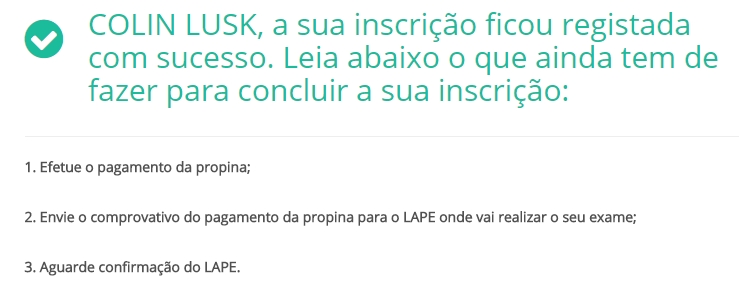
I finally managed to make my subscription for the Portuguese B2 exam, the intermediate Diploma. It feels like I have a long, long way to go but this should motivate me to work hard between now and November!
…using this graphic as a sort of site icon. It reminded me of something though, and I couldn’t think what. Then it clicked: the name Portugal doesn’t come from the Arabic word for orange at all, no matter what I said last week. It’s clearly a corruption of “Pokeball”
There are a few really stubborn mistakes I just can’t seem to get past. They crop up again and again, and I never get around to addressing them because they are boring and too obscure to be easily addressed by googling “How to do ____ in Portuguese”. I think if I could sort them out a lot of the baseline problems with my sentence-construction would be sorted and I’d be a much stronger speaker.
Little Fiddly Words In Front of Infinitives
Infinitives are the definitive forms of a verb, normally translated as “to be”, “to know”, “to do” and so on. Because of this, when I write one in portuguese I expect it to not need anything in front of it but sometimes it does and sometimes it doesn’t. About the only rules here are to do with Gostar and Precisar, each of which takes a “de” after it
Ter can have a “que” or a “de”, depending what you’re doing and in other cases it might have an “a”, a “para” or just nothing. I need to get to the bottom of this and work out how it works once and for all.
Genders of Nouns
I think I’m right about 80% of the time but that’s not enough. Difficult to think how to do this without biting the bullet and learning them by rote. I considered making little stickers with lipstick on some and a moustache on others and sticking them on all the objects in my house, but that wouldn’t help me with abstract nouns. Have you ever tried sticking a moustache on despair?
Reflexive and Pseudo-Reflexive Verbs
First of all: there seem to be a hell of a lot of reflexive verbs – far more than in french – and I sometimes come across verbs that look like they have a reflexive pronoun but aren’t actually reflexive. They seem to be something to do with the passive voice – e.g. sabe-se que = “it is known that…” and yet my grammar book doesn’t show that as a way of constructing the passive voice. This sounds like one I will have to ask a teacher about.
Awkward Irregular Verbs
Things like Ser, Ir and Estar are easy because they get so much attention. The real killers are things like Dar, Pôr and of course the terrible twins, ver and vir, because they irregular and fairly common but not so common that you get a real familiarity with them day-to-day. I printed these buggers out ages ago, thinking I would just bruteforce it all into my head but somehow, whenever I think about it, there always seems to be something more pressing like picking fluff of the carpet with my bare hands, arranging my socks alphabetically or playing the national anthem on the teeth of a comb. Important stuff, you know.
So that’s what I’ll be working on this week in addition to my Hot Summer Reading. I’ll probably write blog posts about some of them as a way of motivating myself and getting them to stick.
 So I’ve finished my reading for this book blogging challenge and it’s been a brilliant source of motivation to read portuguese in massive (for me) doses. I’ve written reviews of all three books on iTalki and I wanted to make a recorded version as well to make some of the vocabulary stick, and my daughter, who is an expert on vlogging, helped me record it. It’s pretty dreadful though, I’m afraid… I’ve put it down at the bottom where it belongs

 …using this graphic as a sort of site icon. It reminded me of something though, and I couldn’t think what. Then it clicked: the name Portugal doesn’t come from the Arabic word for orange at all, no matter what I said last week. It’s clearly a corruption of “Pokeball”

