This aspect of portuguese is seldom part of standard lessons. Maybe it should be?
Category: English
Capitão Fausto – Na-Na-Nada
Welcome back to the Capitão Fausto Fan Blog! It’s still Friday night as I write this, and the translation I did for yesterday’s blog was so short I thought I’d try another
| Português | Inglês |
|---|---|
| Quando aqui chegou Foi porque ainda não estava Nada se apagou enquanto eu protestava E às tantas sossegou Explicaram que afinal não era nada | When she* got here It was because she wasn’t here yet Nothing stopped while I was protesting And at last it calmed down They explained that in the end it was nothing |
| Andar em contramão Calçar a botifarra Quero ouvir calão e o som de uma guitarra Se dás, eu também dou Se gritas muito, eu dou-te uma dentada | Going against the flow Putting on my clumpy boots I want to hear slang and the sound of a guitar If you give I’ll give too If you scream, I’ll bite you |
| Cheguei a casa e sossegou Explicaram que afinal não era na-na-na-na nada Na-na-na-na-na-na Na-na-na-na nada, na-na-na-na-na-na Na-na-na-na nada, na-na-na-na-na-na Na-na-na-na nada, na-na-na-na-na-na | I got home and chilled out They explained that in the end it was no-no-no-no-nothing, no-no-no-no-nothing No-no-no-no-nothing no-no-no-no-nothing No-no-no-no-nothing no-no-no-no-nothing No-no-no-no-nothing no-no-no-no-nothing |
| Quem me der a mão é porque quer que eu nunca caia Pode ser que queira vir comigo até à praia Ou pode ser que não, de qualquer forma vai ter de entender Que ainda há muita coisa pra aprender Algumas delas servirão Mas outras nunca vão servir pra na-na-na-na nada | Whoever gives me their hand, its because they don’t want me to ever fall Maybe they want to come to the beach with me Or maybe not. Somehow she’ll have to understand That there’s still a lot to learn Some of them will be OK But others are good for nothing |
| Na-na-na-na-na-na Na-na-na-na nada, na-na-na-na-na-na Na-na-na-na nada, na-na-na-na-na-na Na-na-na-na nada, na-na-na-na-na-na | No-no-no-no-nothing No-no-no-no-nothing no-no-no-no-nothing No-no-no-no-nothing no-no-no-no-nothing No-no-no-no-nothing no-no-no-no-nothing |
*Honestly, it’s anybody’s guess what pronouns to use in most of this song. Who or what is he on about? Are those imperfect verbs in the first or third person? Can we even get an adjective with an ending that tells us what gender we’re dealing with? Throw me a frickin’ bone here!
OK, I think I’m sick of them again now,
Capitão Fausto – Santa Ana
Well, I can’t see my new pro-Fausto stance lasting long because, as I said yesterday, their studio output is quite bland and overproduced, but while I am in the zone, let’s try a translation. This is Santa Ana from their first album, Gazela, and one of the songs they played as the finale for the show.
| Português | Inglês |
|---|---|
| Está a chover dentro da sala de estar A casa ardeu; ninguém parou de dançar | It’s raining in the living room The house caught fire. Nobody stopped dancing |
| Ela diz que devo aprender As noites simples e o que é ficar Ela é linda e o seu parecer Faz-me sentir que é tempo de mudar | She says I should learn The ordinary nights are what it is to stay She’s lovely and her appearance Makes me think it’s time to change |
| Está a chover dentro da sala de estar A casa ardeu; ninguém parou de dançar | It’s raining in the living room The house caught fire. Nobody stopped dancing |
| Ela diz que eu devo aprender As noites simples e o que é ficar Ela é linda mas não quer ver Que qualquer dia já cá não vou estar | She says I should learn The ordinary nights are what it is to stay She’s lovely but I don’t want to see That someday I won’t be here |
Is that all? 8 lines? I don’t feel like I’ve had much of a workout. That’s a long instrumental break they did at the end there. OK, well, I like the lyrics anyway, even if they are a bit terse, sometimes it’s best to keep it tight and not waffle on for 4 verses. I hope you enjoyed it.
Second Exam Result and The Next Stage
Got the result for the second of the exams. It arrived via a completely different route from the other, contributing to my impression that the Universidade Aberta’s systems are a bit more random than the Open University in Britain. Anyway, never mind. As for my own performance, well, it was pretty terrible. Worse than expected, even. 7/12, which is only just over the pass mark. Luckily, this one has 40% for continual evaluation though, and I did pretty well in that so the average was dragged up. 13.7/20 which is what? 65 +3.5 = 68.5%. That’s not bad really! If I’d had 5 more minutes for a quick grammar check Iºd have probably gone up 5 or 10%, I think, but it was not to be!
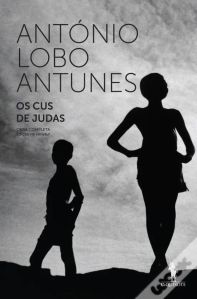
The final stage of the course is starting now: Literatura e Cultura Portuguesas – Época Contemporânea. It seems to be all about the colonial wars and the end of empire and there are three set books, two of which I have read already and one is on my TBR: respectively “O Retorno” (Dulce Maria Cardoso), “A Costa dos Murmúrios” (Lídia Jorge) and “Os Cus de Judas” (António Lobo Antunes). I’m excited to get started because I enjoyed the first two books but don’t remember them well, so a guided re-read of them would be great, and Os Cus de Judas comes highly recommended too!
Final Mark’s In For The Literature and Culture Exam
And it’s not exactly easy to find. Nobody told me I had passed or anything but according to the site I got “18.00”. OK, well fine but out of what? Not 18% I hope!
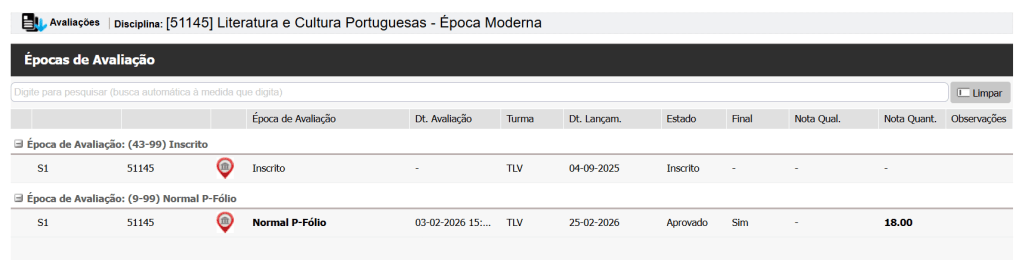
I had to go back to the course description in the end and it says that…
O Exame Final consiste numa única prova escrita, realizada na plataforma WISEFlow e classificada numa escala de 0 (zero) a 20 (vinte) valores.
So… I think I got 90%! Pretty pleased with that! The pass mark is only 50, and 90% is way beyond what I’ve got in any exam since O-Levels, so yeah, pretty pleased!
Oof, Well That Went Sightly Less Well…
I’ve just finished the literature exam. I think I gave pretty solid answers, but I was much more pressed for time in this one than the last and crucially didn’t have time to go back and fix typos. And the browser they use for the exams doesn’t even have spellcheck or any of the other features I take for granted when writing here, say, so I imagine I will be losing some marks for my shit grammar.
Chewing over other things I probably could have done better, I discussed a narrative told to the narrator by a character she interviews and I probably should have slipped the word “intradiegético” in there somewhere. Likewise, when discussing other forms of art used as framing devices in Os Memoráveis (the fact that they are making a film, and the fact that they have a photograph with them which they are using the jog people’s memories) I think I explained the mechanism pretty well but I should have used the word “intermediality”. Just throwing away points, there.
Half way through, a parakeet came and landed on the bird feeder near where I’m sitting. It’s really only for little birds like robins and tits, so if I see a parakeet, a crow or a pigeon out there I usually chuck a pen, or whatever is to hand, at the window to scare them away. This time I only had my wallet so I threw that, realising, just as it left my hand, that the window was open in the direction i was throwing. Luckily, I hit the glass and disaster was averted. Imagine how embarrassing it would be to have to come on here and say “Well, I was failed for leaving the table for 3 minutes while I ran downstairs to retrieve my credit cards from the pavement after lobbing them at a ring-necked parakeet”!
Revision
Since the final exam of the literature module starts in an hour and a quarter, I might have left the revision a bit late. In truth, I haven’t even finished the third book. It took me ages to get into it although now I have, I am flying along but I haven’t reached the end. Oh well, never mind, I can finish it in my own good time
Conceitos
Intermedialidade
A intermedialidade é a possibilidade de descobrirmos interações entre discursos em mediáticos autónomos: livros, filmes, bandas desenhadas podem dialogar entre eles.
-> e intertextualidade é um sub-genero disto.
Transnarratividade
A transnarratividade é a disseminação da narratividade em práticas para além das narrativas formalmente constituídas como tais.
Transmedialidade
A transmedialidade trata-se de uma passagem de uma narrative de uma forma para outra. Por exemplo, uma adaptação de um livro no cinema.
Figuração
Processo de construir uma “figura” ou seja um “ser de papel” (Barthes, citado por Carlos Reis) o que não se restringe a uma aceção personalista ‘ veja por exemplo a Casa do Ramalhete d’Os Maias ou a Manderley no Rebecca. “Os Cinco Mil” é um exemplo disto
Liberalismo e romantismo – interlogados
Oitecentista
Extradiegetica « o narador
Intradiegetica – contado por uma personagem
Metadiegética – dito por uma pessoa em curso de uma narrativa contado por uma personagem!
Viagens na Minha Terra
1846 – entre 1789 e 1848! (uau! a serio?)
Joaninha – Ultrapassa o arquétipo da “Mulher Anjo” ou mulher siflide – “a menina dos rouxinois
Carlos – herói liberal de sangue quente, dividida entre a Georgiana e a Joaninha. “Rousseauniano” . Acaba gordo e um deputado.
Frei Dinis – Inflexível, consciente do seu grande pecadp
A terra como figura
“Fashionável”
Trio em Lá Menor
Os Memoráveis
“De todos os testemunhos, sem dúvida o mais emotivo aquele que é dado pela viúva de Charlie 8 “o rapaz dos tanques e dos chaimites”, aquele que pôs o relógio da história a andar, mas que o regime maltratou, negando-lhe uma pensão que não negou aos torcionários da pide.” here
Aaaaand thatºs all i had time for really…
This Made Me Giggle
I love a dad joke and this is a good example of the genre. It’s a good example of how prepositions in Portuguese are often different from what we’d expect on English. Where we would say “You can count on me” as a way of saying I’ll always be there when you need me, in Portuguese you say “Podes contar comigo” (You can count with me”. So…
That Went Well
Or at least I think it did. The exam has just finished. It was only an hour and 45 minutes. The assignment had two parts:
The first was to rewrite a text that had a load of errors in it. For example, it said the aim of the course was to see how Portuguese identity had changed and the role of literature on this process, which true to a certain extent, but that’s not the stated objective of the course. Then it said that there were four key figures of the course. I rather snippily added a parenthesis saying it was three individuals and a couple. I suppose arguably two couples but the Marquês of Chamilly has no rights. We do not stan. The four, it claimed, reinforced traditional stereotypes (yeah, sure, Brites de Almeida is a typical girly girl). It described Teorema by Herberto Hélder but made some straightforward mistakes – the identity of the protagonist, his first name, and the centuries in which the story takes place. The story is so good that I was able to spot the mistakes pretty well, except that the text said it took place in Santarém and I honestly have no idea where it’s meant to have happened, so although I thought it was probably wrong, I left it as it was.
The second question just asked in what way this statue represents Dom João II. I had included it in my revision first thing this morning, so I had all the vocabulary to hand.
Where might I have gone wrong?
Well, first of all, the setup of the question seems to imply that there are certain indisputible mistakes in the first text. I thought some of them were a bit debatable and probably waffled on a bit, explaining to what extent I thought the statements were false and why. But I still finished early, so… Well, i surely wasn’t supposed to do less was I?
And secondly, in expressing my fascination with the story of the Portuguese letters, I came down pretty unambiguously on the side of the non-marianistas. The question didn’t really ask for a discussion of the pros and cons of this point of view so I thought I was pretty safe there but I’ve probably expressed it too strongly. I say she was the victim of a lie (because tbe letters were probably fake) but now I think of it again, I wonder if it comes across as me saying the romance itself didn’t happen. That was probably clumsy.
On the whole, I really enjoyed this challenge. It was nice to write a piece of graded work in an exam setting where the aim was to communicate, and to make a particular case, and not to be grammatically correct. I checked the grammar, of course, but the grammar wasn’t the point, as it would have been in a CAPLE exam.
And This!
Yeah, I know I missed them last time, but this one is on my wedding anniversary so, rota allowing, it might be an actual date!
 Luso
Luso 