Text about the bookshops I visited on my recent road trip to Cambridge. Notes at the bottom. Thanks “Butt Roidholds” for the corrections.
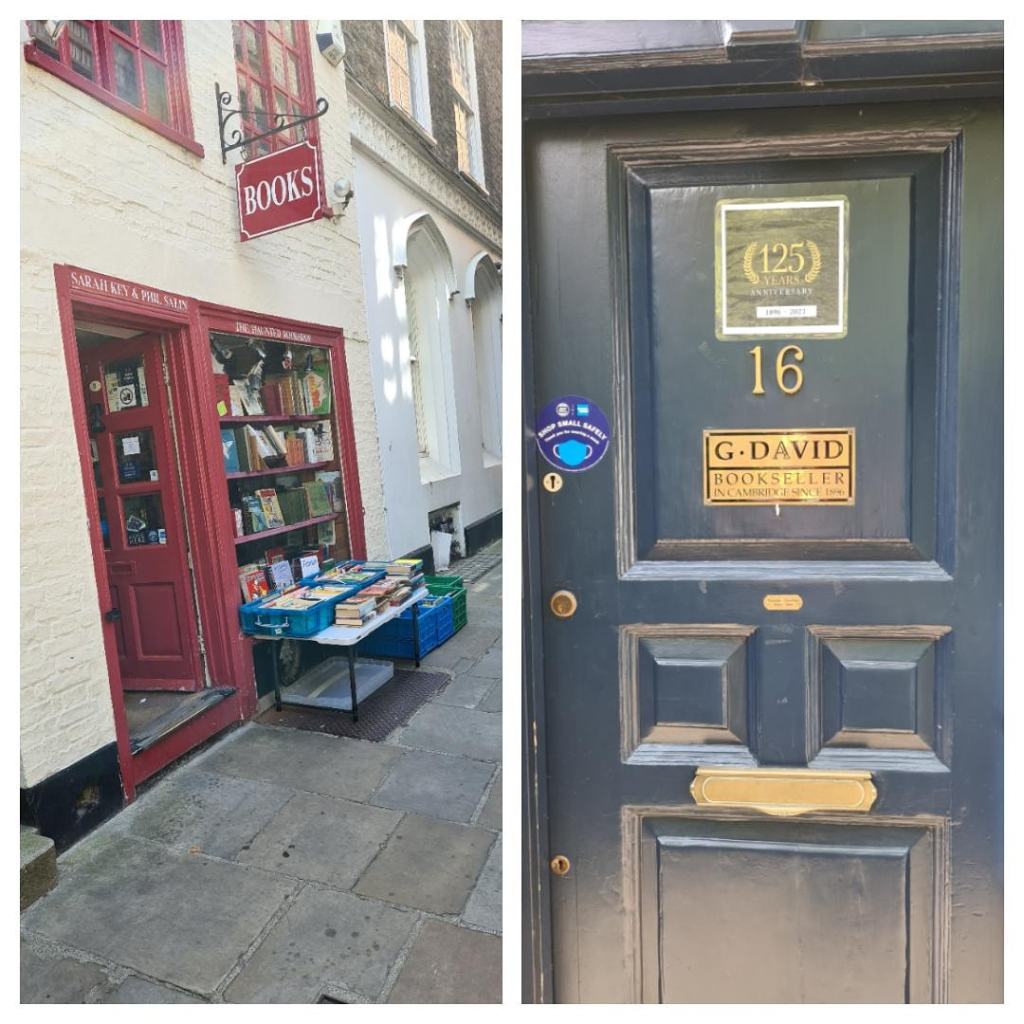
Visitei duas livrarias de segunda mão em Cambridge. A da direita é mesmo bem arrumada e cheia de artigos meticulosamente organizados* e de alta qualidade mas a da esquerda (mesmo ao pé da outra) é gloriosamente desconjuntada com tudo arranjado de modo aleatório, com duas filas por prateleira, com uma vasta secção de livros infantis, e itens raros intercalados com outros mais quotidianos. Acho que se pode escrever uma dissertação sobre a relação entre a disposição duma livraria e a personalidade do seu dono.
*=i originally used “itens cuidadosamente curados” to mean “carefully curated items” but “item” has a limited meaning – just referring to items on a list, agenda or inventory and “curado” can’t be used in that way.
Acabo de fazer um churrasco. É difícil de arranjar pois vivemos num apartamento e não temos jardim. Há quem goste de impedir qualquer tentativa de diversão no campo à volta do prédio mas felizmente nesta ocasião, não houve problema. Consegui grelhar as salsichas e os hambúrgueres sem os queimar ou os deixar cair na relva. A nossa convidada (a minha sobrinha) gostou da comida e o jantar correu bem.
Today’s text was corrected by Travonildo (thank you!)
Vou dar uma voltinha de bicicleta daqui a dois dias. Não tenho trabalho (temporariamente, espero eu) portanto tenho a oportunidade de fazer umas mini-férias em Cambridge, 70 milhas do nosso lar. A minha família prefere ficar em casa mas eu fico com vontade de viaja para os quatro cantos* do mundo… Mas para já Cambridge há de servir. 70 milhas num só dia será um desafio. Nunca andei tanto num dia sob o meu próprio esforço (nem de pé nem de bicicleta) mas preciso de perder peso e preciso de estar sozinho durante algum tempo. Por isso a bicicleta é perfeita.
* =There are a couple of words for corner: esquina and canto. But canto is the right one for this situation. This expression means “the dour corners of the world”. I got it wrong in the original.
It’s a new bike by the way. I’m very excited. Its so fast and so easy to ride.
I’d been arguing yesterday about whether or not boiled eggs belong in a fish pie so I decided to make a Portuguese version of the recipe. ThisCatIsConfused helped me to debug the grammar and wins my undying gratitude (gratintude?) again.
Ingredientes: 1kg de batatas 400ml de leite 25g de manteiga 25g de farinha de trigo 350g duma mistura de peixes congeladas tal como bacalhau, solha, atum, (pode-se incluir camarões também) 4 ovos, cozidos e cortados pela metade* Uma mão-cheia de ervilhas Sal pimenta e salsa qb**
Método Pré-aqueça*** o forno a 200 graus Coza as batatas e esmague-as. Adicione um salpico de leite e continue a amassar até ficarem puré. Entretanto, derreta a manteiga num tacho. Coloque a farinha dentro e mexa. Quando os dois ficam uma massa, despeje o leite no tacho. Vá mexendo o tempo inteiro para fazer um molho branco e cremoso. Deite o peixe num prato refratário com o molho, a salsa e as ervilhas. Ponha as metades de ovo em cima e cubra todos os conteúdos com puré de batata. Se quiser, pode-se colocar um pouco de queijo talhado também. Leve o prato ao forno para gratinar durante 25 minutos até a superfície ficar dourada e o molho estar a ferver. Sirva com couve branca ou brócolos.
*=i will die on this hill!
**=qb stands for quanto baste, ie, as much as you need. It’s equivalent to “to taste” in English recipes
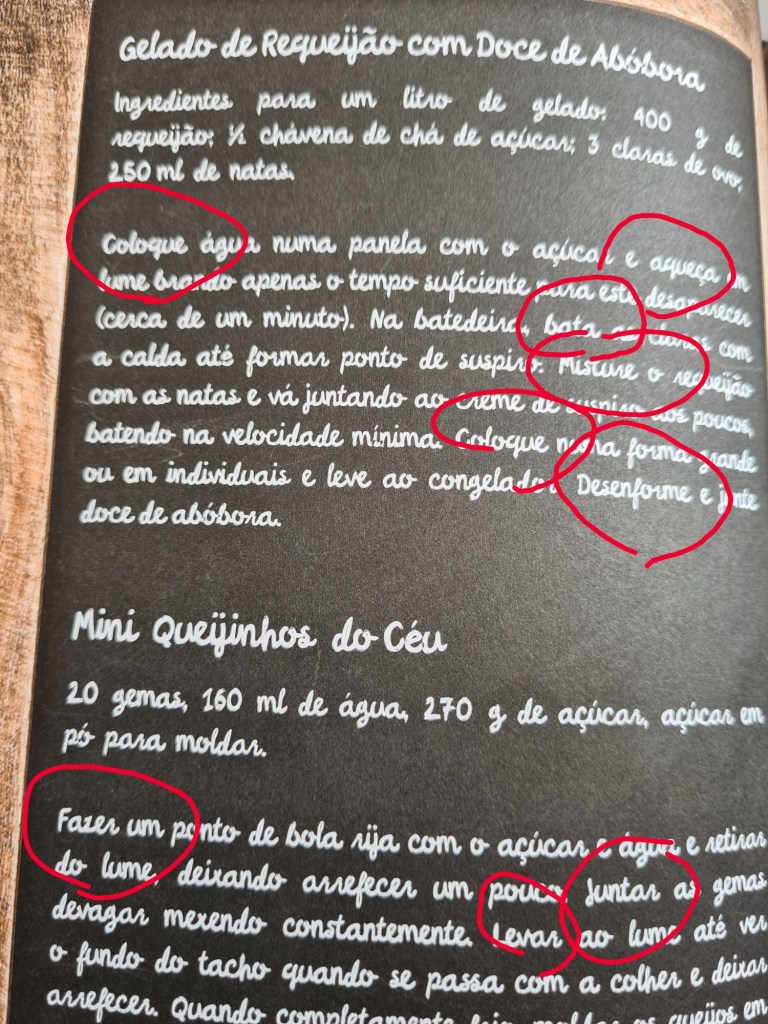
***=what tense to use for the steps in a recipe or an instruction manual is more complicated than in English. It’s not just “do this, do that, because that tense (the imperative) has both a singular and a plural form and of course formal and informal too. This is using singular imperative, as if I were giving instructions to one person, but for example you can find someone here writing instructions and clearly imagining herself addressing a group of readers using the plural imperative. There doesn’t seem to be much reason to choose one form over the other, apart from just whether you want to want to come across like a classroom teacher (addressing people as a group) or a coach (making each reader feel like you are addressing them directly). To complicate things even further, it’s also possible to write the entire text in infinitives. You can see a good example of this in a single page of a beautiful book called Viagens Pelas Receitas de Portugal By Nelson Carvalheiro.
In the first recipe, he’s using a singular imperative for every verb that’s giving an instruction: coloque, aqueça, bata, misture, coloque, desenforme. In the second he switches to infinitives: fazer, juntar, levar and so on. There are other verbs too, including a present participle (deixando arrefecer=leaving it to cool) but the overall voice of the recipe is all infinitives all the way. I found this really confusing when I first saw it, but it’s a thing apparently!
Update later the same day:
I asked about this on the reddit forum and the consensus was that the infinitive and imperative forms were equally acceptable but that maybe the infinitive had been used more recently because historically the standard was formal/imperative but that seemed too formal and the infinitive allowed people to opt out of commitment to one level of formality and keep it all neutral.
Portuguese Version of yesterday’s post about bottling out of the lesson about Portuguese suffragettes. Notes at the bottom. Thanks to “Butt Roidholds” for the corrections!
Carolina Beatriz Ângelo, The first woman to vote in Portugal, in 1911
Há umas semanas, fiz parte dum curso lançado pela livraria Bertrand, apresentado por Marco Neves, um autor português que escreveu livros tal como “Doze Segredos da Língua Portuguesa”. Gostei tanto, tanto! Fiz um resumo do curso no meu blog e inscrevi-me em mais um evento. Desta vez, escolhi um curso que faz parte duma série sobre feminismo e que fala sobre a história do movimento sufragista. Boa. Chegou a noite do curso. Abri o Zoom e vi a professora. Mas ela pediu aos* participantes para ligarem as câmaras e os microfones. Meu Deus, tinha pensado em ficar só a ouvir mas se tivéssemos de falar, não estava preparado para** ser o único homem e o único estrangeiro a discutir a minha opinião das heroínas da democracia portuguesa.
Fechei o zoom e fui-me embora!
*=pedir a… para… if you’re asking someone to do something.
**=preparar needs para after it if saying “prepare(d) to”
I’m moving some of my more useful blog post material into some fixed pages that I’ll update from time to time. I like the idea that it’s safe in one place and not spread around all over teh last 5 years of material.
If you’re reading this on a computer you should see a list over there on the right 👉
If you’re looking at it on the phone it’ll probably be a few page-lengths down there 👇
And if you’re reading it on an etch-a-sketch you probably aren’t seeing it anywhere so here are the ones I’ve done so far (but there will be more soon)
This is a bit of a silly one. Notes down at the bottom. Thanks again ThisCatIsConfused for correcting it (and having the patience to read my silly word games!)
Abbabo de ver um filme baseado nas músicas de aca. Hum… Quero dizer “Acabo de ver um filme baseado nas músicas de ABBA”. O seu título é Mamma Mia. A minha filha e a sua amiga fizeram uma festa ontem à noite. Abbastecemo-las… Hum… Ou seja Abastecemo-las com petiscos e abbandonámo-las… Abandonámo-las na sala de estar. Hoje de manhã estão com sono e estão só capazes de comer panquecas com xarope e ver filmes.
Abbasar de ser…. Hum… Apesar de ser de sexo masculino*, gosto do filme. Há muitas estrelas no elenco. Acima de todos, gosto de Christine Baranski que é abbasolutamente… Hum… absolutamente fantastica. O enredo é engraçado, e as canções… Tipo… Quem não abbora ada… Ou seja quem. Não adora ABBA?
*=i just wrote “apesar de ser masculino but you have to say” de sexo masculino”. Probably would have been easier to say “apesar de ser homem” really, eh?
So what’s the joke?
I’d better explain for the benefit of anyone who is confused by the unfamiliar vocabulary that this is a sort of long-running pun: I’ve swapped the word “abba” onto other similar words like “apesar”, “acabo” and “abandonámos” and occasionally swapped letters in the other direction too. In each case, I correct myself immediately after but if you’re still at an early stage of your journey it probably looks a bit confusing so I’m sorry about that!
I joined in one of the Bertrand training courses I mentioned a couple of weeks ago. It’s part of a series on feminism, looking at the subject of the portuguese suffragette movement. I thought I’d try and listen in on the lecture and learn something about history. However, the person running it asked people to put on their cameras and mics so they could participate and I thought well, I don’t really want to be the only foreigner and in all likelihood the only bloke if it’s going to be a round-table discussion, so I scarpered. Oh well, that’s fifteen euros down the drain!
Practice text with notes. Thanks again, Dani, for the help
Quando comecei a aprender português há muitos anos, pus-me a memorizar as conjugações de verbos, e as regras e uma pilha de cartas de vocabulário. Este método é mais ou menos o mesmo que usámos na escola quando eu e os meus colegas da escola da escola aprendemos francês. Mas infelizmente é uma grande seca. Fiquei farto de flexões! Não fui capaz* de superar o obstáculo de aborrecimento, portanto não consegui aprender assim tanto. Mais tarde, decidi assumir um comprimisso**: “aprender português ou morrer na tentativa!” Comecei a ter aulas com uma professora aqui em Londres mas só mais tarde, quando ouvi um CD “Português com Michel Thomas” e depois li o livro do Benny Lewis***, cheguei a um nível de competência mais alto através de “Language Hacking”. Leio livros, vejo vídeos de Booktube português, oiço músicas… É mais divertido e por isso é mais provável que não desista!
*=não ser capaz, meaning “to be incapable” always seems like an unwieldy way of saying you can’t do something so in usually go for “não consigo” or “não posso” but it’s often a more natural way of saying it.
**=I wrote “fazer um compromisso” (make a compromise) but “assumir” is the better verb to use
***=I’m not sure if I’ve mentioned this book before even when I wrote a whole blog post defending him from some guy who criticised him a couple of years back, but it’s good stuff. I think the idea of language hacking is pretty mainstream these days, but if you haven’t already come across it, that’s a pretty good place to start.


 Luso
Luso 