Joaquim de Almeida no Festival Internacional do Filme de Amor em Mons (Bélgica) 2011 (pic. Ricardo Silva)
Here’s another biographical post with footnotes about the interesting corrections. Thanks to redditor MisterMister1964 for the help with this one.
Joaquim de Almeida é um dos atores portugueses mais conhecidos fora do seu país. Nasceu em Lisboa em 1957. Depois de uma juventude perturbada mudou de país para Áustria em 1974. Por lá, encontrou a sua futura* esposa, Andrea Nemetz, que, na altura, era secretária do embaixador do Zaire.
A Andrea recebeu uma bolsa para estudar nos EUA e o casal foi para lá em 1976 (tornar-se-iam cidadãos daquele país depois de algum tempo). No ano seguinte, Joaquim foi aceite num prestigiado instituto de artes dramáticas. Desde o início da década de 1980, tem protagonizado vários papéis em Hollywood. Sendo escrito por americanos, estes papéis foram principalmente os de narcotraficantes colombianos e criminosos mexicanos, mas é um ator internacional que atuou em filmes de diversos países e diversas línguas, incluindo vários no seu país natal**, como Capitães de Abril e Os Imortais.
*=I wrote “futuro” here. Thinking in an anglophone way, “future wife” seemed like a concept, maybe deserving a hyphen, like ex-wife, indicating a future/past state of affairs and it didn’t really occur to me that future was an adjective modifying “wife” and therefore needed to agree.
**=I wrote “nativo”. I’m sure I made a similar mistake a few days ago – I really need to start learning from my mistakes instead of repeating them. Nativo does exist in phrases like “língua nativa” but in this case, it’s natal. The country of one’s birth vs native language.
So yesterday I started talking about a couple of Portuguese phrases, one of which included the word “bicho”. I translated it as “beast” because it’s cognate – in other words, bicho and beast both come from the same Latin root, namely the Latin word “bestius”. It can be used interchangeably with “animal” in some circumstances, but not all. For example, it’s used in the title of a classic book by Miguel Torga, Bichos, and in the Brazilian translation of George Orwell’s Animal Farm – A Revolução dos Bichos* But that’s not always true. In some cases, it means something else. And the plot really thickens when we bring in its female equivalent, “bicha”. Common sense dictates that this would just mean the same thing but for female animals, and sometimes that would be right but usually not.
As you can see, I really missed my calling – should have been a graphic designer.
I thought I’d sit down and list out all the meanings of both words and see how much overlap there is – how often is it true that bicha is the feminine form of bicho vs when does it just behave like a totally different word. I’ll ignore the Brazilian meanings completely.
Overlapping meanings
Bicha and bicho are the male and female versions of only one sense:
Some kind of animal – in the case of bicho, this is the primary meaning of the word. For bicha, it’s only the fourth meaning and even then it’s “especially a domestic animal”, so even this isn’t a perfect match. Bicho should, really, exclude humans but the Miguel Torga book I mentioned earlier has at least one story that’s about a human woman so… 🤷🏼♀️
Bicho only
These are meanings that only belong to bicho
A stallion or bull, specifically
An insignificant creature
An imaginary creature like an ogre or goblin, used to scare children
Antisocial person (especially as “bicho-do-mato” (informal)
The person you’re talking about, if you want to refer to them ironically “silêncio o bicho vem aí” = quiet, the beast approaches!
Cancer
A germ or illness – if you search twitter for covid bicho you’ll find lots of people referring to covid as a bicho. In this case, it’s more like “bug” than “beast”
An obsessive interest or taste for something: just like the example above, this seems to be used in the same way we would use “bug” – the example they give is “cedo, descobri o bicho de representação” could translate as “early on, i caught the acting bug”
A secondary school student (name given by students at the University of coimbra) – and again, you’ll sometimes find senior boys in boarding school novels referring to new boys as “new bugs” so the bicho/bug equivalence is confirmed!
Bicha only
And these words are specific to the feminine word bicha
EDIT – since writing this, I’ve had some more feedback about day-to-day use of “bicha” that is definitely worth bearing in mind. It’s contained in the first footnote to this post about finding worms in blackberries.
Any animal with a long body and no legs such as a snake, worm or leach
Some kind of firework – I’m not actually sure what to imagine here. Judging by what I can find online, they seem to be more powerful or dangerous than normal, commercial fireworks because some were confiscated by the police in this story… So… Flares for a flare gun, maybe? I’m not sure.
The wire that connects the conta-quilómetros (milometer) to the wheels
Snake-shaped charm earring
An angry or unreasonable person person
A stripe or decoration on the sleeve of a military uniform (the words “galão” and “divisa” are also used in this context)
The 15th and 16th definition are “male sexual organ” and “female sexual organ” respectively. Er… OK.
A customs launch
A kind of nautical strap with clips at the ends
Aguardente
Related Words
In addition to the noun uses of bicha, we also have some other uses, mainly based on the definitions of bicha, rather than bicho.
Bicha (adjective) effeminate, camp
Bichar (verb) to fill up with worms, maggots or other yucky things (also “abichar”)
Bichar (verb) to form a queue
Expressions
You might be familiar with a few expressions using the same word. In addition to yesterday’s, we have…
Bicha de conta-quilómetros = milometer
Bicho da cozinha = kitchen hand
De criar bicho = violent, intense
Matar o bicho /mata-bicho = breakfast booze, the hair of the dog that bit you
Matar o bicho do ouvido de alguém =to annoy someone with tips and suggestions
Bicho de Sete Cabeças – a really hard problem
So it’s tempting to think of these words as equivalent to each other but for opposite genders, but that’s not really true, and it needs a little bit of effort to relax the mind enough to take in a different way of using them in different situations.
*The Portuguese version is closer to the original: A Quinta dos Animais if you’re interested.
Pensei em escrever algo sobre as notícias dos EUA mas não me apetece ser muito sério hoje.
As donas de casa saíram ontem à noite para assistir a um concerto dos Warpaint. Fiquei em casa. Acho que devia ter aproveitado o tempo para fazer coisas de homem solteiro tal como fumar charutos e ver o Fight Club mas falta-me a testosterona* portanto fiz yoga e comi tofu e verduras fritas enquanto lia um livro.
*me finding out that “testosterone” is a feminine word in portuguese
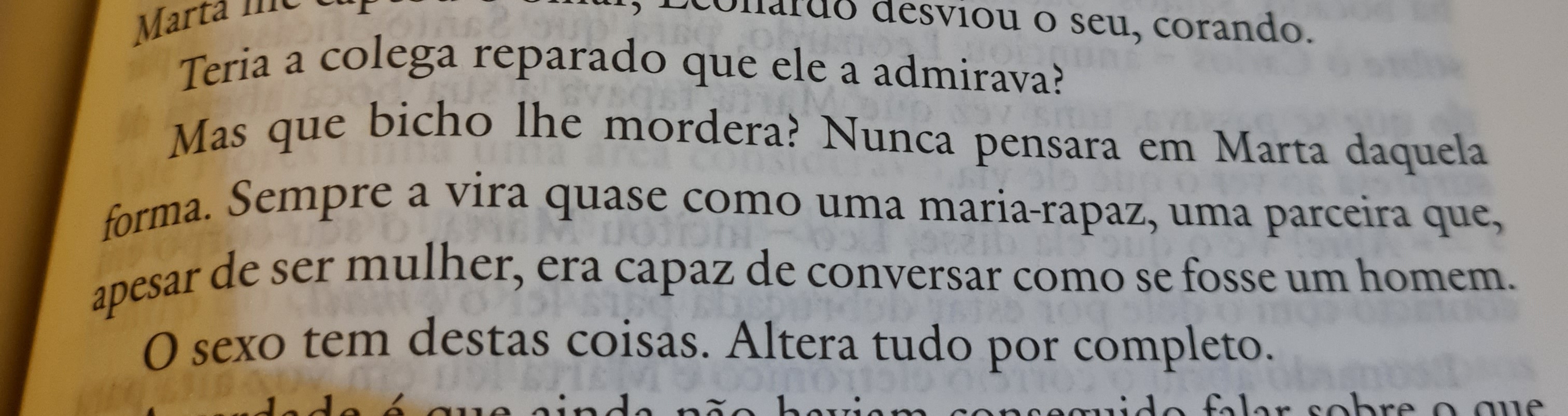
Ooh, I was intrigued by this passage in the book I’m reading. Are you ready for a couple of new expressions and some incoherent ramblings about gender? You are? Then come with me!
Had his colleague noticed that he admired her?
But what creature had bitten him? He had never thought about Marta that way. He had always seen her as like a Maria-rapaz, a partner who, although she was a woman, was able to talk like a man.
Sex is like that. It changes everything completely.
There are a couple of cool new things here. First of all, “que bicho lhe mordera” (“what beast had bitten him”) could be taken literally – there are certainly sites online that use some version of that as a headline to inform readers of how to figure out the origin of an insect bite or sting. In this case, though, it’s figurative. It just means something like “what had got into him?” or “why was he acting so strangely”.
The second phrase is even better. “Maria-rapaz”, as you can probably guess from the context, is a tomboy. According to the Wikipedia entry, there are quite a few different versions of this idea in popular usage, such as “moleca” and “maria-homem”. The meaning of it seems pretty congruent with the English equivalent. The Portuguese article is mercifully straightforward (at the time of writing), in contrast with the English version which has been larded with gender-studies buzzwords because, obviously, girls can’t just play with skateboards without well-meaning adults sticking labels on them. Ugh.
As the article says, the feminine male equivalent – “maricas” is much more likely to be seen as implying that the person is gay, which isn’t present in the idea of a tomboy, and – male gender stereotypes being more rigid – it’s generally seen as a more negative, derogatory word. There isn’t a Wikipedia page for maricas but Priberam sets out the different meanings pretty clearly.
I think that’s all for today. I had an extended side-note about that word “bicho” in the first expression, that was going to unpack the beastliness but I think I’ve decided it needs a blog post of its own so I’m going to do part 2 in this discussion tomorrow.
Here’s another of my biographical texts. This one or about Herman José who I mentioned a few weeks ago. Thanks very much to redditors Patis12 (who corrected my careless errors) and Danimorgenstern (who added polish with some good C1/C2 level tips). There are some notas de rodapé (footnotes) at the bottom about the ones that I found the most interesting.
Herman José é um comediante, ator e apresentador alemão*. A sua nacionalidade é relativamente complicada: nasceu em Portugal e mora lá mas adquiriu cidadania alemã por ter um pai alemão e renunciou à nacionalidade da sua terra-mãe** aos 17 anos de idade para evitar a obrigatoriedade de cumprir o serviço militar que existia na altura.
Quanto à sua carreira, eh pá***, vou resumir porque a sua página de Wikipedia é imensa!
Desde jovem, Herman mostrou grande interesse na música e na atuação. Estreou-se no teatro logo depois da Revolução dos Cravos em 1974, e durante as décadas de 1970 e 1980 trabalhou como ator e cantor em paralelo, sendo um candidato no Festival RTP da Canção em 1983 e a estrela do seu próprio programa, “Hermanias” no ano seguinte. Ao mesmo tempo, estabeleceu uma presença no mundo radiofónico.
Durante os anos noventa, a sua fama cresceu ainda mais. Apresentou (entre vários programas) um talk-show no qual entrevistou vários convidados nacionais e internacionais. Em 1998, formou a sua própria empresa, a produtora HZP (Herman Zap Produções)
No início do século XXI, mudou de canal para o SIC, onde apresentou um novo Talk-show, Herman SIC, entrevistando celebridades e apresentando**** ao mundo a cantora Mariza. Também fez parte dos programas “Masterplan – o Grande Mestre” e “Hora H”.
Em Dezembro de 2003, depois de ter sido defensor do Carlos Cruz, um ator que foi detido na sequência do chamado “Processo Casa Pia”, o próprio Herman foi constituído arguido no âmbito do mesmo processo porque uma rapariga alegou de ter sido abusada por ele num carro nas traseiras do seu restaurante de Alcântara. A acusação foi retirada quando foi provado que o ator estava no Brasil na data do alegado crime.
Desde 2010, Herman está de volta à RTP. Apresentou mais um talk show, e fez parte de vários programas tal como “Há tarde”, “Nelo e Idália” e “Cá Por Casa” (que soa como um programa do isolamento social mas não é: estreou em 2016).
* In the original I wrote “uma comediante […] alemã” which was a double error, using feminine endings in two words, although in my defence, these things these can be confusing when dealing with a character comedian…
** I keep writing “Terra de mãe” for some reason. What I mean is something like “terra-mãe” (mother country) but “terra natal”, the country of his birth, was suggested too. Probably more accurate but I decided to leave it as it was to reinforce the phrase I keep getting wrong.
Epá
*** I wrote “epá” and the actual suggested change was “é pá” so I did a bit of digging because I have seen a few different spellings but not that one. I’ve seen it written epá (and also opá) but that’s not just slang, as I thought, but actually incorrect. This article in Ciberdúvidas gives the correct spellings as “eh pá” and “ó pá”, and lists out a few alternatives. Priberam also lists “eh pá” as a valid expression. As for “é pá”, I can find it here in the Dicionário Informal but the meaning isn’t quite what I was looking for. If I’m understanding the difference, “é pá” is like “yeah, dude” and “eh pá” is more like “woah, dude”. I was aiming for more of a “woah, dude” so I have corrected myself but not quite in the suggested way.
**** I wrote “introduzindo” here, thinking of it was meaning “introducing” just as we would use that word in English but it’s a good example of a false friend. If you read the definitions of introduzir on Priberam, its meanings all relate to inserting something or letting it enter a space, or one of a few other things that are really close to the English meaning but not quite the same, and none of them fits into a phrase like “I met Jeff at the party and introduced him to Wendy”.
I’m a day late with this so I’ll backdate it: Feliz Dia da Mãe to all Portuguese mothers, and Feliz Dia Do Trabalhador to all members of the Classe Operária (Portuguese working class)
If you’re both a mother and a labourer, make sure the people in your household bake you two cakes because you’ve earned it.
I was talking to m’wife this morning about May Day and how we don’t really register it as a big deal here apart from having a bank holiday and an excuse to sit in the garden (weather allowing) reading and drinking. If we think about it hard enough we might remember that there’s a socialist celebration known as May Day which happens to fall roughly on the same date as the older, pagan May Day festival, but there isn’t usually a lot of fuss about it. We don’t drive tanks down Pall Mall like the Soviets would have, and Hallmark don’t sell Tony Benn greetings cards or Hallowe’en-style costumes depicting the Spectre of Communism haunting Europe. It does seem to be a bigger deal on Portugal though, with its socialist tradition, dating back to the resistance to the Novo Estado. In fact, according to this tweet from the Assembleia da República, almost the first thing the revolutionaries did after overthrowing the Fascists on April 25th was to give themselves a holiday a few days later. Nice!
Dois dias após a Revolução de 25 de Abril de 1974, o 1.º de Maio foi instituído como Dia do Trabalhador e feriado nacional. Em Lisboa, a população saiu à rua para celebrar o primeiro 1.º de Maio. Fotos de Miranda Castela, Arquivo Histórico Parlamentar. #1demaio#diadotrabalhadorpic.twitter.com/9ZQwaquHkV
— Assembleia da República (@AssembleiaRepub) May 1, 2022






 Luso
Luso 
