I keep seeing people posting these funny little boxes online, looking like a bad game of tetris, but I only found out today that there’s a Portuguese version of Wordle called Termo. This is definitely going to be a part of my study-adjacent messing about from now on.
I need to do a techie course in a specific kind of database system and there are loads on offer on Udemy. I’m wondering if I dare try one of the courses offered by Brazilian Portuguese language teachers. This is a terrible idea isn’t it? It costs money and it’s quite challenging in English, so making it harder seems silly, but I’m drawn to the idea of a two-for-one. If there was one in European Portuguese I’d have a go, but… Hm…
I wrote this the day after his birthday but it’s even more out of date now.
Raízes
James Earl Jones fez 91 anos ontem. É um ator incrível. Nos anos setenta do século passado, protagonizou Alex Hailey numa série chamada Roots (Raízes), baseada num livro do mesmo Alex Hailey, que conta a história dos americanos negros, vista pelos olhos dos membros da sua própria família.
Mas o seu papel mais famoso é o de Darth Vader, ou seja a voz de Darth Vader. O Vader foi representado fisicamente pelo corpo de Dave Prowse, um ator inglês alto e musculado, mas infelizmente a voz dele era ridícula: demasiado aguda* e com um forte sotaque do oeste do país. Existem videos de várias cenas bem conhecidas do filme, nos quais se ouve a voz de Prowse. Têm um ar cómico. Por isso, o realizador substituiu a voz dele pela voz mais grave** de James Earl Jones e assim nasceu um vilão!
Prowse vs Jones
*=I wanted to write “alta” meaning “high” but that just conveys the idea of loudness rather than pitch. Alta frequência seemed too scientific so I went with “aguda” since one of the meanings of that word fits and I can find a couple of examples of it in linguee. Later on, my wife suggested esganiçada as a possible alternative.
**=Same as above: I ended up using “profunda” (deep) but the correct word was “grave“
A couple of text corrections on the same subject – first written before my visit to the solicitors office on Friday…
O Advogado
Em 2019, fiz um pedido de adquirir cidadania portuguesa em conjunção com a minha cidadania britânica, por causa do brexit e das minhas circunstâncias pessoais. Felizmente, ambos os países permitem dupla cidadania (ao contrário da Espanha). O processo foi indeferido em 2020 e caiu no esquecimento durante as primeiras fases da pandemia, mas estou a candidatar-me mais uma vez à cidadania portuguesa. Hoje, tenho uma reunião marcada com um advogado português que vai certificar o meu formulário e depois os documentos todos irão no correio para Lisboa!
And then after…
A Advogada
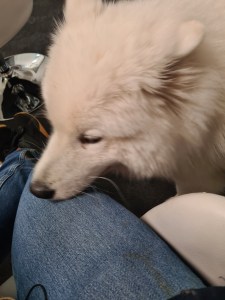
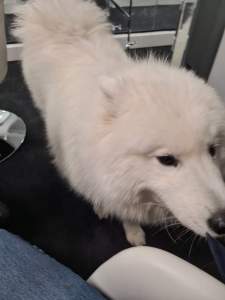
Enganei-me ontem. Escrevi um texto intitulado “o advogado” mas acabei por descobrir que era uma advogada. OK, eu sei, não era erro nenhum porque sem saber o género da pessoa, usamos o masculino por padrão, mas sinto-me obrigado a corrigir a palavra! Fui para lá de bicicleta, e quando cheguei fui informado de que o elevador estava avariado então tive de subir as escadas para o quarto andar. Na sala de espera, havia um cão branco de pêlo longo que me permitiu afagá-lo enquanto a advogada assinava e certificava o documento. Depois, o documento, junto com as cópias dos certificados e tal, foi num envelope para o correio e já estáa a caminho para Lisboa.
I hope it goes without saying that although this is loosely based on reality, I’ve exaggerated a lot, partly for comic effect, but mostly so I could practise using those possessive indirect object pronouns I wrote about the other day. Most of the actual violence described is in the service of grammar practice. No husbands or imaginary MPs were harmed during the making of this blog post.
Ao acordar* hoje de manhã, a minha mulher estava zangada comigo. Ela esbofateu-me** a cara. Porquê? O que é que fiz de errado? Vasculhei a memória mas não tinha feito nada. Pelo menos nada de que ela saiba. Perguntei-lhe e ela explicou: tinha sonhado que estávamos de férias numa casa à beira-mar mas logo de manhã (ainda no sonho), convidei o Jacob Rees Mogg (um político inglês) para tomar o pequeno almoço connosco. Depois, demos uma voltinha, juntos num barco e ela sentiu-se contrariada porque nem sequer teve oportunidade de segurar um remo, bater-lhe a cabeça e atirar o corpo borda fora***. Acordou com coração despedaçado
Nada disso me diz respeito: nós os maridos somos incapazes de influenciar os sonhos das nossas mulheres mas elas culpam-nos na mesma.
*I wrote “Acordando” because today’s C1 exercise was about gerunds and although not technically wrong it’s unusual.
**Rare case where I didn’t use a pronoun and the corrector told me to put it in (it’s usually the other way around) because its more impactful and less ambiguous.
Alguém disse “Liberdade de expressão não é a liberdade de gritar ‘Fogo!’ num teatro cheio de gente”. Mas estamos num teatro cheio de gente que já está em chamas e o autor do livro que estou a ler está a gritar “Fica sentado! O fogo não é assim tão mau e podemos extingui-lo por atirar pipocas para cima”
(the book I’m complaining about here is “Cool It” by Bjorn Lomborg. It doesn’t seem to be available at my favourite bookshop at the moment – but here’s one by the same author to give you an idea of where he’s coming from. It wasn’t quite as bad as my first impression but I’m a long, long way from recommending it, as you’ve probably guessed by now!)
Returning to my recent theme, I’ve been doing yoga in January and I signed up for a Hatha Yoga class with A Escola Sunshine Yoga so I could try a live lesson instead of just following a YouTube video. And of course I wanted to challenge my Portuguese anatomy vocabulary. And I was pleased to find I could get what she was talking about most of the time, although listening through a tinny laptop speaker made it hard to follow all the instructions and I had to look at the screen quite a lot.
The instructor could see us students too, of course, and gave us feedback. It was a good session – interesting and challenging and twice as long as the American YouTube videos I’ve been watching, so I really felt like it was money well spent. Everyine was very welcoming too, which was nice.
So the die is cast and I have made my second dual citizenship application. I wrote a summary of the first one, but a couple of things are different this time, so I’m going to document those changes here in case it helps anyone in the same position.
When I originally applied, I was missing one document: a criminal records check from the FBI, so I sent that and it didn’t arrive (gah!) I should have followed up at the time but it sort of got lost among the general apathetic weirdness of lockdown life and eventually the time ran out and they rejected the whole thing. As a result, I had to go back to square one.
Well, not quite square one in fact, because they confirmed for me that they had the original documents in archive so I could just send updates for *both* CRB checks, not just the American one, and refer to the original case ID for the passport, wedding certificate and all the rest. But I would need to submit a new form and start a new process and of course the real pain was having to pay the €250 fee again, but it’s my own stupid fault.
So I sent off my request to the FBI and ACRO, got them back, sent them out to the same translator I used last time, got the translations back, and in the meantime started scratching my head trying to figure out how I was going to get my signature witnessed and the fee paid, given that I am based in the UK. Last time I applied I went to Porto in person and rocked up at the SEF office to submit my application in person but travel is a bit more awkward these days and it seemed better to donut by post if possible.
Paying the fee
When I originally applied you needed cash (obviously not safe to send in the mail!) a Vale Postal, which you can only get in Portugal or a banker’s cheque from a bank with branches in Portugal. Tricky. I did a fair bit of detective work and contacted a few Portuguese banks with branches in London, to see if I could set up a current account there as a prospective future citizen without an ID card. The only one I had any luck with was the Caixa Geral de Depósitos, who confirmed they could provide an account, but it can’t be done online so they offered me an appointment to set up an account, but the day before I was due to meet them I found a better way and so I called them to cancel. I might set one up eventually anyway, but in the age of omicron it seemed daft to go and have a face-to-face meeting with someone if I didn’t need to.
So what’s this better way? Well, you can now do credit card payments. Yeessss!!! It’s not incredibly obvious but if you go through the website you can find your way there. I can’t give you a direct link because it varies slightly depending on your situation but start on this page. Click on the case that best fits your situation. Scroll down to where it says “modalidade de pagar”. Under the first section, “Por Cartão de Crédito ou Cartão de Débito”, click the link to Plataforma de pagamentos. You should now find it’s showing the right fee, and you can fill in the rest. When you’ve paid, they’ll email you a copy of the right modelo (form) with the payment details printed at the top instead of the normal payment section, so print it out and use it in place of the standard form. And that’s it! A hundred times easier than last time!
Getting the Signature Witnessed
It’s possible to do this at the consulate apparently but the Portuguese consulate in London has a dreadful reputation and I’ve been there a couple of times so I can see why. Anyway, it’s an option and probably cheaper if you can do it. I gave up pretty early on when it asked for an ID card number. Maybe I could have got my wife to do it and accompany me on the visit but wild horses couldn’t drag her to the consulate so it didn’t seem worth the effort. There’s a firm of Portuguese solicitors in London called Castelo who are able to properly notorise official documents but it’ll cost you a little north of a hundred and seventy quid including VAT. They have three branches but I went to the one in Victoria. It’s a really nice place, very welcoming, and there is a heckin’ beautiful floofy white dog (a Samoyed?) who is there every day and who keeps you company in the waiting room and lets you stroke his (her?) fur. In my opinion, that was worth the price of the fee all on its own. I believe the solicitors are all Portuguese. The one I spoke to just sounded British to me, so that I wondered if it was maybe a Portuguese firm with staff from both countries but when I made the mistake of asking if she spoke Portuguese she switched languages right away and said she was Portuguese and I felt a bit silly for having asked.
Company in the waiting room
One potential snag was that she mentioned I might need an “apostille” from the foreign office to accompany the form because it was being sent from outside the country. I wasn’t keen to delay the application because the CRB checks have a limited shelf life, and couldn’t see any mention of such a thing in the instructions so I decided to just cross my fingers and hope it only applies to certain types of applications. If I find out later that I need one, I’ll update this page.
I put all the signed forms and other papers and translations together with a printed email of the conversation I’d had up to now about the end of the previous application, including the reference number, and took them to the post office to send by recorded delivery so I’d know it hadn’t got lost. The chap behind the counter helpfully pointed out that I’d spelled Lisbon with an A and I said oh well, never mind, it’ll probably get there.
I’ve just put my envelope in the post for my second attempt at acquiring dual citizenship. I’ve been working on it for a while and finally got the form notorised and then the whole lot went to the post office (where the guy helpfully pointed out I’d spelled Lisbon with an A at the end…)
Anyway, it’s been interesting and I’ll have to write more about it on another day but I’m exhausted. I cycled there and back and it’s about twenty miles there and back.
What’s Portuguese for “floof”?
Anyway, I’ll talk about that more when I’ve recovered but in the meantime, here’s a teaser.
The book I’m reading has quite a high incidence of a grammatical structure I’ve always found a bit hard to understand. It just looks like a stray indirect object that doesn’t seem to have much purpose in the sentence.
Tendo também medo de aranhas(…), lhe pareceu senti-las a passarem-lhe pelo corpo
Agarrou-lhe o braço
….O necessário para te limpar a ferida
The third of these looks a bit different because it has “te” instead of “lhe” and it comes before the verb not after (an example of “próclise“) but it’s basically doing the same thing as the lhe in the other two examples. Te and lhe are both indirect objects so they mean “to you” and “to him/her/it” respectively. So if you were to translate the phrases, super-literally into English you’d get absolute monstrosities
Being afraid of spiders too, it seemed as if they passed to her over the body
It grabbed to him the arm
…The things necessary for cleaning to you the injury
There are two unfamiliar things going on here. Firstly, something called “posse inalienável” (inalienable possession) which sounds fancy but it’s not that hard to understand. It just means that the ownership of the object isn’t really in question so you don’t even need to say “my arm”, just “the arm”.
OK, that explains why there’s no possessive pronoun. That’s not the thing I want to focus on today though, so let’s move on to the second point: What’s up with the indirect object? Well, even though you don’t need to say “your arm”, you do still need to say who has been grabbed or cleaned or whatever, so that’s where the indirect object comes in. He grabbed the arm to him. It sounds very weird to anglophone ears but that seems to be what’s going on.
It doesn’t only happen in the context of body parts though. For example, to use an example from the Reddit discussion, “Roubou-me a carteira” is fine, and so are “lê-me um livro” and “faz-me um favor”. Now I don’t know about you, but these three phrases don’t all seem the same to me.
Lê-me um livro = Read me a book. That’s completely fine in English. Read the book TO me – >indirect object
Faz-me um favor =Do me a favour. Also fine. Do the favour FOR me – > indirect object
Roubou-me a carteira is a different kettle of fish though. Treating the indirect object like its English equivalent, I’d translate it as “he stole me the wallet”, implying that I asked someone to steal a wallet on my behalf and they obliged. That’s not how Portuguese works though. Prepositions are all different. It’s legit to say “Roubou a carteira a mim” (He stole the wallet to me). The victim is the recipient of the action even though the thief is the recipient of the wallet. It’s a different way of thinking and I’ll just have to meditate on it a bit and not try and translate it literally in my head.
Another way to look at it would be to think of the indirect object as doing the job of a possessive pronoun. There’s a ciberdúvidas article about this phenomenon here.





 Luso
Luso 