Posted in Portuguese

Key Learnings 3 -A Pair of Ears and a Stray à

Today’s top two new things were:

Orelha and Ouvida: I have known for a while that there were two words for the ear but I had lazily assumed they were synonyms. But in fact, Ouvido is the bit you hear with and Orelha is just the flappy bit on the outside.

This sentence:

Em casa da família de acolhimento é melhor que o estudante tenha a idade aproximada à das crianças da família.

was baffling to me because the à [a+a], immediately followed by das [de+as] seems to mean “to the of the children” until I finally wrapped my head around what it was doing. The à is actually “to it” not “to the” because an a can be a pronoun as well as an article, so the sentence means

In the house of the host family it’s better that the student be of the same age as it (i.e “as the age”) of the children in the family.

As for the actual statement itself, OK, I know, I’m not sure why that would be true, but when I had the initial conversation about this I thought “família de acolhimento” meant a foster family, so it made a sort of sense. I think it’s more like a host family in some sort of school exchange program though.

Posted in Portuguese

A Bicicleta

[Uncorrected Portuguese Klaxon]

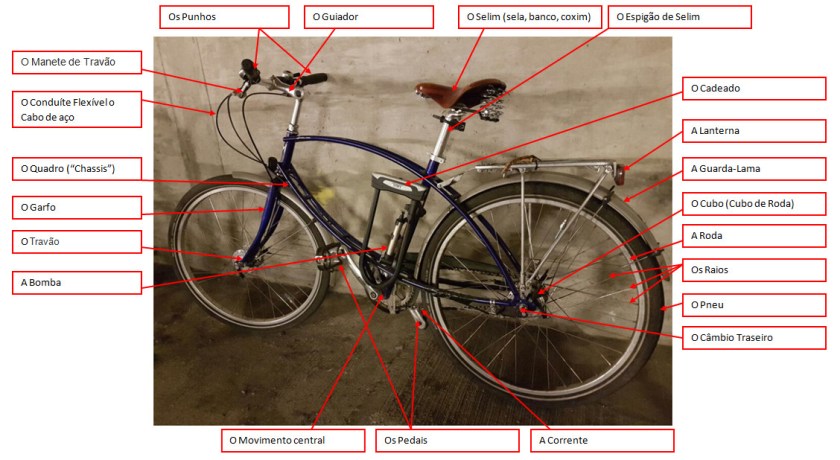
Percebi que o website Cycling Fallacies (“As Falácias Sobre A Bicicleta”) tem sido traduzido ao Português e tinha a motivação a fazer alguma coisa que estava a planear desde o mês passado: classificar e rotular as peças de uma bicicleta para ensinar-me algum vocabulário útil.

bicicleta

Nesta imagem, utilizei o vocabulário especifico a Portugal da Pagina Wikipedia Português, acrescentado pelas palavras da Loja Das Bicicletas. A imagem está diminuída por o blogue mas espero que possa lê-lo.

Posted in Portuguese

Aconselhamentos

Caro Rui*,
Estou muito feliz de ouvir que pensas visitar-me aqui em Londres. Ainda que não tenhas muito dinheiro, vem**! A libra está muito baixa hoje em dia por causa dos “Brexiteers” e por isso tudo é muito barato.
Eis as minhas regras para uma viagem a Londres:
É necessário que tragas um guarda-chuva porque chove muito aqui.
É possível que compres um “Oyster Card” na estação de comboios. Com isto, é possível fazeres viagens todos os dias sem pagar.
É viável andares de comboio (a rede de comboios subterrâneos de Londres chamar-se “The Tube”) porque convém evitar o tráfego*** nas ruas.
Não é provável que encontres o Stephen Fry no supermercado mas se é que o encontras, deves levantar o seu chapéu, quer queiras quer não. Por isso, é aconselhável que tragas um chapéu. Embora tenhas dores de cabeça, usa-o todos os dias que fiques no país.

*=Just to explain why the phraseology in this is so weird, here is the note I attached to it in iTalki

Este exercício destina-se a ajudar-me a praticar três tempos: presente do conjuntivo, infinitivo pessoal e imperativo. Por isso, algumas frases não são muito idiomáticas, mas não faz mal. Acho que a gramática é pouco especifica a Portugal. Pode ser que a gramática do Brasil seja diferente. Eu ficaria muito contente em receber correcções do Português de Portugal. Muito obrigado

**=I can’t believe this is the 2nd person imperative form of “vir”!

***=I originally wrote “tráfico” but that means traffic in the sense of “drug trafficking”

Posted in English

Mind Mapping

Clipboard01

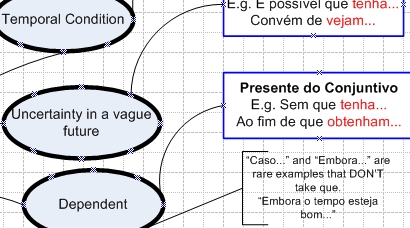
I decided to try my hand at mind-mapping to set out all the situations in which I might need to use the subjunctive tenses. In case you don’t know, these are three tenses that are used in situations where there’s some sort of doubt, intention, or future eventuality implied. Usually, they are not the main verb in a sentence, just part of a supporting phrase. They’re actually pretty easy to conjugate. The difficulty for us English speakers is recognising the situation in which they are needed, and remembering to pull one out of the bag in place of the standard indicative. That’s because we hardly use them at all in English. Basically the only time they would rear their head is in a phrase like “If I were a rich man”. So, in the song:

If I were a rich man,
Daidle deedle daidle
Daidle daidle deedle daidle dum,
All day long I’d biddy-biddy-bum.

“Were” is a subjunctive (imperfect subjunctive, I think) because it’s describing a hypothetical situation (being a rich man), which is why we’re using “were” instead of “was”. When it comes to translating, I think the verb we want here is “Ser” because although rich people can become poor, it feels more like a statement about a permanent state of affairs. I don’t think he wants to be rich for just one day. So we would translate this as “fosse” (first person imperfect subjunctive of “ser”)

“I’d” – short for “I would” of course – indicates we’re dealing with the conditional, which is a normal indicative tense, because it’s leading into the main thrust in the sentence: what he would do in that hypothetical situation. It’s a little difficult to translate because I don’t know the Portuguese verb for “to biddy-biddy-bum” but let me make an educated guess: bidibidibombiar, and you can make the first person conditional by just whacking an “-ia” on the end.

As for the daidles and deedles, well, I’ll have to leave those to someone with more expertise. Hey, my degrees are both in science, so what do I know about language? They’ll be adverbs, I expect. I never trusted adverbs.
Putting it all together then:

Se eu fosse um homem rico,
Daidle deedle daidle
Daidle daidle deedle daidle dum,
Todos os dias, eu bidibidibombiaria.

If you’re reading this and you’re not sure if you need to know about subjunctives, check with your teacher, but I believe they only really come into play at DIPLE/B2 level. It’s worth looking at them earlier, if only because they come up in books quite often and it’s useful to be able to recognise them, but I don’t think you would need to worry about them at B1 level… I didn’t anyway!

Anyway, if you’re interested, I’ve saved a pdf of the work in progress here. So far it only has the presente do conjuntivo (present subjunctive) but when it’s finished it’ll have the other two subjunctives – imperfeito (imperfect) and futuro (future)

Anyway, if you’re interested, I’ve saved a pdf of the work in progress here. So far it only has the presente do conjuntivo (present subjunctive) but when it’s finished it’ll have the other two subjunctives – imperfeito (imperfect) and futuro (future)

Anyway, if you’re interested, I’ve saved a pdf of the diagram here.
Posted in English

July Book Haul 

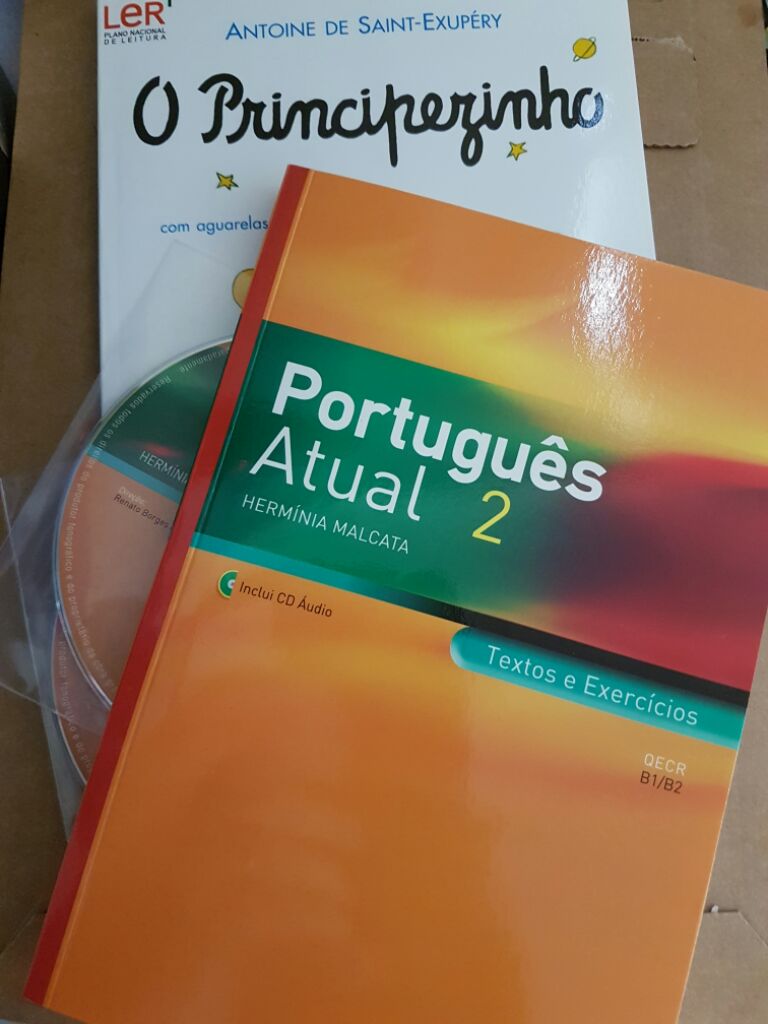
I mostly study Portuguese as an excuse to buy more books. This week it’s “O Principezinho” (The Little Prince) by Antoine de Saint-Exupéry and “Português Atual“, which has all the grammar I need for the B2 exam. I already have a book of Modelos (mock exam papers) but this will be a good way of getting on top of the grammar in the next couple of months.

Posted in English

The Olympic Language Challenge

I signed up for iTalki’s Olympic Language Challenge. I’m doing OK. I’ve already hit “Power-Lifting” (3 hours of teaching in a day) and when I have finished my current booked lessons that will get me javelin (5 consecutive days). Then all I need is to do another 5 hours in July to hit marathon (20 hours total in the period). I quite fancied doing the fourth activity, Archery, which would mean taking a lesson each in three other languages, which I think would be a good laugh but I wanted to do at least one of them with my daughter and she wasn’t up for it. I haven’t completely given up though. I need to think about how to make it fun and also let her choose a teacher. iTalki lets you see the person in a video first so you can make sure they aren’t scarily strict. That’s reassuring.

Mini-challenges like this are a pretty good way of motivating yourself if you need a kick-start, and I definitely did. I question their value as a long-term way of keeping motivation alive though, because they encourage a stop-start attitude, where you reach the end of the time and decide to just not bother any more.  It’s already underway, but if you fancy signing up a little late you can have a look here.

Posted in English

Key Learnings 2: Frankenwords

Yesterday’s exercise involved two lists of words. I had to take a word from each list and make a phrase or portmanteau word. Por Exemplo, “Estrela de Mar” or “Belas Artes”. I managed to get the first dozen or so with the aid of a dictionary but I was left with three in each list that I couldn’t budge. I decided to pair them up at random and enter them into Google Search and see what sites/pictures each brought back. If a particular combination came up with nothing but pictures of cheese wheels then I’d know I had a winner.

On the first try, I was a bit taken aback with the phrase “Troca de Casal”. Oo-er, madam! Mrs Lusk walked in to find me giggling at a screen full of saucy looking men with moustaches rubbing their hands and leering at the sight of scantily-clad raparigas. Apparently, Troca de casal means “wife-swapping”.

The correct combinations, if you’re interested, were “troca-tintas” (literally, a paint-slinger, or more figuratively, someone whose words can’t be trusted. In short, a bullshitter) and “Cabeça de casal” (head of the household”)

água

azul

belas

cabeça

castanho

chapéu

estrela

guarda

luso

novo

obra

porta

saca

surdo

trinca

troca

fim

rico

mar

fato

prima

mudo

claro

voz

tintas

escuro

sol

artes

brasileiro

colônia

rolhas

semana

cabra

casal

espinhas


Posted in English

Os Resultados

Well, they said I wouldn’t get the resultados until Setembro, but it’s only July and the angels have wafted the good news to me on their wings – I have passed the DEPLE exam! There’s a bottle of Prosecco in the fridge. I worked harder for this than I did for any of my University modules, or for anything, really, since my “A” Levels in 1852, and I couldn’t be more proud!

Clipboard01
Update: Apparently the classificação: bom means I got between 70 and 84%. That’ll do me. 

Posted in English

Key Learnings

I think I might try a new thing: writing notes of mistakes I have made in lessons to avoid making them again. Here are a few from today’s lesson with a new teacher:

após de trabalhar tão duro

should be

após trabalhar tão arduamente

because após doesn’t need a “de” after it (I always find these small change words hard to deal with!) and “duro” means hard in the sense of solid, as opposed to “working hard” and apparently it sounds a bit sexual in the wrong context, so best avoided. Ahem. Moving on, “arduamente” (cognate with “arduously”) seems to be a better fit

para conhecer um ao outro

should be

para nos conhecermos

because it’s a more natural way of speaking in place of a  literal translation of “get to know one another” it’s more like “to us get to know us”. Anything involving the infinitivo pessoal is bound to be very, very unfamiliar to English ears, so it’s all down to practice, I suppose, and getting used to it so you can pull it out of the word-hoard when you need it.

se tem épocas

should be

se tiver(es) disponibilidade

Actually, “épocas” sounds weird in English, since it’s obviously cognate with “epochs” but it’s the way the CAPLE registration page describes a lack of available spaces in their schedule (“Ainda não existem épocas disponíveis neste LAPE”), which is why I used it. Formal Portuguese sometimes uses weird words no normal person would use so it’s better to say “disponibilidade” (“availability”). “Tiveres” or “tiver” is the future subjunctive because it’s something that I’m talking about in the future and there’s some uncertainty in the mix.

Finally

Arranjar

in the sense of “arrange a meeting” doesn’t work. It’s a false friend. Arranjar means to fix something that’s broken. The correct word is

Marcar

which has a few senses, including “to score a goal” as you can see here.