Encapuzado: Hoodie 😕

Encapuzado: Hoodie 😕
Expressions relating to eating and drinking, fixed homework, aiming to find equivalent expressions in English. Most don’t have literal identical versions in English, so I’m just looking for something more less equivalent.
Trincar qualquer coisa (Trincar =morder)
Existem muitas opções. A minha preferida é “Have a little smackerel of something”, que é uma frase do livro Winnie the Pooh
Dar ao Dente
Não há nada igual, mas talvez “nibble” seja a palavra mais parecida, uma vez que implica o uso dos dentes.
Morfar (Morfar = comer )
Também posso sugerir várias alternativas mas acho que “scoff” é a mais próxima
Encher o Bandulho (Bandulho =barriga)
Acho que diríamos “fill your belly”
Encher a mula (mula = mule)
Não temos uma expressão igual. Às vezes falamos de “fill your boots” (“encher as botas”) que pode ser semelhante mas não tem necessariamente a ver com comida. Pode significar “faz qualquer coisa tanto quanto quiseres”. Por exemplo, “Queres colher rosas no meu jardim? Vá lá! Enche as botas!”
Ferrar o dente
Diríamos “Get my teeth into” alguma coisita.
Estar com larica (larica =erva daninha mas neste contexto quer dizer “fome”)
Equivalente a “To feel peckish”
Enfardar (enfardar = comer muito)
Equivalente a “gorge” ou “binge”
Matar o Bicho
Esta expressão pode significar “tomar o pequeno almoço”, ou até “dar uma gorjeta” mas para tratar uma ressaca bebendo aguardente em jejum é chamado “hair of the dog” em inglês. Se fossemos mordidos por um cão, é óbvio que precisaríamos dum pêlo do cão que nos mordeu. [this one is sort of complicated too and probably doesn’t quite mean “hair of the dog” but sometimes it’s just breakfast (implying the “bicho” is hunger) and sometimes just means booze for breakfast (the background explained in a one-minute-long video on this page)
Afogar as mágoas
A única frase que tem uma equivalente muito próxima: to drown ones sorrows.
Dar de beber à dor
Hum… Drink to forget (beber para esquecer)? Não é igual, mas não consigo me lembrar de uma expressão melhor .
Estar/ficar bem aviado (aviar =preparar)
Diríamos “to be well-oiled”. Existem outras expressões mas acho que olear um avião ou um veículo é necessário antes da viagem e daí escolhi esta! [i got the translation slightly wrong originally. There are a few meanings for the word aviar in Priberam and I think I was lulled by the similarity to “avião” to think of it as preparing for a trip, but it can be other kinds of preparation. For example, here’s a page telling EU citizens how to have their prescription made up in another EU country, and the word used is aviar. I think “Well oiled still works as an equivalent even if it isn’t quite as good as I thought it was]
Beber de caixão à cova (caixão = caixa grande para conter um cadáver; cova = o buraco onde se enterra o caixão)
Mais uma vez temos muitas expressões tipo “tie one on” ou “go on a bender”
Emborcar
Podemos dizer “neck”, que nem sequer é um verbo, mas se fosse uma palavra portuguesa, seria “pescoçar”!
Apanhar uma piela (piela = estado de estar bêbado)
Embora tenhamos um monte de adjetivos significando “bêbado” acho que não temos um substantivo no nosso calão que represente o estado de embriaguez. Tanto quanto sei, o único exemplo é “swerve” na expressão americana “Get your swerve on”, ou seja, bebe tanto que não consegues andar em linha recta.
Enfrascar-se (enfrascar-se = meter em frascos)
Dizemos “crawl into a bottle” que soa muito parecido mas o significado é mais perto de “Afogar as mágoas”. (after I wrote this I remembered that there are a couple of slightly antiquated expressions for drunkenness that are a bit closer: “Potted” and “pickled” both seem like the kind of thing you’d find in a PG Wodehouse novel when a member of the Drones Club had had one too many cocktails but they’re pretty good synonyms I reckon!)
Obscure Vocabulary Break!
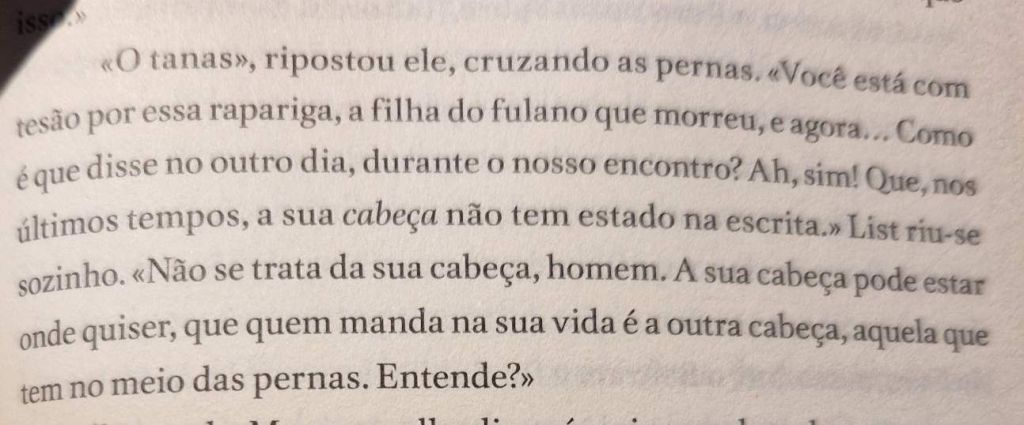
What the heck is a “Tanas”? Well, as it happens, that’s the wrong question. The word does exist and it means a sort of useless, indecisive person, but “O tanas” is also an exclamation indicating disagreement or disbelief, so something like “That’s what you think” or “No way!”, or, of you’re in a hurry, “Bollocks!”
It seems to hardly appear online. Priberam defines it but Linguee doesn’t know about it at all, so I’d say probably not one to whip out in the supermarket.
Shamelessly just doing my homework on here because I am short of time and shorter of ideas: synonyms from a passage from “Casa do Beco das Sardinheiras”, whose author, Mário de Carvalho seems like someone who likes to use interesting words, making him a challenging read.
I’m going to go above and beyond and do everything that I don’t already know, or am a bit vague about. If the word has multiple meanings I’ll use the one i think is closest to the original meaning in the text.
(Update – Quite a few corrections…)
Farejar => Caçar pelo olfato
Precaver-se => Ter cuidado
Precatar => Acautelar
Gaiato => Miúdo
Tareco => Traste, objeto de pouco valor (e também pode ser um gato doméstico, informalmente)
Eriçado => Levantado, ouriçado
Patorra => Pata grande
Avantajar => Ultrapassar
Surdir => Emergir
Poiso => Esconderijo
Escanifobético => Esquisito
Lá ser é => Isso é verdade
Taludo => Robusto (Pode ser “gordo” também, mas no fundo da página 61, a mulher do chefe da família diz “lá que o Gigas está magrinho par o tamanho)
Alforria => Libertação
Amarrotar => Amachucar
Alvoroço => Agitação
Estraçalhado => Despedaçado
Fera => Criatura feroz
Medonho => Terrível
Algazarra => Tumulto
Arribar => Chegar
Agastar-se => Ficar irritado
Temo-la armada => Vamos ter problemas
Para Cascos de Rolha => Para um lugar afastadíssimo
Notívago => Noturno
Espavento => Assombrado
Prontos! => Combinado!
Quite => Desobrigado *
Lamúria => Lamento
Polícias de Giro => Polícias que andam a pé?**
Botar => Lançar para fora***
Amanhar-se => Adaptar-se
*interesting one, this. It’s plural in the passage: “quites” and I thought it was borrowed from English, like “we’ll call it quits”. It seems not. There must be some common ancestry there though, because it’s too specific to be a coincidence. It’s quite a hard one to come up with a synonym. I’ve gone with Desobrigado but we’re really looking at an “I have now scratched your back after you scratched mine and further backacratching is no longer required”
**Esta frase é poço usada e existe um “Grupamento de Intervenção Rápida Ostensiva” (GIRO) no Brasil mas acho que não tem nada a ver com isto.
*** Os significados desta palavra são muitos e fazem parte nesta canção humorística. “A bota a gente calça e a calça a gente bota” (TW: Brazilian Portuguese)
Writing this lot out so I remember it.
Niche point about the difference between planning to do a thing and intending to do a thing. I recently had an exercise to paraphrase the following snippet
“visa colocar o país”
It’s obviously not a full sentence so it’s a little difficult to do. “Visa” here doesn’t mean a visa you use to get into a country, it’s part of “visar”, which means “aim”, either literally (aiming a weapon) or in the sense of intending or having an objective.
So a good translation would be something like “intends to put the country” (in the original, it was followed by something like “…on a path toward sporting success”). Well, I suppose I was thinking something like that needs a long term strategy, or, if you like, a plan, so the word I used in place of “visa” was “planeia”. That’s not precise enough though. Planear is about the journey to get to your objective, and visar is more to do with your intention.
Better synonyms of visar would have been “pretender”, “tencionar” or “objetivar”
I also had to come up with a synonym for “o papel absorvente”. You’re obviously supposed to think of aborbent paper like kitchen towel (as opposed to papel higiénico, which is toilet paper), but it’s a trick! Papel can also mean “role”, and in the context “a escola assume um papel muito absorvente na vida deles” (from here) it was saying that school occupied a role in their lives that absorbed a lot of their attention and free time.
I said something about “estado social” intending to say “social status”, but it means “social state”. The word for status is actually “status”, which is weird becuse you don’t get many words in portuguese that start with st-. But there you have it: status social.
I knew “equipe” was a “francesismo”*, but I was a bit thrown by seeing it used in the wild so I looked up both equipe and equipa in Priberam. The lexicographers haven’t really been very helpful in explaining it, but the TL;DR is that yes, equipa is the preferred spelling. It’s just that the frenchified version is allowed and is sometimes used. I suppose it’s like cafe/café in english. É doesn’t really exist in our alphabet, so cafe is the closest standard english spelling but nobody is going to have an aneurism if you bust out an accent.
Homem Rico vs Rico Homem; Velha Casa vs Casa Velha
Um rico homem seems to mean “a good/valued man” as opposed to just a rich man. It’s the eighth definition on Priberam, although they use it for netos rather than homens. A question on Wordreference Forums refers to a blog (sarcastically?) asking of José Socrates is “um rico homem ou um homem rico” but I can’t find the original.
There’s also an old-fashioned expression “rico-homem“. with a hyphen, which seems to mean a member of the nobility.
Velha casa seems to be more deprecative, meaning outmoded or old fashioned, as opposed to simply old. This meaning of velho is the fourth one in Priberam, but they use it with technology rather than houses. My sense is that this one isn’t as clear-cut. I don’t see many references or explainers, and it’s translated all sorts of ways in Linguee.
*Which sounds like it should mean “earthquake in Paris” but actually just means a word or phrase borrowed from french, just like anglicismo means a word or phrase borrowed from english.
I’m still watching videos from the occasionally excellent improv music show, Canta-me Uma História.
One of the things they often say during the live shows is “Não Mandem Bocas”. It’s used in the theme song and in the host’s t-shirt. So what does it mean? Don’t send mouths? Eh?
A boca, in this context, is a criticism. Specifically, a low-effort, smartarse remark. It’s the eleventh definition on Priberam – “comentário provocatório ou crítico”. So basically, a heckle. The audience has access to a big screen at the back of the stage and they can use it for requests and messages, so it seems they have a rule not to spoil the vibe by shit-talking the performers while they’re half way through some parody number they’ve written.

Porquinho Mealheiro – a money box in the shape of a piglet. A piggy bank in other words. In fact, mealheiro on its own seems to show piggy banks if you google it, but there are definitely some other shapes there. Here’s Fátima Lopes talking about Moneyboxes in her lifestyle website a couple of years ago and as you can see she’s gone with a porquinho motif even though she doesn’t mention the word.

Here’s a little detail I spotted in o Mangusto. The pupils in this PE class refer to their teachers as stôr and stôra. I thought it seemed weird as an abbreviation for professor(a), because where does the t come from, but apparently it is short for “Senhor(a) Doutor(a)”
I still have to reach for the dictionary a fair bit, especially when reading something high-brow, but it’s not often I hit a sentence that has four unknown words in it.
Não se lembrava ela de lhe ter visto os dentes, mas recorda-lhe as mãos gorilentas, as calças de seriguilha descaídas no ventre e em cujo cós deve estar enfiada uma podoa em jeito de faca recurva.
Check this out.
Gorilenta isn’t even in the dictionary but I think I can guess it…
She didn’t remember having seen his teeth but she remembered his gorilla-like hands, the trousers of rough wool, sagging in the belly, and in whose waistband is stuck a pruning shear in the form of a curved knife.
Ooof!
Ooh, well I haven’t done a post about cool stuff words found on twitter for a while, but here’s one

It’s such an unusual-looking word, I wondered if it was a joke word – maybe 3 words stuck together for effect or something – but it’s not.
Here’s what Priberam has to say about it
arcaboiço
(ar·ca·boi·ço)
nome masculino1. Conjunto dos ossos de um vertebrado. = OSSATURA
2. Estrutura óssea do peito. = TÓRAX
3. [Por extensão] Constituição física.
4. [Técnica] Estrutura de madeira de uma construção. = ARMAÇÃO, MADEIRAMENTO
5. Traçado inicial de algo. = DELINEAMENTO, ESBOÇO
6. [Figurado] Capacidade, envergadura (ex.: o técnico não tem arcaboiço para substituir o treinador).
“arcaboiço”, in Dicionário Priberam da Língua Portuguesa [em linha], 2008-2023, https://dicionario.priberam.org/arcaboi%C3%A7o.
So it’s like “bone structure”, but focused on bodily articulation, as distinct from, say, facial bone structure. Nice!
 Luso
Luso 