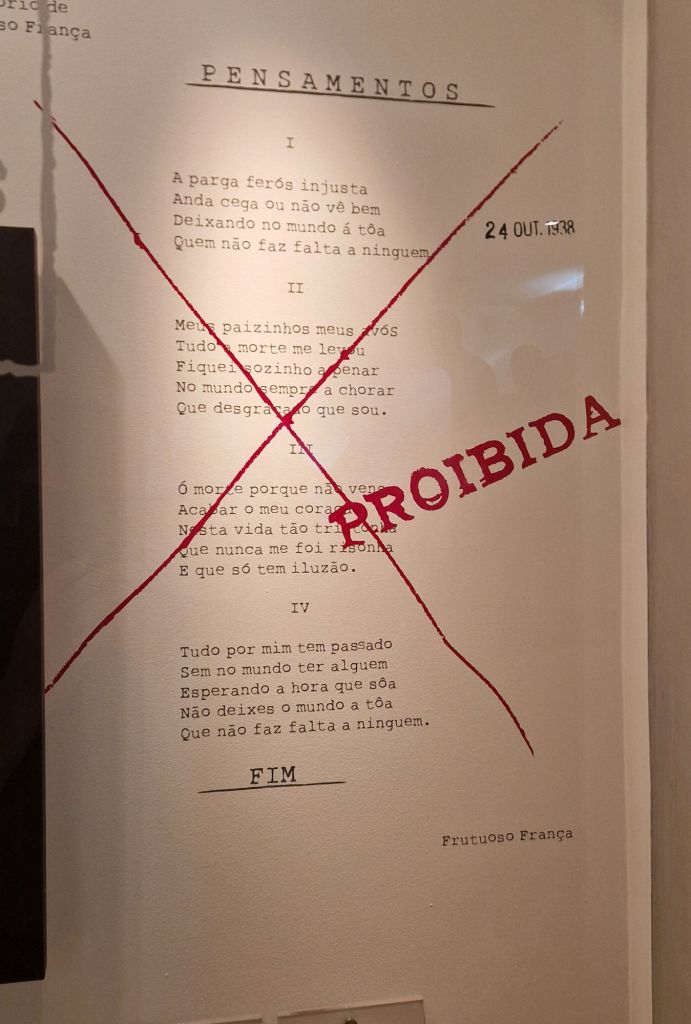
Following on from the last post – this picture I took at the Museu do Fado contains Fazer falta, and it’s prohibited so I am drawn to translate it…. Pre-AO spelling though so ironically it’s just as illegal now as it was then 🙂
The fierce, unjust heap Is blind or doesn't see well Randomly leaving in the world People who won't be missed
My parents, my grandparents Death has taken everyone from me I was left alone, suffering In the world, always crying What an outcast I am
Oh death, why don't you come for me To stop by heart In this sad life That was never cheerful for me And only has illusion
Everything is over for me Without having anyone in the world Weighting for the hour that sounds Don't leave the world at random That nobody will miss
It’s interesting isn’t it? First of all, that first word, parga, is quite unusual. It’s a heap of stored hay and grain stored away from the weather (silage?). I wonder if it had some other meaning on the 1930s. Alternatively, it might even be a typo, because praga (plague) would make a lot of sense.
I’m also interested in the slight shift in wording between the last two lines of the first verse and the last two of the last. I wonder what difference it makes. I feel like there’s a shift in emphasis there but I can’t quite put my finger on it.
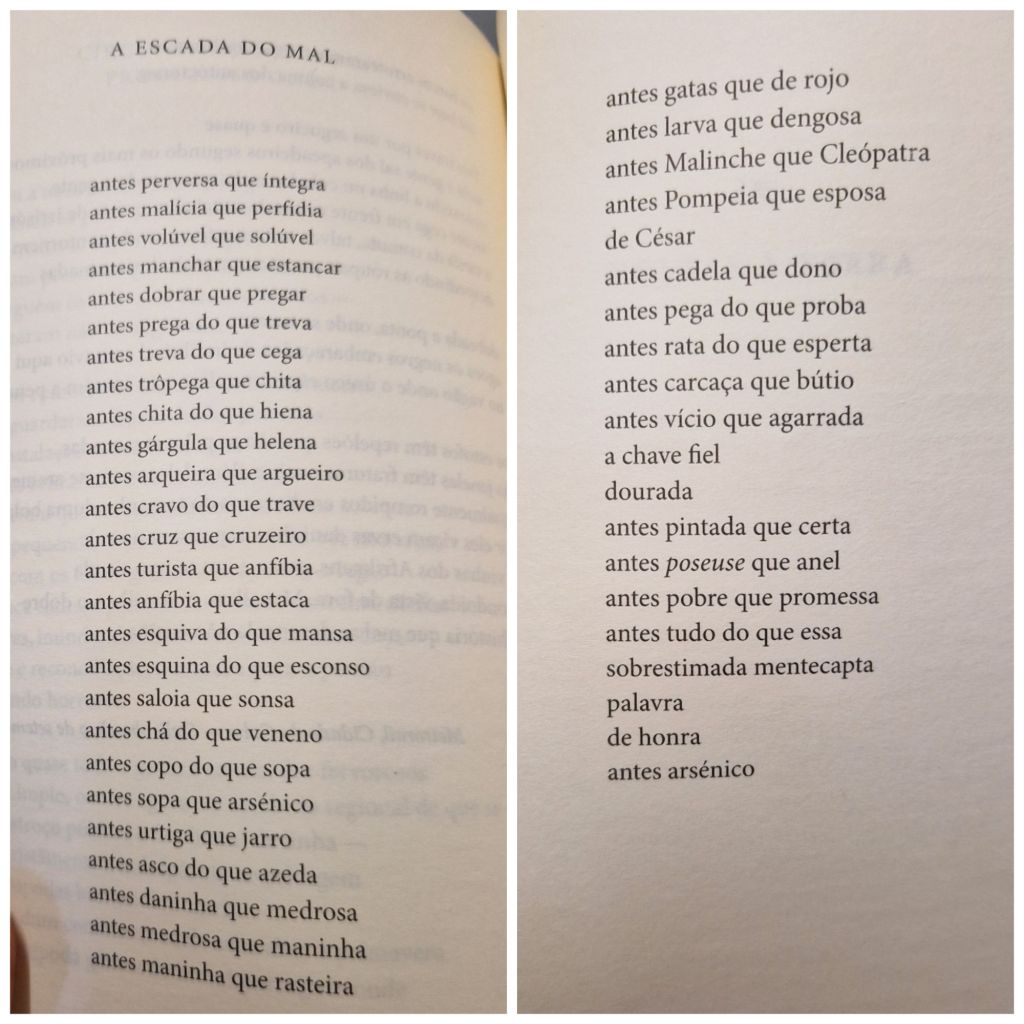
Someone or other once said that poetry isn’t a puzzle to be solved, but it annoys me to see someone clearly doing something clever and I don’t understand it so I thought I’d dig into this one and see what was going on. It’s from Atirar Para o Torto.
OK, let’s do this….
Most of the lines are in the form Antes ……….. (do) que ……. Which in english would be something like “Better a ………. than a ……..” or “I’d rather …………. than ………..” or “I’d prefer ……. to ……”.
Some lines use “do que” and some just “que” on it own, so i have one eye on this page which I usually use as a reference when I’m not sure which to use, and I’m curious to see how closely the poem follows the strict rules. Not very, I expect. Actually, not at all. If you look at the pattern, the presence or absence of the “do” depends on the number of syllables. Que sounds better with longer words, Do Que with shorter
Quite a lot of the words have multiple meanings so part of the game is working out which meaning the writer intends. In some cases the resulting sentence sounds ridiculous and I am pretty sure I have the wrong end of a few sticks, but for what it’s worth, here’s my best shot….
A ESCADA DO MAL antes perversa que íntegra – better perverse than entire antes malícia que perfídia – better malice than perfidy antes volúvel que solúvel – better voluble than soluble antes manchar que estancar – better to stain than to staunch antes dobrar que pregar – better to fold than to pin antes prega do que treva – better a fold than darkness antes treva do que cega – better darkness than blind antes trôpega que chita – better immobile than linen (um…. don’t get this one!) antes chita do que hiena – better cheetah than hyena (second meaning of chita!) antes gárgula que helena – better gargoyle than a hellenic antes arqueira que argueiro – better a bowmaker than a speck antes cravo do que trave – better a nail than a crossbar (assuming cravo is nail here, not a carnation) antes cruz que cruzeiro – better a cross than a cruise antes turista que anfíbia – better tourist than amphibian antes anfíbia que estática – better amphibian than static antes esquiva do que mansa – better a loner than domesticated antes autista que sápida – better autistic than tasty antes esquina do que esconso – better corner than garret antes saloia que sonsa – better yokel than poser antes chá do que veneno – better tea than poison antes copo do que sopa – better a glass than soup antes sopa que arsénico – better soup than arsenic antes verbena que urtiga – better verbena than nettle antes agreste que azeda – better bitter than sour antes daninha que medrosa – better harmful than fearful antes medrosa que maninha – better fearful than a little sister antes maninha que rasteira – better a little sister than servile antes gatas que de rojo – better on hands and knees than dragging antes larva que dengosa – better maggot than brown-noser (dengoso has a lot of meanings – it could be a person with dengue fever!) antes Malinche que Cleópatra – better Malinche than Cleopatra antes Pompeia que esposa de César – better Pompey than Caesar’s wife antes cadela que dono – better bitch than master antes pega do que proba – better thief than honest person antes rata do que esperta – better eccentric than astute antes carcaça que bútio – better skeleton than lazybones antes vício que agarrada – better addicted than hooked a chave fiel – the faithful key dourada – golden antes pintada que certa – better painted than true antes poseuse que anel – better poser than ring (than married?) antes pobre que promessa – better poor than promise antes tudo do que essa – better anything than that sobrestimada mentecapta – overestimated brainless palavra – word de honra – of honour antes arsénico – better arsenic.
And if you’re interested, here’s what Deepl has to say about it
rather perverse than upright rather malice than perfidy rather fickle than soluble rather stain than stop rather bend than preach rather preach than darkness rather darkness than blindness rather stumble than cheetah rather cheetah than hyena before gargoyle than helena before an archer better carnation than beam rather cross than cruise before tourist than amphibian rather amphibian than static rather dodgy than meek
This is the song Mariza sang as an encore at the concert. It’s more motivational-poetry-ish than I’m really comfortable with, but that’s OK, each to their own, and a lot of people really seem to like it. There are a few versions on youtube but I think I like this live, acoustic version better than the official video (which is definitely trying too hard imho)
Hoje a semente que dorme na terra E que se esconde no escuro que encerra Amanhã nascerá uma flor Ainda que a esperança da luz seja escassa A chuva que molha e passa Vai trazer numa luta amor
Today the seed that sleeps in the earth And that hides in the enclosing darkness Tomorrow a flower will be born Even though the hope of light is scarce The rain that wets and moves on Is going to fight to bring love
Também eu estou à espera da luz Deixou-me aqui onde a sombra seduz Também eu estou à espera de mim Algo me diz que a tormenta passará
I’m waiting for light too He left me here where the shade seduces I’m waiting for myself too Something tells me the torment will pass
É preciso perder para depois se ganhar E mesmo sem ver, acreditar É a vida que segue e não espera pela gente Cada passo que demos em frente Caminhando sem medo de errar Creio que a noite sempre se tornará dia E o brilho que o sol irradia Há-de sempre me iluminar
You have to lose so you can win And even without seeing it, believe it It’s life that goes on and doesn’t wait for people Every step forward that we take Walking without fear of going wrong I believe the night always becomes day And the light the sun gives out Will surely always shine on me
Quebro as algemas neste meu lamento Se renasço a cada momento Meu destino na vida é maior
I’m breaking the handcuffs in this my lament Of rebirth in every moment My destiny in life is greater
Também eu vou em busca da luz Saio daqui onde a sombra seduz Também eu estou à espera de mim Algo me diz que a tormenta passará
I too am in search of the light I’m getting out of here where the shade seduces I’m waiting for myself too Something tells me the torment will pass
É preciso perder para depois se ganhar E mesmo sem ver, acreditar É a vida que segue e não espera pela gente Cada passo que demos em frente Caminhando sem medo de errar E creio que a noite sempre se tornará dia E o brilho que o sol irradia Há-de sempre nos iluminar
You have to lose so you can win And even without seeing it, believe it It’s life that goes on and doesn’t wait for people Every step forward that we take Walking without fear of going wrong I believe the night always becomes day And the light the sun gives out Will surely always shine on me
Sei que o melhor de mim está pra chegar Sei que o melhor de mim está por chegar Sei que o melhor de mim está pra chegar
I know the best of me is yet to come I know the best of me is yet to come I know the best of me is yet to come
Cuca Roseta is coming to play in London soon. It really has been an excellent year for portuguese entertainment here. I’m sure there are a lot of fair-sized towns in Portugal that haven’t had as much choice of big name acts visiting them as we have. Anyway, I’d never heard of her, as far as I remember, but I looked her up and found one of the craziest song titles ever: Call the FBI of the Heart. It’s mid but I thought I’d try and translate it. It didn’t make me like it any more, I’m afraid.
Português
Inglês
Tirem-me às palavras o sentido Se é p’ra ser sonante ao ouvido Do que é certo ou do que tem mais valor
Tenso assalto aos meus neurónios De uma espécie rara de demónios E que ninguém saiba que se chama amor
Take the meaning of my words If it sounds better to your ear Of what is right or has more value
Tense assault on my braincells by a rare kind of demon And that no-one knows it’s called love
Tirem-me as palavras à cigana Que de faca e de mão na trama Saem da boca sem lhe dar a permissão
Eu bem que me tento comedir Penso em trocá-las ao sair Mas sou sempre ultrapassada p’la emoção
Take my words from the gypsy Who, with knife and a hand in the plot come out of her permission
I’m trying to contain myself I’m thinking of swapping them on the way out But I’m always overtaken by emotion
Chamem o FBI do coração Façam sindicato da paixão Tragam-mе as algemas para a boca Estou a ficar louca Levem-mе para a prisão da Cuca
Call the FBI of the heart Make a love syndicate Bring me handcuffs for my mouth I’m going crazy Take me to Cuca-prison.
Tirem-me as palavras que desato Quando chegas perto e eu relato Digo tudo o que não queria dizer
Venho a mastiga-los pela boca De uma outra eu que é meia louca Que faz sempre o que eu não queria fazer
Take my words that I untie When you get close and I report I say everything I didn’t want to say
I come to chew them in the mouth Of another me who’s half crazy Who always does what I didn’t want to do
Ao meu lado Dorme a tristeza Gota a gota dessa vil certeza De não te poder tirar do coração
At my side Sadness is sleeping Drop by drop of this criminal certainty of not being able to take it from my heart
Chamem o FBI do coração Façam sindicato da paixão Tragam-me as algemas para a boca Estou a ficar louca Levem-me para a prisão da Cuca Chamem o FBI Chamem o FBI Chamem o FBI Do coração
Call the FBI of the heart Make a love syndicate Take these handcuffs off my mouth I’m going crazy Take me to Cuca-prison. Call the FBI Call the FBI Call the FBI of the heart
Ouvi uma versão desta canção recentemente no canal de David Antunes + the Midnight Band, que é sempre uma fonte de maravilhas e o desempenho neste caso é mesmo esmagador, uma vez que é tocado quase exclusivamente em instrumentos infantis (o vídeo está debaixo da tabela de letras nesta página) O original saiu em 2012 e foi lançado por Sebastião Antunes e Quadrilha. O Sebastião não é um familiar do David apesar de os dois partilharem um sobrenome, mas o David tocou várias vezes a canção ao vivo nos seus próprios espetáculos e o Sebastião até apareceu no canal do David também.
A música teve muito sucesso e (tanto quanto sei) muita gente gosta dela. A versão original é invulgar por incluir uma gaita de foles. O meu pai sabia tocar a gaita de foles escocesa e por isso estou predisposto a gostar a canção apesar de me sentir por outro lado dum abismo cultural de cem milhas de largura.
Português
Inglês
Deram-me uma burra Que era mansa que era brava Toda bem parecida Mas a burra não andava A burra não andava Nem prá frente nem pra trás Muito lhe ralhava Mas eu não era capaz Eu não era capaz De fazer a burra andar Passava do meio dia E eu a desesperar E eu a desesperar Ai que desespero o meu Falei-lhe no burrico* E a burra até correu
They gave me a donkey That was tame and that was wild Everything seemed fine But the donkey wouldn’t move The donkey wouldn’t move Neither forward nor backward I yelled at it a lot But I couldn’t I couldn’t Make the donkey move It was after midday And I was in despair And I was in despair Oh, I was in such despair I told her about the (male) donkey And it even started running
*This seems to be disputed. When I first wrote this I copied the lyrics from A Música Portuguesa and it says “falhei-lhe”. It seems like that version appears on quite a lot of pages dotted around the web, but I am reliably informed that the non-h version is the right one, so there you go!
Carolina Deslandes is definitely growing on me. Her lyrics seem really well-crafted. Her voice doesn’t have the earth-shattering power of Sara Correia (the last portuguese singer I went to see), but she’s a different kind of singer and her voice works for the kind of music she’s making. I really like this one.
When I found the lyrics I saw they had transcribed it with “luta” in place of “puta”. You can find videos of her singing it that way on Rádio Comercial, but this video is bleeped out and I’m pretty sure they wouldn’t have bleeped luta, so I’m changing it back to what I think must be the original. Como é Linda a Puta de Vida is the name of a book by Miguel Esteves Cardoso, and I don’t know if she pinched the line from him or if it has older roots.
Português
Inglês
Esfolar os joelhos A achar que sabia voar Ignorar os conselhos Que no fim nos iam salvar
Skinning your knees And finding you don’t know how to fly Ignoring the advice That would save us in the end
Ser abandonada Não ter onde arrumar o amor Não querer saber de nada E saber-te ao pormenor
Being abandoned Not having a place to put love Not wanting to know anything And knowing yourself in detail
Como é linda e caótica A puta da vida, amor Vê lá bem a nossa sorte Vê lá bem o nosso azar Como é linda e caótica A puta da vida, amor Viver a fintar a morte Hoje saímos pra dançar
It’s so beautiful and chaotic The bitch of life, my love. Just look at our good luck Just look at our bad luck It’s so beautiful and chaotic The bitch of life, my love. Living to trick death Today we’re going out dancing
Partir o coração Dar razão a quem nos avisou Uma desilusão Uma ferida que nunca sarou
Breaking your heart Proving the people who warned us right A disappointment A wound that never healed
Ser traído, chorar Desatar os nós da garganta Querer esquecer e lembrar Quando a saudade é tanta, tanta
Being betrayed, crying Untying the knots in our throat* Wanting to forget and remember When there’s so, so much longing**
Como é linda e caótica A puta da vida amor Vê lá bem a nossa sorte Vê lá bem o nosso azar Como é linda e caótica A puta da vida amor Viver a fintar a morte Hoje saímos pra dançar
It’s so beautiful and chaotic The bitch of life, my love. Just look at our good luck Just look at our bad luck It’s so beautiful and chaotic The bitch of life, my love. Living to trick death Today we’re going out dancing
* Um nó da garganta is what english speakers would call “a lump in the throat”, so she’s talking about grief, panic or some other strong emotion
`**Should I even be translating “saudade” at this point?
I’m trying to get familiar with Carolina Deslandes’ back catalogue now that I have tickets to see her. When I reached “Dois Dedos de Testa” I was intrigued by the title, which means “two fingers of forehead”. What could it mean? I went down a few dead-ends when I researched it: the first site I found was explaining that having dois dedos de testa (ie, a forehead that’s more than two fingerwidths deep) was a sign of whether or not a fringe would suit you. But I was pretty sure the sing wasn’t about hair styling. I finally found this page which sums it up in the first line
Ter dois dedos de testa costuma ser sinónimo de gente inteligente, com boa cabeça
The scientists in this old ad for Tefal appliances were rocking a solid oito dedos de testa.
So I think that’s the relevant meaning: being clever, having common sense. I’m going to translate “ter dois dedos de testa” as “to be smart” in the lyrics for simplicity’s sake and because “to have two fingerwidths of forehead” would sound ridiculous.
The video also starts with “fátima futebol fado”, which was the Estado Novo’s equivalent to “bread and circuses”: the way of focusing the population’s attention away from thoughts of revolution. She changes it to one she likes better.
All in all, I really like the lyrics. Sometimes I do these translations and the lyric are baffling, sometimes they’re too easy, but I like that this had some mysteries that could be solved and led me to discover new things.
Dois Dedos de Testa
Português
Inglês
Ser mulher aqui é ser mulher de quem? Ter um papel assinado pra ser alguém Ser decente, quem se apresenta à mãe Mesmo que o filho não valha a mulher que tem
Being a woman here means being who’s wife?* To have a role assigned to be someone To be decent, someone fit to meet your mother Even though the son isn’t worthy of the woman he has
Ser mulher aqui é ser submissa Rezar o terço, dizer sim e ir à missa Não ter opinião, ser bonita Ser tão nova quanto o estado e andar bem vestida
To be a woman here is to be submissive Pray the rosary**, say yes and go to mass Don’t have a opinion, be pretty Be as young as the state*** and be well-dressed
E eu que tenho a liberdade debaixo dos braços Tenho brasas a arder debaixo dos pés Pus uma pedra sobre o meu passado E se o que eu sou ofende quem és
And i who have freedom in my grip**** I have coals burning under my feet I put a stone on top of my past***** And if who I am offends, who you are
Deixa-me abanar a cabeça, põe mais vinho nesta mesa Que eu, eu quero esquecer Quero ser o centro da festa, o assunto da conversa Eu, eu quero aparecer
Let me shake my head, put more wine on this table Because me, I want to forget I want to be the centre of the party, the subject of conversation Me, I want to appear
Deixa-me abanar a cabeça, põe mais vinho nesta mesa Que eu, que eu hoje faço um brinde Quero ser dona da festa, tenho dois dedos de testa Sou a voz e nem sou boa ouvinte
Let me shake my head, put more wine on this table Because me, I want to make a toast I want to be the mistress of the party, be smart I’m the voice and I’m not a good listener
Foi deixada, abandonada É carente e mal amada Está tão triste e tão sozinha Pobrezinha
She was left, abandoned She was needy and barely loved She’s so sad and so alone Poor thing!
Sem apelido e sem marido E de quem será o filho? Está cansada, ela trabalha Coitadinha, coitadinha
Without a surname, without a husband And who’s child is it? She’s tired, she works Poor thing, poor thing!
Deixa-me abanar a cabeça, põe mais vinho nesta mesa Que eu, eu quero esquecer Quero ser o centro da festa, o assunto da conversa Eu, eu quero aparecer
Let me shake my head, put more wine on this table Because me, I want to forget I want to be the centre of the party, the subject of conversation Me, I want to appear
Deixa-me abanar a cabeça, põe mais vinho nesta mesa Que eu, que eu hoje faço um brinde Quero ser dona da festa, tenho dois dedos de testa Sou a voz e nem sou boa ouvinte
Let me shake my head, put more wine on this table Because me, I want to make a toast I want to be the mistress of the party, be smart I’m the voice and I’m not a good listener
E eu que tenho a liberdade debaixo dos braços Tenho brasas a arder debaixo dos pés Pus uma pedra sobre o meu passado E se o que eu sou ofende quem és
And I who have freedom in my grip**** I have coals burning under my feet I put a stone on top of my past***** And if who I am offends, who you are
Deixa-me abanar a cabeça, põe mais vinho nesta mesa Que eu, eu quero esquecer Quero ser o centro da festa, o assunto da conversa Eu, eu quero aparecer
Let me shake my head, put more wine on this table Because me, I want to forget I want to be the centre of the party, the subject of conversation Me, I want to appear
Deixa-me abanar a cabeça, põe mais vinho nesta mesa Que eu, que eu hoje faço um brinde (brinde) Quero ser dona da festa, tenho dois dedos de testa Sou a voz e nem sou boa ouvinte
Let me shake my head, put more wine on this table Because me, I want to make a toast I want to be the mistress of the party, be smart I’m the voice and I’m not a good listener
* This sentence loses a lot of its cleverness in the translation, I think
***Another one that loses some of its force in english – it’s another reference to the Estado Novo, if I read it correctly
****Debaixo do braço is a set phrase meaning grasped under the arm, next to the body, so I am picturing her holding liberdade like a rugby ball
*****This one smelled like an expression too. Most results return as “colocar uma pedra sobre” and “pôr” is less common but obviously scans better. You can find both on this page. I think we’re meant to imagine the stone as a paperweight you put on your work when you’ve finished writing or something. It means what we would now call “drawing a line under” the subject, basically, putting a full stop to the sentence.
Translation Time! I was drawn to this song because it has two words I don’t recognise in the title. They proved to be incredibly hard to translate. If you go directly from what Priberam says, the title means “It makes sparks and a barren wasteland” which obviously makes no sense. I asked around and the answers I got were
Faísca is a light effect and Chavascal a sound effect
Both are synonms for chaos and
A pointer to this page, with the suggestion that definition 5 was the relevant one.
OK, so it’s noisy, chaotic. So… an explosion? Some sort of massive freak-out or general mayhem?
Next question: What the heck tense is it in? Portugal is very sparing with its national pronoun reserves, and it’s not totally clear whether “faz” is third person present (talking about the experience she’s having?) or second person imperative (telling you, the listener what to do). In other words is she saying “It makes sparks…” or “Make sparks!” I think the second, just because some of the lines don’t make sense otherwise. It brings confetti to the garden? How?
So assuming whatever faísca and chavascal mean they’re something that a human is capable of doing, I’ve gone with “Be flashy and make a scene”. I’m sure this is debatable but this seems like it follows a trend line through the available evidence and I hope I’m not too far wrong.
The actual music is a bit odd. The arrangement has a whiplash change of mood, going from sultry club jazz to cringey pop when it hits the chorus, and some of the camera work is quite shonky too, but never mind, here we go!
Portuguese
English
aaaaaahhh acordo a tempo de chegar ensaio o espaço e volto atrás sem ver os tons a mudar ooooohh, aaaaahhh esperei sete ondas para saltar clarões em branco e lilás quem são os teus orixás? pergunto
aaaaahhh I wake up when it’s time to arrive I study the space and turn back Without seeing the tones change Ooooohh, aaaaahhh I wait seven waves before jumping Flashes of white and lilac Who are your idols*? I ask
faz faísca e chavascal got addicted, não tem mal não és tu (não és tu…) traz confettis pro quintal com pitanga é carnaval tudo cru, ooooohhh faz faísca e chavascal faz faísca e chavascal got addicted, não tem mal ooooohhhh
Be flashy and make a scene Got addicted, don’t take it badly It’s not you (it’s not you) Bring confetti to the garden With pitanga** it’s carnival All raw, ooooohhh Be flashy and make a scene Be flashy and make a scene Got addicted, don’t take it badly ooooohhh
água na boca vinho a compensar nada no ombro e nada pra falar dá sempre pra duvidar ou então largar as rosas no mar
Water in the mouth Wine to compensate Nothing on the shoulder And nothing to sat It always makes me doubt Or even leave roses in the sea
faz faísca e chavascal faz faísca e chavascal traz a fruta tropical faz o próprio carnaval
Be flashy and make a scene Be flashy and make a scene Bring the tropical fruit make your own carnival
faz faísca e chavascal got addicted, não tem mal não és tu (não és tu…) traz confettis pro quintal com pitanga é carnaval tudo cru, ooooohhh
Be flashy and make a scene Got addicted, it’s not bad It’s not you (it’s not you) Bring confetti to the garden With pitanga** it’s carnival All raw, ooooohhh
faz faísca e chavascal faz faísca e chavascal got addicted, não tem mal ooooohhhh
Be flashy and make a scene Be flashy and make a scene Got addicted, don’t take it badly ooooohhh
*Specifically, an orixá is a representation of a minor divinity in the Yoruba religion
**Pitanga isn’t really a fruit we have in the UK, and the wiki page gives a few names, but since one of them is just “pitanga”, I’ve left this alone.
Translation time! I quite like this one, and it has some good expressions in it. It’s about how hard it is to be young. I checked, and in case you’re wondering he released it in 1990 when he was 33, so we’ll let it pass.
Portuguaês
Inglês
Não há estrelas no céu a dourar o meu caminho Por mais amigos que tenha, sinto-me sempre sozinho De que vale ter a chave de casa para entrar? Ter uma nota no bolso p’ra cigarros e bilhar?
There are no stars in the sky gilding my path No matter how many friends I have I always feel alone What’s the point of a housekey to get in? Or a note in my pocket for cigarettes and billiards?
A primavera da vida é bonita de viver Tão depressa o sol brilha como a seguir está a chover Para mim hoje é janeiro, está um frio de rachar Parece que o mundo inteiro se uniu p’ra me tramar
It’s beautiful to live in the springtime of life As soon as the sun shines, straight away it rains For me today is January, freezing cold It seems like the whole world is conspiring against me
Passo horas no café sem saber para onde ir Tudo à volta é tão feio, só me apetece fugir Vejo-me à noite ao espelho, o corpo sempre a mudar De manhã ouço o conselho que o velho tem p’ra me dar
I spend hours in the café, not knowing where to go Everything around is so ugly I just feel like escaping I see myself in the mirror at night, my body’s always changing In the morning I hear the advice the old man has for me
A primavera da vida é bonita de viver Tão depressa o sol brilha como a seguir está a chover Para mim hoje é janeiro, está um frio de rachar Parece que o mundo inteiro se uniu p’ra me tramar
It’s beautiful to live in the springtime of life As soon as the sun shines, straight away it rains For me today is January, freezing cold It seems like the whole world is conspiring against me
Vou por aí às escondidas a espreitar às janelas Perdido nas avenidas e achado nas vielas Mãe, o meu primeiro amor foi um trapézio sem rede Sai da frente, por favor, estou entre a espada e a parede
I’m going over there, secretly, to look in at the windows Lost in the avenues and found in the alleys Mother, my first love was a trapeze with no net Get out of the way please, I’m between the sword and the wall*
Não vês como isto é duro, ser jovem não é um posto Ter de encarar o futuro com borbulhas no rosto Porque é que tudo é incerto, não pode ser sempre assim Se não fosse o Rock and Roll, o que seria de mim?
You don’t see how hard it is, being young isn’t easy** You have to face the future with a spotty face Why is everything uncertain, it can’t always be like this If it wasn’t for Rock and Roll, what wojuld become of me?
A primavera da vida é bonita de viver Tão depressa o sol brilha como a seguir está a chover Para mim hoje é janeiro, está um frio de rachar Parece que o mundo inteiro se uniu p’ra me tramar
It’s beautiful to live in the springtime of life As soon as the sun shines, straight away it rains For me today is January, freezing cold It seems like the whole world is conspiring against me
Não há estrelas no céu (não, não, não, não há) Estrelas no céu (não, não, não, não há) Estrelas no céu (não, não, não, não há) Estrelas no céu (não, não, não, não há) Estrelas no céu (não, não, não, não há) Estrelas no céu…
There are no stars in the sky (no, no, no there aren’t) Stars in the sky (no, no, no there aren’t) Stars in the sky (no, no, no there aren’t) Stars in the sky (no, no, no there aren’t) Stars in the sky (no, no, no there aren’t) Stars in the sky…
*Nice expression! Obviously an equivalent of “between a rock and a hard place”
**The translation is simplified, I think: as far as I can tell, “ser x não é um posto” is a way of saying it isn’t just an easy job that comes naturally, implying you really have to be worthy, or to work hard for it. See here for example, or here.
As I’ve probably said, I’m a bit of a philistine when it comes to poetry, but the book I am reading on-and-off at the moment, “atirar para o torto” by margarida vale de gato* “dá água pela barba” and my dictionary is taking a real beating. Translating this one in full because there are so many unknowns in it that I lost track. Words outlined in orange are the ones I had to look up
This galaxy will soon be a glowing coal Our earth sparks - I think this In the environ** of the street, feeling faint Words beating in my head About the cone*** of this planet - oh warming marble with only one iris**** Fertilising the egg of the moon, steep curdled, wounded***** red. I'm going when i arrive to lock myself out, key inside, to sleep with the beasts in the dew and just one bottle - I ought to break it by the neck to heal with a ruby in my mouth and anaesthesia the bluff or another apocalypse
Incidentally, I happened upon a thesis published online where the author cites this poem in full as evidence of “an apocalyptic tone adopted recently in portuguese poetry”
*Should be in title case, I know, but she writes it in lower case on the cover so maybe it’s deliberate, I dunno.
**This is a pretty terrible translation since enlevo is more like enchantment, rapture, that kind of thing but I can’t quite find an english word that works in context. This is why I am not a professional translator!
***Another surprising one. The umbra and penumbra of an eclipse form cones, so she might be referring to that but it’s not clear to me
****I want “iris” to mean the little squiggle of colour inside an old-school marble, but I don’t see any evidence of that online.
*****Coalho was the only word I really didn’t know but it’s hard to see what she’s getting at here. Ingreme usually means steep but can be a high point, coalho means coagulate but can also be a thistle flower of all things. So maybe she means the blood moon looks like a thistle high up in the sky…. nah… i don’t see it.