Posted in English

Say It In Portuguese

Oh! I must have accidentally unsubscribed to Say It In Portuguese’s email feed because I completely missed the notification about the last episode. I had been watching out for it because I’m in it, but I’ve just noticed it’s in my podcast app!

It’s this episode which deals with a song by Deolinda called Fado Toninho, and it was inspired by my attempt to grapple with the meaning of the song, in a post in February.

The podcast is definitely one you should be subscribed to if you are working toward B2 or over. It’s not the sort of thing you can listen to as a newbie, but if you already have decent skills, it gives you a wealth of knowledge about expressions and culture, all of which are essential for moving up to the next level. So, in other words, I can’t recommend it strongly enough! Cristina was my teacher for later C1 through to graduating C2, and she is very much a “friend of the blog”, but I would recommend SIIP even if that weren’t the case, because it’s excellent, it’s been around for ages and there’s nothing else like it, really.

Generally, the podcast picks an idiomatic expression and unpacks it for you, but in this one, we discuss the lyrics of a song, mainly trying to analyse the meaning of “Toninho” itself, but there are some expressions in the song too, and those are worth noticing. So if you don’t know the song already, I challenge thee: set aside some time to give the video and the podcast episode a listen and see how much you can learn in fifteen minutes.

Posted in English

Podding Along

I’ve mentioned the podcast Say It In Portuguese a few times, mainly because its creator, Cristina, coached me through C1 and C2, but also before that, because it’s just a very good podcast for more advanced learners who want to explore the huge range of expressions in Portuguese.

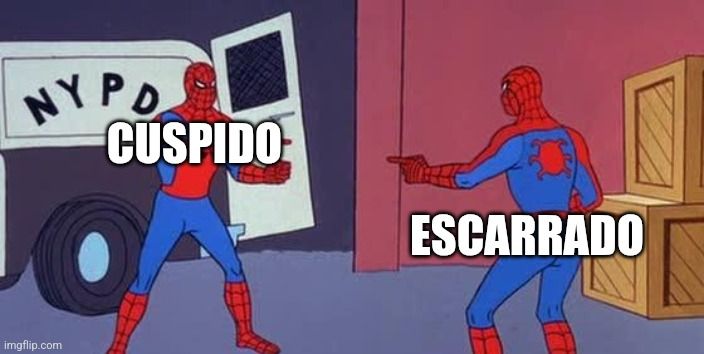
Anyway, I wrote a blog post recently about the expression “Cuspido e Escarrado” and joked that I was copying the style of the podcast, and… Long story short, it ended up being an episode! I adapted it for the format, and put a sound effect in place of the gif, and it sounds OK, though I say so myself. It’s here if you want to listen:

Say it in Portuguese: Cuspido e Escarrado

By the way, full disclosure, when I was looking around for the blog post that became the podcast, I found an older post where I’d mentioned the phrase earlier. It was only as a sidebar to a post discussing a different expression, “Cara de um, focinho do outro“. I’d completely forgotten about this. Having a terrible memory makes it hard to learn languages but it does have the advantage that I can be surprised by a new and interesting fact even after having written a blog post about it!

Anyway, in the earlier blog, I’d given a slightly different explanation: that it comes from. “esculpido em carrara” but the sources I looked at this time around described that origin as “less likely” which is why I didn’t mention it in the later one.

In truth, these sorts of etymological explanations are a lot of fun to speculate about but often they are just attempts by modern speakers to explain the inexplicable. Sometimes expressions are just weird and they don’t make sense, so it’s best to treat the explanations with caution!

Anyway, now that I’ve recorded a podcast about it, hopefully I’ll remember it this time, but don’t be surprised if I write another blog about the same expression next year and seem just as amazed by it then as I was last week!

Posted in English

Plans

OK, the exam is on the 13th of November. To be honest, I wish I’d gone for May next year, but here we are… I’m going to be taking another of the Say It In Portuguese CAPLE Exam preparation courses. I need to use the remaining time wisely so I’m going to try and cut out a lot of unnecessary stuff, put a few things on hold till the second half of November to make more time for learning, especially listening and speaking (using some of the techniques this fella lays out in this video) and I’ll add this lot to my Planner app:

Raw Exam Prep

  1. Do the exam modelos Cristina gives me
  2. Go through the list of key structures in the C2 syllabus here, and try and figure out what I need to work on, possibly in the lessons

Just general tidying

  • I have some lists of structures I often get wrong and structures that get used a lot in portuguese that I never use because I keep forgetting about them, so try and make sure I get as many of them as possible into blog posts instead of just treading the same old familiar linguistic pathways that I rely on in everything I write.
  • Try and bribe my wife to speak to me in her beguiling madeiran accent. Poached eggs will probably work. She loves a good poached egg.

General Input

  • Reading – I have an english book I am committed to reading for family book club and a couple of audiobooks that I am already part way through, but when those are finished, no new english books, just portuguese ones. Probably not many though, because I don’t really need much practice – just bedtime reading, and just things that seem like they will expand my brain. Like I have a Gil Vicente play in BD form, but I looked at it earlier and it’s much too archaic so I’ll save it for after the exam.
  • Podcasts – Portuguese only till after the exam. I might even unsubscribe to some of the english language ones to remove temptation.
  • Eat-Rep exercises – I’m going to drop some of the morning quizzes I do and watch a quarter of Os Gatos Não Têm Vertigens instead – that’s about two watches per week. try to do some “scratching” in the first weeks and move toward “copycat” exercises in later weeks.

    Exercises

    This weekend

    • Start final chapter of Português em Foco
    • “Puzzle Brain” activity – listen to portuguese audio while doing a jigsaw

    W/E 27-10-2024

    • Finish Português em Foco exercises in the main book (meant to do these before Lisbon really, but…)
    • Start the (self marked) grammar exercises in the Caderno de Exercícios

    W/E 03-11-2024

    • Finish the grammar exercises in the Caderno de Exercícios
    • “Scuba Diving” exercises with text and audio of “Amor de Perdição”

    W/E 10-11-2024

    Non-thorough run through of the paper exercise books I have, looking for grammar exercises that look like they might be beneficial.

    • The remainder of the vocabulary and verb tenses sections of Português Outra Vez, (the expressões section is rubbish and I can’t be bothered with it)
    • The C1 sections of “Vamos Lá Continuar” and
    • Some of the more challenging exercises from Qual é a Dúvida. I finished this book ages but there were some exercises that left me floored, so I’ll be interested to see if I find them just as hard the second time around!

    Exam Week!!!!

    I’ll keep this free for whatever I think needs shoring up

    Posted in English

    CAPLE Exam Prep Lessons: Review

    I mentioned a while ago that I was starting the Say it in Portuguese CAPLE Exam Prep course. I thought it would be worth taking a really focussed course to try and get myself match fit instead of winging it. In case anyone is in the same boat, thinking of taking it for a future exam, here’s what it’s like:

    The course took place over 4 weeks because that’s how long I had from enquiring to the date of the exam. Following an introductory meeting, Cristina offered a range of three options, based on what I said my weak points were. There were different levels/prices, depending how much support I wanted and I went with the middle one. I won’t say what the prices were in case it’s a trade secret, but I’d definitely call it very good value.

    As you might already know, there are four sections in the exam*, and I felt reasonably comfortable with the reading comprehension but decidedly iffy about some of the others, so the really important stuff for me was in the form of four weekly drops of one sample paper from the written part of the exam and a recording and set of multiple choice questions from the aural comprehension section. I completed them in my own time and emailed them back. Very detailed feedback would then arrive the following day for me to work through.

    On Fridays we had an online meeting where we’d go through some of the homework feedback and also did a simulated parts 1 and 2 of the “produção e interação orais” exam format. Mistakes made in the meeting would prompt more feedback via email, including actually recording the lesson and doing a step-by-step feedback recording that I could listen to and hear my mistakes.

    Cristina does other courses and she’s also host of one of the earliest portuguese podcasts, so she’s an experienced teacher, but I think I was one of the early adopters on this specific DAPLE course, and there were a couple of teething troubles – a few typos in the questions – which I fed back and will no doubt have been corrected by the time the next person takes the course. In the post-exam debrief, I also suggested she might change the order the aural papers were given in, since I think the first one was a real past paper and the later ones were close simulacra. They were very good recordings and sounded almost exactly like real exam questions, but the questions were a tiny bit less ambiguous and tricksy, so I thought maybe it would be better to start with those and finish on the real past paper.

    The course definitely boosted my confidence and helped me approach the exercises in a more controlled, less panicky way. Yeah, the exam could have gone better, but it could have gone worse too, and it definitely would have if I hadn’t done the course! I would definitely recommend it to anyone planning on taking a CAPLE exam, especially if you’ve never taken one before and are not familiar with the format.

    * = And if you don’t already know about the structure, here’s the description of the most recent C1 exam and here’s the first – the B1.

    Posted in English

    I Said It In Portuguese

    Well, I had that exam prep lesson with Cristina from Say It In Portuguese and it was really helpful. We did a dummy “interação oral” test and gave me good feedback about what I’d done wrong in some written work, along with some advice about how to avoid stupid mistakes by – say – writing in an illegible scrawl. I’ve booked a few more over the next few weeks to get some more practice in. I’m determined to get a “very good” mark for a change.

    Posted in English

    Multi-Asking

    Oof, well I’ve finished working my way through the exam paper. That aural comprehension part remains an absolute bastard. The DAPLE paper is like the rest I’ve come across: it doesn’t leave you much time to read, some of the answers seem purposely ambiguous, but I just about held on. But the fifth section has really long, detailed sentences. I’m sorry, but I just don’t see how it’s possible to answer them all. I’m going to take a prep course from the Say it in Portuguese site that I mentioned a few weeks ago to try and hone my technique. I suspect that best strategy is probably to look at the later questions in each group and make little one-word notes about each, because by the end you’re more likely to be lost so you’ll be glad of the help. Then do teh same for any long questions so you don’t have to try and parse them while the person is talking. Maybe there’s something to be said for not even trying to answer the questions on the first reading; just make notes about what the person says and then use that in teh second round…? I dunno, that feels like a high-risk option though. Maybe divide the answers in half and try to answer the first half in the first reading and the second half in the second reading?

    Posted in English

    Say It In Portuguese Update

    Interested to see a new course on offer from Say It In Portuguese (home of the very fine podcast about idiomatic expressions) which focuses on CAPLE exam technique. Bookmark that one for later…

    I’m not really aware of anything similar. Even the official Instituto Camões site is quite brittle and limited with no proper test simulation, so although it’s worth taking, I pity anyone going into the exam having only done that, especially at C2/DUPLE level, because they don’t even offer that.

    And I’ve added a new section about exam prep to the online learning resources page, since that seemed like a useful addition.