Posted in English, Portuguese

Os Chapéus dos Outros Cantores

Translation time!

I mentioned António Zambujo’s recently acquired brazilian hat yesterday, and it reminded me of this video where he’s singing with this choir of practitioners of Cante Alentejano, who wear traditional dress, including a very distinctive hat. Why Cante and not Canto? It’s just a regionalism. I’ve been meaning to do a proper post about Cante Alantejano for a while now and I must get around to that. Anyway, here we go…

PortuguêsInglês
Trago Alentejo na voz
Do cantar da minha gente
Ai rios de todos nós
Que te perdes na corrente
Ai rios de todos nós
Que te perdes na corrente
I carry Alentejo in my voice
From the song of my people
Oh the rivers that belong to us all
You can lose yourself in the current
Oh the rivers that belong to us all
You can lose yourself in the current
Ai planícies sonhadas
Ai sentir de olivais
Ai ventos na madrugada
Que me transcendem demais
Aí ventos na madrugada
Que me transcendem demais
Oh, plains of my dreams
Oh the feel of the olive groves
Oh the winds at dawn
That are too overwhelming
Oh the winds at dawn
That are too overwhelming
Amigos, amigos
Papoilas no trigo*
Só lá eu as tenho
E de braço dado contigo a meu lado
É de lá que eu venho
E de braço dado
Cantando ao amor
Guardamos o gado, papoilas em flor
Que o vento num brado
Refresca o calor
E de braço dado, contigo a meu lado
Cantamos o amor
Friends, friends
Poppies in the wheat
Only there do I have them
And arm in arm with you at my side
It’s there that I come from
And arm in arm
Singing of love

We tend the cattle, poppies in bloom
The wind in a howl
Cools the heat
And arm in arm, with you at my side
We sing of love
Ai rebanhos de saudades
Que deixei naqueles montes
Ai pastores de ansiedade
Bebendo água nas fontes
Ai pastores de ansiedades
Bebendo água nas fontes
Oh flocks of longing
That I left in those mountains
Oh shepherds of unease**
Drinking water in the springs
Oh shepherds of unease
Drinking water in the springs
Ai sede das tardes quentes
Ai lembrança que me alcança
Ai terra prenhe de gente
Nos olhos duma criança
Ai terra prenha de gente
Nos olhos duma criança
Oh place of warm afternoons
Oh the memories that come over me
Oh land, giving birth to a people
In the eyes of a child
Oh land, giving birth to a people
In the eyes of a child

*Adoro esta rima

**O que mais me surpreendeu é que achei “ansiedade” uma palavra mais “intraduzível” neste contexto do que a famosa “saudade”. Consigo imaginar a emoção de uma pessoa longe da sua terra: homesickness, sorrow, sadness, longing, não há problema com saudade. Mas “ansiedade” é cognata com a nossa “anxiety” o que é completamente fora da questão. Que mais? Linguee oferece vários alternativos, tipo “stress”, “trepidation”, “angst”. “Anticipation” é uma tradução muito comum: já ouvi montes de booktubers a falar da sua ansiedade por ler o novo livro numa série qualquer. A palavra serviria se o narrador fosse a caminho de casa mas não é. Optei por “unease” mas não estou cem por cento satisfeito!
Posted in English

The Saud And The Fury

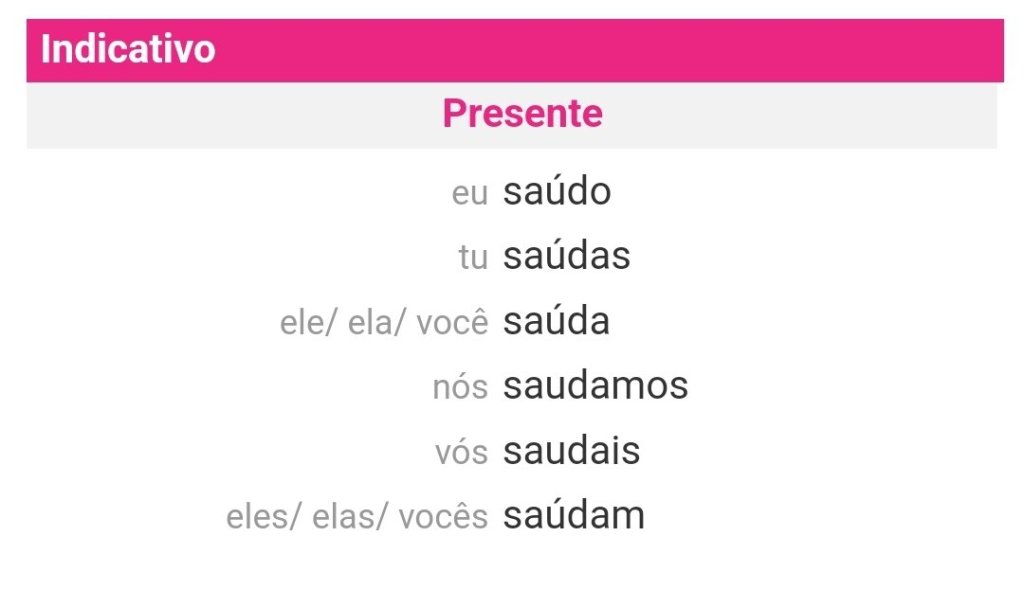
I had to use the verb “Saudar” in a sentence the other day. I don’t use it often and I was surprised to find that in the present tense most of the conjugations put an accent over the U:

This looked a bit weird to this foreigner. The first syllable or Saudar is pronounced to more-or-less rhyme with “loud” but saúdo is more like sa-OOD-oh, so it isn’t just cosmetic, it changes the sound of the root of the verb.

Not only is this not how conjugations usually work, it made me wonder whether there was any link to the word “saúde” (health). I asked in the portuguese fórum, but now I think of it, I probably should have just opened wiktionary. Basically, yes, they are distant cousins.

Saúde is from the Latin word for health or safety: salus.

Saudar is from salutare, meaning to protect, or to save. Well, it’s a verb form, but salutare and salus are certainly linked.

So in other words, although they have different meanings, they come from the same basic Latin root, with the L disappearing and the T gradually getting worn away to a D. Disappearance of soft sounds like Ls and Ds, and conversions of hard sounds like T and P to softer equivalents like D and B are both fairly common paths for Latin words becoming portuguese. So Potere in Latin became poder in portuguese, Sapere became saber, Salire became sair, videre became ver and so on.

Incidentally, saudade sounds like it’s in the same sort of area. Is that another long-lost cousin of Saudar and saúde? No, it used to be spelled Soudade, but it’s spelling changed over the yeas. It actually comes from the Latin Solitatem, meaning it’s related to Solitude in English and Soledad in Spanish.

Posted in English

Saudade, Saudade

Maro - Saudade, Saudade

It’s been a busy year in the Saudade mines and Portugal now has such a vast surplus of their untranslatable major export that they’ve taken to giving double portions away with every Eurovision entry. “Saudade, Saudade” is a good song. It’s a strange choice for a Eurovision entry, but that’s not a huge surprise: they’ve been sending strange choices to Eurovision for some time now and it keeps things interesting! I actually really struggled to listen to it on yesterday’s Eurovision final, because I was trying to tune in to the Portuguese lyrics but it wasn’t till the second listen that I realised it’s almost all in English! In my defence, there was a lot of background noise!

The only Portuguese verse (not counting the word “Saudade” itself of course) is

Tem tanto que trago comigo
Foi sempre o meu porto de abrigo
E agora nada faz sentido
Perdi o meu melhor amigo

E se não for demais
Peço por sinais
Resta uma só palavra

Which translates as

He has so much I carry inside myself
He was always my port in the storm
And now nothing makes sense
I lost my best friend

And if its not too much,
I ask for a sign
Only one word remains

Bolo de Berlim, bolo de arroz, queijada, pão de ló

By the way, we set out to get a range of snacks from lots of European nations to eat while watching but we ended up just loading up on cakes from the Portuguese stall at Richmond’s Duckpond Market